”KERBEROS”
Sameer Farooq
Reg_No: 11501907
M.tech (CSE)
.
Dept.of Computer Science& Engineering
Lovely Professional University
Phagwara, Jalandhar-144401
CONTENTS
 WHAT IS KERBEROS?
 HISTORY.
 TERMINOLOGY.
 WORKING.
 KERBEROS ENVIRONMENT.
 KERBEROS DATABASE.
 KERBEROS ADMINISTRATOR.
 ADVANTAGES & DISADVANTAGES.
 PUBLIC KEY CRYPTOGRAPHY.
 CONCLUSION.
 REFERENCES.
Whatis Kerberos ?
• Network authentication protocol.
• Developed at MIT in the mid 1980s.
• Uses trusted 3rd party authentication scheme.
• Assumes that hosts are not trustworthy.
• Requires that each client (each request for service) prove it’s identity.
• Does not require user to enter password every time a service is
requested !.
History
• Steve Miller and Clifford Neuman designed the primary Kerberos version in1983.
• Versions 1–3 occurred only internally at MIT as part of project Athena.
• Windows 2000 was Microsoft's first system to implement Kerberos security
standard.
• Version 5, designed by John Kohl and Clifford Neuman, appeared in 1993 .
Recent updates include:-
• Encryption and Checksum Specifications.
• Clarification of the protocol with more detailed and clearer explanation
of intended use.
• A new edition of the GSS-API( Generic Security Service Application
Program Interface ) specification.
Why Kerberos ?
• Sending usernames and passwords in the clear jeopardizes the
security of the network.
• Each time a password is sent in the clear, there is a chance for
interception.
Provides
• strong security on physically insecure network.
• a centralized authentication server which authenticates
• Users to servers.
• Servers to users.
Firewall vs. Kerberos ?
• Firewalls make a risky assumption: that attackers are coming from the
outside. In reality, attacks frequently come from within.
• Assumes “bad guys” are on the outside….while the
really damaging ones can be inside !.
• Restrict use of Internet.
• Kerberos assumes that network connections (rather than servers and
work stations) are the weak link in network security.
TERMINOLOGY
 Realm:
Indicates an authentication administrator domain.
 Principal:
It is the name used to refer to the entries in AS.
 Ticket:
It is issued by AS & Encrypted using Secret key of Service.
 Encryption:
 Encryption type:
DES, RC4-HMAC, AES128 &AES256 algorithms.
 Encryption key.
 Key Version Number (kvno)
 Key Distribution Center (KDC):
 Database:
Contains information about Users & Services.
 Authentication Server (AS):
Give reply to initial authentication Request from Client & issues
TGT.
 Ticket Granting Server (TGS):
Distributes Service tickets to client.
 Session Key:
It is secret between Users & Services for which a client has work session open
on a server.
 Replay Cache
 Credential Cache:
Used to store password & related session key.
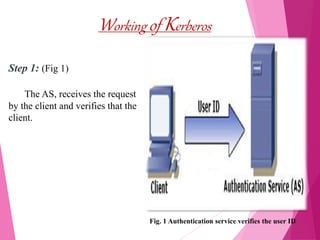
Fig. 1 Authentication service verifies the user ID
Working of Kerberos
Step 1: (Fig 1)
The AS, receives the request
by the client and verifies that the
client.
Fig. 2 Authentication service issues TGT.
Step 2:
 Upon verification, a timestamp is
created with current time in a user
session with expiration date.
 The timestamp ensures that when
8 hours is up, the encryption key is
useless.
Step 3: (Fig 2)
The key is sent back to the
client in the form of a TGT.
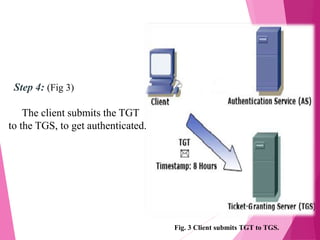
Fig. 3 Client submits TGT to TGS.
Step 4: (Fig 3)
The client submits the TGT
to the TGS, to get authenticated.
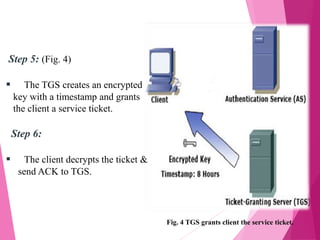
Fig. 4 TGS grants client the service ticket.
Step 5: (Fig. 4)
 The TGS creates an encrypted
key with a timestamp and grants
the client a service ticket.
Step 6:
 The client decrypts the ticket &
send ACK to TGS.
Fig. 5 Service server decrypts key & checks timestamp
Step 7:
 Then sends its own encrypted
key to the service server.
 The service decrypts the
key and check timestamp is
still valid or not.
 If it is, the service contacts
the KDC to receive a session
that is returned to the client.
Fig. 6 For valid keys communication is initiated.
Step 8: (Fig. 6)
 The client decrypts the ticket.
If the keys are still valid , comm-
-unication is initiated between client
and server.
 Now the client is authenticated
until the session expires.
Kerberos Environment
Fig. 7 A possible Kerberos environment
 First, Kerberos infrastructure
contain at least one Kerberos
Server.
 The KDC holds a complete
database of user and service
keys.
 Second, Kerberos-enabled
clients and services called
kerberized clients and services.
1. Typical Infrastructure(Fig. 7)
2. Kerberized Services
Kerberos Database
Fig. 8 Authentication Requests.
 Kerberos operations requires both
read only and write access is done
through Kerberos database.
 From figure operations requiring read-
only access to the Kerberos database are
performed by the AS(KDBM), which
can run on both master and slave M/c.
 From figure we may say that
changes may only be made to the
Master Kerberos database where
Slave copies are read-only.
 Therefore, the KDBM server may
only run on the master Kerberos M/c.
Fig. Administration Requests.
Kerberos Administrator
 It manages and controls all the Operations & Functions of Kerberos.
 Running a program to initialize database.
 Register essential principals in the database.
 Kerberos administration server and AS must be started up properly.
 For new Kerberos application ,it must take few steps to get it working.
 It must be registered in the database
 Assigned a private key
 It must also ensure that Kerberos machines are physically secure & also
able to maintain backups of the Master database.
 Advantages:
 Passwords are never sent across the network unencrypted.
 Clients and applications services mutually authenticated.
 Tickets have a limited lifetime.
 Authentication through the AS only has to happen once.
 Sharing secret keys is more efficient than public-keys.
 Disadvantages:
 Kerberos only provides authentication for clients and services.
 Vulnerable to users making poor password choices.
 Client M/c and service(servers) M/c to be designed with Kerberos authentication in
mind.
PUBLIC KEY CRYPTOGRAPHY
 In Public Key Cryptography two different but mathematically related keys are
used.
 The public key may be freely distributed, while its paired private key must
remain secret.
 The public key is typically used for encryption, while the private or secret key is
used for decryption.
 It give new direction to Kerberos as it eases key distribution a lot.
 KDC doesn’t need to save client keys in its database.
 To obtain a TGT, the client has to present his public key.
 A trusted certification authority (CA) has to sign every valid public key.
CONCLUSION
 Researched and developed for over 8 years.
 Kerberos doesn’t fail to deliver services.
 Ex:- Cisco, Microsoft, Apple, and many others.
 As authentication is critical for the security of computer systems, traditional
authentication methods are not suitable for use in computer networks
 The Kerberos authentication system is well suited for authentication of users in
such environments.
REFERENCES
 Computer Networking by James Kurose and Keith Rose.
 Kerberos: Network Authentication System by Brain Pung.
 Introduction to Kerberos technology.
 http://web.mit.edu/Kerberos/
 http://searchsecurity.techtarget.com/sDefinition/
 http://www.google.co.in/
kerberos

kerberos

  • 1.
    ”KERBEROS” Sameer Farooq Reg_No: 11501907 M.tech(CSE) . Dept.of Computer Science& Engineering Lovely Professional University Phagwara, Jalandhar-144401
  • 2.
    CONTENTS  WHAT ISKERBEROS?  HISTORY.  TERMINOLOGY.  WORKING.  KERBEROS ENVIRONMENT.  KERBEROS DATABASE.  KERBEROS ADMINISTRATOR.  ADVANTAGES & DISADVANTAGES.  PUBLIC KEY CRYPTOGRAPHY.  CONCLUSION.  REFERENCES.
  • 3.
    Whatis Kerberos ? •Network authentication protocol. • Developed at MIT in the mid 1980s. • Uses trusted 3rd party authentication scheme. • Assumes that hosts are not trustworthy. • Requires that each client (each request for service) prove it’s identity. • Does not require user to enter password every time a service is requested !.
  • 4.
    History • Steve Millerand Clifford Neuman designed the primary Kerberos version in1983. • Versions 1–3 occurred only internally at MIT as part of project Athena. • Windows 2000 was Microsoft's first system to implement Kerberos security standard. • Version 5, designed by John Kohl and Clifford Neuman, appeared in 1993 .
  • 5.
    Recent updates include:- •Encryption and Checksum Specifications. • Clarification of the protocol with more detailed and clearer explanation of intended use. • A new edition of the GSS-API( Generic Security Service Application Program Interface ) specification.
  • 6.
    Why Kerberos ? •Sending usernames and passwords in the clear jeopardizes the security of the network. • Each time a password is sent in the clear, there is a chance for interception. Provides • strong security on physically insecure network. • a centralized authentication server which authenticates • Users to servers. • Servers to users.
  • 7.
    Firewall vs. Kerberos? • Firewalls make a risky assumption: that attackers are coming from the outside. In reality, attacks frequently come from within. • Assumes “bad guys” are on the outside….while the really damaging ones can be inside !. • Restrict use of Internet. • Kerberos assumes that network connections (rather than servers and work stations) are the weak link in network security.
  • 8.
    TERMINOLOGY  Realm: Indicates anauthentication administrator domain.  Principal: It is the name used to refer to the entries in AS.  Ticket: It is issued by AS & Encrypted using Secret key of Service.  Encryption:  Encryption type: DES, RC4-HMAC, AES128 &AES256 algorithms.  Encryption key.  Key Version Number (kvno)
  • 9.
     Key DistributionCenter (KDC):  Database: Contains information about Users & Services.  Authentication Server (AS): Give reply to initial authentication Request from Client & issues TGT.  Ticket Granting Server (TGS): Distributes Service tickets to client.  Session Key: It is secret between Users & Services for which a client has work session open on a server.  Replay Cache  Credential Cache: Used to store password & related session key.
  • 10.
    Fig. 1 Authenticationservice verifies the user ID Working of Kerberos Step 1: (Fig 1) The AS, receives the request by the client and verifies that the client.
  • 11.
    Fig. 2 Authenticationservice issues TGT. Step 2:  Upon verification, a timestamp is created with current time in a user session with expiration date.  The timestamp ensures that when 8 hours is up, the encryption key is useless. Step 3: (Fig 2) The key is sent back to the client in the form of a TGT.
  • 12.
    Fig. 3 Clientsubmits TGT to TGS. Step 4: (Fig 3) The client submits the TGT to the TGS, to get authenticated.
  • 13.
    Fig. 4 TGSgrants client the service ticket. Step 5: (Fig. 4)  The TGS creates an encrypted key with a timestamp and grants the client a service ticket. Step 6:  The client decrypts the ticket & send ACK to TGS.
  • 14.
    Fig. 5 Serviceserver decrypts key & checks timestamp Step 7:  Then sends its own encrypted key to the service server.  The service decrypts the key and check timestamp is still valid or not.  If it is, the service contacts the KDC to receive a session that is returned to the client.
  • 15.
    Fig. 6 Forvalid keys communication is initiated. Step 8: (Fig. 6)  The client decrypts the ticket. If the keys are still valid , comm- -unication is initiated between client and server.  Now the client is authenticated until the session expires.
  • 16.
    Kerberos Environment Fig. 7A possible Kerberos environment  First, Kerberos infrastructure contain at least one Kerberos Server.  The KDC holds a complete database of user and service keys.  Second, Kerberos-enabled clients and services called kerberized clients and services. 1. Typical Infrastructure(Fig. 7) 2. Kerberized Services
  • 17.
    Kerberos Database Fig. 8Authentication Requests.  Kerberos operations requires both read only and write access is done through Kerberos database.  From figure operations requiring read- only access to the Kerberos database are performed by the AS(KDBM), which can run on both master and slave M/c.
  • 18.
     From figurewe may say that changes may only be made to the Master Kerberos database where Slave copies are read-only.  Therefore, the KDBM server may only run on the master Kerberos M/c. Fig. Administration Requests.
  • 19.
    Kerberos Administrator  Itmanages and controls all the Operations & Functions of Kerberos.  Running a program to initialize database.  Register essential principals in the database.  Kerberos administration server and AS must be started up properly.  For new Kerberos application ,it must take few steps to get it working.  It must be registered in the database  Assigned a private key  It must also ensure that Kerberos machines are physically secure & also able to maintain backups of the Master database.
  • 20.
     Advantages:  Passwordsare never sent across the network unencrypted.  Clients and applications services mutually authenticated.  Tickets have a limited lifetime.  Authentication through the AS only has to happen once.  Sharing secret keys is more efficient than public-keys.  Disadvantages:  Kerberos only provides authentication for clients and services.  Vulnerable to users making poor password choices.  Client M/c and service(servers) M/c to be designed with Kerberos authentication in mind.
  • 21.
    PUBLIC KEY CRYPTOGRAPHY In Public Key Cryptography two different but mathematically related keys are used.  The public key may be freely distributed, while its paired private key must remain secret.  The public key is typically used for encryption, while the private or secret key is used for decryption.  It give new direction to Kerberos as it eases key distribution a lot.  KDC doesn’t need to save client keys in its database.  To obtain a TGT, the client has to present his public key.  A trusted certification authority (CA) has to sign every valid public key.
  • 22.
    CONCLUSION  Researched anddeveloped for over 8 years.  Kerberos doesn’t fail to deliver services.  Ex:- Cisco, Microsoft, Apple, and many others.  As authentication is critical for the security of computer systems, traditional authentication methods are not suitable for use in computer networks  The Kerberos authentication system is well suited for authentication of users in such environments.
  • 23.
    REFERENCES  Computer Networkingby James Kurose and Keith Rose.  Kerberos: Network Authentication System by Brain Pung.  Introduction to Kerberos technology.  http://web.mit.edu/Kerberos/  http://searchsecurity.techtarget.com/sDefinition/  http://www.google.co.in/