SEMINAR
ON
SSL
(SECURE SOCKET LAYER)
TOPIC COVERED
 SSL Overview
 SSL Architecture
 SSL components
 SSL Record Protocol – processing overview
 Header
 Encryption
 SSL Alert Protocol
 SSL Handshake Protocol – overview
 Supported key exchange methods
 Message authentication
 MAC usage
 Summary
WHAT IS SSL?
 SSL – Secure Socket Layer
 it provides a secure transport connection between
applications (e.g., a web server and a browser).
 SSL was developed by Netscape.
 SSL version 3.0 has been implemented in many web
browsers (e.g., Netscape Navigator and MS Internet
Explorer) and web servers and widely used on the Internet.
 SSL v3.0 was specified in an Internet Draft (1996)
it evolved into RFC 2246 and was renamed to TLS (Transport
Layer Security).
 TLS can be viewed as SSL v3.1
SSL ARCHITECTURE
SSL
Handshake
Protocol
SSL chang
Cipher Spec
Protocol
SSL Alert
Protocol
Applications
(eg., HTTP)
SSL Record Protocol
TCP
IP
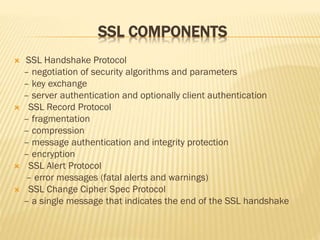
SSL COMPONENTS
 SSL Handshake Protocol
– negotiation of security algorithms and parameters
– key exchange
– server authentication and optionally client authentication
 SSL Record Protocol
– fragmentation
– compression
– message authentication and integrity protection
– encryption
 SSL Alert Protocol
– error messages (fatal alerts and warnings)
 SSL Change Cipher Spec Protocol
– a single message that indicates the end of the SSL handshake
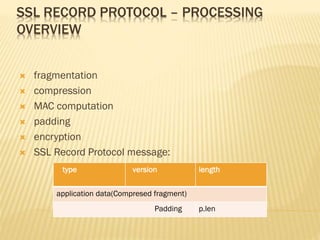
SSL RECORD PROTOCOL – PROCESSING
OVERVIEW
 fragmentation
 compression
 MAC computation
 padding
 encryption
 SSL Record Protocol message:
type version length
application data(Compresed fragment)
Padding p.len
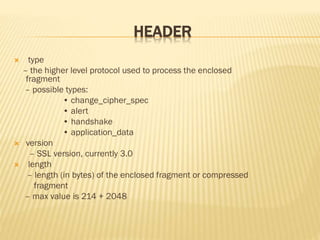
HEADER
 type
– the higher level protocol used to process the enclosed
fragment
– possible types:
• change_cipher_spec
• alert
• handshake
• application_data
 version
– SSL version, currently 3.0
 length
– length (in bytes) of the enclosed fragment or compressed
fragment
– max value is 214 + 2048
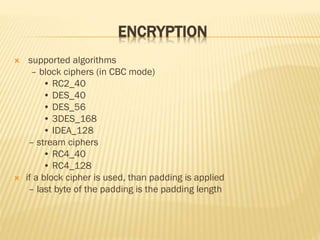
ENCRYPTION
 supported algorithms
– block ciphers (in CBC mode)
• RC2_40
• DES_40
• DES_56
• 3DES_168
• IDEA_128
– stream ciphers
• RC4_40
• RC4_128
 if a block cipher is used, than padding is applied
– last byte of the padding is the padding length
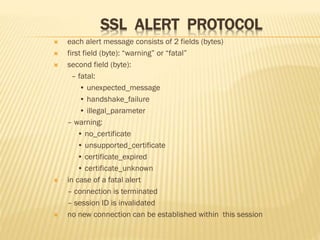
SSL ALERT PROTOCOL
 each alert message consists of 2 fields (bytes)
 first field (byte): “warning” or “fatal”
 second field (byte):
– fatal:
• unexpected_message
• handshake_failure
• illegal_parameter
– warning:
• no_certificate
• unsupported_certificate
• certificate_expired
• certificate_unknown
 in case of a fatal alert
– connection is terminated
– session ID is invalidated
 no new connection can be established within this session
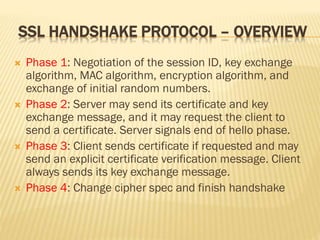
SSL HANDSHAKE PROTOCOL – OVERVIEW
 Phase 1: Negotiation of the session ID, key exchange
algorithm, MAC algorithm, encryption algorithm, and
exchange of initial random numbers.
 Phase 2: Server may send its certificate and key
exchange message, and it may request the client to
send a certificate. Server signals end of hello phase.
 Phase 3: Client sends certificate if requested and may
send an explicit certificate verification message. Client
always sends its key exchange message.
 Phase 4: Change cipher spec and finish handshake
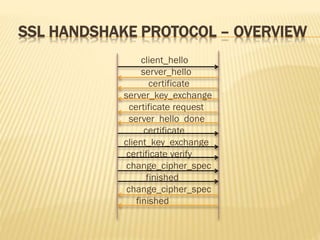
SSL HANDSHAKE PROTOCOL – OVERVIEW
client_hello
server_hello
certificate
server_key_exchange
certificate request
server_hello_done
certificate
client_key_exchange
certificate verify
change_cipher_spec
finished
change_cipher_spec
finished
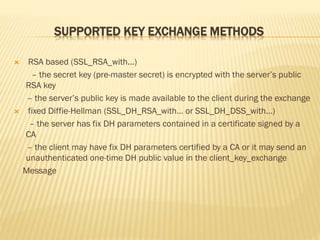
SUPPORTED KEY EXCHANGE METHODS
 RSA based (SSL_RSA_with...)
– the secret key (pre-master secret) is encrypted with the server’s public
RSA key
– the server’s public key is made available to the client during the exchange
 fixed Diffie-Hellman (SSL_DH_RSA_with… or SSL_DH_DSS_with…)
– the server has fix DH parameters contained in a certificate signed by a
CA
– the client may have fix DH parameters certified by a CA or it may send an
unauthenticated one-time DH public value in the client_key_exchange
Message
SUPPORTED KEY EXCHANGE METHODS
 ephemeral Diffie-Hellman (SSL_DHE_RSA_with… or
SSL_DHE_DSS_with…)
– both the server and the client generate one-time DH
parameters
– the server signs its DH parameters with its private
RSA or DSS key
– the client may authenticate itself (if requested by the
server) by signing the hash of the handshake messages
with its private RSA or DSS key
 anonymous Diffie-Hellman (SSL_DH_anon_with…)
– both the server and the client generate one-time DH
parameters
– they send their parameters to the peer without
authentication
MESSAGE AUTHENTICATION
 SSL uses a HMAC-like MAC
– it actually uses an obsolete version of HMAC
 HMAC is provably secure
 MAC secret is 128 bits long
 different MAC secrets are used in different directions and connections
- the MAC doesn’t involve the version number (part of the message).
- if the version number is ever used, then it should be covered by the MAC
- if the version number is never used, then it should not be sent
MAC USAGE
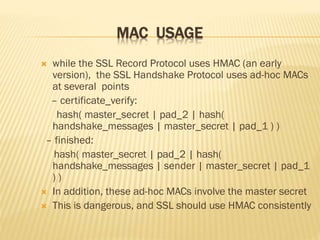
 while the SSL Record Protocol uses HMAC (an early
version), the SSL Handshake Protocol uses ad-hoc MACs
at several points
– certificate_verify:
hash( master_secret | pad_2 | hash(
handshake_messages | master_secret | pad_1 ) )
– finished:
hash( master_secret | pad_2 | hash(
handshake_messages | sender | master_secret | pad_1
) )
 In addition, these ad-hoc MACs involve the master secret
 This is dangerous, and SSL should use HMAC consistently
SUMMARY
 SSL Record Protocol
-- good protection against passive eavesdropping and active attacks
– should better protect against traffic analysis (e.g., apply random padding)
– should use the latest version of HMAC
 SSL Handshake Protocol
-- some active attacks are foiled
• cipher suite rollback
• version rollback
– other active attacks could still be possible depending on how an implementation
interprets the SSL specification
• dropping change_cipher_spec messages
• key-exchange algorithm rollback
– ad-hoc MAC constructions should be replaced with HMAC
 overall: SSL 3.0 was an extremely important step toward practical communication
security for Internet applications
“Thank You
for your time
and
Listening me.”

Ssl (Secure Socket Layer)

  • 1.
  • 2.
    TOPIC COVERED  SSLOverview  SSL Architecture  SSL components  SSL Record Protocol – processing overview  Header  Encryption  SSL Alert Protocol  SSL Handshake Protocol – overview  Supported key exchange methods  Message authentication  MAC usage  Summary
  • 3.
    WHAT IS SSL? SSL – Secure Socket Layer  it provides a secure transport connection between applications (e.g., a web server and a browser).  SSL was developed by Netscape.  SSL version 3.0 has been implemented in many web browsers (e.g., Netscape Navigator and MS Internet Explorer) and web servers and widely used on the Internet.  SSL v3.0 was specified in an Internet Draft (1996) it evolved into RFC 2246 and was renamed to TLS (Transport Layer Security).  TLS can be viewed as SSL v3.1
  • 4.
    SSL ARCHITECTURE SSL Handshake Protocol SSL chang CipherSpec Protocol SSL Alert Protocol Applications (eg., HTTP) SSL Record Protocol TCP IP
  • 5.
    SSL COMPONENTS  SSLHandshake Protocol – negotiation of security algorithms and parameters – key exchange – server authentication and optionally client authentication  SSL Record Protocol – fragmentation – compression – message authentication and integrity protection – encryption  SSL Alert Protocol – error messages (fatal alerts and warnings)  SSL Change Cipher Spec Protocol – a single message that indicates the end of the SSL handshake
  • 6.
    SSL RECORD PROTOCOL– PROCESSING OVERVIEW  fragmentation  compression  MAC computation  padding  encryption  SSL Record Protocol message: type version length application data(Compresed fragment) Padding p.len
  • 7.
    HEADER  type – thehigher level protocol used to process the enclosed fragment – possible types: • change_cipher_spec • alert • handshake • application_data  version – SSL version, currently 3.0  length – length (in bytes) of the enclosed fragment or compressed fragment – max value is 214 + 2048
  • 8.
    ENCRYPTION  supported algorithms –block ciphers (in CBC mode) • RC2_40 • DES_40 • DES_56 • 3DES_168 • IDEA_128 – stream ciphers • RC4_40 • RC4_128  if a block cipher is used, than padding is applied – last byte of the padding is the padding length
  • 9.
    SSL ALERT PROTOCOL each alert message consists of 2 fields (bytes)  first field (byte): “warning” or “fatal”  second field (byte): – fatal: • unexpected_message • handshake_failure • illegal_parameter – warning: • no_certificate • unsupported_certificate • certificate_expired • certificate_unknown  in case of a fatal alert – connection is terminated – session ID is invalidated  no new connection can be established within this session
  • 10.
    SSL HANDSHAKE PROTOCOL– OVERVIEW  Phase 1: Negotiation of the session ID, key exchange algorithm, MAC algorithm, encryption algorithm, and exchange of initial random numbers.  Phase 2: Server may send its certificate and key exchange message, and it may request the client to send a certificate. Server signals end of hello phase.  Phase 3: Client sends certificate if requested and may send an explicit certificate verification message. Client always sends its key exchange message.  Phase 4: Change cipher spec and finish handshake
  • 11.
    SSL HANDSHAKE PROTOCOL– OVERVIEW client_hello server_hello certificate server_key_exchange certificate request server_hello_done certificate client_key_exchange certificate verify change_cipher_spec finished change_cipher_spec finished
  • 12.
    SUPPORTED KEY EXCHANGEMETHODS  RSA based (SSL_RSA_with...) – the secret key (pre-master secret) is encrypted with the server’s public RSA key – the server’s public key is made available to the client during the exchange  fixed Diffie-Hellman (SSL_DH_RSA_with… or SSL_DH_DSS_with…) – the server has fix DH parameters contained in a certificate signed by a CA – the client may have fix DH parameters certified by a CA or it may send an unauthenticated one-time DH public value in the client_key_exchange Message
  • 13.
    SUPPORTED KEY EXCHANGEMETHODS  ephemeral Diffie-Hellman (SSL_DHE_RSA_with… or SSL_DHE_DSS_with…) – both the server and the client generate one-time DH parameters – the server signs its DH parameters with its private RSA or DSS key – the client may authenticate itself (if requested by the server) by signing the hash of the handshake messages with its private RSA or DSS key  anonymous Diffie-Hellman (SSL_DH_anon_with…) – both the server and the client generate one-time DH parameters – they send their parameters to the peer without authentication
  • 14.
    MESSAGE AUTHENTICATION  SSLuses a HMAC-like MAC – it actually uses an obsolete version of HMAC  HMAC is provably secure  MAC secret is 128 bits long  different MAC secrets are used in different directions and connections - the MAC doesn’t involve the version number (part of the message). - if the version number is ever used, then it should be covered by the MAC - if the version number is never used, then it should not be sent
  • 15.
    MAC USAGE  whilethe SSL Record Protocol uses HMAC (an early version), the SSL Handshake Protocol uses ad-hoc MACs at several points – certificate_verify: hash( master_secret | pad_2 | hash( handshake_messages | master_secret | pad_1 ) ) – finished: hash( master_secret | pad_2 | hash( handshake_messages | sender | master_secret | pad_1 ) )  In addition, these ad-hoc MACs involve the master secret  This is dangerous, and SSL should use HMAC consistently
  • 16.
    SUMMARY  SSL RecordProtocol -- good protection against passive eavesdropping and active attacks – should better protect against traffic analysis (e.g., apply random padding) – should use the latest version of HMAC  SSL Handshake Protocol -- some active attacks are foiled • cipher suite rollback • version rollback – other active attacks could still be possible depending on how an implementation interprets the SSL specification • dropping change_cipher_spec messages • key-exchange algorithm rollback – ad-hoc MAC constructions should be replaced with HMAC  overall: SSL 3.0 was an extremely important step toward practical communication security for Internet applications
  • 17.
    “Thank You for yourtime and Listening me.”