GENERAL SHOP
DESIGN &
CONSTRUCTION
[JoCh]
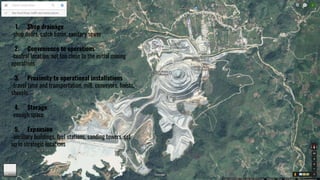
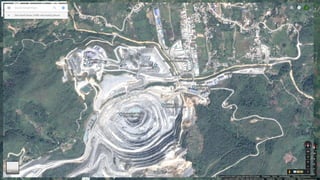
Shop Site Location
1. Shop drainage
-shop doors, catch basin, sanitary sewer
2. Convenience to operations
-central location, not too close to the initial mining
operations
3. Proximity to operational installations
-travel time and transportation, mill, conveyors, hoists,
shovels
4. Storage
-enough space
5. Expansion
-ancillary buildings, fuel stations, sanding towers, set
up in strategic locations
Type of Building
Construction
PROS: pleasing & low upkeep, shop buildings
warehouses no need for crane beam column
supports, building under 5,000 ft² floor area
CONS: high initial cost, need skilled masons, not
close to mine operation, difficulty in expansion
1. Masonry
- brick, concrete block, poured
concrete, precast concrete
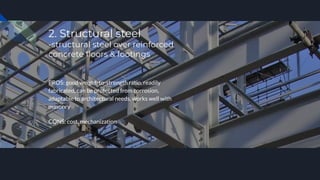
2. Structural steel
-structural steel over reinforced
concrete floors & footings
PROS: good weight-to-strength ratio, readily
fabricated, can be protected from corrosion,
adaptable to architectural needs, works well with
masonry
CONS: cost, mechanization
Roof Construction
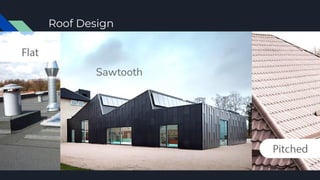
Roof Design
PROS: suitable for mounting roof-top
equipment, fan, A/C, convenient
CONS: rain damage, snow load, hail
PROS: drainage
CONS: difficulty in design &
maintenance
Sawtooth
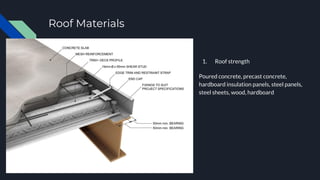
Roof Materials
1. Roof strength
Poured concrete, precast concrete,
hardboard insulation panels, steel panels,
steel sheets, wood, hardboard
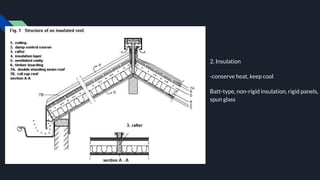
2. Insulation
-conserve heat, keep cool
Batt-type, non-rigid insulation, rigid panels,
spun glass
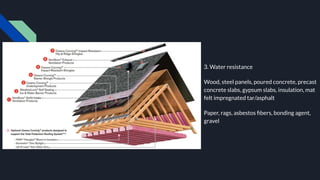
3. Water resistance
Wood, steel panels, poured concrete, precast
concrete slabs, gypsum slabs, insulation, mat
felt impregnated tar/asphalt
Paper, rags, asbestos fibers, bonding agent,
gravel
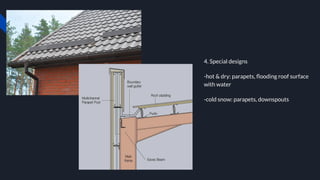
4. Special designs
-hot & dry: parapets, flooding roof surface
with water
-cold snow: parapets, downspouts
5. General
A well-designed & well-constructed roof will
function for many years relatively
maintenance free.
Floors
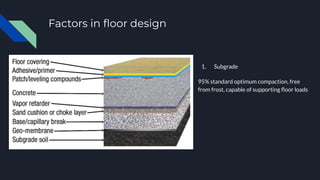
Factors in floor design
1. Subgrade
95% standard optimum compaction, free
from frost, capable of supporting floor loads
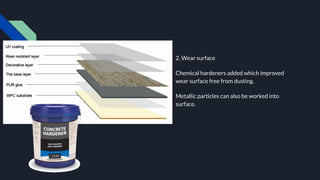
2. Wear surface
Chemical hardeners added which improved
wear surface free from dusting.
Metallic particles can also be worked into
surface.
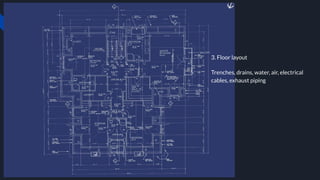
3. Floor layout
Trenches, drains, water, air, electrical
cables, exhaust piping
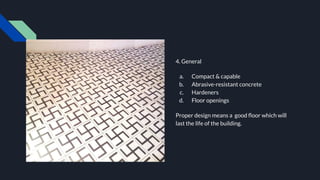
4. General
a. Compact & capable
b. Abrasive-resistant concrete
c. Hardeners
d. Floor openings
Proper design means a good floor which will
last the life of the building.
Electrical Distribution
Systems
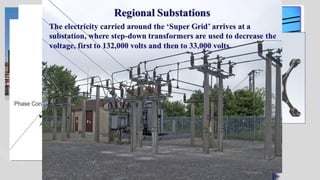
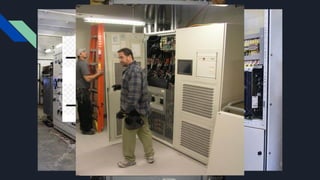
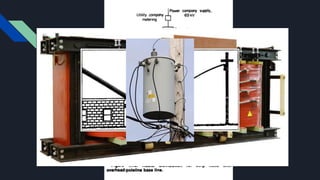
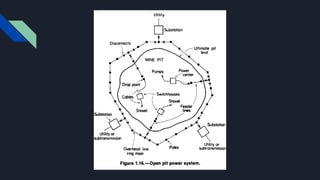
Incoming power must be stepped down to a distribution voltage at the main
substation or stations.
The voltage will be determined by the amount of equipment to be operated,
physical size, and the distance which to be distributed.
Commonly 4160 V, although higher voltages are used.
Distribution
Power should be distributed through individual circuit breakers to the mine, crusher, shops, and
other auxiliary equipment.
Circuits feeding potable equipment and originating from a common bux bar including isolating
transformer.
1. Distribution
-power should be distributed through individual circuit breakers
to the mine, crusher, shops, and other auxiliary equipment
2. Circuit Design
-overall circuit design should limit impedance to
acceptable values
3. Lighting
-it add up considerable portion of the total load
Heating, Cooling &
Ventilation
Heating
Advantages of heating:
1. A larger heating plant is more efficient
2. Fuel handling is simplified
3. Operating labor is minimized
4. Maintenance costs are lower
5. Cheaper fuels can be used
6. Less possibility of system failures
7. Space in shops is not taken up with
heating equipment
8. Controls for heating are simpler
Central heating plant
The size of the boilers would depend on
the heat load calculations.
1. Ambient temperatures expected
2. Inside temperature desired
3. Building construction
4. Winds
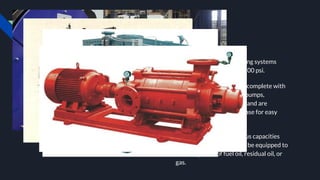
For low temperature heating systems
which is around 15 psi to 200 psi.
The boilers are purchased complete with
boiler, burner, feed water pumps,
controls, electrical panels, and are
mounted on a structural base for easy
installation.
It can be obtained in various capacities
from 15 to 600 hp and can be equipped to
burn all grades of fuel oil, residual oil, or
gas.
Individual shop heating
Advantages
1. No problem of piping to the central
plant
2. A heating failure in one shop does
not affect the other shops
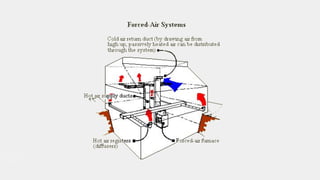
The most inexpensive systems for
individual shops are hot-air systems
Forced-air systems
-Forced air systems use a furnace or heat
pump to heat the air and then disperse it
through the house via ductwork and
in-room vents.
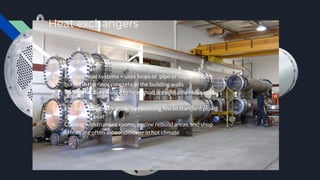
Heat exchangers
Special Systems
1. Radiant-heat systems = uses loops or pipe or copper tubing
buried in the floor concrete in the building walls
2. Radiant heaters = used to heat small areas in otherwise cold
buildings
3. Fin-tube radiators = made by fastening fins to standard piping
are used to heat
4. Cooling = instrument rooms, engine rebuild areas, and shop
offices are often air-conditioner in hot climate
Ventilation
General Ventilation
All maintenance shops generate fumes
of some kind which cannot be
removed at their source. General
ventilating fans are needed to insure
fresh air.
1. Zoned exhaust = roof or sidewall fans
are located to serve zones of the
building
2. Make-up (controlled) exhaust = air is

introduced into the shop by an intake
fan blowing across steam coils then
the heated air is distributed through
directional louvers or ductwork.
Local Ventilation
Provided where heavy welding or burning is
done.
Heating cleaning tanks containing solvents,
areas of heavy grinding, gasoline vehicle
repair areas, and rubber skiving areas all
require local ventilation for the health and
comfort of maintenance worker.
Cranes & Monorails
-the size of the crane
would be determined by
the heaviest piece to be
handled.
-monorail cranes are
effective only when one
route is possible
Water Treatment &
Sewage Disposal
-in initial design it is
wise to be generous in
the sizing of water and
sewage facilities
Storage
-stand, racks, cabinets,
and shelving provide the
most efficient use of
storage space
Offices, Washrooms &
Locker Space
● Offices should be central to the shops.
● The office of the shop foreman should be large enough
to accommodate small meetings.
● An outside entrance is desirable.
● Good lighting and many electrical outlets are needed
● Ceilings should be of acoustica material: walls and
floors should have easily cleaned surfaces.
Special Miscellaneous
Provisions
1. Scrap Handling Storage
Maintenance shops generate scrap of all kinds-combustible and noncombustible. The first step
in efficient scrap handling is to design easily handles scrap containers for the shops.
Combustibles are easily disposed of by burning.
2. Outdoor Material and Handling
Heavy bulky material such as steel plate, beams, rounds, and pipes are normally stored outside.
3. Centralized Oxygen and Acetylene Systems
Purchase the gas in small tanks and distribute them throughout the shops needed. A central
plant can be equipped to distribute oxygen and acetylene through a piping system to each
shop.
Fire Protection

General shop design & construction

  • 1.
  • 2.
  • 3.
    1. Shop drainage -shopdoors, catch basin, sanitary sewer 2. Convenience to operations -central location, not too close to the initial mining operations 3. Proximity to operational installations -travel time and transportation, mill, conveyors, hoists, shovels 4. Storage -enough space 5. Expansion -ancillary buildings, fuel stations, sanding towers, set up in strategic locations
  • 5.
  • 6.
    PROS: pleasing &low upkeep, shop buildings warehouses no need for crane beam column supports, building under 5,000 ft² floor area CONS: high initial cost, need skilled masons, not close to mine operation, difficulty in expansion 1. Masonry - brick, concrete block, poured concrete, precast concrete
  • 7.
    2. Structural steel -structuralsteel over reinforced concrete floors & footings PROS: good weight-to-strength ratio, readily fabricated, can be protected from corrosion, adaptable to architectural needs, works well with masonry CONS: cost, mechanization
  • 8.
  • 9.
    Roof Design PROS: suitablefor mounting roof-top equipment, fan, A/C, convenient CONS: rain damage, snow load, hail PROS: drainage CONS: difficulty in design & maintenance Sawtooth
  • 10.
    Roof Materials 1. Roofstrength Poured concrete, precast concrete, hardboard insulation panels, steel panels, steel sheets, wood, hardboard
  • 11.
    2. Insulation -conserve heat,keep cool Batt-type, non-rigid insulation, rigid panels, spun glass
  • 12.
    3. Water resistance Wood,steel panels, poured concrete, precast concrete slabs, gypsum slabs, insulation, mat felt impregnated tar/asphalt Paper, rags, asbestos fibers, bonding agent, gravel
  • 13.
    4. Special designs -hot& dry: parapets, flooding roof surface with water -cold snow: parapets, downspouts
  • 14.
    5. General A well-designed& well-constructed roof will function for many years relatively maintenance free.
  • 15.
  • 16.
    Factors in floordesign 1. Subgrade 95% standard optimum compaction, free from frost, capable of supporting floor loads
  • 20.
    2. Wear surface Chemicalhardeners added which improved wear surface free from dusting. Metallic particles can also be worked into surface.
  • 21.
    3. Floor layout Trenches,drains, water, air, electrical cables, exhaust piping
  • 22.
    4. General a. Compact& capable b. Abrasive-resistant concrete c. Hardeners d. Floor openings Proper design means a good floor which will last the life of the building.
  • 23.
    Electrical Distribution Systems Incoming powermust be stepped down to a distribution voltage at the main substation or stations. The voltage will be determined by the amount of equipment to be operated, physical size, and the distance which to be distributed. Commonly 4160 V, although higher voltages are used.
  • 25.
    Distribution Power should bedistributed through individual circuit breakers to the mine, crusher, shops, and other auxiliary equipment. Circuits feeding potable equipment and originating from a common bux bar including isolating transformer.
  • 30.
    1. Distribution -power shouldbe distributed through individual circuit breakers to the mine, crusher, shops, and other auxiliary equipment 2. Circuit Design -overall circuit design should limit impedance to acceptable values 3. Lighting -it add up considerable portion of the total load
  • 31.
  • 32.
    Heating Advantages of heating: 1.A larger heating plant is more efficient 2. Fuel handling is simplified 3. Operating labor is minimized 4. Maintenance costs are lower 5. Cheaper fuels can be used 6. Less possibility of system failures 7. Space in shops is not taken up with heating equipment 8. Controls for heating are simpler
  • 33.
    Central heating plant Thesize of the boilers would depend on the heat load calculations. 1. Ambient temperatures expected 2. Inside temperature desired 3. Building construction 4. Winds For low temperature heating systems which is around 15 psi to 200 psi. The boilers are purchased complete with boiler, burner, feed water pumps, controls, electrical panels, and are mounted on a structural base for easy installation. It can be obtained in various capacities from 15 to 600 hp and can be equipped to burn all grades of fuel oil, residual oil, or gas.
  • 34.
    Individual shop heating Advantages 1.No problem of piping to the central plant 2. A heating failure in one shop does not affect the other shops The most inexpensive systems for individual shops are hot-air systems Forced-air systems -Forced air systems use a furnace or heat pump to heat the air and then disperse it through the house via ductwork and in-room vents.
  • 36.
    Heat exchangers Special Systems 1.Radiant-heat systems = uses loops or pipe or copper tubing buried in the floor concrete in the building walls 2. Radiant heaters = used to heat small areas in otherwise cold buildings 3. Fin-tube radiators = made by fastening fins to standard piping are used to heat 4. Cooling = instrument rooms, engine rebuild areas, and shop offices are often air-conditioner in hot climate
  • 37.
  • 38.
    General Ventilation All maintenanceshops generate fumes of some kind which cannot be removed at their source. General ventilating fans are needed to insure fresh air. 1. Zoned exhaust = roof or sidewall fans are located to serve zones of the building 2. Make-up (controlled) exhaust = air is introduced into the shop by an intake fan blowing across steam coils then the heated air is distributed through directional louvers or ductwork. Local Ventilation Provided where heavy welding or burning is done. Heating cleaning tanks containing solvents, areas of heavy grinding, gasoline vehicle repair areas, and rubber skiving areas all require local ventilation for the health and comfort of maintenance worker.
  • 39.
    Cranes & Monorails -thesize of the crane would be determined by the heaviest piece to be handled. -monorail cranes are effective only when one route is possible
  • 40.
    Water Treatment & SewageDisposal -in initial design it is wise to be generous in the sizing of water and sewage facilities
  • 41.
    Storage -stand, racks, cabinets, andshelving provide the most efficient use of storage space
  • 42.
  • 43.
    ● Offices shouldbe central to the shops. ● The office of the shop foreman should be large enough to accommodate small meetings. ● An outside entrance is desirable. ● Good lighting and many electrical outlets are needed ● Ceilings should be of acoustica material: walls and floors should have easily cleaned surfaces.
  • 44.
  • 45.
    1. Scrap HandlingStorage Maintenance shops generate scrap of all kinds-combustible and noncombustible. The first step in efficient scrap handling is to design easily handles scrap containers for the shops. Combustibles are easily disposed of by burning. 2. Outdoor Material and Handling Heavy bulky material such as steel plate, beams, rounds, and pipes are normally stored outside. 3. Centralized Oxygen and Acetylene Systems Purchase the gas in small tanks and distribute them throughout the shops needed. A central plant can be equipped to distribute oxygen and acetylene through a piping system to each shop.
  • 46.