Room & Pillar Mining Method
Ayon Saha Sadia Hossain Setu Md. Imdadul Islam Shaikh Ashikur Rahaman
14GLM019 14GLM042 14GLM006 14GLM009
Presented By
GROUP 01
Content
 Introduction
 Usability
 Geological Requirements
 Basic principles
 Classifications
 General consideration
 Design Parameters of Room and Pillar Mining
 Room and Pillar in Hard Rocks
 Room and Pillar in Soft Rocks
 Advantages & Disadvantages
 Case study (Jharia Coal field)
Introduction
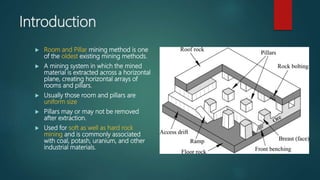
 Room and Pillar mining method is one
of the oldest existing mining methods.
 A mining system in which the mined
material is extracted across a horizontal
plane, creating horizontal arrays of
rooms and pillars.
 Usually those room and pillars are
uniform size
 Pillars may or may not be removed
after extraction.
 Used for soft as well as hard rock
mining and is commonly associated
with coal, potash, uranium, and other
industrial materials.
Usability
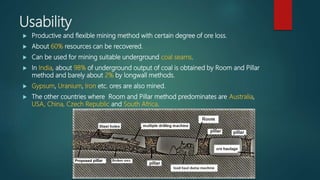
 Productive and flexible mining method with certain degree of ore loss.
 About 60% resources can be recovered.
 Can be used for mining suitable underground coal seams.
 In India, about 98% of underground output of coal is obtained by Room and Pillar
method and barely about 2% by longwall methods.
 Gypsum, Uranium, Iron etc. ores are also mined.
 The other countries where Room and Pillar method predominates are Australia,
USA, China, Czech Republic and South Africa.
Proposed pillar
Geological Requirements
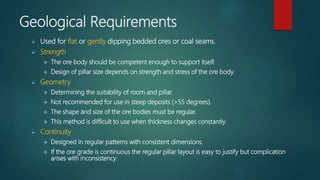
 Used for flat or gently dipping bedded ores or coal seams.
 Strength
 The ore body should be competent enough to support itself.
 Design of pillar size depends on strength and stress of the ore body.
 Geometry
 Determining the suitability of room and pillar.
 Not recommended for use in steep deposits (>55 degrees).
 The shape and size of the ore bodies must be regular.
 This method is difficult to use when thickness changes constantly
 Continuity
 Designed in regular patterns with consistent dimensions.
 If the ore grade is continuous the regular pillar layout is easy to justify but complication
arises with inconsistency.
Basic principles
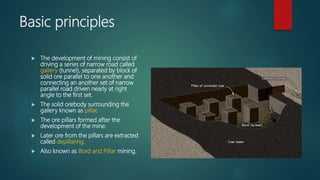
 The development of mining consist of
driving a series of narrow road called
gallery (tunnel), separated by block of
solid ore parallel to one another and
connecting an another set of narrow
parallel road driven nearly at right
angle to the first set.
 The solid orebody surrounding the
gallery known as pillar.
 The ore pillars formed after the
development of the mine.
 Later ore from the pillars are extracted
called depillaring.
 Also known as Bord and Pillar mining.
Classifications
Room and Pillar mining method are classified as bellows:
 Develop the entire area into pillars and then extract the pillars starting from the
boundary.
 Develop the area into panels (rooms) and extract pillars subsequently panel wise. This
is called panel system of mining.
 “whole” followed by “broken” working in which the mine is opened out by a few
headings only and thereafter development and depillaring go on simultaneously.
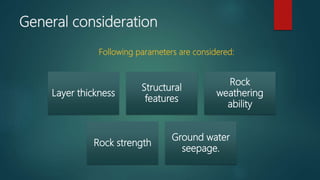
General consideration
Following parameters are considered:
Layer thickness
Structural
features
Rock
weathering
ability
Rock strength
Ground water
seepage.
Room and Pillar in Hard Rocks
Conditions of deposit for application of Room and Pillar in Hard rocks:
 Ore resistance: moderate to high
 Resistance of the host rocks: moderate to high
 Form: tabular lenticular (variable)
 Diving: generally <30° to the horizontal
 Ore grade: low to moderate
 Uniformity: variable
 Depth of deposit: shallow to moderate
Room and Pillar in Soft Rocks
Conditions of deposit for application of Room and Pillar in Soft rocks:
 Resistance of the ore: mild to moderate
 Resistance of the host rocks: moderate to high
 Forms: tabular (in layer), large lateral extent
 Diving: generally horizontal or <15° with the horizontal
 Uniformity: good uniformity of grades and thicknesses of ore
 Depth of deposit: on carbon, preferably less than 600 meters.
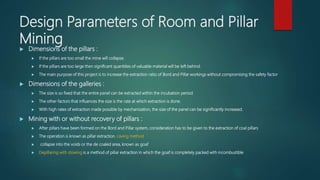
Design Parameters of Room and Pillar
Mining
 Dimensions of the pillars :
 If the pillars are too small the mine will collapse.
 If the pillars are too large then significant quantities of valuable material will be left behind.
 The main purpose of this project is to increase the extraction ratio of Bord and Pillar workings without compromising the safety factor
 Dimensions of the galleries :
 The size is so fixed that the entire panel can be extracted within the incubation period.
 The other factors that influences the size is the rate at which extraction is done.
 With high rates of extraction made possible by mechanization, the size of the panel can be significantly increased.
 Mining with or without recovery of pillars :
 After pillars have been formed on the Bord and Pillar system, consideration has to be given to the extraction of coal pillars
 The operation is known as pillar extraction. caving method
 collapse into the voids or the de coaled area, known as goaf.
 Depillaring with stowing is a method of pillar extraction in which the goaf is completely packed with incombustible
Advantages
 Flexible
 Highly Mechanized
 Easy Maintenance
 Low Operating Costs
 Low Development Costs
 Good Working Conditions
Disadvantage
 Roof Maintenance
 High Capital Costs
 Low Recovery
 Depth limitation
 Subsidence
Case study (Jharia Coalfield)
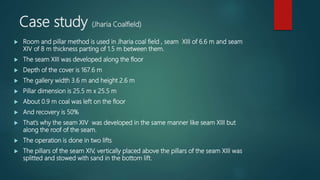
 Room and pillar method is used in Jharia coal field , seam XIII of 6.6 m and seam
XIV of 8 m thickness parting of 1.5 m between them.
 The seam XIII was developed along the floor
 Depth of the cover is 167.6 m
 The gallery width 3.6 m and height 2.6 m
 Pillar dimension is 25.5 m x 25.5 m
 About 0.9 m coal was left on the floor
 And recovery is 50%
 That’s why the seam XIV was developed in the same manner like seam XIII but
along the roof of the seam.
 The operation is done in two lifts
 The pillars of the seam XIV, vertically placed above the pillars of the seam XIII was
splitted and stowed with sand in the bottom lift.
Case study (Jharia Coalfield)
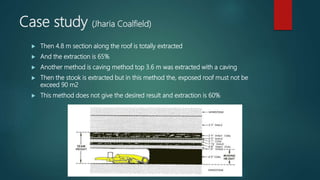
 Then 4.8 m section along the roof is totally extracted
 And the extraction is 65%
 Another method is caving method top 3.6 m was extracted with a caving
 Then the stook is extracted but in this method the, exposed roof must not be
exceed 90 m2
 This method does not give the desired result and extraction is 60%
References
 Hassan Z. Harraz, 2014-2015, Underground Mining Methods: Room and Pillar method
 Asim Kumer Satapathy, Department of mining engineering national institute of
technology Rourkela-769008, 2016, Criteria for selection of Board and Pillar for
multiple seams.
 Aashutosh Chhirolya, Design of BORD and PILLAR method in coal seams.
 J.T. Jordaan, Bord-and-pillar mining in inclined orebodies
 Wikipedia: Room and Pillar Method
 Minewiki: Bord and pillar mining method
 http://ethesis.nitrkl.ac.in/1692/1/final.pdf
 http://www.ijsrp.org/research-paper-1014/ijsrp-p3464.pdf
 http://www.mgmcl.org.bd
THANK YOU
any

Room & Pillar Mining Method

  • 1.
    Room & PillarMining Method Ayon Saha Sadia Hossain Setu Md. Imdadul Islam Shaikh Ashikur Rahaman 14GLM019 14GLM042 14GLM006 14GLM009 Presented By GROUP 01
  • 2.
    Content  Introduction  Usability Geological Requirements  Basic principles  Classifications  General consideration  Design Parameters of Room and Pillar Mining  Room and Pillar in Hard Rocks  Room and Pillar in Soft Rocks  Advantages & Disadvantages  Case study (Jharia Coal field)
  • 3.
    Introduction  Room andPillar mining method is one of the oldest existing mining methods.  A mining system in which the mined material is extracted across a horizontal plane, creating horizontal arrays of rooms and pillars.  Usually those room and pillars are uniform size  Pillars may or may not be removed after extraction.  Used for soft as well as hard rock mining and is commonly associated with coal, potash, uranium, and other industrial materials.
  • 4.
    Usability  Productive andflexible mining method with certain degree of ore loss.  About 60% resources can be recovered.  Can be used for mining suitable underground coal seams.  In India, about 98% of underground output of coal is obtained by Room and Pillar method and barely about 2% by longwall methods.  Gypsum, Uranium, Iron etc. ores are also mined.  The other countries where Room and Pillar method predominates are Australia, USA, China, Czech Republic and South Africa. Proposed pillar
  • 5.
    Geological Requirements  Usedfor flat or gently dipping bedded ores or coal seams.  Strength  The ore body should be competent enough to support itself.  Design of pillar size depends on strength and stress of the ore body.  Geometry  Determining the suitability of room and pillar.  Not recommended for use in steep deposits (>55 degrees).  The shape and size of the ore bodies must be regular.  This method is difficult to use when thickness changes constantly  Continuity  Designed in regular patterns with consistent dimensions.  If the ore grade is continuous the regular pillar layout is easy to justify but complication arises with inconsistency.
  • 6.
    Basic principles  Thedevelopment of mining consist of driving a series of narrow road called gallery (tunnel), separated by block of solid ore parallel to one another and connecting an another set of narrow parallel road driven nearly at right angle to the first set.  The solid orebody surrounding the gallery known as pillar.  The ore pillars formed after the development of the mine.  Later ore from the pillars are extracted called depillaring.  Also known as Bord and Pillar mining.
  • 7.
    Classifications Room and Pillarmining method are classified as bellows:  Develop the entire area into pillars and then extract the pillars starting from the boundary.  Develop the area into panels (rooms) and extract pillars subsequently panel wise. This is called panel system of mining.  “whole” followed by “broken” working in which the mine is opened out by a few headings only and thereafter development and depillaring go on simultaneously.
  • 8.
    General consideration Following parametersare considered: Layer thickness Structural features Rock weathering ability Rock strength Ground water seepage.
  • 9.
    Room and Pillarin Hard Rocks Conditions of deposit for application of Room and Pillar in Hard rocks:  Ore resistance: moderate to high  Resistance of the host rocks: moderate to high  Form: tabular lenticular (variable)  Diving: generally <30° to the horizontal  Ore grade: low to moderate  Uniformity: variable  Depth of deposit: shallow to moderate
  • 10.
    Room and Pillarin Soft Rocks Conditions of deposit for application of Room and Pillar in Soft rocks:  Resistance of the ore: mild to moderate  Resistance of the host rocks: moderate to high  Forms: tabular (in layer), large lateral extent  Diving: generally horizontal or <15° with the horizontal  Uniformity: good uniformity of grades and thicknesses of ore  Depth of deposit: on carbon, preferably less than 600 meters.
  • 11.
    Design Parameters ofRoom and Pillar Mining  Dimensions of the pillars :  If the pillars are too small the mine will collapse.  If the pillars are too large then significant quantities of valuable material will be left behind.  The main purpose of this project is to increase the extraction ratio of Bord and Pillar workings without compromising the safety factor  Dimensions of the galleries :  The size is so fixed that the entire panel can be extracted within the incubation period.  The other factors that influences the size is the rate at which extraction is done.  With high rates of extraction made possible by mechanization, the size of the panel can be significantly increased.  Mining with or without recovery of pillars :  After pillars have been formed on the Bord and Pillar system, consideration has to be given to the extraction of coal pillars  The operation is known as pillar extraction. caving method  collapse into the voids or the de coaled area, known as goaf.  Depillaring with stowing is a method of pillar extraction in which the goaf is completely packed with incombustible
  • 12.
    Advantages  Flexible  HighlyMechanized  Easy Maintenance  Low Operating Costs  Low Development Costs  Good Working Conditions Disadvantage  Roof Maintenance  High Capital Costs  Low Recovery  Depth limitation  Subsidence
  • 13.
    Case study (JhariaCoalfield)  Room and pillar method is used in Jharia coal field , seam XIII of 6.6 m and seam XIV of 8 m thickness parting of 1.5 m between them.  The seam XIII was developed along the floor  Depth of the cover is 167.6 m  The gallery width 3.6 m and height 2.6 m  Pillar dimension is 25.5 m x 25.5 m  About 0.9 m coal was left on the floor  And recovery is 50%  That’s why the seam XIV was developed in the same manner like seam XIII but along the roof of the seam.  The operation is done in two lifts  The pillars of the seam XIV, vertically placed above the pillars of the seam XIII was splitted and stowed with sand in the bottom lift.
  • 14.
    Case study (JhariaCoalfield)  Then 4.8 m section along the roof is totally extracted  And the extraction is 65%  Another method is caving method top 3.6 m was extracted with a caving  Then the stook is extracted but in this method the, exposed roof must not be exceed 90 m2  This method does not give the desired result and extraction is 60%
  • 15.
    References  Hassan Z.Harraz, 2014-2015, Underground Mining Methods: Room and Pillar method  Asim Kumer Satapathy, Department of mining engineering national institute of technology Rourkela-769008, 2016, Criteria for selection of Board and Pillar for multiple seams.  Aashutosh Chhirolya, Design of BORD and PILLAR method in coal seams.  J.T. Jordaan, Bord-and-pillar mining in inclined orebodies  Wikipedia: Room and Pillar Method  Minewiki: Bord and pillar mining method  http://ethesis.nitrkl.ac.in/1692/1/final.pdf  http://www.ijsrp.org/research-paper-1014/ijsrp-p3464.pdf  http://www.mgmcl.org.bd
  • 16.

Editor's Notes

  • #6 Having no strict guideline for minimum ore strength, but the ore body should be competent enough to support itself. Pillar size are designed based off strength and stress estimates for all geotechnical information. Geometry Its very crucial in determining the suitability of room and pillar. usually is not recommended for use in steep deposits (>55 degrees), where material is able to flow by gravity. The shape and size of the ore bodies must be regular. This method is difficult to use when thickness changes constantly Continuity Pillars are usually designed in regular patterns with consistent dimensions If the ore grade is continuous the regular pillar layout is easy to justify but complication arises with inconsistency.
  • #12 behind reducing the profitability of the mine.