PresenterDeepak Chandra Pant
ECE - Third Year

1
Spread Spectrum
 What is Spectrum…?
 Spread Spectrum is a communication technique that

spreads a narrow band communication signal over a wide
range of frequencies for transmission and de-spreads it into
the original data bandwidth at the receiver.
 Processing Gain (N) = Bss/B

2
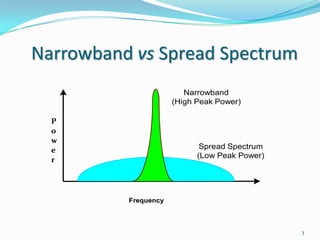
Narrowband vs Spread Spectrum

P
o
w
e
r

3
Conditions for Spread Spectrum System
 Modulated Signal Bandwidth >> Message Signal

Bandwidth
 A same code called pseudonoise sequence must be

used at the transmitter as well as at receiver in order to
recover the message.

4
Characteristics of Spread Spectrum
 Hard to interference
 Resistant to jamming
 Hard to intercept

 Multiple access capability

5
Techniques for Spread Spectrum
 Direct Sequence Spread Spectrum (DS/SS)
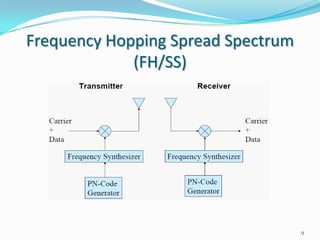
 Frequency Hopping Spread Spectrum (FH/SS)
 Hybrid Spread Spectrum

6
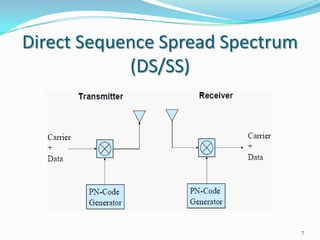
Direct Sequence Spread Spectrum
(DS/SS)

7
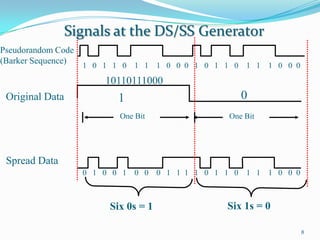
Signals at the DS/SS Generator
Pseudorandom Code
(Barker Sequence)

1 0 1 1 0 1 1 1 0 0 0 1 0 1 1 0 1 1 1 0 0 0

10110111000
Original Data

1
One Bit

0
One Bit

Spread Data
0 1 0 0 1 0 0 0 1 1 1 1 0 1 1 0 1 1 1 0 0 0

Six 0s = 1

Six 1s = 0
8
Frequency Hopping Spread Spectrum
(FH/SS)

9
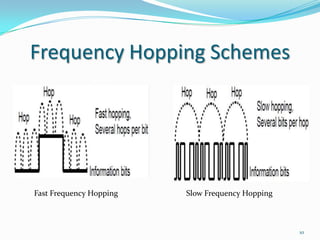
Frequency Hopping Schemes

Fast Frequency Hopping

Slow Frequency Hopping

10
Hybrid Spread Spectrum
 Combination of DS/SS and FH/SS

11
 Advantages:
 Resists interferences

 Anti jamming effect
 Can share same band of frequency with other users
 Privacy due to Pseudorandom Code
 Disadvantages:
 Bandwidth Inefficient

 Complex Implementation
 Near – Far Problem
12
Application’s of Spread Spectrum
 Cellular Telephony
 Global Positioning System (GPS)
 Wireless local area network

 Secure communication in military

13
THANK YOU…

14

Spread Spectrum System

  • 1.
  • 2.
    Spread Spectrum  Whatis Spectrum…?  Spread Spectrum is a communication technique that spreads a narrow band communication signal over a wide range of frequencies for transmission and de-spreads it into the original data bandwidth at the receiver.  Processing Gain (N) = Bss/B 2
  • 3.
    Narrowband vs SpreadSpectrum P o w e r 3
  • 4.
    Conditions for SpreadSpectrum System  Modulated Signal Bandwidth >> Message Signal Bandwidth  A same code called pseudonoise sequence must be used at the transmitter as well as at receiver in order to recover the message. 4
  • 5.
    Characteristics of SpreadSpectrum  Hard to interference  Resistant to jamming  Hard to intercept  Multiple access capability 5
  • 6.
    Techniques for SpreadSpectrum  Direct Sequence Spread Spectrum (DS/SS)  Frequency Hopping Spread Spectrum (FH/SS)  Hybrid Spread Spectrum 6
  • 7.
    Direct Sequence SpreadSpectrum (DS/SS) 7
  • 8.
    Signals at theDS/SS Generator Pseudorandom Code (Barker Sequence) 1 0 1 1 0 1 1 1 0 0 0 1 0 1 1 0 1 1 1 0 0 0 10110111000 Original Data 1 One Bit 0 One Bit Spread Data 0 1 0 0 1 0 0 0 1 1 1 1 0 1 1 0 1 1 1 0 0 0 Six 0s = 1 Six 1s = 0 8
  • 9.
    Frequency Hopping SpreadSpectrum (FH/SS) 9
  • 10.
    Frequency Hopping Schemes FastFrequency Hopping Slow Frequency Hopping 10
  • 11.
    Hybrid Spread Spectrum Combination of DS/SS and FH/SS 11
  • 12.
     Advantages:  Resistsinterferences  Anti jamming effect  Can share same band of frequency with other users  Privacy due to Pseudorandom Code  Disadvantages:  Bandwidth Inefficient  Complex Implementation  Near – Far Problem 12
  • 13.
    Application’s of SpreadSpectrum  Cellular Telephony  Global Positioning System (GPS)  Wireless local area network  Secure communication in military 13
  • 14.