15 April 2015 1
Submitted to:-sir. Dinesh dayal Submitted by:- Sonu jaiswal
Branch :- ECE
Roll no. :- 1209031172
SEMINAR TOPIC
SPREAD SPECTRUM
May 28-June1, 2001R. Z. Ziemer, Colorado Springs, CO 2
Spreadspectrum
I. History of Spread Spectrum
II. Spread Spectrum System Model
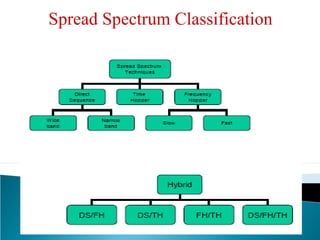
III. Spread Spectrum Classification
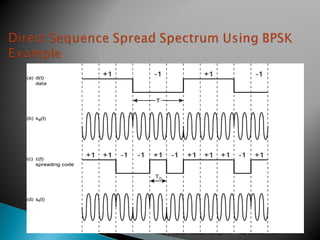
IV. Spread Spectrum Techniques
Outline
History of Spread Spectrum
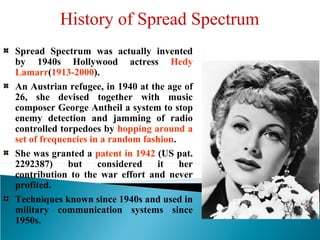
Spread Spectrum was actually invented
by 1940s Hollywood actress Hedy
Lamarr(1913-2000).
An Austrian refugee, in 1940 at the age of
26, she devised together with music
composer George Antheil a system to stop
enemy detection and jamming of radio
controlled torpedoes by hopping around a
set of frequencies in a random fashion.
She was granted a patent in 1942 (US pat.
2292387) but considered it her
contribution to the war effort and never
profited.
Techniques known since 1940s and used in
military communication systems since
1950s.
“Spread” radio signal over a wide frequency range
Several magnitudes higher than minimum requirement
Gained popularity by the needs of military communication
Proved resistant against hostile jammers
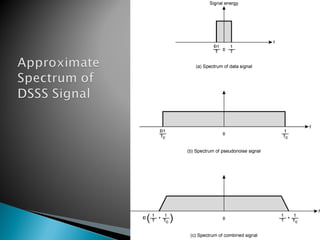
Ratio of information bandwidth and spreading bandwidth is
identified as spreading gain or processing gain
Processing gain does not combat white Noise
Introduction to Spread Spectrum
Offers the following applications:
􀂉 able to deal with multi-path
􀂉 multiple access due to different spreading sequences
􀂉 spreading sequence design is very important for
performance
􀂉 low probability of interception
􀂉 privacy
􀂉 anti-jam capabilities
Spread Spectrum Applications
Interference
̶ Prevents interference at specific frequencies
̶ E.g. other radio users, electrical systems
Military
̶ Prevents signal jamming
̶ Scrambling of ‘secret’ messages
Wireless LAN security
̶ Prevents ‘eavesdropping’ of wireless links
̶ Prevents ‘hacking’ into wireless LANs
CDMA (Code Division Multiple Access)
̶ Multiple separate channels in same medium using different
spreading codes
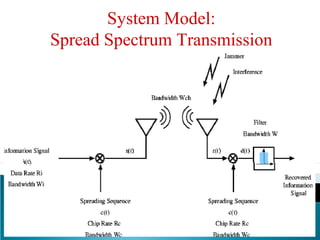
System Model:
Spread Spectrum Transmission
Spread Spectrum Criteria
A communication system is considered a spread spectrum system if it
satisfies the following two criteria:
Bandwidth of the spread spectrum signal has to be greater than the
information bandwidth. (This is also true for frequency and pulse
code modulation!)
The spreading sequence has to be independent from the
information. Thus, no possibility to calculate the information if the
sequence is known and vice versa.
Spread Spectrum Classification
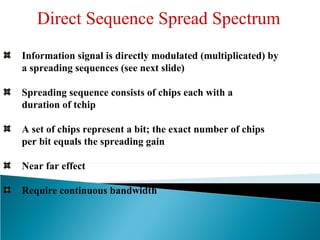
Direct Sequence Spread Spectrum
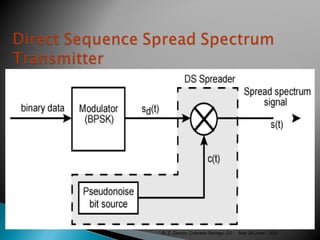
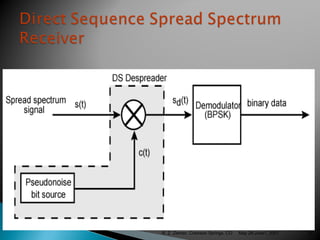
Information signal is directly modulated (multiplicated) by
a spreading sequences (see next slide)
Spreading sequence consists of chips each with a
duration of tchip
A set of chips represent a bit; the exact number of chips
per bit equals the spreading gain
Near far effect
Require continuous bandwidth
May 28-June1, 2001R. Z. Ziemer, Colorado Springs, CO 12
May 28-June1, 2001R. Z. Ziemer, Colorado Springs, CO 13
May 28-June1, 2001R. Z. Ziemer, Colorado Springs, CO 14
May 28-June1, 2001R. Z. Ziemer, Colorado Springs, CO 15
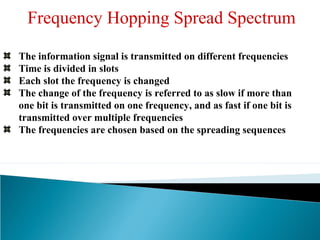
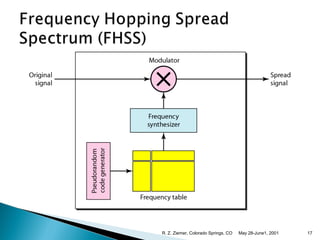
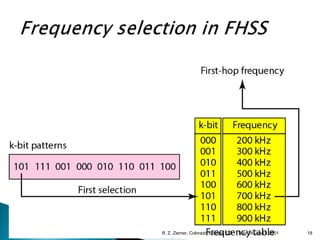
The information signal is transmitted on different frequencies
Time is divided in slots
Each slot the frequency is changed
The change of the frequency is referred to as slow if more than
one bit is transmitted on one frequency, and as fast if one bit is
transmitted over multiple frequencies
The frequencies are chosen based on the spreading sequences
Frequency Hopping Spread Spectrum
May 28-June1, 2001R. Z. Ziemer, Colorado Springs, CO 17
May 28-June1, 2001R. Z. Ziemer, Colorado Springs, CO 18
Time Hopping Spread Spectrum
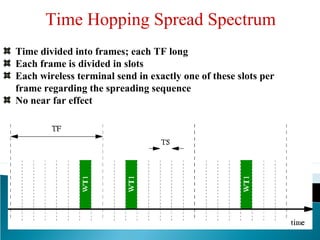
Time divided into frames; each TF long
Each frame is divided in slots
Each wireless terminal send in exactly one of these slots per
frame regarding the spreading sequence
No near far effect
Comparison of different Spread Spectrum
Techniques
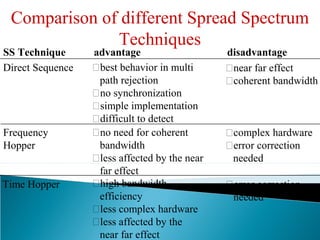
SS Technique advantage disadvantage
Direct Sequence �best behavior in multi
path rejection
�no synchronization
�simple implementation
�difficult to detect
�near far effect
�coherent bandwidth
Frequency
Hopper
�no need for coherent
bandwidth
�less affected by the near
far effect
�complex hardware
�error correction
needed
Time Hopper �high bandwidth
efficiency
�less complex hardware
�less affected by the
near far effect
�error correction
needed
Spread spectrum

Spread spectrum

  • 1.
    15 April 20151 Submitted to:-sir. Dinesh dayal Submitted by:- Sonu jaiswal Branch :- ECE Roll no. :- 1209031172 SEMINAR TOPIC SPREAD SPECTRUM
  • 2.
    May 28-June1, 2001R.Z. Ziemer, Colorado Springs, CO 2 Spreadspectrum
  • 3.
    I. History ofSpread Spectrum II. Spread Spectrum System Model III. Spread Spectrum Classification IV. Spread Spectrum Techniques Outline
  • 4.
    History of SpreadSpectrum Spread Spectrum was actually invented by 1940s Hollywood actress Hedy Lamarr(1913-2000). An Austrian refugee, in 1940 at the age of 26, she devised together with music composer George Antheil a system to stop enemy detection and jamming of radio controlled torpedoes by hopping around a set of frequencies in a random fashion. She was granted a patent in 1942 (US pat. 2292387) but considered it her contribution to the war effort and never profited. Techniques known since 1940s and used in military communication systems since 1950s.
  • 5.
    “Spread” radio signalover a wide frequency range Several magnitudes higher than minimum requirement Gained popularity by the needs of military communication Proved resistant against hostile jammers Ratio of information bandwidth and spreading bandwidth is identified as spreading gain or processing gain Processing gain does not combat white Noise Introduction to Spread Spectrum
  • 6.
    Offers the followingapplications: 􀂉 able to deal with multi-path 􀂉 multiple access due to different spreading sequences 􀂉 spreading sequence design is very important for performance 􀂉 low probability of interception 􀂉 privacy 􀂉 anti-jam capabilities
  • 7.
    Spread Spectrum Applications Interference ̶Prevents interference at specific frequencies ̶ E.g. other radio users, electrical systems Military ̶ Prevents signal jamming ̶ Scrambling of ‘secret’ messages Wireless LAN security ̶ Prevents ‘eavesdropping’ of wireless links ̶ Prevents ‘hacking’ into wireless LANs CDMA (Code Division Multiple Access) ̶ Multiple separate channels in same medium using different spreading codes
  • 8.
  • 9.
    Spread Spectrum Criteria Acommunication system is considered a spread spectrum system if it satisfies the following two criteria: Bandwidth of the spread spectrum signal has to be greater than the information bandwidth. (This is also true for frequency and pulse code modulation!) The spreading sequence has to be independent from the information. Thus, no possibility to calculate the information if the sequence is known and vice versa.
  • 10.
  • 11.
    Direct Sequence SpreadSpectrum Information signal is directly modulated (multiplicated) by a spreading sequences (see next slide) Spreading sequence consists of chips each with a duration of tchip A set of chips represent a bit; the exact number of chips per bit equals the spreading gain Near far effect Require continuous bandwidth
  • 12.
    May 28-June1, 2001R.Z. Ziemer, Colorado Springs, CO 12
  • 13.
    May 28-June1, 2001R.Z. Ziemer, Colorado Springs, CO 13
  • 14.
    May 28-June1, 2001R.Z. Ziemer, Colorado Springs, CO 14
  • 15.
    May 28-June1, 2001R.Z. Ziemer, Colorado Springs, CO 15
  • 16.
    The information signalis transmitted on different frequencies Time is divided in slots Each slot the frequency is changed The change of the frequency is referred to as slow if more than one bit is transmitted on one frequency, and as fast if one bit is transmitted over multiple frequencies The frequencies are chosen based on the spreading sequences Frequency Hopping Spread Spectrum
  • 17.
    May 28-June1, 2001R.Z. Ziemer, Colorado Springs, CO 17
  • 18.
    May 28-June1, 2001R.Z. Ziemer, Colorado Springs, CO 18
  • 19.
    Time Hopping SpreadSpectrum Time divided into frames; each TF long Each frame is divided in slots Each wireless terminal send in exactly one of these slots per frame regarding the spreading sequence No near far effect
  • 20.
    Comparison of differentSpread Spectrum Techniques SS Technique advantage disadvantage Direct Sequence �best behavior in multi path rejection �no synchronization �simple implementation �difficult to detect �near far effect �coherent bandwidth Frequency Hopper �no need for coherent bandwidth �less affected by the near far effect �complex hardware �error correction needed Time Hopper �high bandwidth efficiency �less complex hardware �less affected by the near far effect �error correction needed