1
Chapter 7. Spread Spectrum
Engr. Farhan Qamar
2
Spread Spectrum
 Input is fed into a channel encoder
 Produces analog signal with narrow bandwidth
 Signal is further modulated using sequence of digits
 Spreading code or spreading sequence
 Generated by pseudonoise, or pseudo-random number generator
 Effect of modulation is to increase bandwidth of signal to be
transmitted
 On receiving end, digit sequence is used to demodulate the
spread spectrum signal
 Signal is fed into a channel decoder to recover data
3
Spread Spectrum
 What can be gained from apparent waste of spectrum?
 Immunity from various kinds of noise and multipath distortion
 Can be used for hiding and encrypting signals
 Several users can independently use the same higher bandwidth
with very little interference
4
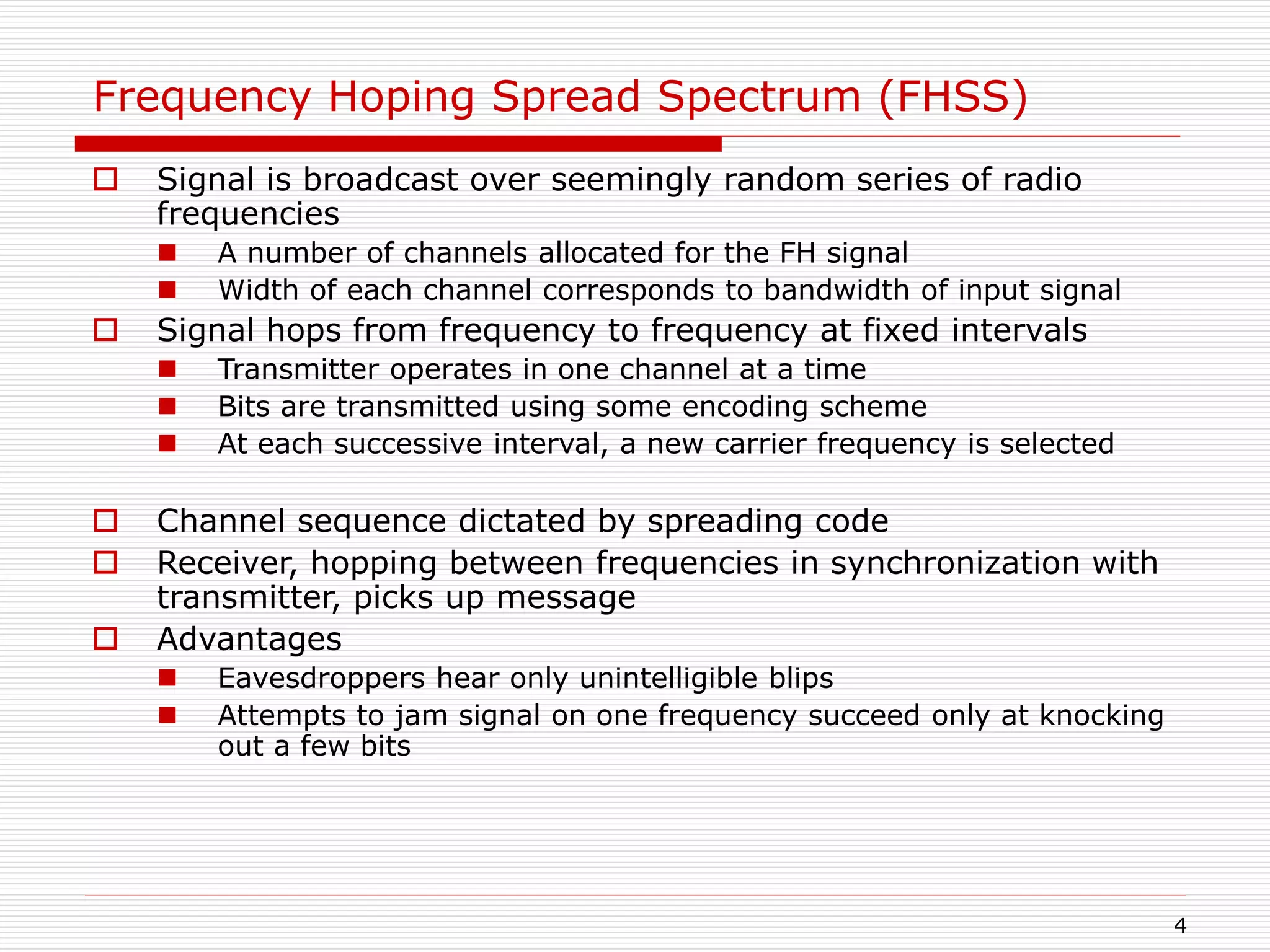
Frequency Hoping Spread Spectrum (FHSS)
 Signal is broadcast over seemingly random series of radio
frequencies
 A number of channels allocated for the FH signal
 Width of each channel corresponds to bandwidth of input signal
 Signal hops from frequency to frequency at fixed intervals
 Transmitter operates in one channel at a time
 Bits are transmitted using some encoding scheme
 At each successive interval, a new carrier frequency is selected
 Channel sequence dictated by spreading code
 Receiver, hopping between frequencies in synchronization with
transmitter, picks up message
 Advantages
 Eavesdroppers hear only unintelligible blips
 Attempts to jam signal on one frequency succeed only at knocking
out a few bits
5
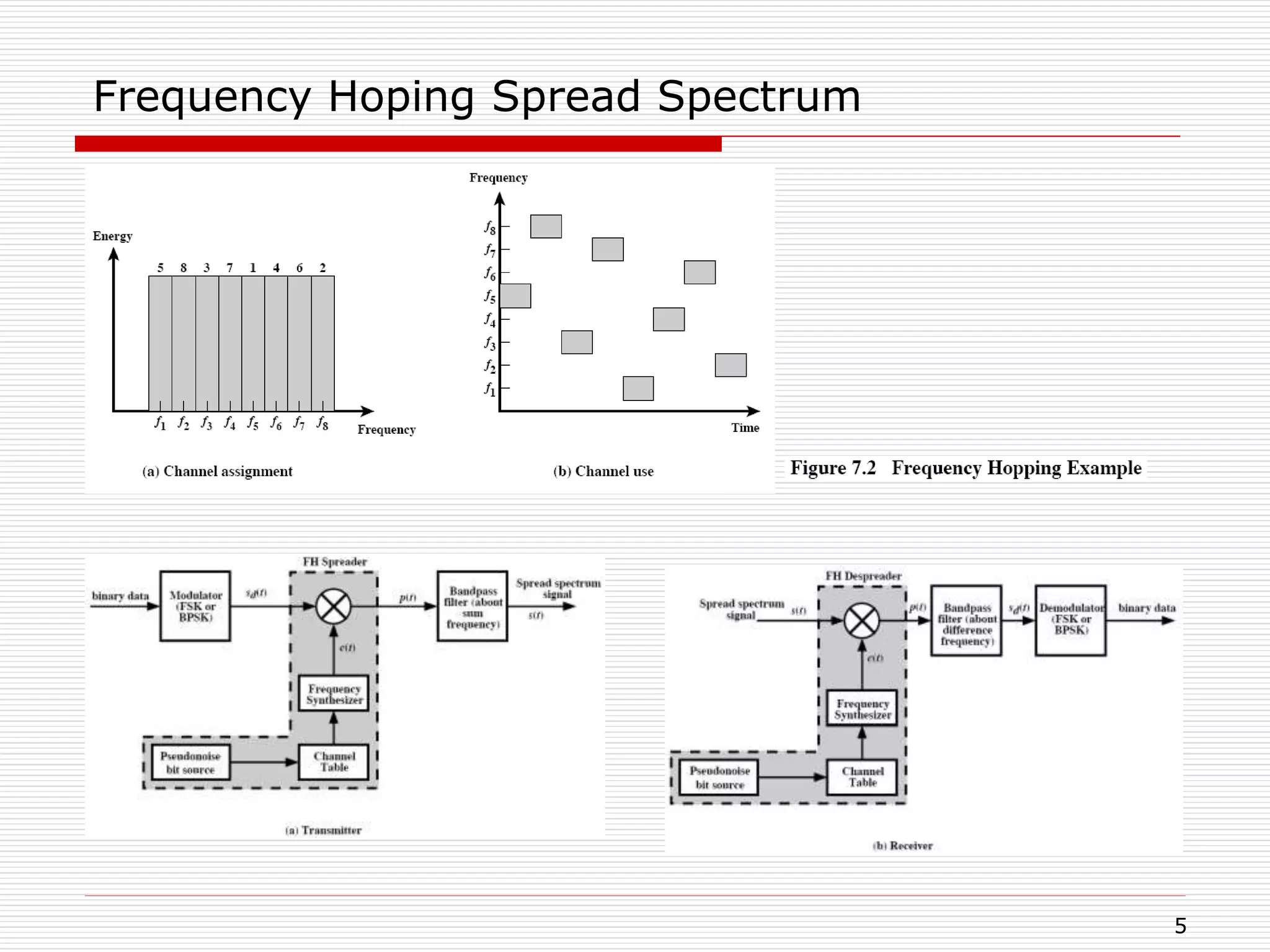
Frequency Hoping Spread Spectrum
6
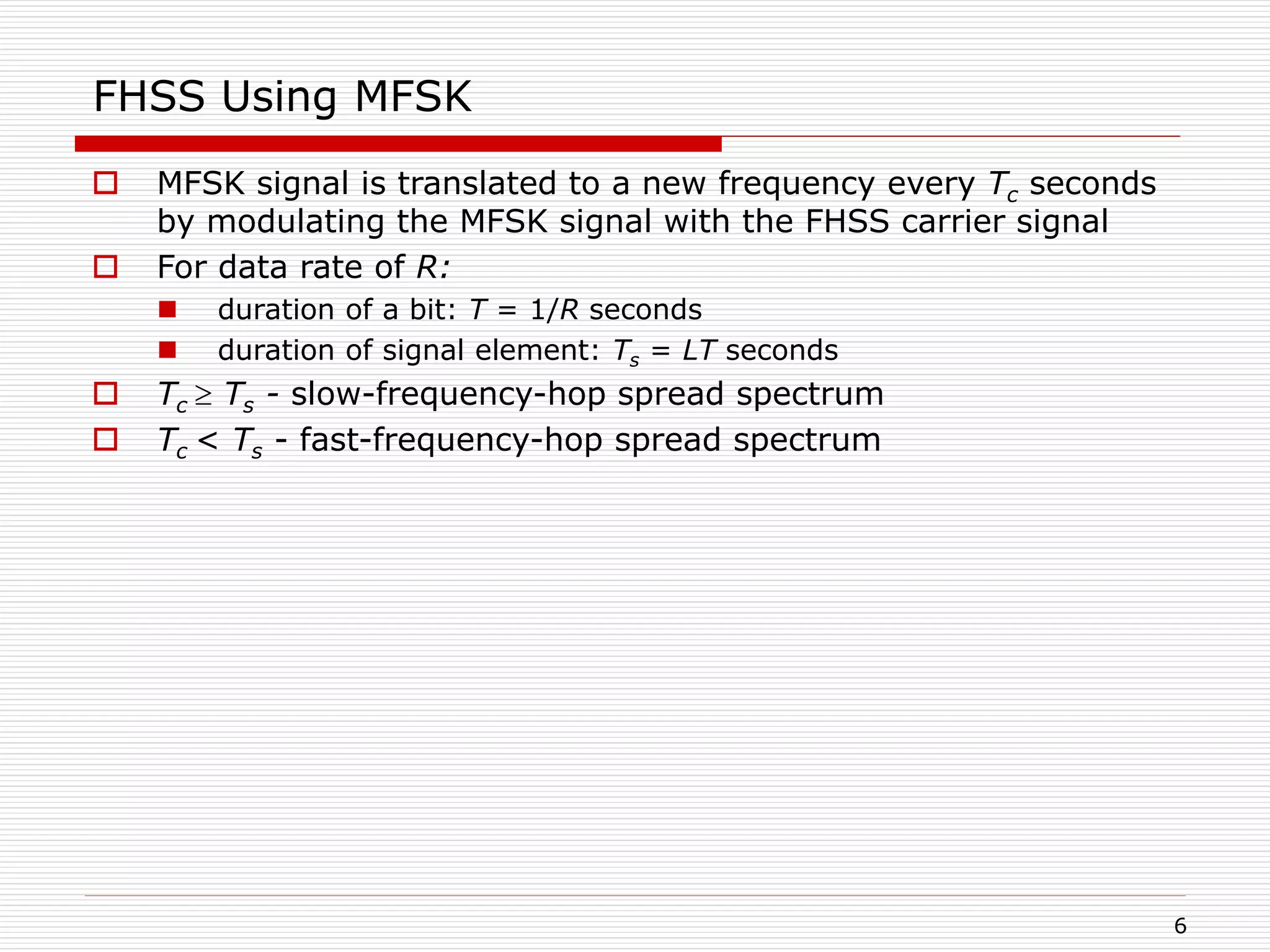
FHSS Using MFSK
 MFSK signal is translated to a new frequency every Tc seconds
by modulating the MFSK signal with the FHSS carrier signal
 For data rate of R:
 duration of a bit: T = 1/R seconds
 duration of signal element: Ts = LT seconds
 Tc  Ts - slow-frequency-hop spread spectrum
 Tc < Ts - fast-frequency-hop spread spectrum
7
FHSS Using MFSK
8
FHSS Performance Considerations
 Large number of frequencies used
 Results in a system that is quite resistant to jamming
 Jammer must jam all frequencies
 With fixed power, this reduces the jamming power in any one
frequency band
9
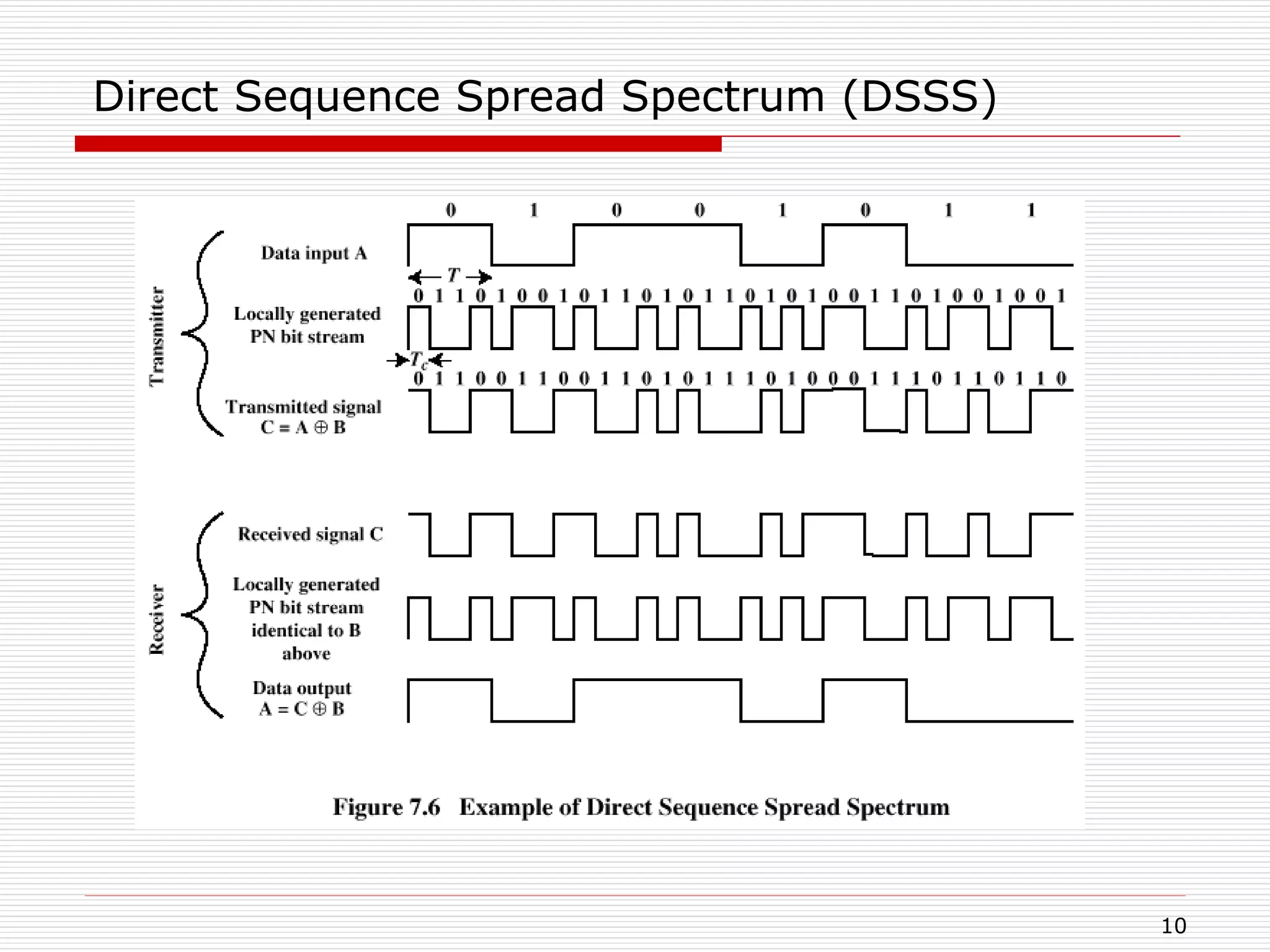
Direct Sequence Spread Spectrum (DSSS)
 Each bit in original signal is represented by multiple bits in the
transmitted signal
 Spreading code spreads signal across a wider frequency band
 Spread is in direct proportion to number of bits used
 One technique combines digital information stream with the
spreading code bit stream using exclusive-OR (Figure 7.6)
10
Direct Sequence Spread Spectrum (DSSS)
11
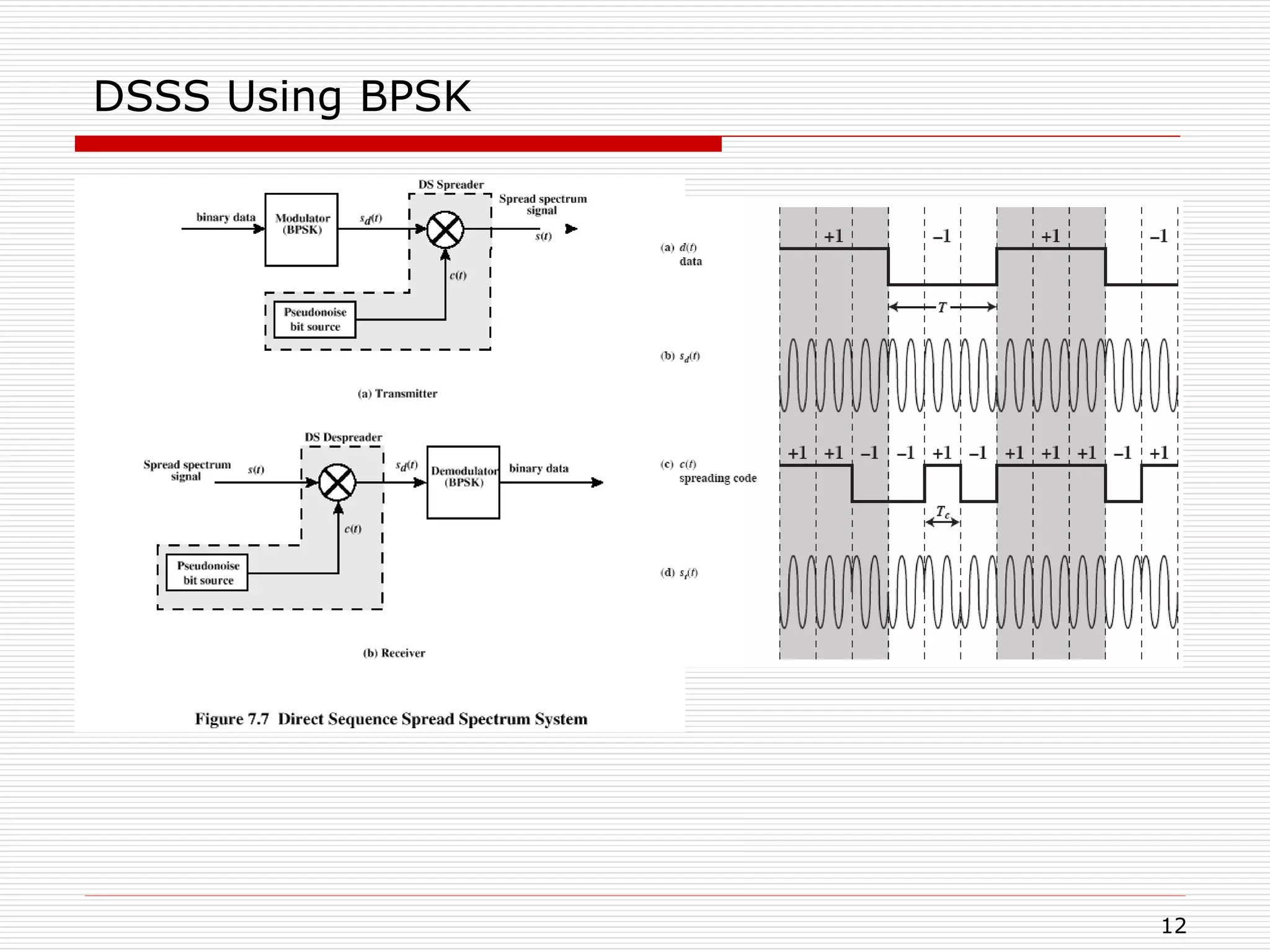
DSSS Using BPSK
 Multiply BPSK signal,
sd(t) = A d(t) cos(2 fct)
by c(t) [takes values +1, -1] to get
s(t) = A d(t)c(t) cos(2 fct)
 A = amplitude of signal
 fc = carrier frequency
 d(t) = discrete function [+1, -1]
 At receiver, incoming signal multiplied by c(t)
 Since, c(t) x c(t) = 1, incoming signal is recovered
s(t) c(t) = A d(t) c(t) c(t) cos(2 fct) = sd(t)
12
DSSS Using BPSK
13
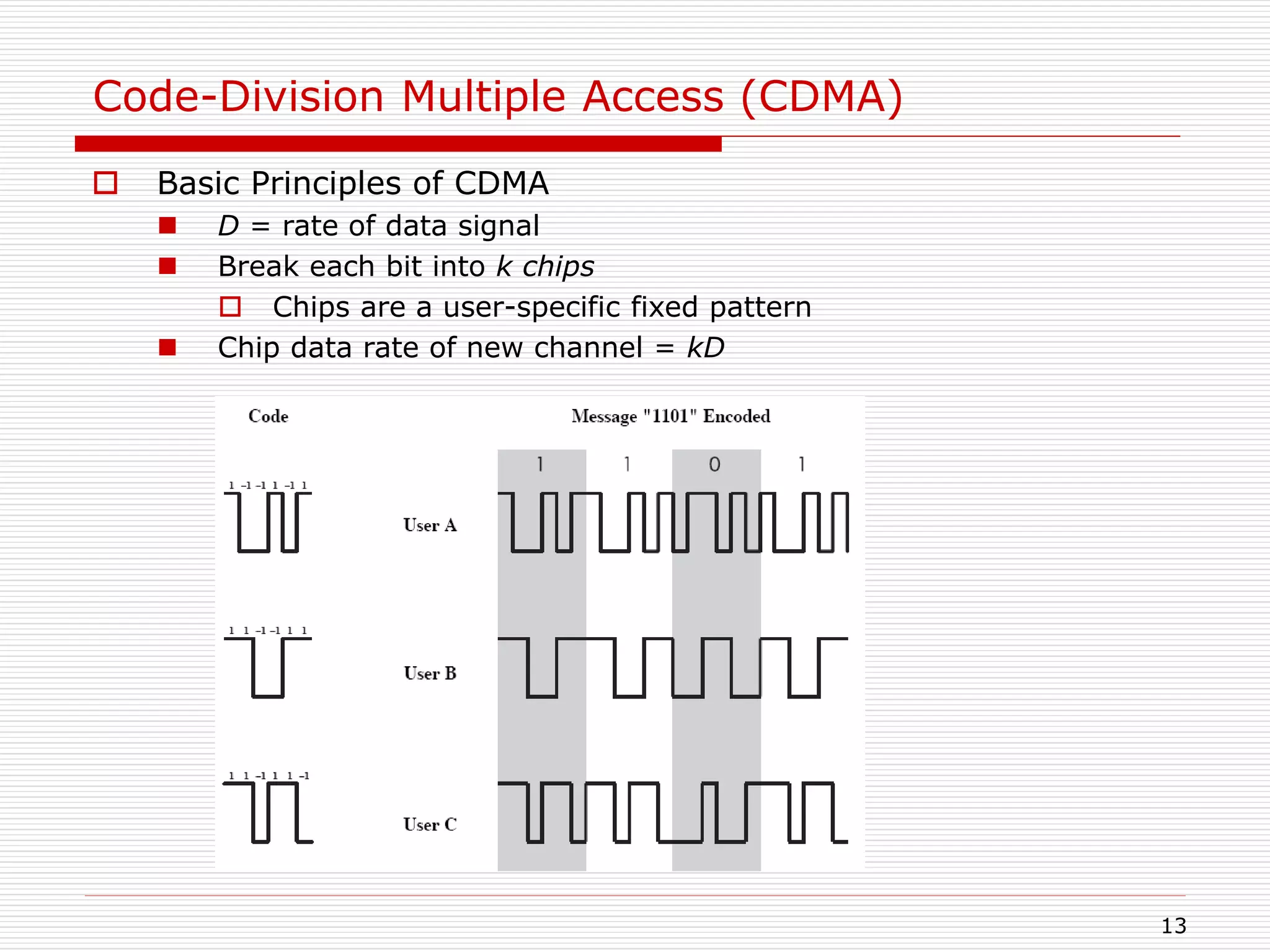
Code-Division Multiple Access (CDMA)
 Basic Principles of CDMA
 D = rate of data signal
 Break each bit into k chips
 Chips are a user-specific fixed pattern
 Chip data rate of new channel = kD
14
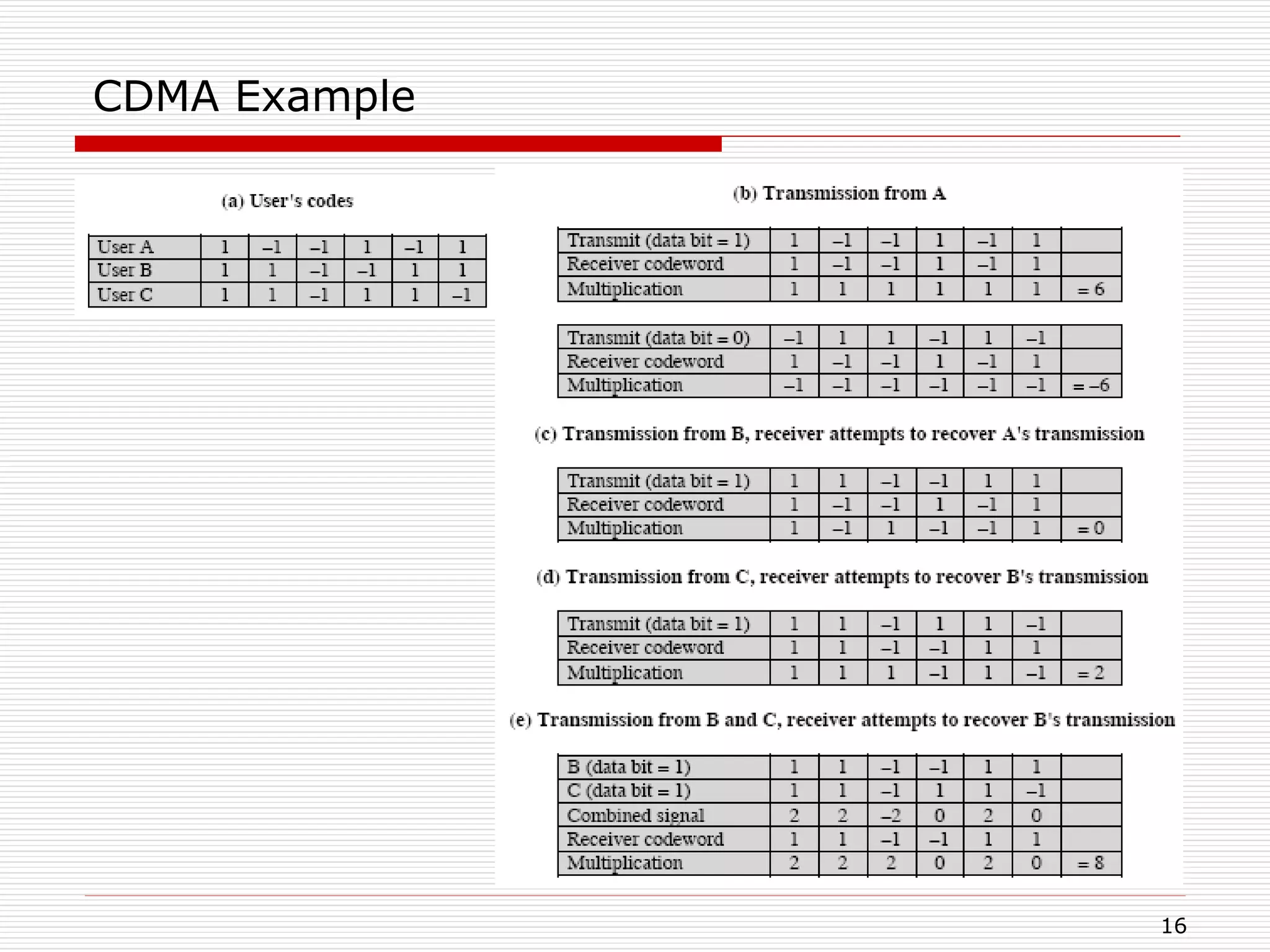
CDMA Example
 If k=6 and code is a sequence of 1s and -1s
 For a ‘1’ bit, A sends code as chip pattern
 <c1, c2, c3, c4, c5, c6>
 For a ‘0’ bit, A sends complement of code
 <-c1, -c2, -c3, -c4, -c5, -c6>
 Receiver knows sender’s code and performs electronic decode
function
 <d1, d2, d3, d4, d5, d6> = received chip pattern
 <c1, c2, c3, c4, c5, c6> = sender’s code
  6
6
5
5
4
4
3
3
2
2
1
1 c
d
c
d
c
d
c
d
c
d
c
d
d
Su 











15
CDMA Example
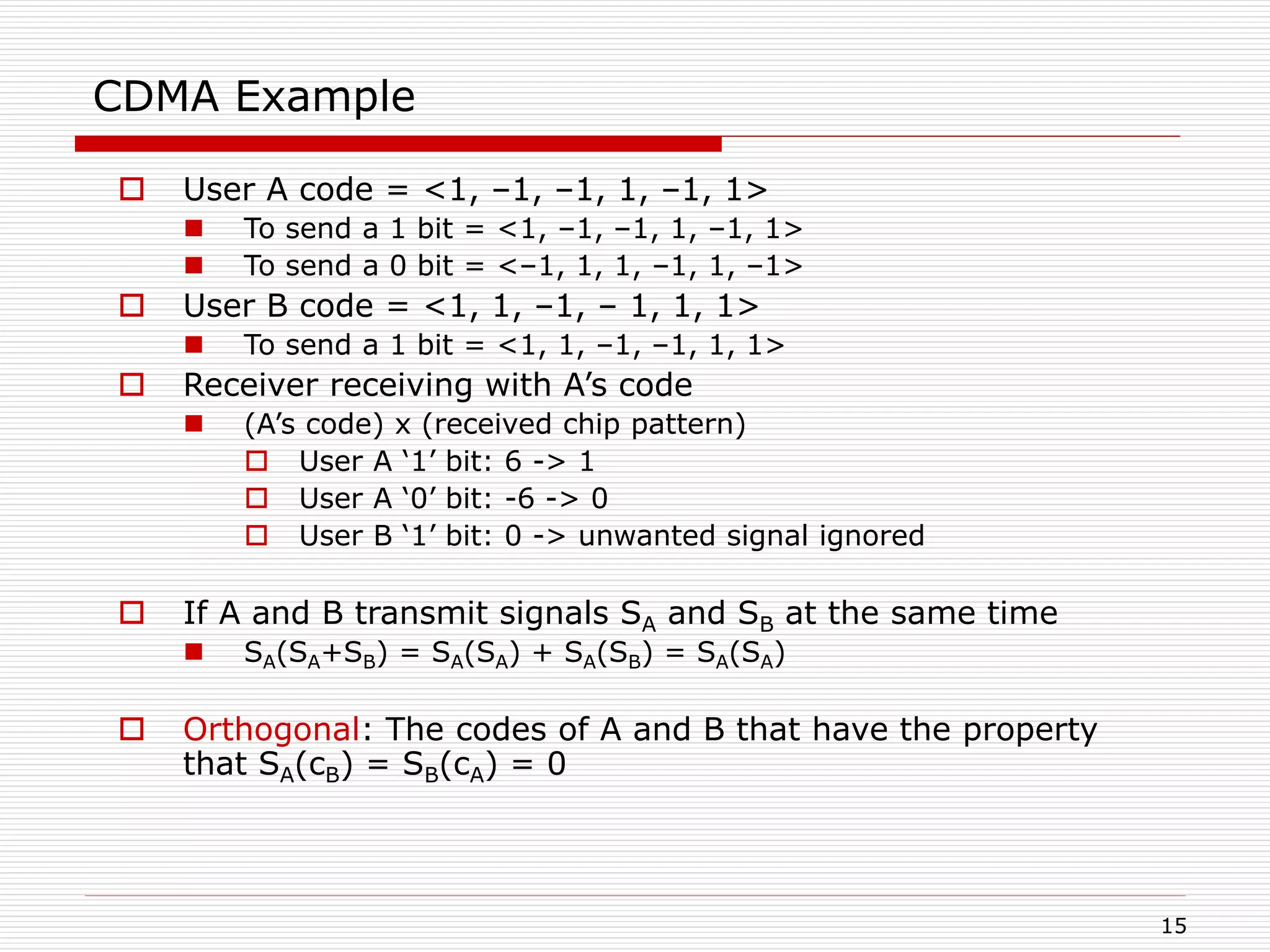
 User A code = <1, –1, –1, 1, –1, 1>
 To send a 1 bit = <1, –1, –1, 1, –1, 1>
 To send a 0 bit = <–1, 1, 1, –1, 1, –1>
 User B code = <1, 1, –1, – 1, 1, 1>
 To send a 1 bit = <1, 1, –1, –1, 1, 1>
 Receiver receiving with A’s code
 (A’s code) x (received chip pattern)
 User A ‘1’ bit: 6 -> 1
 User A ‘0’ bit: -6 -> 0
 User B ‘1’ bit: 0 -> unwanted signal ignored
 If A and B transmit signals SA and SB at the same time
 SA(SA+SB) = SA(SA) + SA(SB) = SA(SA)
 Orthogonal: The codes of A and B that have the property
that SA(cB) = SB(cA) = 0
16
CDMA Example
17
CDMA for Direct Sequence Spread Spectrum
18
Categories of Spreading Sequences
 Spreading Sequence Categories
 PN sequences
 Orthogonal codes
 For FHSS systems
 PN sequences most common
 For DSSS systems not employing CDMA
 PN sequences most common
 For DSSS CDMA systems
 PN sequences
 Orthogonal codes
19
PN Sequences
 PN generator produces periodic sequence that appears to be
random
 PN Sequences
 Generated by an algorithm using initial seed
 Sequence isn’t statistically random but will pass many test of
randomness
 Sequences referred to as pseudorandom numbers or pseudonoise
sequences
 Unless algorithm and seed are known, the sequence is impractical
to predict
20
Important PN Properties
 Randomness
 Uniform distribution
 Balance property
 Run property
 Independence
 Correlation property
 Unpredictability

Spread Spectrum.ppt

  • 1.
    1 Chapter 7. SpreadSpectrum Engr. Farhan Qamar
  • 2.
    2 Spread Spectrum  Inputis fed into a channel encoder  Produces analog signal with narrow bandwidth  Signal is further modulated using sequence of digits  Spreading code or spreading sequence  Generated by pseudonoise, or pseudo-random number generator  Effect of modulation is to increase bandwidth of signal to be transmitted  On receiving end, digit sequence is used to demodulate the spread spectrum signal  Signal is fed into a channel decoder to recover data
  • 3.
    3 Spread Spectrum  Whatcan be gained from apparent waste of spectrum?  Immunity from various kinds of noise and multipath distortion  Can be used for hiding and encrypting signals  Several users can independently use the same higher bandwidth with very little interference
  • 4.
    4 Frequency Hoping SpreadSpectrum (FHSS)  Signal is broadcast over seemingly random series of radio frequencies  A number of channels allocated for the FH signal  Width of each channel corresponds to bandwidth of input signal  Signal hops from frequency to frequency at fixed intervals  Transmitter operates in one channel at a time  Bits are transmitted using some encoding scheme  At each successive interval, a new carrier frequency is selected  Channel sequence dictated by spreading code  Receiver, hopping between frequencies in synchronization with transmitter, picks up message  Advantages  Eavesdroppers hear only unintelligible blips  Attempts to jam signal on one frequency succeed only at knocking out a few bits
  • 5.
  • 6.
    6 FHSS Using MFSK MFSK signal is translated to a new frequency every Tc seconds by modulating the MFSK signal with the FHSS carrier signal  For data rate of R:  duration of a bit: T = 1/R seconds  duration of signal element: Ts = LT seconds  Tc  Ts - slow-frequency-hop spread spectrum  Tc < Ts - fast-frequency-hop spread spectrum
  • 7.
  • 8.
    8 FHSS Performance Considerations Large number of frequencies used  Results in a system that is quite resistant to jamming  Jammer must jam all frequencies  With fixed power, this reduces the jamming power in any one frequency band
  • 9.
    9 Direct Sequence SpreadSpectrum (DSSS)  Each bit in original signal is represented by multiple bits in the transmitted signal  Spreading code spreads signal across a wider frequency band  Spread is in direct proportion to number of bits used  One technique combines digital information stream with the spreading code bit stream using exclusive-OR (Figure 7.6)
  • 10.
  • 11.
    11 DSSS Using BPSK Multiply BPSK signal, sd(t) = A d(t) cos(2 fct) by c(t) [takes values +1, -1] to get s(t) = A d(t)c(t) cos(2 fct)  A = amplitude of signal  fc = carrier frequency  d(t) = discrete function [+1, -1]  At receiver, incoming signal multiplied by c(t)  Since, c(t) x c(t) = 1, incoming signal is recovered s(t) c(t) = A d(t) c(t) c(t) cos(2 fct) = sd(t)
  • 12.
  • 13.
    13 Code-Division Multiple Access(CDMA)  Basic Principles of CDMA  D = rate of data signal  Break each bit into k chips  Chips are a user-specific fixed pattern  Chip data rate of new channel = kD
  • 14.
    14 CDMA Example  Ifk=6 and code is a sequence of 1s and -1s  For a ‘1’ bit, A sends code as chip pattern  <c1, c2, c3, c4, c5, c6>  For a ‘0’ bit, A sends complement of code  <-c1, -c2, -c3, -c4, -c5, -c6>  Receiver knows sender’s code and performs electronic decode function  <d1, d2, d3, d4, d5, d6> = received chip pattern  <c1, c2, c3, c4, c5, c6> = sender’s code   6 6 5 5 4 4 3 3 2 2 1 1 c d c d c d c d c d c d d Su            
  • 15.
    15 CDMA Example  UserA code = <1, –1, –1, 1, –1, 1>  To send a 1 bit = <1, –1, –1, 1, –1, 1>  To send a 0 bit = <–1, 1, 1, –1, 1, –1>  User B code = <1, 1, –1, – 1, 1, 1>  To send a 1 bit = <1, 1, –1, –1, 1, 1>  Receiver receiving with A’s code  (A’s code) x (received chip pattern)  User A ‘1’ bit: 6 -> 1  User A ‘0’ bit: -6 -> 0  User B ‘1’ bit: 0 -> unwanted signal ignored  If A and B transmit signals SA and SB at the same time  SA(SA+SB) = SA(SA) + SA(SB) = SA(SA)  Orthogonal: The codes of A and B that have the property that SA(cB) = SB(cA) = 0
  • 16.
  • 17.
    17 CDMA for DirectSequence Spread Spectrum
  • 18.
    18 Categories of SpreadingSequences  Spreading Sequence Categories  PN sequences  Orthogonal codes  For FHSS systems  PN sequences most common  For DSSS systems not employing CDMA  PN sequences most common  For DSSS CDMA systems  PN sequences  Orthogonal codes
  • 19.
    19 PN Sequences  PNgenerator produces periodic sequence that appears to be random  PN Sequences  Generated by an algorithm using initial seed  Sequence isn’t statistically random but will pass many test of randomness  Sequences referred to as pseudorandom numbers or pseudonoise sequences  Unless algorithm and seed are known, the sequence is impractical to predict
  • 20.
    20 Important PN Properties Randomness  Uniform distribution  Balance property  Run property  Independence  Correlation property  Unpredictability