Spotlight on iPSC Reprogramming
Creative Bioarray
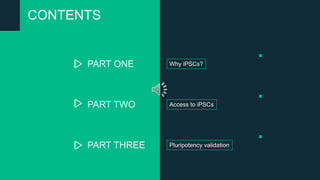
PART ONE Why iPSCs?
PART TWO Access to iPSCs
PART THREE Pluripotency validation
CONTENTS
1 PART ONE
Why iPSCs?
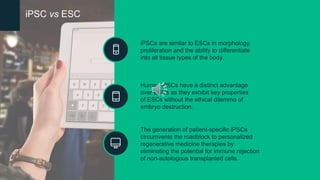
iPSC vs ESC
iPSCs are similar to ESCs in morphology,
proliferation and the ability to differentiate
into all tissue types of the body.
Human iPSCs have a distinct advantage
over ESCs as they exhibit key properties
of ESCs without the ethical dilemma of
embryo destruction.
The generation of patient-specific iPSCs
circumvents the roadblock to personalized
regenerative medicine therapies by
eliminating the potential for immune rejection
of non-autologous transplanted cells.
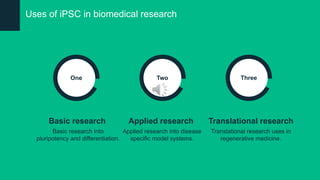
Uses of iPSC in biomedical research
Basic research into
pluripotency and differentiation.
Basic research
Applied research into disease
specific model systems.
Applied research
Translational research uses in
regenerative medicine.
Translational research
One Two Three
2 PART TWO
Access to iPSCs
Yamanaka Factors
Oct4, Sox2, KLF4, c-MYC
Thomson Factors
Oct4, Sox2, Nanog, Lin28
Choice of reprogramming factors
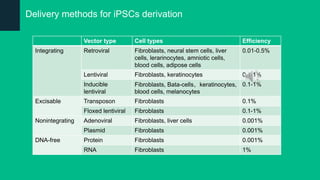
Delivery methods for iPSCs derivation
Vector type Cell types Efficiency
Integrating Retroviral Fibroblasts, neural stem cells, liver
cells, lerarinocytes, amniotic cells,
blood cells, adipose cells
0.01-0.5%
Lentiviral Fibroblasts, keratinocytes 0.1-1%
Inducible
lentiviral
Fibroblasts, Bata-cells,keratinocytes,
blood cells, melanocytes
0.1-1%
Excisable Transposon Fibroblasts 0.1%
Floxed lentiviral Fibroblasts 0.1-1%
Nonintegrating Adenoviral Fibroblasts, liver cells 0.001%
Plasmid Fibroblasts 0.001%
DNA-free Protein Fibroblasts 0.001%
RNA Fibroblasts 1%
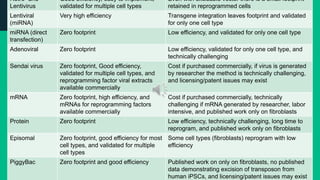
Pros and Cons of various delivery methods
Retro- and
Lentivirus
Good efficiency, easy to implement,
validated for multiple cell types
Even with excisable vector there is a small footprint
retained in reprogrammed cells
Lentiviral
(miRNA)
Very high efficiency Transgene integration leaves footprint and validated
for only one cell type
miRNA (direct
transfection)
Zero footprint Low efficiency, and validated for only one cell type
Adenoviral Zero footprint Low efficiency, validated for only one cell type, and
technically challenging
Sendai virus Zero footprint, Good efficiency,
validated for multiple cell types, and
reprogramming factor viral extracts
available commercially
Cost if purchased commercially, if virus is generated
by researcher the method is technically challenging,
and licensing/patent issues may exist
mRNA Zero footprint, high efficiency, and
mRNAs for reprogramming factors
available commercially
Cost if purchased commercially, technically
challenging if mRNA generated by researcher, labor
intensive, and published work only on fibroblasts
Protein Zero footprint Low efficiency, technically challenging, long time to
reprogram, and published work only on fibroblasts
Episomal Zero footprint, good efficiency for most
cell types, and validated for multiple
cell types
Some cell types (fibroblasts) reprogram with low
efficiency
PiggyBac Zero footprint and good efficiency Published work on only on fibroblasts, no published
data demonstrating excision of transposon from
human iPSCs, and licensing/patent issues may exist
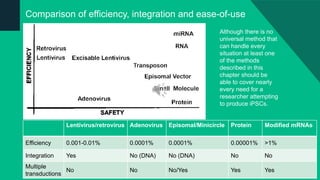
Comparison of efficiency, integration and ease-of-use
Lentivirus/retrovirus Adenovirus Episomal/Minicircle Protein Modified mRNAs
Efficiency 0.001-0.01% 0.0001% 0.0001% 0.00001% >1%
Integration Yes No (DNA) No (DNA) No No
Multiple
transductions
No No No/Yes Yes Yes
Although there is no
universal method that
can handle every
situation at least one
of the methods
described in this
chapter should be
able to cover nearly
every need for a
researcher attempting
to produce iPSCs.
3 PART THREE
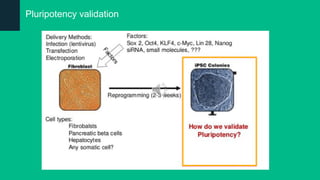
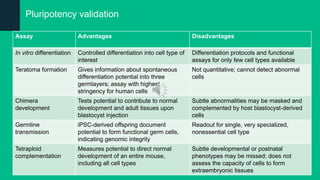
Pluripotency validation
Assay Advantages Disadvantages
In vitro differentiation Controlled differentiation into cell type of
interest
Differentiation protocols and functional
assays for only few cell types available
Teratoma formation Gives information about spontaneous
differentiation potential into three
germlayers; assay with highest
stringency for human cells
Not quantitative; cannot detect abnormal
cells
Chimera
development
Tests potential to contribute to normal
development and adult tissues upon
blastocyst injection
Subtle abnormalities may be masked and
complemented by host blastocyst-derived
cells
Germline
transmission
iPSC-derived offspring document
potential to form functional germ cells,
indicating genomic integrity
Readout for single, very specialized,
nonessential cell type
Tetraploid
complementation
Measures potential to direct normal
development of an entire mouse,
including all cell types
Subtle developmental or postnatal
phenotypes may be missed; does not
assess the capacity of cells to form
extraembryonic tissues
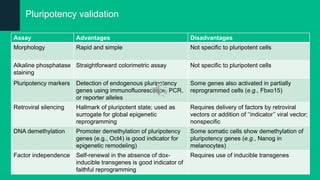
Pluripotency validation
Assay Advantages Disadvantages
Morphology Rapid and simple Not specific to pluripotent cells
Alkaline phosphatase
staining
Straightforward colorimetric assay Not specific to pluripotent cells
Pluripotency markers Detection of endogenous pluripotency
genes using immunofluorescence, PCR,
or reporter alleles
Some genes also activated in partially
reprogrammed cells (e.g., Fbxo15)
Retroviral silencing Hallmark of pluripotent state; used as
surrogate for global epigenetic
reprogramming
Requires delivery of factors by retroviral
vectors or addition of ‘‘indicator’’ viral vector;
nonspecific
DNA demethylation Promoter demethylation of pluripotency
genes (e.g., Oct4) is good indicator for
epigenetic remodeling)
Some somatic cells show demethylation of
pluripotency genes (e.g., Nanog in
melanocytes)
Factor independence Self-renewal in the absence of dox-
inducible transgenes is good indicator of
faithful reprogramming
Requires use of inducible transgenes
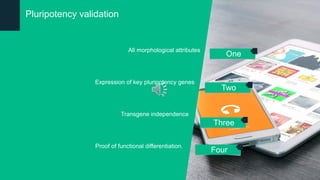
One
All morphological attributes
Two
Expression of key pluripotency genes
Three
Transgene independence
Four
Proof of functional differentiation.
Pluripotency validation
Prospects and challenges
A B
iPSCs have given us the ability to look at disease in a
very meaningful way, in large part because we can study
the disease on an individual level, in the context of the
patient's unique genetic makeup. This personalized look
at disease is incredibly powerful and will certainly inform
the development of new and exciting treatments in the
future.
Although many stem cell researchers dream of iPSCs
being used to treat disease directly, the clinical utility of
iPSCs, for the moment, is not as exciting as their role in
research and their usefulness in modeling disease.
www.creative-bioarray.com

Spotlight on ipsc reprogramming

  • 1.
    Spotlight on iPSCReprogramming Creative Bioarray
  • 2.
    PART ONE WhyiPSCs? PART TWO Access to iPSCs PART THREE Pluripotency validation CONTENTS
  • 3.
  • 4.
    iPSC vs ESC iPSCsare similar to ESCs in morphology, proliferation and the ability to differentiate into all tissue types of the body. Human iPSCs have a distinct advantage over ESCs as they exhibit key properties of ESCs without the ethical dilemma of embryo destruction. The generation of patient-specific iPSCs circumvents the roadblock to personalized regenerative medicine therapies by eliminating the potential for immune rejection of non-autologous transplanted cells.
  • 5.
    Uses of iPSCin biomedical research Basic research into pluripotency and differentiation. Basic research Applied research into disease specific model systems. Applied research Translational research uses in regenerative medicine. Translational research One Two Three
  • 6.
  • 7.
    Yamanaka Factors Oct4, Sox2,KLF4, c-MYC Thomson Factors Oct4, Sox2, Nanog, Lin28 Choice of reprogramming factors
  • 8.
    Delivery methods foriPSCs derivation Vector type Cell types Efficiency Integrating Retroviral Fibroblasts, neural stem cells, liver cells, lerarinocytes, amniotic cells, blood cells, adipose cells 0.01-0.5% Lentiviral Fibroblasts, keratinocytes 0.1-1% Inducible lentiviral Fibroblasts, Bata-cells,keratinocytes, blood cells, melanocytes 0.1-1% Excisable Transposon Fibroblasts 0.1% Floxed lentiviral Fibroblasts 0.1-1% Nonintegrating Adenoviral Fibroblasts, liver cells 0.001% Plasmid Fibroblasts 0.001% DNA-free Protein Fibroblasts 0.001% RNA Fibroblasts 1%
  • 9.
    Pros and Consof various delivery methods Retro- and Lentivirus Good efficiency, easy to implement, validated for multiple cell types Even with excisable vector there is a small footprint retained in reprogrammed cells Lentiviral (miRNA) Very high efficiency Transgene integration leaves footprint and validated for only one cell type miRNA (direct transfection) Zero footprint Low efficiency, and validated for only one cell type Adenoviral Zero footprint Low efficiency, validated for only one cell type, and technically challenging Sendai virus Zero footprint, Good efficiency, validated for multiple cell types, and reprogramming factor viral extracts available commercially Cost if purchased commercially, if virus is generated by researcher the method is technically challenging, and licensing/patent issues may exist mRNA Zero footprint, high efficiency, and mRNAs for reprogramming factors available commercially Cost if purchased commercially, technically challenging if mRNA generated by researcher, labor intensive, and published work only on fibroblasts Protein Zero footprint Low efficiency, technically challenging, long time to reprogram, and published work only on fibroblasts Episomal Zero footprint, good efficiency for most cell types, and validated for multiple cell types Some cell types (fibroblasts) reprogram with low efficiency PiggyBac Zero footprint and good efficiency Published work on only on fibroblasts, no published data demonstrating excision of transposon from human iPSCs, and licensing/patent issues may exist
  • 10.
    Comparison of efficiency,integration and ease-of-use Lentivirus/retrovirus Adenovirus Episomal/Minicircle Protein Modified mRNAs Efficiency 0.001-0.01% 0.0001% 0.0001% 0.00001% >1% Integration Yes No (DNA) No (DNA) No No Multiple transductions No No No/Yes Yes Yes Although there is no universal method that can handle every situation at least one of the methods described in this chapter should be able to cover nearly every need for a researcher attempting to produce iPSCs.
  • 11.
  • 12.
  • 13.
    Pluripotency validation Assay AdvantagesDisadvantages In vitro differentiation Controlled differentiation into cell type of interest Differentiation protocols and functional assays for only few cell types available Teratoma formation Gives information about spontaneous differentiation potential into three germlayers; assay with highest stringency for human cells Not quantitative; cannot detect abnormal cells Chimera development Tests potential to contribute to normal development and adult tissues upon blastocyst injection Subtle abnormalities may be masked and complemented by host blastocyst-derived cells Germline transmission iPSC-derived offspring document potential to form functional germ cells, indicating genomic integrity Readout for single, very specialized, nonessential cell type Tetraploid complementation Measures potential to direct normal development of an entire mouse, including all cell types Subtle developmental or postnatal phenotypes may be missed; does not assess the capacity of cells to form extraembryonic tissues
  • 14.
    Pluripotency validation Assay AdvantagesDisadvantages Morphology Rapid and simple Not specific to pluripotent cells Alkaline phosphatase staining Straightforward colorimetric assay Not specific to pluripotent cells Pluripotency markers Detection of endogenous pluripotency genes using immunofluorescence, PCR, or reporter alleles Some genes also activated in partially reprogrammed cells (e.g., Fbxo15) Retroviral silencing Hallmark of pluripotent state; used as surrogate for global epigenetic reprogramming Requires delivery of factors by retroviral vectors or addition of ‘‘indicator’’ viral vector; nonspecific DNA demethylation Promoter demethylation of pluripotency genes (e.g., Oct4) is good indicator for epigenetic remodeling) Some somatic cells show demethylation of pluripotency genes (e.g., Nanog in melanocytes) Factor independence Self-renewal in the absence of dox- inducible transgenes is good indicator of faithful reprogramming Requires use of inducible transgenes
  • 15.
    One All morphological attributes Two Expressionof key pluripotency genes Three Transgene independence Four Proof of functional differentiation. Pluripotency validation
  • 16.
    Prospects and challenges AB iPSCs have given us the ability to look at disease in a very meaningful way, in large part because we can study the disease on an individual level, in the context of the patient's unique genetic makeup. This personalized look at disease is incredibly powerful and will certainly inform the development of new and exciting treatments in the future. Although many stem cell researchers dream of iPSCs being used to treat disease directly, the clinical utility of iPSCs, for the moment, is not as exciting as their role in research and their usefulness in modeling disease.
  • 17.