GUIDED BY-
“DR.ANN SANDHYA MICHEAL”
FACULTY
DEPARTMENT OF LIFE SCIENCE
BANGALORE UNIVERSITY
PRESENTED BY-
SUSHMITA SINGH
4th SEMESTER
DEPARTMENT OF LIFE SCIENCE
BANGALORE UNIVERSITY
REPROGRAMMING FRONTIERS-INDUCED PLURIPOTENT STEM
CELLS
INDEX
INTRODUCTION
TYPES
IPSCS
REPROGRAMMING GENES
APPLICATION
CONCLUSION
REFERENCES
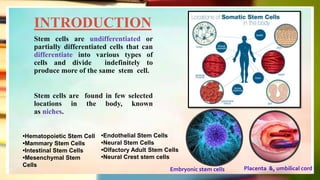
INTRODUCTION
Stem cells are undifferentiated or
partially differentiated cells that can
differentiate into various types of
cells and divide indefinitely to
produce more of the same stem cell.
Stem cells are found in few selected
locations in the body, known
as niches.
Placenta &, umbilical cordEmbryonic stem cells
•Hematopoietic Stem Cell
•Mammary Stem Cells
•Intestinal Stem Cells
•Mesenchymal Stem
Cells
•Endothelial Stem Cells
•Neural Stem Cells
•Olfactory Adult Stem Cells
•Neural Crest stem cells
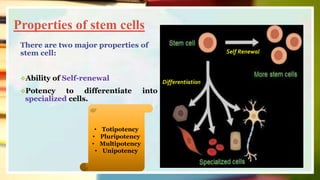
Properties of stem cells
Differentiation
Self Renewal
There are two major properties of
stem cell:
Ability of Self-renewal
Potency to differentiate into
specialized cells.
• Totipotency
• Pluripotency
• Multipotency
• Unipotency
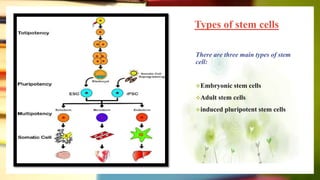
Types of stem cells
There are three main types of stem
cell:
Embryonic stem cells
Adult stem cells
induced pluripotent stem cells
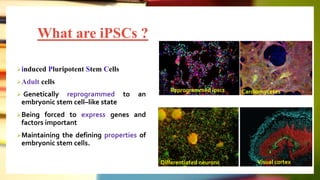
What are iPSCs ?
induced Pluripotent Stem Cells
Adult cells
 Genetically reprogrammed to an
embryonic stem cell–like state
Being forced to express genes and
factors important
Maintaining the defining properties of
embryonic stem cells.
Cardiomycetes
Differentiated neurons Visual cortex
Reprogrammed ipscs
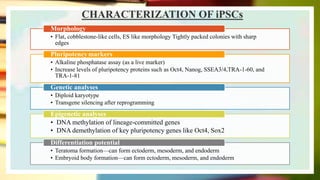
• Flat, cobblestone-like cells, ES like morphology Tightly packed colonies with sharp
edges
Morphology
• Alkaline phosphatase assay (as a live marker)
• Increase levels of pluripotency proteins such as Oct4, Nanog, SSEA3/4,TRA-1-60, and
TRA-1-81
Pluripotencymarkers
• Diploid karyotype
• Transgene silencing after reprogramming
Genetic analyses
• DNA methylation of lineage-committed genes
• DNA demethylation of key pluripotency genes like Oct4, Sox2
Epigenetic analyses
• Teratoma formation—can form ectoderm, mesoderm, and endoderm
• Embryoid body formation—can form ectoderm, mesoderm, and endoderm
Differentiation potential
CHARACTERIZATION OF iPSCs
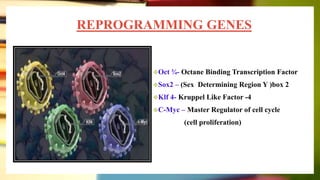
REPROGRAMMING GENES
Oct ¾- Octane Binding Transcription Factor
Sox2 – (Sex Determining Region Y )box 2
Klf 4- Kruppel Like Factor -4
C-Myc – Master Regulator of cell cycle
(cell proliferation)
FUNCTION OF REPROGRAMMING
GENES
Oct ¾ -
• Involve in the maintenance of self renewal of pluripotent cells
• Repression in ES cells leads to formation of trophoectoderm
• Over expression leads to formation of various lineages including primitive
ectoderm
SOX-2 -
• Essential for embryonic development
• Down regulation by si RNA silencing leads to differentiation of cells
Klf 4 -
• It repress p53 (regulatory genes) directly.
• Contributes to activation of Nanog and other ES specific genes.
• Act as inhibitors of C-Myc induces through p53.
Nanog -
• Acts as necessary for promoting pluripotency.
Lin 28 -
• An mRNA Binding protein expressed in embryonic stem cells and
embryonic carcinoma stem cells (proliferation and differentiation).
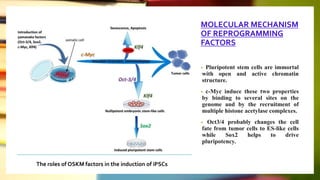
MOLECULAR MECHANISM
OF REPROGRAMMING
FACTORS
• Pluripotent stem cells are immortal
with open and active chromatin
structure.
• c-Myc induce these two properties
by binding to several sites on the
genome and by the recruitment of
multiple histone acetylase complexes.
• Oct3/4 probably changes the cell
fate from tumor cells to ES-like cells
while Sox2 helps to drive
pluripotency.
The roles of OSKM factors in the induction of iPSCs
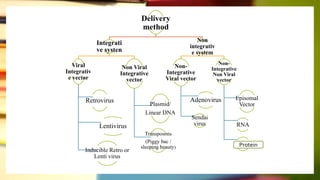
Delivery
method
Integrati
ve systen
Viral
Integrativ
e vector
Retrovirus
Lentivirus
Inducible Retro or
Lenti virus
Non Viral
Integrative
vector
Plasmid/
Linear DNA
Transposons
(Piggy bac /
sleeping beauty)
Non
integrativ
e system
Non-
Integrative
Viral vector
Adenovirus
Sendai
virus
Non-
Integrative
Non Viral
vector
Episomal
Vector
RNA
ProtineProtein
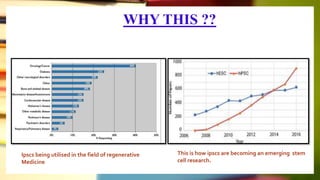
WHY THIS ??
This is how ipscs are becoming an emerging stem
cell research.
Ipscs being utilised in the field of regenerative
Medicine
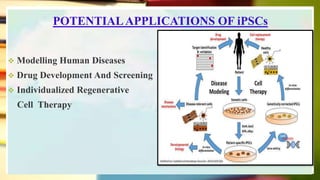
POTENTIALAPPLICATIONS OF iPSCs
 Modelling Human Diseases
 Drug Development And Screening
 Individualized Regenerative
Cell Therapy
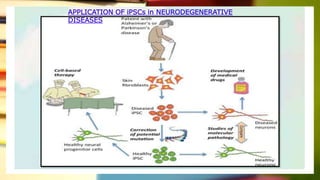
APPLICATION OF iPSCs in NEURODEGENERATIVE
DISEASES
ADVANTAGES
• Eliminates ethical issues and religious concerns
associated with ESCs use
• Risk of immune rejection is reduced.
• Donor cells is easily obtained,no embryo
destruction.
• Accessible to large number of patients, unlike ESCs
limited by ethical concerns.
• Personalization of treatment with patient-specific
stem cells and drugs.
• Allows for gene targeting and gene editing
technology to correct mutations.
LIMITATIONS
• Efficiency of reprogramming is
generally low.
• Tumorogenesis.
• Risk of insertional mutagenesis from
viruse based delivery methods.
• Increase chances of development of
diseases due to factors used .
• Use for disease modelling-they carry
the same disease-causing factor as the
patient Complex and polygenic
diseases are difficult to be modeled
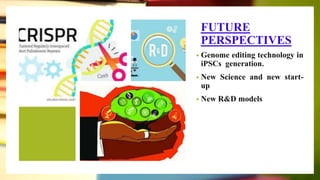
FUTURE
PERSPECTIVES
• Genome editing technology in
iPSCs generation.
• New Science and new start-
up
• New R&D models
CONCLUSION
• The last decade has witnessed remarkable
advancement in our understanding of the
molecular mechanisms of induced pluripotency.
• The remaining barriers blocking the path to
successful translation of this technology into
clinical therapy have to be overcome.
• We believe many of these challenges are only
technical and with time “this too shall pass away.”
AoiT,Yae K, Nakagawa M, IchisakaT, Okita K,Takahashi K, ChibaT,Yamanaka
S. 2008.
Generation of pluripotent stem cells from adult mouse liver and stomach cells.
Science
321(5889):699–702 DOI 10.1126/science.1154884.
Avilion AA, Nicolis SK, Pevny LH, Perez L,Vivian N
REFERENCES
AoiT,Yae K, Nakagawa M, IchisakaT, Okita K,Takahashi K, ChibaT,Yamanaka S. 2008.
Generation of pluripotent stem cells from adult mouse liver and stomach cells. Science
321(5889):699–702
Cong L, Ran FA, Cox D, Lin S, Barretto R, Habib N, Hsu PD, Wu X, Jiang W, Marraffini LA,
Zhang F. 2013. Multiplex genomic engineering using CRISPR-Cas systems. Science
339(6121):819–823
Nicaise, A. M. et al. Cellular senescence in progenitor cells contributes to diminished remyelination
potential in progressive multiple sclerosis. Proc. Natl Acad. Sci.
USAhttps://doi.org/10.1073/pnas.1818348116 (2019)
https://www.ucsf.edu/news/2016/09/404271/induced-pluripotent-stem-cells-10-
years-after-breakthrough
RF-ipscs

RF-ipscs

  • 1.
    GUIDED BY- “DR.ANN SANDHYAMICHEAL” FACULTY DEPARTMENT OF LIFE SCIENCE BANGALORE UNIVERSITY PRESENTED BY- SUSHMITA SINGH 4th SEMESTER DEPARTMENT OF LIFE SCIENCE BANGALORE UNIVERSITY REPROGRAMMING FRONTIERS-INDUCED PLURIPOTENT STEM CELLS
  • 2.
  • 3.
    INTRODUCTION Stem cells areundifferentiated or partially differentiated cells that can differentiate into various types of cells and divide indefinitely to produce more of the same stem cell. Stem cells are found in few selected locations in the body, known as niches. Placenta &, umbilical cordEmbryonic stem cells •Hematopoietic Stem Cell •Mammary Stem Cells •Intestinal Stem Cells •Mesenchymal Stem Cells •Endothelial Stem Cells •Neural Stem Cells •Olfactory Adult Stem Cells •Neural Crest stem cells
  • 4.
    Properties of stemcells Differentiation Self Renewal There are two major properties of stem cell: Ability of Self-renewal Potency to differentiate into specialized cells. • Totipotency • Pluripotency • Multipotency • Unipotency
  • 5.
    Types of stemcells There are three main types of stem cell: Embryonic stem cells Adult stem cells induced pluripotent stem cells
  • 6.
    What are iPSCs? induced Pluripotent Stem Cells Adult cells  Genetically reprogrammed to an embryonic stem cell–like state Being forced to express genes and factors important Maintaining the defining properties of embryonic stem cells. Cardiomycetes Differentiated neurons Visual cortex Reprogrammed ipscs
  • 7.
    • Flat, cobblestone-likecells, ES like morphology Tightly packed colonies with sharp edges Morphology • Alkaline phosphatase assay (as a live marker) • Increase levels of pluripotency proteins such as Oct4, Nanog, SSEA3/4,TRA-1-60, and TRA-1-81 Pluripotencymarkers • Diploid karyotype • Transgene silencing after reprogramming Genetic analyses • DNA methylation of lineage-committed genes • DNA demethylation of key pluripotency genes like Oct4, Sox2 Epigenetic analyses • Teratoma formation—can form ectoderm, mesoderm, and endoderm • Embryoid body formation—can form ectoderm, mesoderm, and endoderm Differentiation potential CHARACTERIZATION OF iPSCs
  • 8.
    REPROGRAMMING GENES Oct ¾-Octane Binding Transcription Factor Sox2 – (Sex Determining Region Y )box 2 Klf 4- Kruppel Like Factor -4 C-Myc – Master Regulator of cell cycle (cell proliferation)
  • 9.
    FUNCTION OF REPROGRAMMING GENES Oct¾ - • Involve in the maintenance of self renewal of pluripotent cells • Repression in ES cells leads to formation of trophoectoderm • Over expression leads to formation of various lineages including primitive ectoderm SOX-2 - • Essential for embryonic development • Down regulation by si RNA silencing leads to differentiation of cells
  • 10.
    Klf 4 - •It repress p53 (regulatory genes) directly. • Contributes to activation of Nanog and other ES specific genes. • Act as inhibitors of C-Myc induces through p53. Nanog - • Acts as necessary for promoting pluripotency. Lin 28 - • An mRNA Binding protein expressed in embryonic stem cells and embryonic carcinoma stem cells (proliferation and differentiation).
  • 11.
    MOLECULAR MECHANISM OF REPROGRAMMING FACTORS •Pluripotent stem cells are immortal with open and active chromatin structure. • c-Myc induce these two properties by binding to several sites on the genome and by the recruitment of multiple histone acetylase complexes. • Oct3/4 probably changes the cell fate from tumor cells to ES-like cells while Sox2 helps to drive pluripotency. The roles of OSKM factors in the induction of iPSCs
  • 12.
    Delivery method Integrati ve systen Viral Integrativ e vector Retrovirus Lentivirus InducibleRetro or Lenti virus Non Viral Integrative vector Plasmid/ Linear DNA Transposons (Piggy bac / sleeping beauty) Non integrativ e system Non- Integrative Viral vector Adenovirus Sendai virus Non- Integrative Non Viral vector Episomal Vector RNA ProtineProtein
  • 13.
    WHY THIS ?? Thisis how ipscs are becoming an emerging stem cell research. Ipscs being utilised in the field of regenerative Medicine
  • 14.
    POTENTIALAPPLICATIONS OF iPSCs Modelling Human Diseases  Drug Development And Screening  Individualized Regenerative Cell Therapy
  • 15.
    APPLICATION OF iPSCsin NEURODEGENERATIVE DISEASES
  • 16.
    ADVANTAGES • Eliminates ethicalissues and religious concerns associated with ESCs use • Risk of immune rejection is reduced. • Donor cells is easily obtained,no embryo destruction. • Accessible to large number of patients, unlike ESCs limited by ethical concerns. • Personalization of treatment with patient-specific stem cells and drugs. • Allows for gene targeting and gene editing technology to correct mutations.
  • 17.
    LIMITATIONS • Efficiency ofreprogramming is generally low. • Tumorogenesis. • Risk of insertional mutagenesis from viruse based delivery methods. • Increase chances of development of diseases due to factors used . • Use for disease modelling-they carry the same disease-causing factor as the patient Complex and polygenic diseases are difficult to be modeled
  • 18.
    FUTURE PERSPECTIVES • Genome editingtechnology in iPSCs generation. • New Science and new start- up • New R&D models
  • 19.
    CONCLUSION • The lastdecade has witnessed remarkable advancement in our understanding of the molecular mechanisms of induced pluripotency. • The remaining barriers blocking the path to successful translation of this technology into clinical therapy have to be overcome. • We believe many of these challenges are only technical and with time “this too shall pass away.”
  • 20.
    AoiT,Yae K, NakagawaM, IchisakaT, Okita K,Takahashi K, ChibaT,Yamanaka S. 2008. Generation of pluripotent stem cells from adult mouse liver and stomach cells. Science 321(5889):699–702 DOI 10.1126/science.1154884. Avilion AA, Nicolis SK, Pevny LH, Perez L,Vivian N REFERENCES AoiT,Yae K, Nakagawa M, IchisakaT, Okita K,Takahashi K, ChibaT,Yamanaka S. 2008. Generation of pluripotent stem cells from adult mouse liver and stomach cells. Science 321(5889):699–702 Cong L, Ran FA, Cox D, Lin S, Barretto R, Habib N, Hsu PD, Wu X, Jiang W, Marraffini LA, Zhang F. 2013. Multiplex genomic engineering using CRISPR-Cas systems. Science 339(6121):819–823 Nicaise, A. M. et al. Cellular senescence in progenitor cells contributes to diminished remyelination potential in progressive multiple sclerosis. Proc. Natl Acad. Sci. USAhttps://doi.org/10.1073/pnas.1818348116 (2019) https://www.ucsf.edu/news/2016/09/404271/induced-pluripotent-stem-cells-10- years-after-breakthrough