Flow Cytometry
Flow =the motion
characteristics of fluids
Cytometry=is a general name
for a group of biological
methods used to measure
various parameters of cells.
1930s 1950s
Counting of RBCs
through capillary tube
Development of
coulter principle
Development of FACS
and other advances
1970s
How Flow Cytometry
Work
Components of Flow Cytometry
Fluidics Optics Electronics
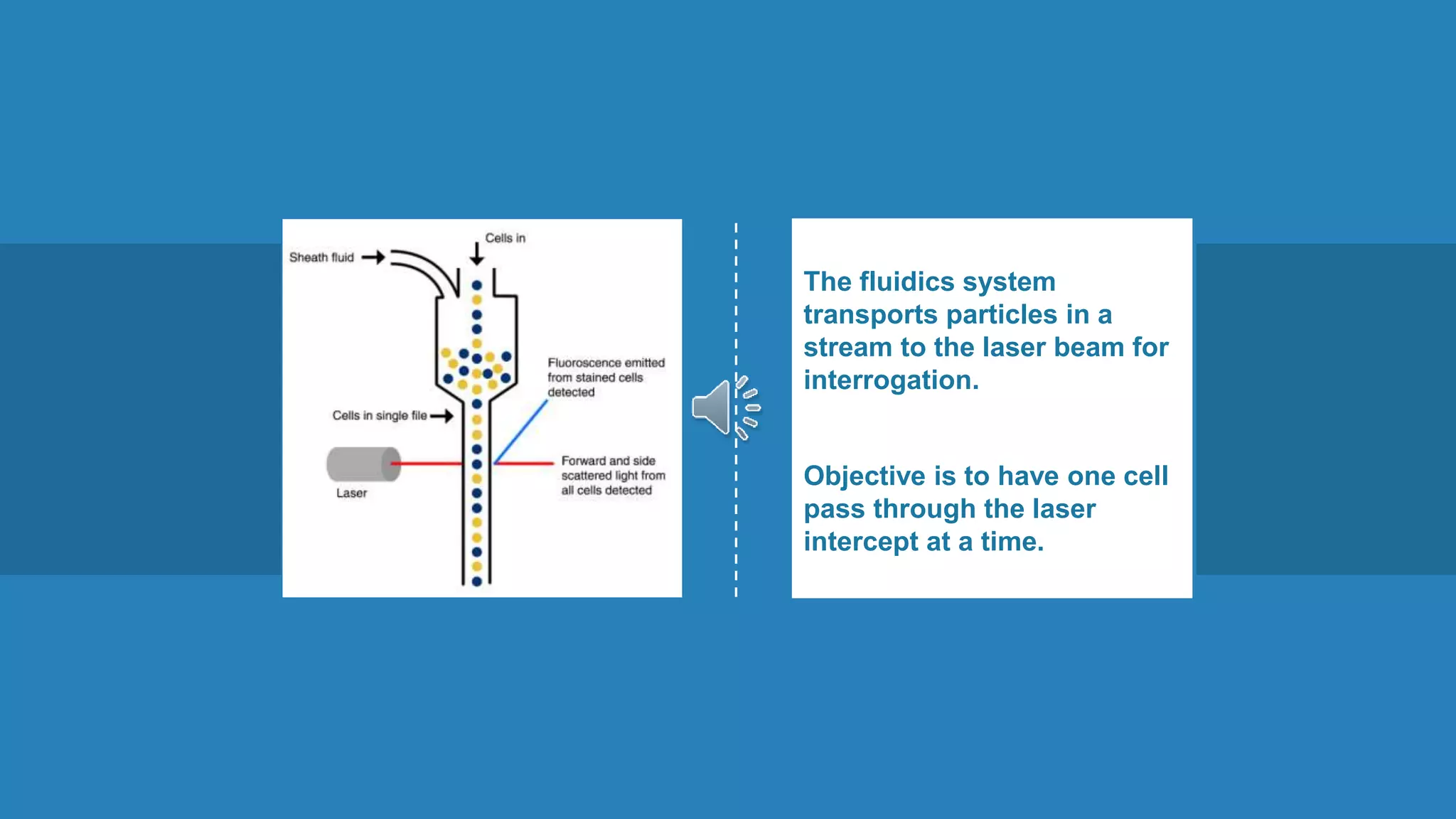
The fluidics system
transports particles in a
stream to the laser beam for
interrogation.
Objective is to have one cell
pass through the laser
intercept at a time.
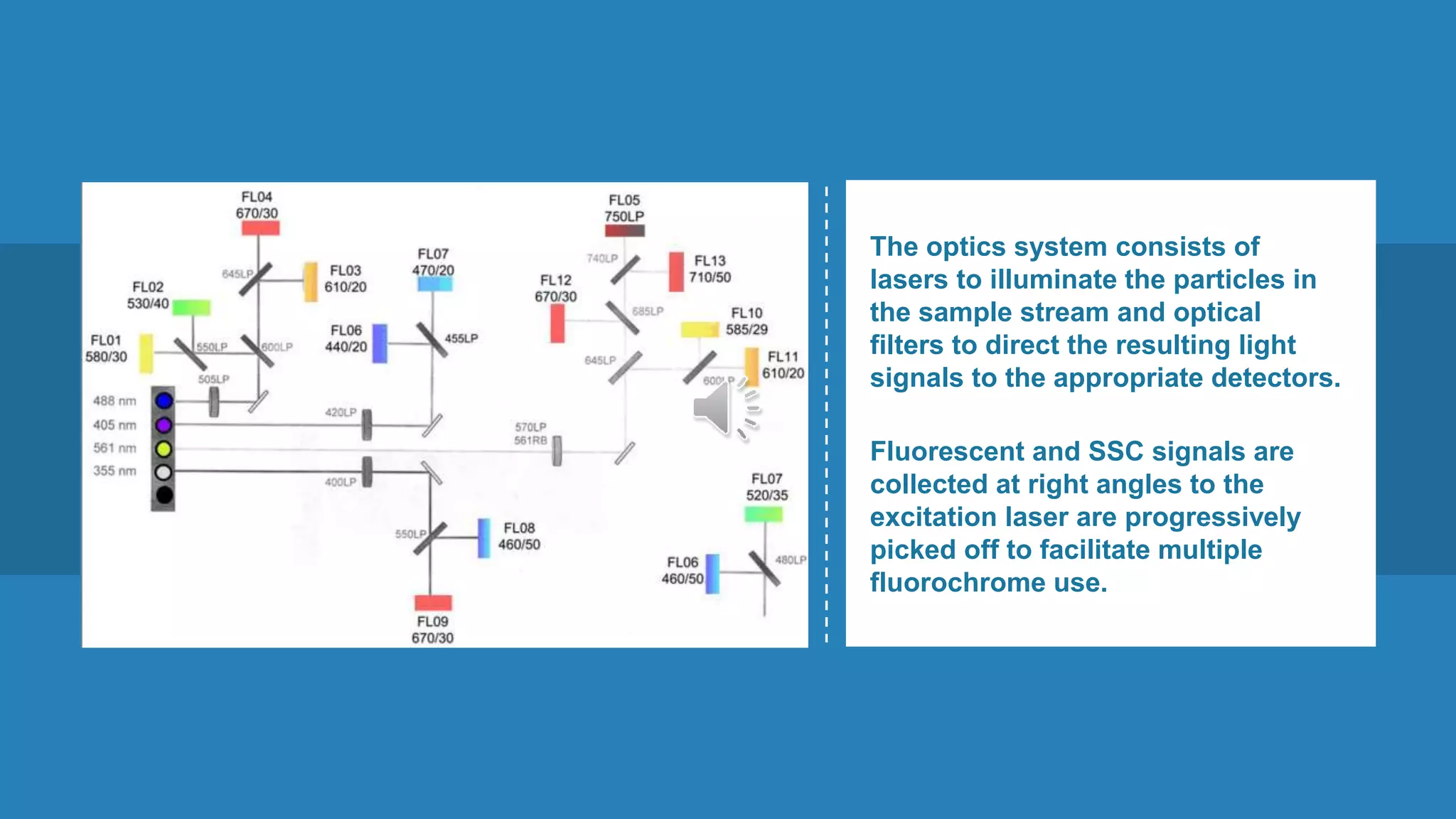
Fluorescent and SSC signals are
collected at right angles to the
excitation laser are progressively
picked off to facilitate multiple
fluorochrome use.
The optics system consists of
lasers to illuminate the particles in
the sample stream and optical
filters to direct the resulting light
signals to the appropriate detectors.
The fluorescence intensity measured
is proportional to the number of
fluorescent molecules bound to the
cell.
For some instruments equipped with
a sorting feature, the electronics
system is also capable of initiating
sorting decisions to charge and
deflect particles.
The electronics system converts the
detected light signals into electronic
signals that can be processed by the
computer.
Scatter Signals and Fluorescent Signals
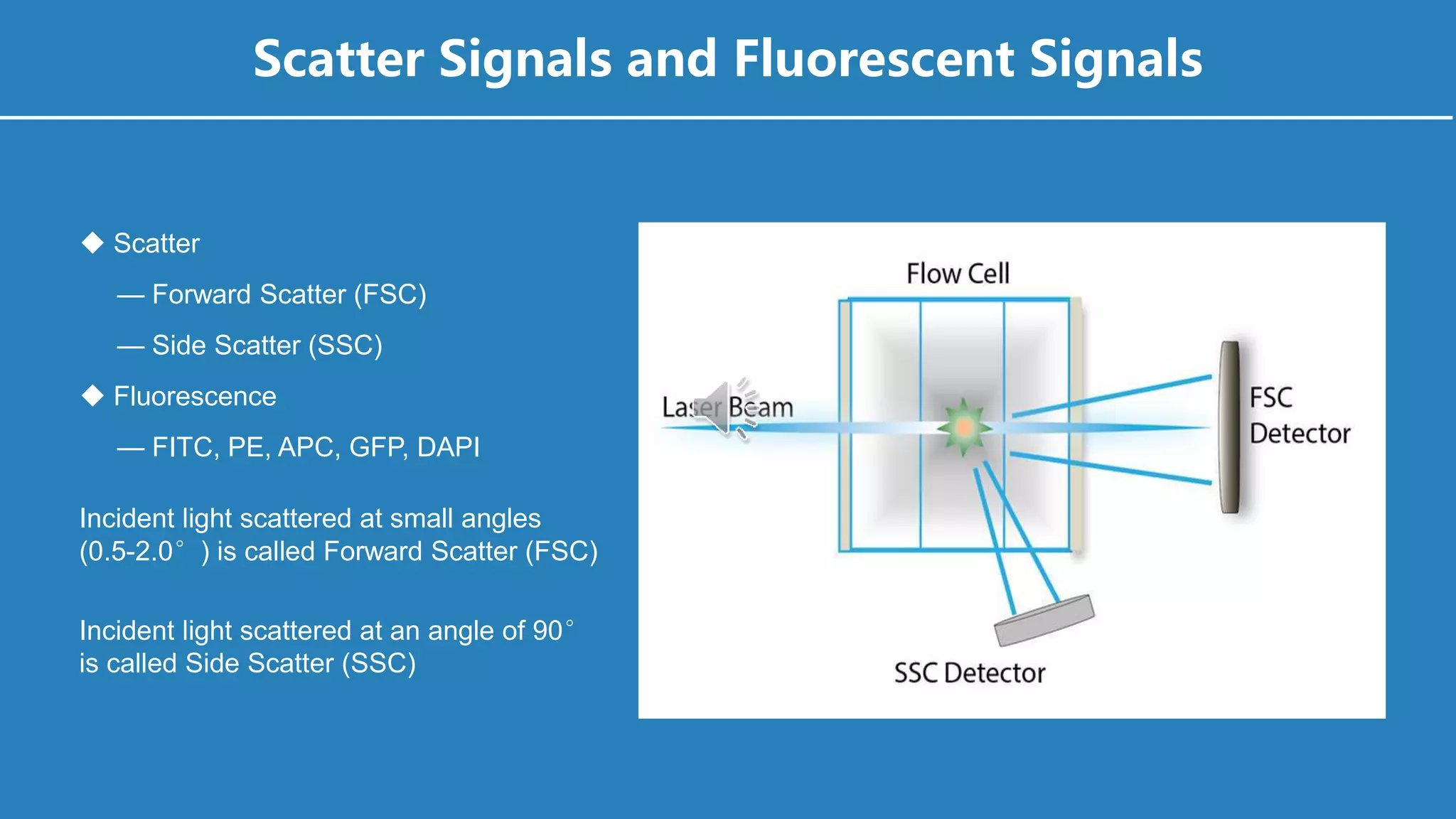
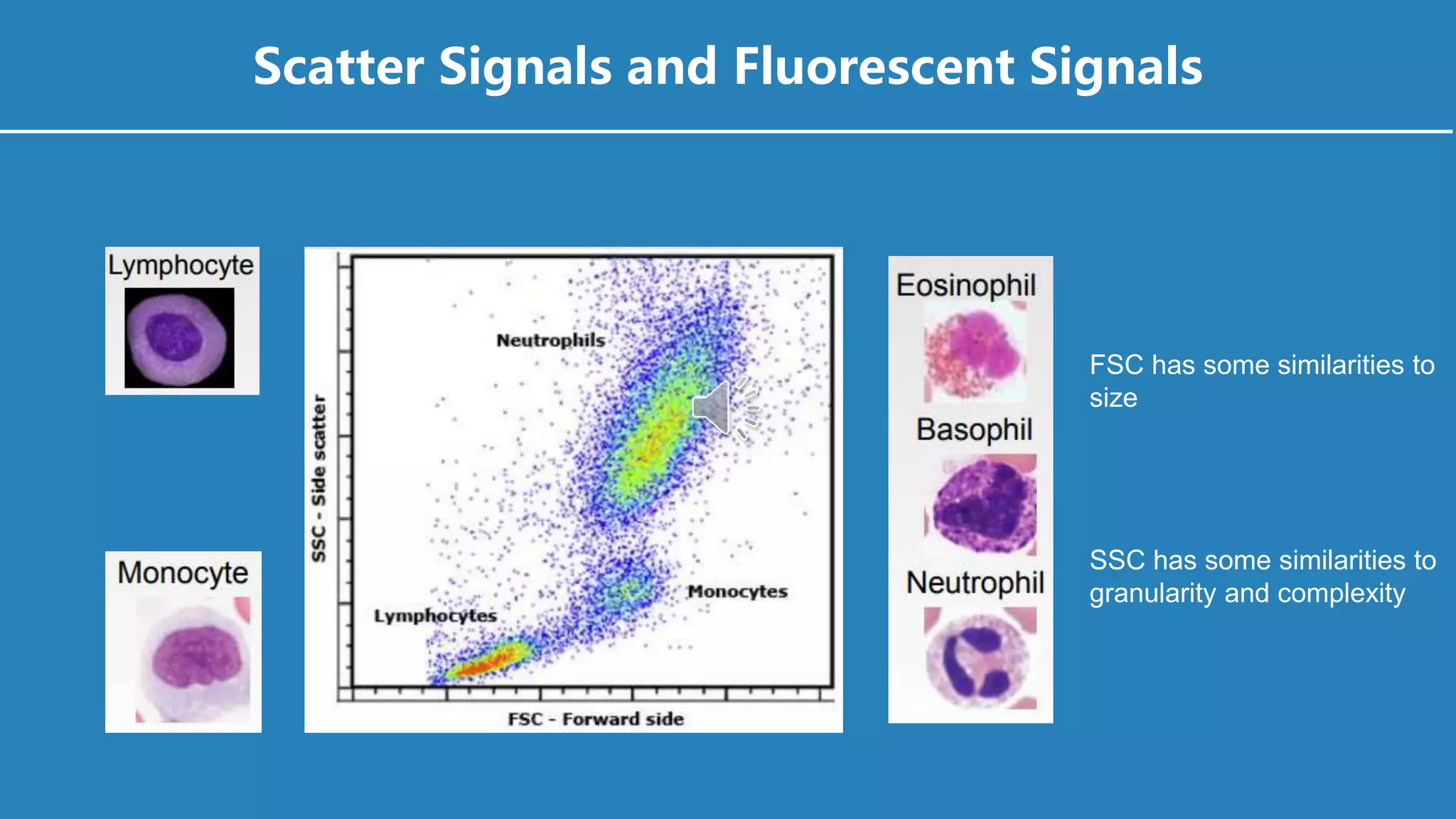
Incident light scattered at small angles
(0.5-2.0°) is called Forward Scatter (FSC)
Incident light scattered at an angle of 90°
is called Side Scatter (SSC)
 Scatter
— Forward Scatter (FSC)
— Side Scatter (SSC)
 Fluorescence
— FITC, PE, APC, GFP, DAPI
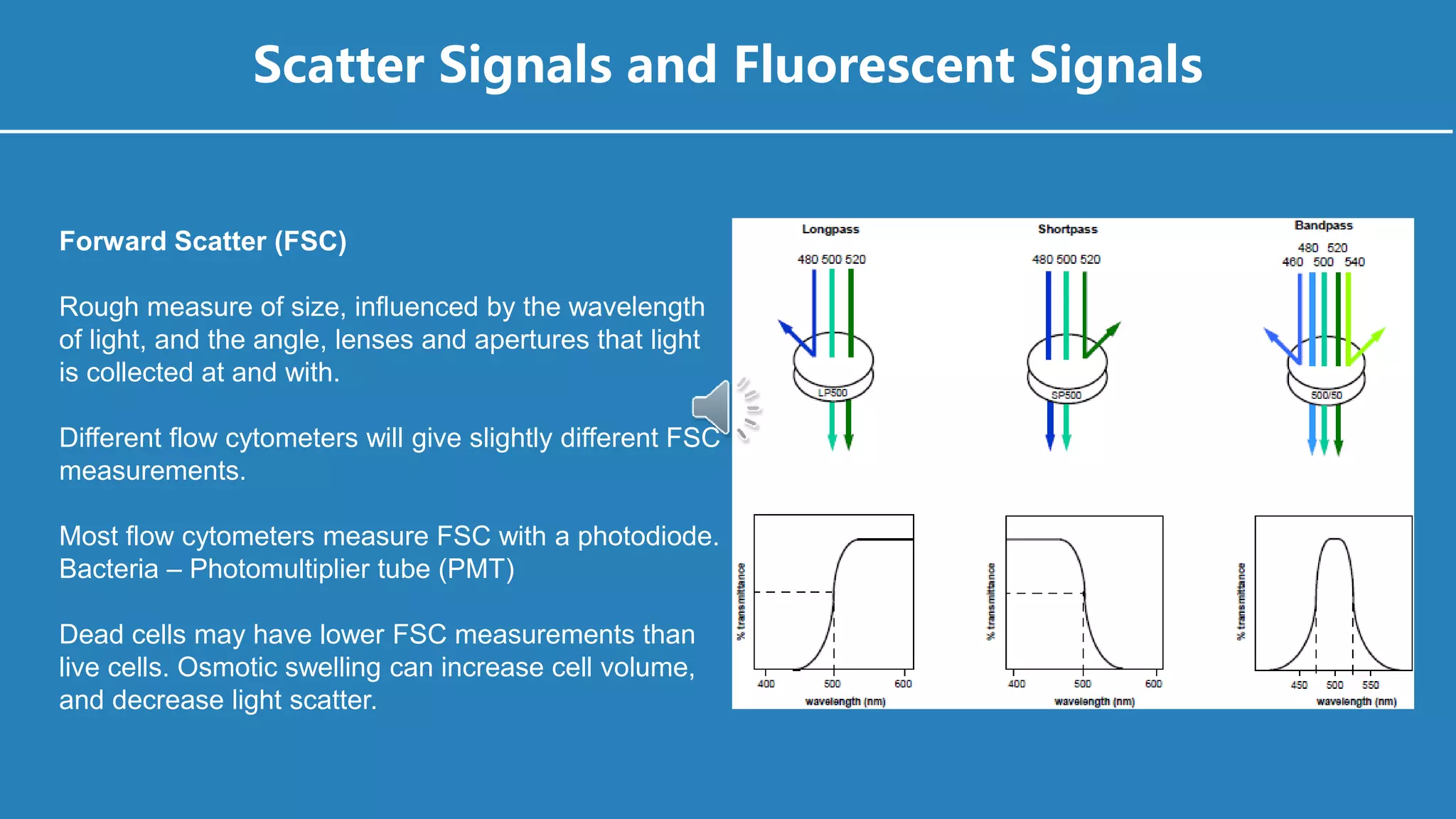
Forward Scatter (FSC)
Rough measure of size, influenced by the wavelength
of light, and the angle, lenses and apertures that light
is collected at and with.
Different flow cytometers will give slightly different FSC
measurements.
Most flow cytometers measure FSC with a photodiode.
Bacteria – Photomultiplier tube (PMT)
Dead cells may have lower FSC measurements than
live cells. Osmotic swelling can increase cell volume,
and decrease light scatter.
Scatter Signals and Fluorescent Signals
Side Scatter (SSC)
SSC is the measure of light scattered at an angle
of 90º (orthogonal).
SSC is a measure of the complexity of the cell’s
internal structures.
The more ‘granular’ a cell is the higher its SSC
will be.
A neutrophil is much more granular than a
lymphocyte.
Scatter Signals and Fluorescent Signals
FSC has some similarities to
size
SSC has some similarities to
granularity and complexity
Scatter Signals and Fluorescent Signals
Fluorochromes
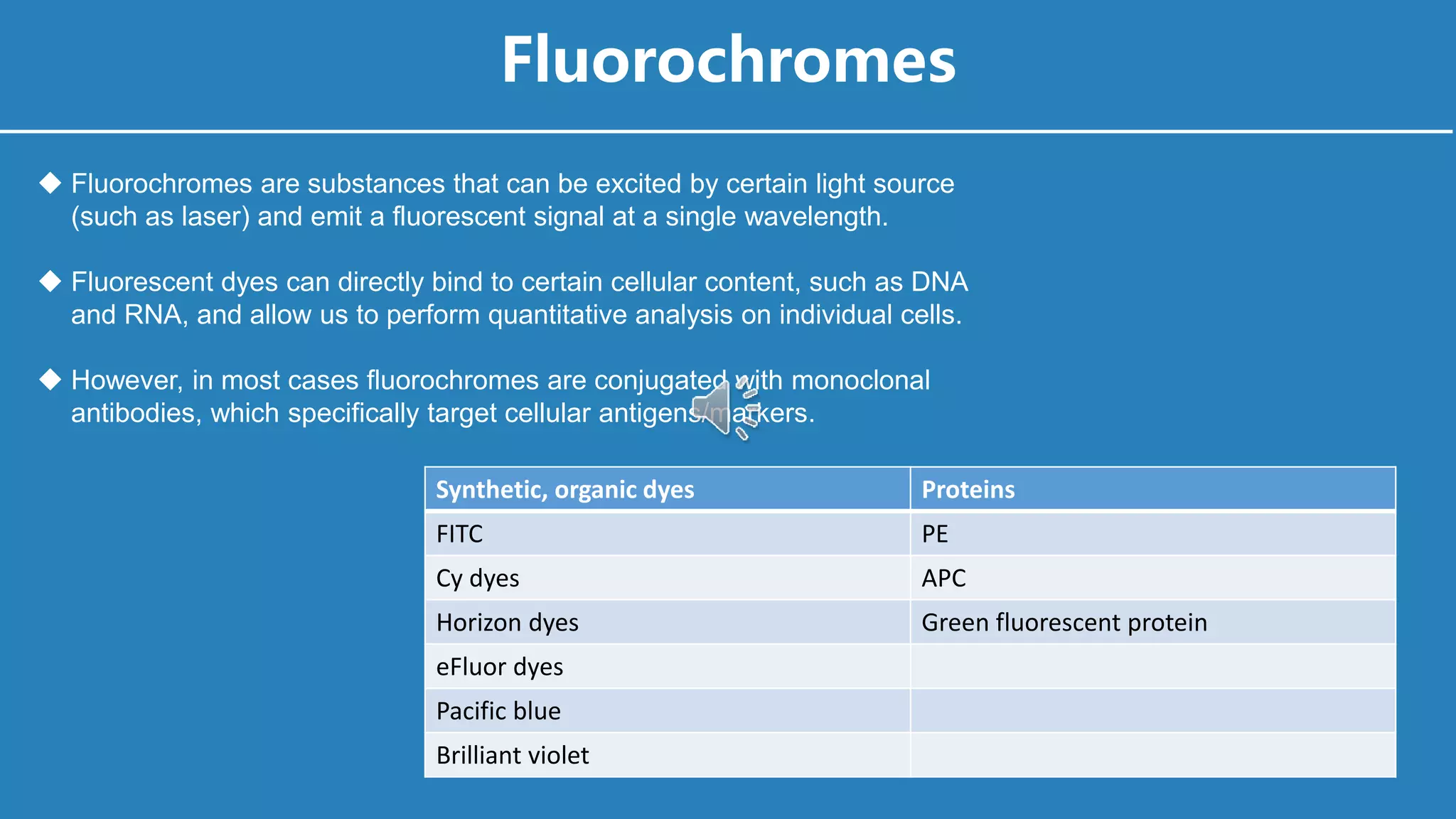
 Fluorochromes are substances that can be excited by certain light source
(such as laser) and emit a fluorescent signal at a single wavelength.
 Fluorescent dyes can directly bind to certain cellular content, such as DNA
and RNA, and allow us to perform quantitative analysis on individual cells.
 However, in most cases fluorochromes are conjugated with monoclonal
antibodies, which specifically target cellular antigens/markers.
Synthetic, organic dyes Proteins
FITC PE
Cy dyes APC
Horizon dyes Green fluorescent protein
eFluor dyes
Pacific blue
Brilliant violet
How to Choose Fluorochromes
Fluorochromes Excitation (nm) Emission (nm)
FITC 488 525
PE 488 575
PI 488 630
Cy5 488 675
PerCP 488 675
APC 633 660
APC-Cy 633 767
 Antibody availability
 Function — i.e. Mcherry VS GFP
 Fluorochrome brightness
 Excitation source
 Emission filters
 Other fluorochromes
Visualizing Flow Cytometry Data
Dot plot: one
parameter vs
another
Density plot: viewing
the frequency of
subpopulations
Contour plot:
showing the
probability
contouring
Histogram plot:
one parameter
only
USA
Europe
Tel: 1-631-626-9181
Fax: 1-631-614-7828
Email: info@creative-bioarray.com
45-1 Ramsey Road, Shirley, NY 11967, USA
Tel: 44-207-097-1828
Email: info@creative-bioarray.com
www.creative-bioarray.com

Flow cytometry

  • 1.
  • 2.
    Flow =the motion characteristicsof fluids Cytometry=is a general name for a group of biological methods used to measure various parameters of cells.
  • 3.
    1930s 1950s Counting ofRBCs through capillary tube Development of coulter principle Development of FACS and other advances 1970s
  • 4.
  • 5.
    Components of FlowCytometry Fluidics Optics Electronics
  • 6.
    The fluidics system transportsparticles in a stream to the laser beam for interrogation. Objective is to have one cell pass through the laser intercept at a time.
  • 7.
    Fluorescent and SSCsignals are collected at right angles to the excitation laser are progressively picked off to facilitate multiple fluorochrome use. The optics system consists of lasers to illuminate the particles in the sample stream and optical filters to direct the resulting light signals to the appropriate detectors.
  • 8.
    The fluorescence intensitymeasured is proportional to the number of fluorescent molecules bound to the cell. For some instruments equipped with a sorting feature, the electronics system is also capable of initiating sorting decisions to charge and deflect particles. The electronics system converts the detected light signals into electronic signals that can be processed by the computer.
  • 9.
    Scatter Signals andFluorescent Signals Incident light scattered at small angles (0.5-2.0°) is called Forward Scatter (FSC) Incident light scattered at an angle of 90° is called Side Scatter (SSC)  Scatter — Forward Scatter (FSC) — Side Scatter (SSC)  Fluorescence — FITC, PE, APC, GFP, DAPI
  • 10.
    Forward Scatter (FSC) Roughmeasure of size, influenced by the wavelength of light, and the angle, lenses and apertures that light is collected at and with. Different flow cytometers will give slightly different FSC measurements. Most flow cytometers measure FSC with a photodiode. Bacteria – Photomultiplier tube (PMT) Dead cells may have lower FSC measurements than live cells. Osmotic swelling can increase cell volume, and decrease light scatter. Scatter Signals and Fluorescent Signals
  • 11.
    Side Scatter (SSC) SSCis the measure of light scattered at an angle of 90º (orthogonal). SSC is a measure of the complexity of the cell’s internal structures. The more ‘granular’ a cell is the higher its SSC will be. A neutrophil is much more granular than a lymphocyte. Scatter Signals and Fluorescent Signals
  • 12.
    FSC has somesimilarities to size SSC has some similarities to granularity and complexity Scatter Signals and Fluorescent Signals
  • 13.
    Fluorochromes  Fluorochromes aresubstances that can be excited by certain light source (such as laser) and emit a fluorescent signal at a single wavelength.  Fluorescent dyes can directly bind to certain cellular content, such as DNA and RNA, and allow us to perform quantitative analysis on individual cells.  However, in most cases fluorochromes are conjugated with monoclonal antibodies, which specifically target cellular antigens/markers. Synthetic, organic dyes Proteins FITC PE Cy dyes APC Horizon dyes Green fluorescent protein eFluor dyes Pacific blue Brilliant violet
  • 14.
    How to ChooseFluorochromes Fluorochromes Excitation (nm) Emission (nm) FITC 488 525 PE 488 575 PI 488 630 Cy5 488 675 PerCP 488 675 APC 633 660 APC-Cy 633 767  Antibody availability  Function — i.e. Mcherry VS GFP  Fluorochrome brightness  Excitation source  Emission filters  Other fluorochromes
  • 15.
    Visualizing Flow CytometryData Dot plot: one parameter vs another Density plot: viewing the frequency of subpopulations Contour plot: showing the probability contouring Histogram plot: one parameter only
  • 16.
    USA Europe Tel: 1-631-626-9181 Fax: 1-631-614-7828 Email:info@creative-bioarray.com 45-1 Ramsey Road, Shirley, NY 11967, USA Tel: 44-207-097-1828 Email: info@creative-bioarray.com www.creative-bioarray.com