Stem Cells Dr.  Tai-ping Sun Biology 280S: Biotechnology & Genetic Engineering Jon Martin Joshua Mendoza-Elias Fall 2008
Outline: I. Introduction A. Definition of Stem Cell B. History and Discovery of SCs II. Therapeutic Applications of SCs  A. Methods for studying Stem Cells B. Problems with cloning C. Alternatives to cloning III. Policy IV. Nuclear Reprogramming
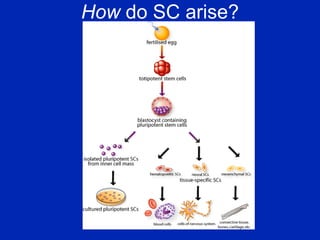
Properties of Stem Cells Self-renewal Potency ・ Totipotent :  Includes fertilized zygote and first few divisions of the fertilized egg. These cells can differentiate into embryonic and extraembryonic cell types. ・ Pluripotent:  SC’s are the descendants of totipotent cells and can differentiate into cells derived from any of the three germ layers. ・ Multipotent:  SC’s can produce only cells of a closely related family of cells (e.g. hematopoietic stem cells differentiate into red blood cells, white blood cells, platelets, etc.). ・ Unipotent :  SC’s cells can produce only one cell type, but have the property of self-renewal which distinguishes them from non-stem cells (e.g. muscle stem cells).
How  do SC arise?
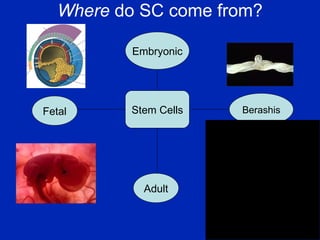
Where  do SC come from? Embryonic Fetal Adult Berashis Stem Cells
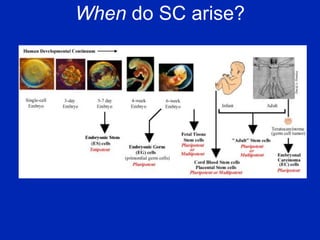
When  do SC arise?
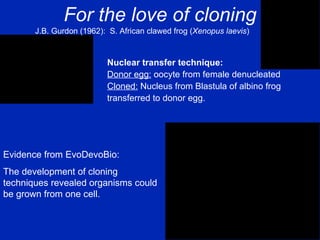
For the love of cloning Nuclear transfer technique: Donor egg:  oocyte from female denucleated Cloned:  Nucleus from Blastula of albino frog  transferred to donor egg. J.B. Gurdon (1962):  S.  African clawed frog  ( Xenopus laevis ) Evidence from EvoDevoBio: The development of cloning techniques revealed organisms could be grown from one cell.
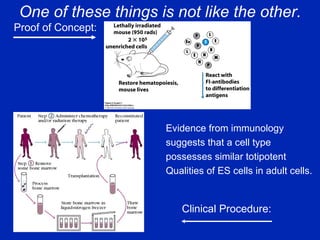
One of these things is not like the other. Evidence from immunology suggests that a cell type  possesses similar totipotent  Qualities of ES cells in adult cells. Proof of Concept: Clinical Procedure:
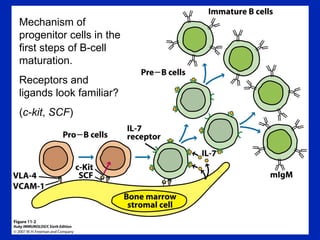
Mechanism of progenitor cells in the first steps of B-cell maturation. Receptors and ligands look familiar? ( c-kit ,  SCF )
Techniques for studying ES cells The more things change, the more the stay the same. Experimental techniques focus on determining  “ uniqueness” of ES cells in the hopes of  imitating it. -genetic expression profiles -Epigenetic state of genome -juxtracrine/endocrine signaling -transplantation effects -TF’s
II. Techniques in Stem Cell Therapy
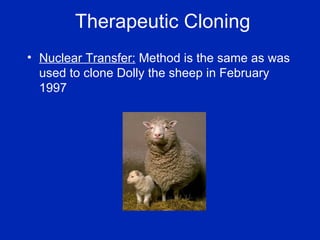
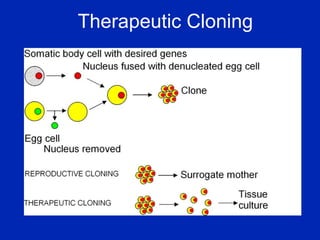
Therapeutic Cloning Nuclear Transfer:  Method is the same as was used to clone Dolly the sheep in February 1997
Therapeutic Cloning
Problems with Therapeutic Cloning Cost Destruction of embryos Inefficiency – 277 cells taken from Dolly’s “mother,” but only 30 became blastocysts. (13.21%)
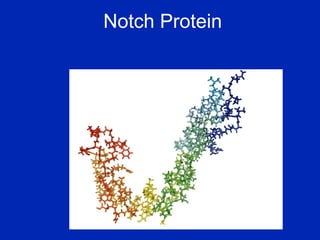
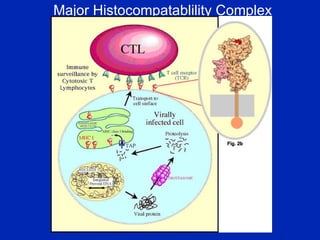
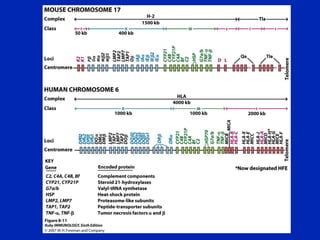
Alternative Therapeutic Methods Immunosuppression Associated risks “ Invisible” cells Notch protein MHC replacement
Notch Protein
Major Histocompatablility Complex
 
Other Alternative Methods Use of haematopoietic stem cells (HSCs) Own bone marrow
The Heart Bone marrow stem cells effective in trials to restore lost tissue Thigh tissue has also been used, though problems have arisen Use of mesenchymal stem cells and G-SCF
Study: Orlic et al. Studied effects of using bone marrow stem cells to treat mice that suffered heart attacks Sorted bone marrow cells according to whether they expressed  c-kit , a surface protein found on HSCs Transplanted into heart
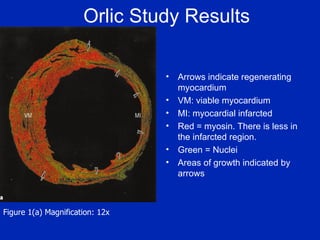
Orlic Study Results Arrows indicate regenerating myocardium VM: viable myocardium MI: myocardial infarcted Red = myosin. There is less in the infarcted region. Green = Nuclei Areas of growth indicated by arrows Figure 1(a) Magnification: 12x
Study Results, cont’d 68% of the space affected by heart attack was replaced by new myocardium New tissue had myocytes and vascular structures Improved haemodynamics over untreated heart ( c-kit  negative)
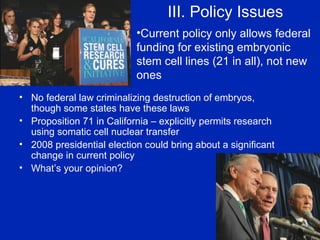
III. Policy Issues No federal law criminalizing destruction of embryos, though some states have these laws Proposition 71 in California – explicitly permits research using somatic cell nuclear transfer 2008 presidential election could bring about a significant change in current policy What’s your opinion? Current policy only allows federal funding for existing embryonic stem cell lines (21 in all), not new ones
Stem Cell Viddeo http: //youtube .com/watch? v=mUcE1Y_bOQE
IV. A Transcriptional Logic for Nuclear Reprogramming Takahashi & Yamanaka/ Kit T. Rodolfa and Kevin Eggan  Cell (2006)  126:  652-655   . Background: -Pluripotency: nuclear transfer or fusion with ES. -Factors for reprogramming unknown. Questions: (i.) Minimal factors? (ii.) Can we use make ES-like cells? (iii.) How do these cells compare to ES cells?
Trans Reprogramming continued Hypothesis : (i.) We can find factors. (ii.) We can build pluripotent cells. Experimental Design: -MEF and Tail Tip Fibroblasts (TTF) introduce factors via retrovirus -Test cell cultures.
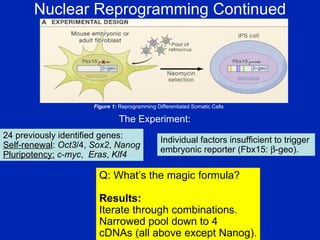
Nuclear Reprogramming Continued The Experiment: Figure 1:  Reprogramming Differentiated Somatic Cells Individual factors insufficient to trigger  embryonic reporter (Fbx15:   -geo). 24 previously identified genes: Self-renewal :  Oct3 /4,  Sox2 ,  Nanog Pluripotency:   c-myc ,  Eras ,  Klf4 Q: What’s the magic formula? Results: Iterate through combinations.  Narrowed pool down to 4 cDNAs (all above except Nanog).
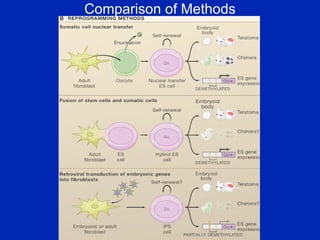
Comparison of Methods
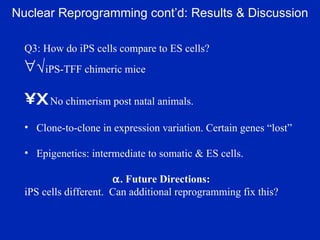
Nuclear Reprogramming cont’d: Results & Discussion Q3: How do iPS cells compare to ES cells?  iPS-TFF chimeric mice X   No chimerism post natal animals.  Clone-to-clone in expression variation. Certain genes “lost” Epigenetics: intermediate to somatic & ES cells.  . Future Directions: iPS cells different.  Can additional reprogramming fix this?
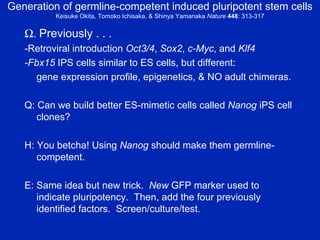
Generation of germline-competent induced pluripotent stem cells Keisuke Okita, Tomoko Ichisaka, & Shinya Yamanaka  Nature   448 : 313-317  .  Previously . . .   -Retroviral introduction  Oct3/4 ,  Sox2 ,  c-Myc , and  Klf4 -Fbx15  IPS cells similar to ES cells, but different:  gene expression profile, epigenetics, & NO adult chimeras. Q: Can we build better ES-mimetic cells called  Nanog  iPS cell clones? H: You betcha! Using  Nanog  should make them germline-competent. E: Same idea but new trick.  New  GFP marker used to indicate pluripotency.  Then, add the four previously identified factors.  Screen/culture/test.
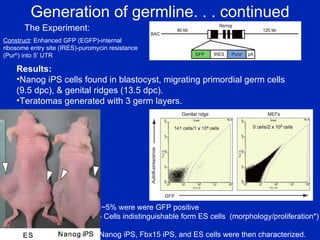
Generation of germline. . . continued The Experiment: Construct : Enhanced GFP (EGFP)-internal ribosome entry site (IRES)-puromycin resistance (Pur R ) into 5’ UTR Results: Nanog iPS cells found in blastocyst, migrating primordial germ cells (9.5 dpc), & genital ridges (13.5 dpc). Teratomas generated with 3 germ layers. ~5% were were GFP positive - Cells indistinguishable form ES cells  (morphology/proliferation*) Nanog iPS, Fbx15 iPS, and ES cells were then characterized.
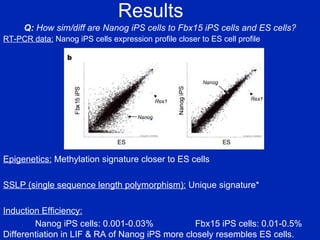
Results Q:  How sim/diff are Nanog iPS cells to Fbx15 iPS cells and ES cells? RT-PCR data:  Nanog iPS cells expression profile closer to ES cell profile Epigenetics:  Methylation signature closer to ES cells SSLP (single sequence length polymorphism):  Unique signature* Induction Efficiency: Nanog iPS cells: 0.001-0.03% Fbx15 iPS cells: 0.01-0.5%  Differentiation in LIF & RA of Nanog iPS more closely resembles ES cells.
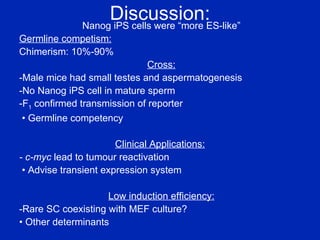
Discussion: Nanog iPS cells were “more ES-like” Germline competism: Chimerism: 10%-90% Cross: -Male mice had small testes and aspermatogenesis -No Nanog iPS cell in mature sperm -F 1  confirmed transmission of reporter •  Germline competency Clinical Applications:   - c-myc  lead to tumour reactivation  •  Advise transient expression system Low induction efficiency: -Rare SC coexisting with MEF culture? •  Other determinants
Conclusion ES cell analogues are possible Epigenetics Further refinement Identification of Factors Delivery system
References: [1] Aldhous, P.  Can they rebuild us?  Nature  (2001)  410 : 622-625. [2] Wadman, M.  Stem-cell issue moves up the US agenda.  Nature  (2007)  446 : 842. [3] Holden, C.  California's proposition 71 launches stem cell gold rush.  Science  (2004)  306 : 1111. [4] Couzin, J. and Vogel, G.  Renovating the heart.  Science  (2004)  304 : 192-194.  [5] Orlic, D., Kajstura, J., Chimenti, Stefano. Jakoniuk, I., Anderson, S.M., Baosheng, L., Pickel, J., McKay, R., Nadal-Ginard, B., Bodline, D.M., Leri, A., and Anversa, P.  Bone marrow cells regenerate infarcted myocardium.  Nature  (2001)  410 : 701-705. [6] Rodolfa, K.T., and Eggan, K. (2006) A transcriptional logic for nuclear reprogramming.  Cell   126 : 652-655. [7] Okita, K., Ichisaka, T., and Yamanaka, S.. Generation of germline-competent induced pluripotent stem cells.  Nature  (2007)  448: , 313-317.

Stem Cells: Minireview Presentation

  • 1.
    Stem Cells Dr. Tai-ping Sun Biology 280S: Biotechnology & Genetic Engineering Jon Martin Joshua Mendoza-Elias Fall 2008
  • 2.
    Outline: I. IntroductionA. Definition of Stem Cell B. History and Discovery of SCs II. Therapeutic Applications of SCs A. Methods for studying Stem Cells B. Problems with cloning C. Alternatives to cloning III. Policy IV. Nuclear Reprogramming
  • 3.
    Properties of StemCells Self-renewal Potency ・ Totipotent : Includes fertilized zygote and first few divisions of the fertilized egg. These cells can differentiate into embryonic and extraembryonic cell types. ・ Pluripotent: SC’s are the descendants of totipotent cells and can differentiate into cells derived from any of the three germ layers. ・ Multipotent: SC’s can produce only cells of a closely related family of cells (e.g. hematopoietic stem cells differentiate into red blood cells, white blood cells, platelets, etc.). ・ Unipotent : SC’s cells can produce only one cell type, but have the property of self-renewal which distinguishes them from non-stem cells (e.g. muscle stem cells).
  • 4.
    How doSC arise?
  • 5.
    Where doSC come from? Embryonic Fetal Adult Berashis Stem Cells
  • 6.
    When doSC arise?
  • 7.
    For the loveof cloning Nuclear transfer technique: Donor egg: oocyte from female denucleated Cloned: Nucleus from Blastula of albino frog transferred to donor egg. J.B. Gurdon (1962): S. African clawed frog ( Xenopus laevis ) Evidence from EvoDevoBio: The development of cloning techniques revealed organisms could be grown from one cell.
  • 8.
    One of thesethings is not like the other. Evidence from immunology suggests that a cell type possesses similar totipotent Qualities of ES cells in adult cells. Proof of Concept: Clinical Procedure:
  • 9.
    Mechanism of progenitorcells in the first steps of B-cell maturation. Receptors and ligands look familiar? ( c-kit , SCF )
  • 10.
    Techniques for studyingES cells The more things change, the more the stay the same. Experimental techniques focus on determining “ uniqueness” of ES cells in the hopes of imitating it. -genetic expression profiles -Epigenetic state of genome -juxtracrine/endocrine signaling -transplantation effects -TF’s
  • 11.
    II. Techniques inStem Cell Therapy
  • 12.
    Therapeutic Cloning NuclearTransfer: Method is the same as was used to clone Dolly the sheep in February 1997
  • 13.
  • 14.
    Problems with TherapeuticCloning Cost Destruction of embryos Inefficiency – 277 cells taken from Dolly’s “mother,” but only 30 became blastocysts. (13.21%)
  • 15.
    Alternative Therapeutic MethodsImmunosuppression Associated risks “ Invisible” cells Notch protein MHC replacement
  • 16.
  • 17.
  • 18.
  • 19.
    Other Alternative MethodsUse of haematopoietic stem cells (HSCs) Own bone marrow
  • 20.
    The Heart Bonemarrow stem cells effective in trials to restore lost tissue Thigh tissue has also been used, though problems have arisen Use of mesenchymal stem cells and G-SCF
  • 21.
    Study: Orlic etal. Studied effects of using bone marrow stem cells to treat mice that suffered heart attacks Sorted bone marrow cells according to whether they expressed c-kit , a surface protein found on HSCs Transplanted into heart
  • 22.
    Orlic Study ResultsArrows indicate regenerating myocardium VM: viable myocardium MI: myocardial infarcted Red = myosin. There is less in the infarcted region. Green = Nuclei Areas of growth indicated by arrows Figure 1(a) Magnification: 12x
  • 23.
    Study Results, cont’d68% of the space affected by heart attack was replaced by new myocardium New tissue had myocytes and vascular structures Improved haemodynamics over untreated heart ( c-kit negative)
  • 24.
    III. Policy IssuesNo federal law criminalizing destruction of embryos, though some states have these laws Proposition 71 in California – explicitly permits research using somatic cell nuclear transfer 2008 presidential election could bring about a significant change in current policy What’s your opinion? Current policy only allows federal funding for existing embryonic stem cell lines (21 in all), not new ones
  • 25.
    Stem Cell Viddeohttp: //youtube .com/watch? v=mUcE1Y_bOQE
  • 26.
    IV. A TranscriptionalLogic for Nuclear Reprogramming Takahashi & Yamanaka/ Kit T. Rodolfa and Kevin Eggan Cell (2006) 126: 652-655  . Background: -Pluripotency: nuclear transfer or fusion with ES. -Factors for reprogramming unknown. Questions: (i.) Minimal factors? (ii.) Can we use make ES-like cells? (iii.) How do these cells compare to ES cells?
  • 27.
    Trans Reprogramming continuedHypothesis : (i.) We can find factors. (ii.) We can build pluripotent cells. Experimental Design: -MEF and Tail Tip Fibroblasts (TTF) introduce factors via retrovirus -Test cell cultures.
  • 28.
    Nuclear Reprogramming ContinuedThe Experiment: Figure 1: Reprogramming Differentiated Somatic Cells Individual factors insufficient to trigger embryonic reporter (Fbx15:  -geo). 24 previously identified genes: Self-renewal : Oct3 /4, Sox2 , Nanog Pluripotency: c-myc , Eras , Klf4 Q: What’s the magic formula? Results: Iterate through combinations. Narrowed pool down to 4 cDNAs (all above except Nanog).
  • 29.
  • 30.
    Nuclear Reprogramming cont’d:Results & Discussion Q3: How do iPS cells compare to ES cells?  iPS-TFF chimeric mice X No chimerism post natal animals. Clone-to-clone in expression variation. Certain genes “lost” Epigenetics: intermediate to somatic & ES cells.  . Future Directions: iPS cells different. Can additional reprogramming fix this?
  • 31.
    Generation of germline-competentinduced pluripotent stem cells Keisuke Okita, Tomoko Ichisaka, & Shinya Yamanaka Nature 448 : 313-317  . Previously . . . -Retroviral introduction Oct3/4 , Sox2 , c-Myc , and Klf4 -Fbx15 IPS cells similar to ES cells, but different: gene expression profile, epigenetics, & NO adult chimeras. Q: Can we build better ES-mimetic cells called Nanog iPS cell clones? H: You betcha! Using Nanog should make them germline-competent. E: Same idea but new trick. New GFP marker used to indicate pluripotency. Then, add the four previously identified factors. Screen/culture/test.
  • 32.
    Generation of germline.. . continued The Experiment: Construct : Enhanced GFP (EGFP)-internal ribosome entry site (IRES)-puromycin resistance (Pur R ) into 5’ UTR Results: Nanog iPS cells found in blastocyst, migrating primordial germ cells (9.5 dpc), & genital ridges (13.5 dpc). Teratomas generated with 3 germ layers. ~5% were were GFP positive - Cells indistinguishable form ES cells (morphology/proliferation*) Nanog iPS, Fbx15 iPS, and ES cells were then characterized.
  • 33.
    Results Q: How sim/diff are Nanog iPS cells to Fbx15 iPS cells and ES cells? RT-PCR data: Nanog iPS cells expression profile closer to ES cell profile Epigenetics: Methylation signature closer to ES cells SSLP (single sequence length polymorphism): Unique signature* Induction Efficiency: Nanog iPS cells: 0.001-0.03% Fbx15 iPS cells: 0.01-0.5% Differentiation in LIF & RA of Nanog iPS more closely resembles ES cells.
  • 34.
    Discussion: Nanog iPScells were “more ES-like” Germline competism: Chimerism: 10%-90% Cross: -Male mice had small testes and aspermatogenesis -No Nanog iPS cell in mature sperm -F 1 confirmed transmission of reporter • Germline competency Clinical Applications: - c-myc lead to tumour reactivation • Advise transient expression system Low induction efficiency: -Rare SC coexisting with MEF culture? • Other determinants
  • 35.
    Conclusion ES cellanalogues are possible Epigenetics Further refinement Identification of Factors Delivery system
  • 36.
    References: [1] Aldhous,P. Can they rebuild us? Nature (2001) 410 : 622-625. [2] Wadman, M. Stem-cell issue moves up the US agenda. Nature (2007) 446 : 842. [3] Holden, C. California's proposition 71 launches stem cell gold rush. Science (2004) 306 : 1111. [4] Couzin, J. and Vogel, G. Renovating the heart. Science (2004) 304 : 192-194. [5] Orlic, D., Kajstura, J., Chimenti, Stefano. Jakoniuk, I., Anderson, S.M., Baosheng, L., Pickel, J., McKay, R., Nadal-Ginard, B., Bodline, D.M., Leri, A., and Anversa, P. Bone marrow cells regenerate infarcted myocardium. Nature (2001) 410 : 701-705. [6] Rodolfa, K.T., and Eggan, K. (2006) A transcriptional logic for nuclear reprogramming. Cell 126 : 652-655. [7] Okita, K., Ichisaka, T., and Yamanaka, S.. Generation of germline-competent induced pluripotent stem cells. Nature (2007) 448: , 313-317.

Editor's Notes

  • #2 Specs: Blue background, with orange, then yellow text.