Email: info@creative-biogene.com
Website: http://www.creative-biogene.com
Reporter Stem Cells Generation
Creative Biogene
Introduction
Gene Reporter Pluripotent Lines
Methods for Reporter Cells Generation
Potential Uses of Reporter Stem Cells
About Creative Biogene
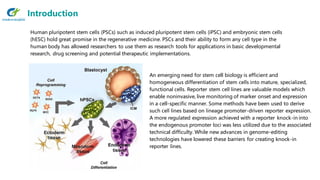
Human pluripotent stem cells (PSCs) such as induced pluripotent stem cells (iPSC) and embryonic stem cells
(hESC) hold great promise in the regenerative medicine. PSCs and their ability to form any cell type in the
human body has allowed researchers to use them as research tools for applications in basic developmental
research, drug screening and potential therapeutic implementations.
An emerging need for stem cell biology is efficient and
homogeneous differentiation of stem cells into mature, specialized,
functional cells. Reporter stem cell lines are valuable models which
enable noninvasive, live monitoring of marker onset and expression
in a cell-specific manner. Some methods have been used to derive
such cell lines based on lineage promoter-driven reporter expression.
A more regulated expression achieved with a reporter knock-in into
the endogenous promoter loci was less utilized due to the associated
technical difficulty. While new advances in genome-editing
technologies have lowered these barriers for creating knock-in
reporter lines.
Introduction
Gene Reporter Pluripotent Lines as Cell Models
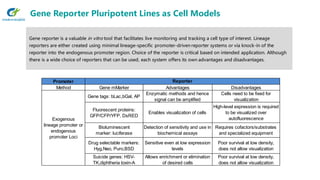
Gene reporter is a valuable in vitro tool that facilitates live monitoring and tracking a cell type of interest. Lineage
reporters are either created using minimal lineage-specific promoter-driven reporter systems or via knock-in of the
reporter into the endogenous promoter region. Choice of the reporter is critical based on intended application. Although
there is a wide choice of reporters that can be used, each system offers its own advantages and disadvantages.
Promoter
Method Gene mMarker Advantages Disadvantages
Gene tags: bLac,bGal, AP
Enzymatic methods and hence
signal can be amplified
Cells need to be fixed for
visualization
Fluorescent proteins:
GFP/CFP/YFP, DsRED
Enables visualization of cells
High-level expression is required
to be visualized over
autofluorescence
Bioluminescent
marker: luciferase
Detection of sensitivity and use in
biochemical assays
Requires cofactors/substrates
and specialized equipment
Drug selectable markers:
Hyg,Neo, Puro,BSD
Sensitive even at low expression
levels
Poor survival at low density,
does not allow visualization
Suicide genes: HSV-
TK,diphtheria toxin-A
Allows enrichment or elimination
of desired cells
Poor survival at low density,
does not allow visualization
Exogenous
lineage promoter or
endogenous
promoter Loci
Reporter
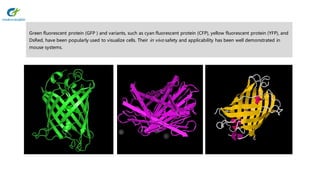
Green fluorescent protein (GFP ) and variants, such as cyan fluorescent protein (CFP), yellow fluorescent protein (YFP), and
DsRed, have been popularly used to visualize cells. Their in vivo safety and applicability has been well demonstrated in
mouse systems.
Methods for Reporter Cells Generation
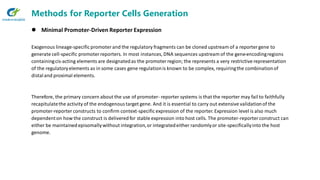
⚫ Minimal Promoter-Driven Reporter Expression
Exogenous lineage-specific promoterand the regulatory fragments can be cloned upstream of a reportergene to
generate cell-specific promoter reporters. In most instances, DNA sequences upstream of the gene-encodingregions
containingcis-acting elements are designatedas the promoterregion; the represents a very restrictive representation
of the regulatoryelements as in some cases gene regulationis known to be complex, requiringthe combinationof
distaland proximal elements.
Therefore, the primary concern about the use of promoter- reporter systems is that the reporter may fail to faithfully
recapitulatethe activity of the endogenoustarget gene. And it is essential to carry out extensive validationof the
promoter-reporter constructs to confirm context-specific expression of the reporter. Expression level is also much
dependenton how the construct is deliveredfor stable expression into host cells. The promoter-reporter construct can
either be maintained episomallywithout integration,or integratedeither randomlyor site-specificallyinto the host
genome.
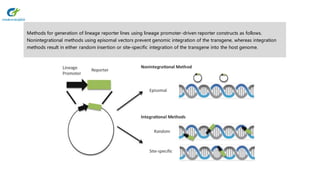
Methods for generation of lineage reporter lines using lineage promoter-driven reporter constructs as follows.
Nonintegrational methods using episomal vectors prevent genomic integration of the transgene, whereas integration
methods result in either random insertion or site-specific integration of the transgene into the host genome.
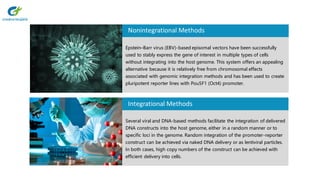
Several viral and DNA-based methods facilitate the integration of delivered
DNA constructs into the host genome, either in a random manner or to
specific loci in the genome. Random integration of the promoter-reporter
construct can be achieved via naked DNA delivery or as lentiviral particles.
In both cases, high copy numbers of the construct can be achieved with
efficient delivery into cells.
Epstein–Barr virus (EBV)-based episomal vectors have been successfully
used to stably express the gene of interest in multiple types of cells
without integrating into the host genome. This system offers an appealing
alternative because it is relatively free from chromosomal effects
associated with genomic integration methods and has been used to create
pluripotent reporter lines with Pou5F1 (Oct4) promoter.
Nonintegrational Methods
Integrational Methods
Methods for Reporter Cells Generation
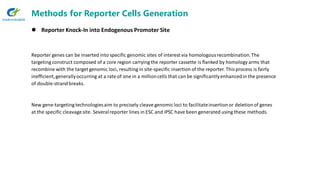
⚫ Reporter Knock-In into Endogenous Promoter Site
Reporter genes can be inserted into specific genomic sites of interest via homologousrecombination.The
targeting construct composed of a core region carrying the reporter cassette is flanked by homology arms that
recombine with the target genomic loci, resulting in site-specific insertion of the reporter. Thisprocess is fairly
inefficient,generallyoccurring at a rate of one in a millioncells that can be significantlyenhancedin the presence
of double-strandbreaks.
New gene-targeting technologiesaim to precisely cleave genomic loci to facilitateinsertionor deletionof genes
at the specific cleavagesite. Severalreporter lines in ESC and iPSC have been generated using these methods.
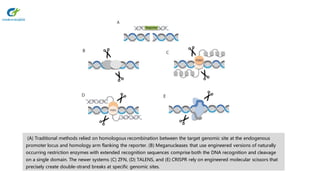
(A) Traditional methods relied on homologous recombination between the target genomic site at the endogenous
promoter locus and homology arm flanking the reporter. (B) Meganucleases that use engineered versions of naturally
occurring restriction enzymes with extended recognition sequences comprise both the DNA recognition and cleavage
on a single domain. The newer systems (C) ZFN, (D) TALENS, and (E) CRISPR rely on engineered molecular scissors that
precisely create double-strand breaks at specific genomic sites.
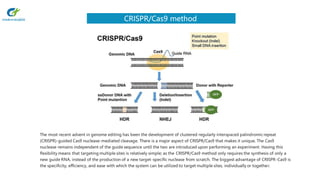
CRISPR/Cas9 method
The most recent advent in genome editing has been the development of clustered regularly interspaced palindromic repeat
(CRISPR)-guided Cas9 nuclease-mediated cleavage. There is a major aspect of CRISPR/Cas9 that makes it unique. The Cas9
nuclease remains independent of the guide sequence until the two are introduced upon performing an experiment. Having this
flexibility means that targeting multiple sites is relatively simple; as the CRISPR/Cas9 method only requires the synthesis of only a
new guide RNA, instead of the production of a new target-specific nuclease from scratch. The biggest advantage of CRISPR-Cas9 is
the specificity, efficiency, and ease with which the system can be utilized to target multiple sites, individually or together.
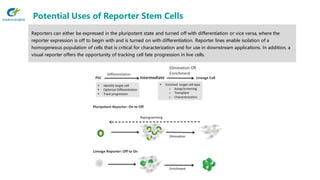
Potential Uses of Reporter Stem Cells
Reporters can either be expressed in the pluripotent state and turned off with differentiation or vice versa, where the
reporter expression is off to begin with and is turned on with differentiation. Reporter lines enable isolation of a
homogeneous population of cells that is critical for characterization and for use in downstream applications. In addition, a
visual reporter offers the opportunity of tracking cell fate progression in live cells.
Based on years of experience and in-depth investigation,
scientists at Creative Biogene can target specific DNA
sequences and induce a double-stranded break, taking
advantage of recombination to create synthetic genetic
genome of a host.
An expression cassette containing reporter and
resistance genes is knocked into the safe-harbor site or
any other sites in host cells. Gene insertion at a safe-
harbor site allows stable gene expression without any
adverse effects on the fitness of the engineered cells.
About Creative Biogene
Highlights
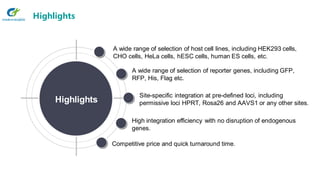
Competitive price and quick turnaround time.
High integration efficiency with no disruption of endogenous
genes.
Site-specific integration at pre-defined loci, including
permissive loci HPRT, Rosa26 and AAVS1 or any other sites.
A wide range of selection of reporter genes, including GFP,
RFP, His, Flag etc.
A wide range of selection of host cell lines, including HEK293 cells,
CHO cells, HeLa cells, hESC cells, human ES cells, etc.
Highlights
Reporter stem cells generation

Reporter stem cells generation

  • 1.
  • 2.
    Introduction Gene Reporter PluripotentLines Methods for Reporter Cells Generation Potential Uses of Reporter Stem Cells About Creative Biogene
  • 3.
    Human pluripotent stemcells (PSCs) such as induced pluripotent stem cells (iPSC) and embryonic stem cells (hESC) hold great promise in the regenerative medicine. PSCs and their ability to form any cell type in the human body has allowed researchers to use them as research tools for applications in basic developmental research, drug screening and potential therapeutic implementations. An emerging need for stem cell biology is efficient and homogeneous differentiation of stem cells into mature, specialized, functional cells. Reporter stem cell lines are valuable models which enable noninvasive, live monitoring of marker onset and expression in a cell-specific manner. Some methods have been used to derive such cell lines based on lineage promoter-driven reporter expression. A more regulated expression achieved with a reporter knock-in into the endogenous promoter loci was less utilized due to the associated technical difficulty. While new advances in genome-editing technologies have lowered these barriers for creating knock-in reporter lines. Introduction
  • 4.
    Gene Reporter PluripotentLines as Cell Models Gene reporter is a valuable in vitro tool that facilitates live monitoring and tracking a cell type of interest. Lineage reporters are either created using minimal lineage-specific promoter-driven reporter systems or via knock-in of the reporter into the endogenous promoter region. Choice of the reporter is critical based on intended application. Although there is a wide choice of reporters that can be used, each system offers its own advantages and disadvantages. Promoter Method Gene mMarker Advantages Disadvantages Gene tags: bLac,bGal, AP Enzymatic methods and hence signal can be amplified Cells need to be fixed for visualization Fluorescent proteins: GFP/CFP/YFP, DsRED Enables visualization of cells High-level expression is required to be visualized over autofluorescence Bioluminescent marker: luciferase Detection of sensitivity and use in biochemical assays Requires cofactors/substrates and specialized equipment Drug selectable markers: Hyg,Neo, Puro,BSD Sensitive even at low expression levels Poor survival at low density, does not allow visualization Suicide genes: HSV- TK,diphtheria toxin-A Allows enrichment or elimination of desired cells Poor survival at low density, does not allow visualization Exogenous lineage promoter or endogenous promoter Loci Reporter
  • 5.
    Green fluorescent protein(GFP ) and variants, such as cyan fluorescent protein (CFP), yellow fluorescent protein (YFP), and DsRed, have been popularly used to visualize cells. Their in vivo safety and applicability has been well demonstrated in mouse systems.
  • 6.
    Methods for ReporterCells Generation ⚫ Minimal Promoter-Driven Reporter Expression Exogenous lineage-specific promoterand the regulatory fragments can be cloned upstream of a reportergene to generate cell-specific promoter reporters. In most instances, DNA sequences upstream of the gene-encodingregions containingcis-acting elements are designatedas the promoterregion; the represents a very restrictive representation of the regulatoryelements as in some cases gene regulationis known to be complex, requiringthe combinationof distaland proximal elements. Therefore, the primary concern about the use of promoter- reporter systems is that the reporter may fail to faithfully recapitulatethe activity of the endogenoustarget gene. And it is essential to carry out extensive validationof the promoter-reporter constructs to confirm context-specific expression of the reporter. Expression level is also much dependenton how the construct is deliveredfor stable expression into host cells. The promoter-reporter construct can either be maintained episomallywithout integration,or integratedeither randomlyor site-specificallyinto the host genome.
  • 7.
    Methods for generationof lineage reporter lines using lineage promoter-driven reporter constructs as follows. Nonintegrational methods using episomal vectors prevent genomic integration of the transgene, whereas integration methods result in either random insertion or site-specific integration of the transgene into the host genome.
  • 8.
    Several viral andDNA-based methods facilitate the integration of delivered DNA constructs into the host genome, either in a random manner or to specific loci in the genome. Random integration of the promoter-reporter construct can be achieved via naked DNA delivery or as lentiviral particles. In both cases, high copy numbers of the construct can be achieved with efficient delivery into cells. Epstein–Barr virus (EBV)-based episomal vectors have been successfully used to stably express the gene of interest in multiple types of cells without integrating into the host genome. This system offers an appealing alternative because it is relatively free from chromosomal effects associated with genomic integration methods and has been used to create pluripotent reporter lines with Pou5F1 (Oct4) promoter. Nonintegrational Methods Integrational Methods
  • 9.
    Methods for ReporterCells Generation ⚫ Reporter Knock-In into Endogenous Promoter Site Reporter genes can be inserted into specific genomic sites of interest via homologousrecombination.The targeting construct composed of a core region carrying the reporter cassette is flanked by homology arms that recombine with the target genomic loci, resulting in site-specific insertion of the reporter. Thisprocess is fairly inefficient,generallyoccurring at a rate of one in a millioncells that can be significantlyenhancedin the presence of double-strandbreaks. New gene-targeting technologiesaim to precisely cleave genomic loci to facilitateinsertionor deletionof genes at the specific cleavagesite. Severalreporter lines in ESC and iPSC have been generated using these methods.
  • 10.
    (A) Traditional methodsrelied on homologous recombination between the target genomic site at the endogenous promoter locus and homology arm flanking the reporter. (B) Meganucleases that use engineered versions of naturally occurring restriction enzymes with extended recognition sequences comprise both the DNA recognition and cleavage on a single domain. The newer systems (C) ZFN, (D) TALENS, and (E) CRISPR rely on engineered molecular scissors that precisely create double-strand breaks at specific genomic sites.
  • 11.
    CRISPR/Cas9 method The mostrecent advent in genome editing has been the development of clustered regularly interspaced palindromic repeat (CRISPR)-guided Cas9 nuclease-mediated cleavage. There is a major aspect of CRISPR/Cas9 that makes it unique. The Cas9 nuclease remains independent of the guide sequence until the two are introduced upon performing an experiment. Having this flexibility means that targeting multiple sites is relatively simple; as the CRISPR/Cas9 method only requires the synthesis of only a new guide RNA, instead of the production of a new target-specific nuclease from scratch. The biggest advantage of CRISPR-Cas9 is the specificity, efficiency, and ease with which the system can be utilized to target multiple sites, individually or together.
  • 12.
    Potential Uses ofReporter Stem Cells Reporters can either be expressed in the pluripotent state and turned off with differentiation or vice versa, where the reporter expression is off to begin with and is turned on with differentiation. Reporter lines enable isolation of a homogeneous population of cells that is critical for characterization and for use in downstream applications. In addition, a visual reporter offers the opportunity of tracking cell fate progression in live cells.
  • 13.
    Based on yearsof experience and in-depth investigation, scientists at Creative Biogene can target specific DNA sequences and induce a double-stranded break, taking advantage of recombination to create synthetic genetic genome of a host. An expression cassette containing reporter and resistance genes is knocked into the safe-harbor site or any other sites in host cells. Gene insertion at a safe- harbor site allows stable gene expression without any adverse effects on the fitness of the engineered cells. About Creative Biogene
  • 14.
    Highlights Competitive price andquick turnaround time. High integration efficiency with no disruption of endogenous genes. Site-specific integration at pre-defined loci, including permissive loci HPRT, Rosa26 and AAVS1 or any other sites. A wide range of selection of reporter genes, including GFP, RFP, His, Flag etc. A wide range of selection of host cell lines, including HEK293 cells, CHO cells, HeLa cells, hESC cells, human ES cells, etc. Highlights