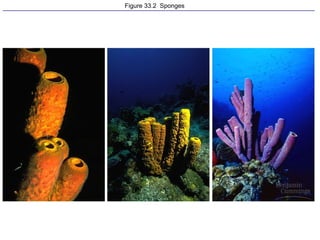
Figure 33.2  Sponges
Sponges (Phylum Porifera) the simplest of all animals
Sponges (Phylum Porifera) the simplest of all animals They have no organs of any kind
Sponges (Phylum Porifera) the simplest of all animals They have no organs of any kind They have no senses
Sponges (Phylum Porifera) the simplest of all animals They have no organs of any kind They have no senses So, what makes them an animal?
Sponges are animals because:
Sponges are animals because: they’re multicellular
Sponges are animals because: they’re multicellular their cells are differentiated and have specialized function s
Sponges are animals because: they’re multicellular their cells are differentiated and have specialized function s their cells have no cell walls
Sponges are animals because: they’re multicellular their cells are differentiated and have specialized function s their cells have no cell walls they’re heterotrophic
Sponges are animals because: they’re multicellular their cells are differentiated and have specialized function s their cells have no cell walls they’re heterotrophic their larvae are motile
Figure 33.3  Anatomy of a sponge
 
Sponges are filter feeders:
Sponges are filter feeders: makes sense for a sessile organism
Sponges are filter feeders: makes sense for a sessile organism collar cells have flagella that create a current which draws water through the pores
Sponges are filter feeders: makes sense for a sessile organism collar cells have flagella that create a current which draws water through the pores small particles get caught in collar cells
Sponges are filter feeders: makes sense for a sessile organism collar cells have flagella that create a current which draws water through the pores small particles get caught in collar cells special amoebocytes engulf particles
Sponges are filter feeders: makes sense for a sessile organism collar cells have flagella that create a current which draws water through the pores small particles get caught in collar cells special amoebocytes engulf particles amoebocytes are a link to the sponge protist ancestry
Sponges are filter feeders: makes sense for a sessile organism collar cells have flagella that create a current which draws water through the pores small particles get caught in collar cells special amoebocytes engulf particles amoebocytes are a link to the sponge protist ancestry also aid in reproduction and creating spicules
http://www.pbs.org/kcet/shapeoflife/episodes/origins_explo1.html
Sponge Spicules
Spicules are like a sponge’s skeleton
Spicules are like a sponge’s skeleton small, structures that come in a variety of shapes
Spicules are like a sponge’s skeleton small, structures that come in a variety of shapes often needle-like
Spicules are like a sponge’s skeleton small, structures that come in a variety of shapes often needle-like located between cell layers
Spicules are like a sponge’s skeleton small, structures that come in a variety of shapes often needle-like located between cell layers form a hard support system for the sponge’s body
 
Sponge reproduction
Sponge reproduction asexual
Sponge reproduction asexual sexual
Sponge reproduction asexual sexual budding
Sponge reproduction asexual sexual budding amazing powers of regeneration
Sponge reproduction asexual sexual budding amazing powers of regeneration hermaphrodites
Sponge reproduction asexual sexual budding amazing powers of regeneration hermaphrodites fertilization mostly internal
Sponges were likely the first true animal on planet Earth.
http://www.pbs.org/kcet/shapeoflife/episodes/origins_explo2.html

Sponges