Phylum Porifera
Sponges
A prerstation of Invertebrate diversity
By
Rooshana Sadaqat, Efza Khalid, Bushra and Khadija
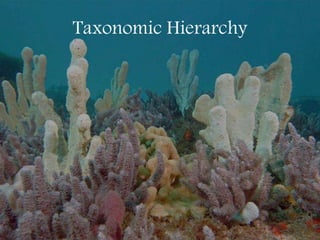
Taxonomic Hierarchy
Introduction
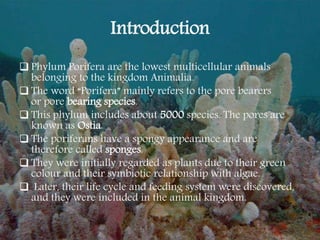
 Phylum Porifera are the lowest multicellular animals
belonging to the kingdom Animalia.
 The word “Porifera” mainly refers to the pore bearers
or pore bearing species.
 This phylum includes about 5000 species. The pores are
known as Ostia.
 The poriferans have a spongy appearance and are
therefore called sponges.
 They were initially regarded as plants due to their green
colour and their symbiotic relationship with algae.
 Later, their life cycle and feeding system were discovered,
and they were included in the animal kingdom.
Classification of Phylum Porifera
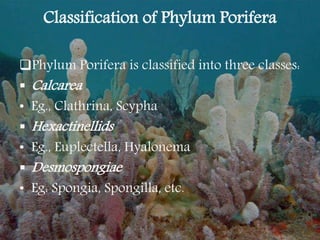
Phylum Porifera is classified into three classes:
 Calcarea
• Eg., Clathrina, Scypha
 Hexactinellids
• Eg., Euplectella, Hyalonema
 Desmospongiae
• Eg: Spongia, Spongilla, etc.
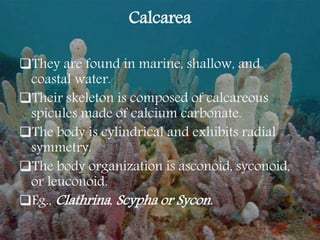
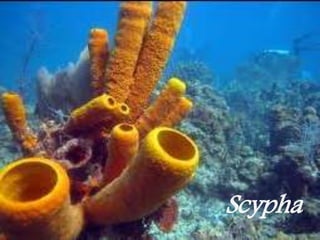
Calcarea
They are found in marine, shallow, and
coastal water.
Their skeleton is composed of calcareous
spicules made of calcium carbonate.
The body is cylindrical and exhibits radial
symmetry.
The body organization is asconoid, syconoid,
or leuconoid.
Eg., Clathrina, Scypha or Sycon.
Scypha
Hexactinellids
They are found in marine and the deep sea.
The skeleton is made up of six-rayed siliceous
spicules.
The body is cylindrical in shape and exhibit
radial symmetry.
The canal system is Sycon or Leucon.
Eg., Euplectella , Hyalonema.
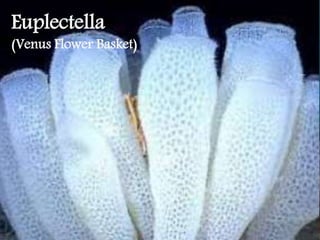
Euplectella
(Venus Flower Basket)
Desmospongiae
They are found in marine or freshwater.
The body is asymmetrical and cylindrical in
shape.
The canal system is a leuconoid type.
The skeleton comprises spongin fibres,
siliceous spicules, which are monoaxon and
triaxon.
Eg: Spongia, Spongilla, etc.
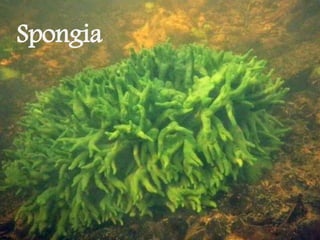
Spongia
Structure of Poriferans
They lack true tissues but have many cell types
that take on these functions.
Sponges are exclusively aquatic, filter feeders
that actively pump water through their bodies to
eat, breathe and excrete.
Sponges have special collar cells (or
choanocytes) that are unique in the animal
kingdom.
They have flagella, whip-like structures that
work to set up water currents so the sponge can
sieve food particles from the water.
The water comes in through an inhalant pore
and leaves the sponge via an exhalant pore.
The special cells of the sponge include those that
filter sea water; cells that are phagocytic (that
engulf and digest food particles); those that form
the external 'skin', breathing pores and tubes
through which water enters and leaves the body;
and those that secrete the mineral and organic
skeletons, called spicules and fibres, respectively.
Sponges are also unique because nearly all their
cells can change function as required
(totipotency).
Skeletons
Many species produce either silica (siliceous)
or calcium carbonate (calcitic) skeletons,
providing some structure to otherwise
basically shapeless growth forms.
Movement
Adult sponges are sessile and firmly attached
to the seabed, while the larvae are motile,
short- lived, and crawl across the seabed
before attaching to it and developing into
adults.
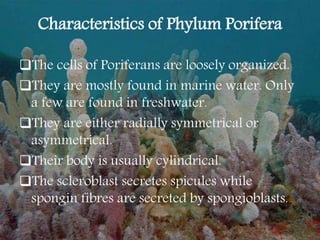
Characteristics of Phylum Porifera
The cells of Poriferans are loosely organized.
They are mostly found in marine water. Only
a few are found in freshwater.
They are either radially symmetrical or
asymmetrical.
Their body is usually cylindrical.
The scleroblast secretes spicules while
spongin fibres are secreted by spongioblasts.
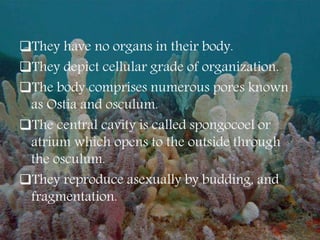
They have no organs in their body.
They depict cellular grade of organization.
The body comprises numerous pores known
as Ostia and osculum.
The central cavity is called spongocoel or
atrium which opens to the outside through
the osculum.
They reproduce asexually by budding, and
fragmentation.
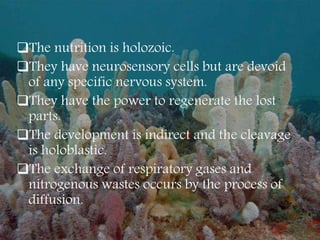
The nutrition is holozoic.
They have neurosensory cells but are devoid
of any specific nervous system.
They have the power to regenerate the lost
parts.
The development is indirect and the cleavage
is holoblastic.
The exchange of respiratory gases and
nitrogenous wastes occurs by the process of
diffusion.
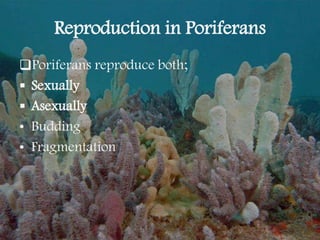
Reproduction in Poriferans
Poriferans reproduce both;
 Sexually
 Asexually
• Budding
• Fragmentation
Sexual Reproduction
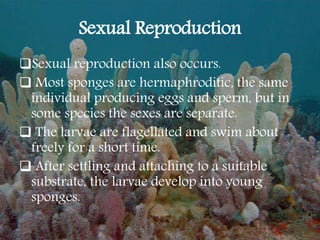
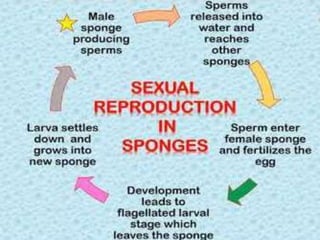
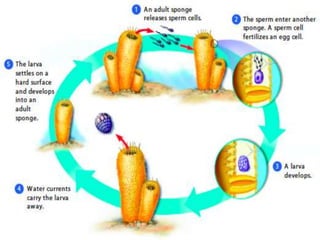
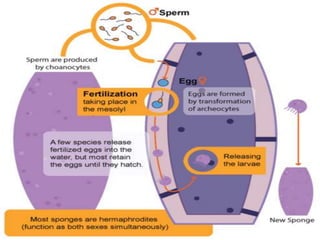
Sexual reproduction also occurs.
 Most sponges are hermaphroditic, the same
individual producing eggs and sperm, but in
some species the sexes are separate.
 The larvae are flagellated and swim about
freely for a short time.
 After settling and attaching to a suitable
substrate, the larvae develop into young
sponges.
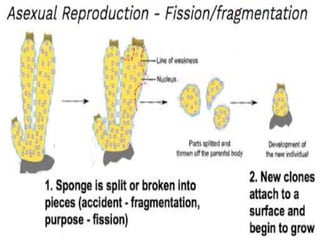
Asexual reproduction
Pieces of sponge are able to regenerate into whole new
sponges.
 Asexual reproduction occurs by budding or by
fragmentation.
The buds may remain attached to the parent or
separate from it, and each bud develops into a new
individual.
Freshwater sponges, as well as several marine species,
form resistant structures called gemmules that can
withstand adverse conditions such as drying or cold
and later develop into new individuals.
 Gemmules are aggregates of sponge tissue and food,
covered by a hard coating containing spicules or
spongin fibers.
s
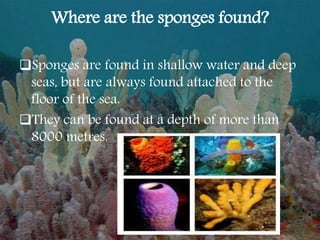
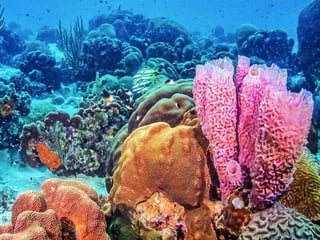
Where are the sponges found?
Sponges are found in shallow water and deep
seas, but are always found attached to the
floor of the sea.
They can be found at a depth of more than
8000 metres.
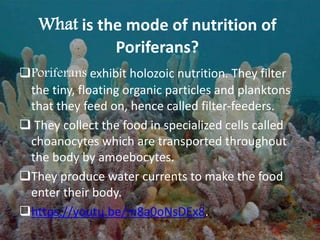
What is the mode of nutrition of
Poriferans?
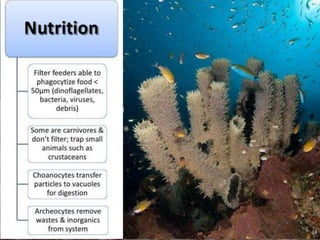
Poriferans exhibit holozoic nutrition. They filter
the tiny, floating organic particles and planktons
that they feed on, hence called filter-feeders.
 They collect the food in specialized cells called
choanocytes which are transported throughout
the body by amoebocytes.
They produce water currents to make the food
enter their body.
https://youtu.be/m8a0oNsDEx8.
Immune System
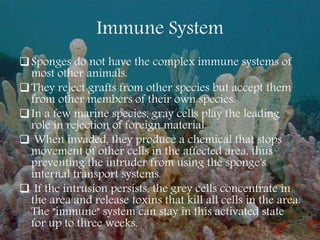
Sponges do not have the complex immune systems of
most other animals.
They reject grafts from other species but accept them
from other members of their own species.
In a few marine species, gray cells play the leading
role in rejection of foreign material.
 When invaded, they produce a chemical that stops
movement of other cells in the affected area, thus
preventing the intruder from using the sponge's
internal transport systems.
 If the intrusion persists, the grey cells concentrate in
the area and release toxins that kill all cells in the area.
The "immune" system can stay in this activated state
for up to three weeks.
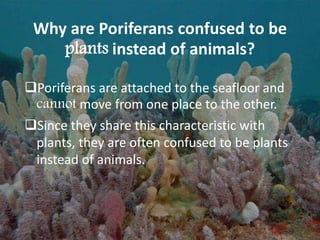
Why are Poriferans confused to be
plants instead of animals?
Poriferans are attached to the seafloor and
cannot move from one place to the other.
Since they share this characteristic with
plants, they are often confused to be plants
instead of animals.
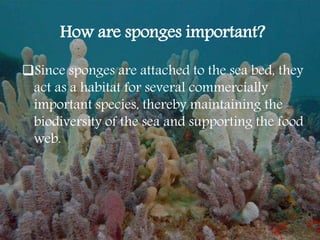
How are sponges important?
Since sponges are attached to the sea bed, they
act as a habitat for several commercially
important species, thereby maintaining the
biodiversity of the sea and supporting the food
web.
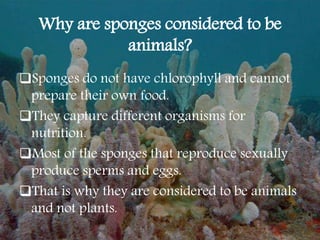
Why are sponges considered to be
animals?
Sponges do not have chlorophyll and cannot
prepare their own food.
They capture different organisms for
nutrition.
Most of the sponges that reproduce sexually
produce sperms and eggs.
That is why they are considered to be animals
and not plants.
Thank you!

Phylum porifera

  • 2.
    Phylum Porifera Sponges A prerstationof Invertebrate diversity By Rooshana Sadaqat, Efza Khalid, Bushra and Khadija
  • 3.
  • 4.
    Introduction  Phylum Poriferaare the lowest multicellular animals belonging to the kingdom Animalia.  The word “Porifera” mainly refers to the pore bearers or pore bearing species.  This phylum includes about 5000 species. The pores are known as Ostia.  The poriferans have a spongy appearance and are therefore called sponges.  They were initially regarded as plants due to their green colour and their symbiotic relationship with algae.  Later, their life cycle and feeding system were discovered, and they were included in the animal kingdom.
  • 5.
    Classification of PhylumPorifera Phylum Porifera is classified into three classes:  Calcarea • Eg., Clathrina, Scypha  Hexactinellids • Eg., Euplectella, Hyalonema  Desmospongiae • Eg: Spongia, Spongilla, etc.
  • 6.
    Calcarea They are foundin marine, shallow, and coastal water. Their skeleton is composed of calcareous spicules made of calcium carbonate. The body is cylindrical and exhibits radial symmetry. The body organization is asconoid, syconoid, or leuconoid. Eg., Clathrina, Scypha or Sycon.
  • 7.
  • 8.
    Hexactinellids They are foundin marine and the deep sea. The skeleton is made up of six-rayed siliceous spicules. The body is cylindrical in shape and exhibit radial symmetry. The canal system is Sycon or Leucon. Eg., Euplectella , Hyalonema.
  • 9.
  • 10.
    Desmospongiae They are foundin marine or freshwater. The body is asymmetrical and cylindrical in shape. The canal system is a leuconoid type. The skeleton comprises spongin fibres, siliceous spicules, which are monoaxon and triaxon. Eg: Spongia, Spongilla, etc.
  • 11.
  • 12.
    Structure of Poriferans Theylack true tissues but have many cell types that take on these functions. Sponges are exclusively aquatic, filter feeders that actively pump water through their bodies to eat, breathe and excrete. Sponges have special collar cells (or choanocytes) that are unique in the animal kingdom. They have flagella, whip-like structures that work to set up water currents so the sponge can sieve food particles from the water.
  • 13.
    The water comesin through an inhalant pore and leaves the sponge via an exhalant pore. The special cells of the sponge include those that filter sea water; cells that are phagocytic (that engulf and digest food particles); those that form the external 'skin', breathing pores and tubes through which water enters and leaves the body; and those that secrete the mineral and organic skeletons, called spicules and fibres, respectively. Sponges are also unique because nearly all their cells can change function as required (totipotency).
  • 14.
    Skeletons Many species produceeither silica (siliceous) or calcium carbonate (calcitic) skeletons, providing some structure to otherwise basically shapeless growth forms.
  • 15.
    Movement Adult sponges aresessile and firmly attached to the seabed, while the larvae are motile, short- lived, and crawl across the seabed before attaching to it and developing into adults.
  • 16.
    Characteristics of PhylumPorifera The cells of Poriferans are loosely organized. They are mostly found in marine water. Only a few are found in freshwater. They are either radially symmetrical or asymmetrical. Their body is usually cylindrical. The scleroblast secretes spicules while spongin fibres are secreted by spongioblasts.
  • 17.
    They have noorgans in their body. They depict cellular grade of organization. The body comprises numerous pores known as Ostia and osculum. The central cavity is called spongocoel or atrium which opens to the outside through the osculum. They reproduce asexually by budding, and fragmentation.
  • 18.
    The nutrition isholozoic. They have neurosensory cells but are devoid of any specific nervous system. They have the power to regenerate the lost parts. The development is indirect and the cleavage is holoblastic. The exchange of respiratory gases and nitrogenous wastes occurs by the process of diffusion.
  • 19.
    Reproduction in Poriferans Poriferansreproduce both;  Sexually  Asexually • Budding • Fragmentation
  • 20.
    Sexual Reproduction Sexual reproductionalso occurs.  Most sponges are hermaphroditic, the same individual producing eggs and sperm, but in some species the sexes are separate.  The larvae are flagellated and swim about freely for a short time.  After settling and attaching to a suitable substrate, the larvae develop into young sponges.
  • 24.
    Asexual reproduction Pieces ofsponge are able to regenerate into whole new sponges.  Asexual reproduction occurs by budding or by fragmentation. The buds may remain attached to the parent or separate from it, and each bud develops into a new individual. Freshwater sponges, as well as several marine species, form resistant structures called gemmules that can withstand adverse conditions such as drying or cold and later develop into new individuals.  Gemmules are aggregates of sponge tissue and food, covered by a hard coating containing spicules or spongin fibers.
  • 25.
  • 26.
    Where are thesponges found? Sponges are found in shallow water and deep seas, but are always found attached to the floor of the sea. They can be found at a depth of more than 8000 metres.
  • 28.
    What is themode of nutrition of Poriferans? Poriferans exhibit holozoic nutrition. They filter the tiny, floating organic particles and planktons that they feed on, hence called filter-feeders.  They collect the food in specialized cells called choanocytes which are transported throughout the body by amoebocytes. They produce water currents to make the food enter their body. https://youtu.be/m8a0oNsDEx8.
  • 29.
    Immune System Sponges donot have the complex immune systems of most other animals. They reject grafts from other species but accept them from other members of their own species. In a few marine species, gray cells play the leading role in rejection of foreign material.  When invaded, they produce a chemical that stops movement of other cells in the affected area, thus preventing the intruder from using the sponge's internal transport systems.  If the intrusion persists, the grey cells concentrate in the area and release toxins that kill all cells in the area. The "immune" system can stay in this activated state for up to three weeks.
  • 31.
    Why are Poriferansconfused to be plants instead of animals? Poriferans are attached to the seafloor and cannot move from one place to the other. Since they share this characteristic with plants, they are often confused to be plants instead of animals.
  • 32.
    How are spongesimportant? Since sponges are attached to the sea bed, they act as a habitat for several commercially important species, thereby maintaining the biodiversity of the sea and supporting the food web.
  • 33.
    Why are spongesconsidered to be animals? Sponges do not have chlorophyll and cannot prepare their own food. They capture different organisms for nutrition. Most of the sponges that reproduce sexually produce sperms and eggs. That is why they are considered to be animals and not plants.
  • 35.