Regulating the Cell Cycle miller 10.3
Controls on Cell Division How is the cell cycle regulated?
Controls on Cell Division How is the cell cycle regulated? by regulatory proteins both inside and outside the cell
Controls on Cell Division How is the cell cycle regulated? by regulatory proteins both inside and outside the cell. these chemicals can turn cell growth signals on or off
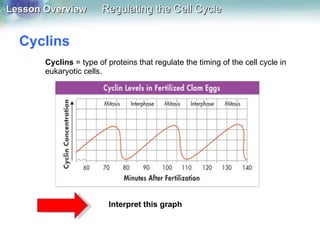
Cyclins Cyclins  = type of proteins that regulate the timing of the cell cycle in eukaryotic cells. Interpret this graph
When might cell growth need to be stimulated?
an injury can stimulate cell growth to heal the damage When might cell growth need to be stimulated?
Cancer:  Uncontrolled Cell Growth How do cancer cells differ from other cells?
Cancer:  Uncontrolled Cell Growth How do cancer cells differ from other cells?   ✓ do not respond to signals that regulate growth of most cells
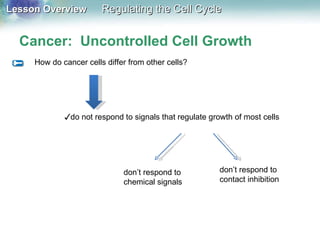
Cancer:  Uncontrolled Cell Growth How do cancer cells differ from other cells?   ✓ do not respond to signals that regulate growth of most cells don’t respond to chemical signals don’t respond to contact inhibition
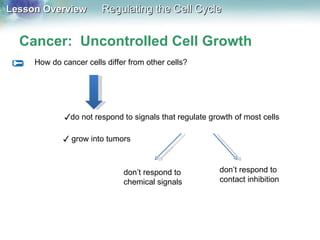
Cancer:  Uncontrolled Cell Growth How do cancer cells differ from other cells?   ✓ do not respond to signals that regulate growth of most cells ✓   grow into tumors don’t respond to chemical signals don’t respond to contact inhibition
Contact Inhibition
 
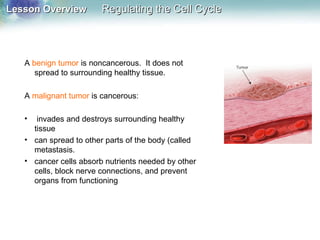
Tumors A  benign tumor  is noncancerous.  It does not spread to surrounding healthy tissue. A  malignant tumor  is cancerous.
A  benign tumor  is noncancerous.  It does not spread to surrounding healthy tissue. A  malignant tumor  is cancerous: invades and destroys surrounding healthy tissue
A  benign tumor  is noncancerous.  It does not spread to surrounding healthy tissue. A  malignant tumor  is cancerous: invades and destroys surrounding healthy tissue can spread to other parts of the body (called metastasis)
A  benign tumor  is noncancerous.  It does not spread to surrounding healthy tissue. A  malignant tumor  is cancerous: invades and destroys surrounding healthy tissue can spread to other parts of the body (called metastasis.  cancer cells absorb nutrients needed by other cells, block nerve connections, and prevent organs from functioning
 
 
What Causes Cancer? Cancers  are caused by defects in genes that regulate cell growth and division.
What Causes Cancer? Cancers  are caused by defects in genes that regulate cell growth and division. gene called “p53” is commonly involved
What Causes Cancer? Cancers  are caused by defects in genes that regulate cell growth and division. gene called “p53” is commonly involved exposure to certain chemicals (from smoking, radiation, viruses for example) can damage genes
end of part 1

Regulating the Cell Cycle

  • 1.
    Regulating the CellCycle miller 10.3
  • 2.
    Controls on CellDivision How is the cell cycle regulated?
  • 3.
    Controls on CellDivision How is the cell cycle regulated? by regulatory proteins both inside and outside the cell
  • 4.
    Controls on CellDivision How is the cell cycle regulated? by regulatory proteins both inside and outside the cell. these chemicals can turn cell growth signals on or off
  • 5.
    Cyclins Cyclins = type of proteins that regulate the timing of the cell cycle in eukaryotic cells. Interpret this graph
  • 6.
    When might cellgrowth need to be stimulated?
  • 7.
    an injury canstimulate cell growth to heal the damage When might cell growth need to be stimulated?
  • 8.
    Cancer: UncontrolledCell Growth How do cancer cells differ from other cells?
  • 9.
    Cancer: UncontrolledCell Growth How do cancer cells differ from other cells?   ✓ do not respond to signals that regulate growth of most cells
  • 10.
    Cancer: UncontrolledCell Growth How do cancer cells differ from other cells?   ✓ do not respond to signals that regulate growth of most cells don’t respond to chemical signals don’t respond to contact inhibition
  • 11.
    Cancer: UncontrolledCell Growth How do cancer cells differ from other cells?   ✓ do not respond to signals that regulate growth of most cells ✓ grow into tumors don’t respond to chemical signals don’t respond to contact inhibition
  • 12.
  • 13.
  • 14.
    Tumors A benign tumor is noncancerous. It does not spread to surrounding healthy tissue. A malignant tumor is cancerous.
  • 15.
    A benigntumor is noncancerous. It does not spread to surrounding healthy tissue. A malignant tumor is cancerous: invades and destroys surrounding healthy tissue
  • 16.
    A benigntumor is noncancerous. It does not spread to surrounding healthy tissue. A malignant tumor is cancerous: invades and destroys surrounding healthy tissue can spread to other parts of the body (called metastasis)
  • 17.
    A benigntumor is noncancerous. It does not spread to surrounding healthy tissue. A malignant tumor is cancerous: invades and destroys surrounding healthy tissue can spread to other parts of the body (called metastasis. cancer cells absorb nutrients needed by other cells, block nerve connections, and prevent organs from functioning
  • 18.
  • 19.
  • 20.
    What Causes Cancer?Cancers are caused by defects in genes that regulate cell growth and division.
  • 21.
    What Causes Cancer?Cancers are caused by defects in genes that regulate cell growth and division. gene called “p53” is commonly involved
  • 22.
    What Causes Cancer?Cancers are caused by defects in genes that regulate cell growth and division. gene called “p53” is commonly involved exposure to certain chemicals (from smoking, radiation, viruses for example) can damage genes
  • 23.