Phylum Porifera


                  1
Phylum Porifera
•   Multicellular
•   Body with pores (ostia)
•   No organs or true tissues.
•   No nervous system
•   Adults sessile & attached to
    substratum.
•   Skeleton of calcareous
    spicules, siliceous spicules,
    spongin or a combination.
•   All aquatic, mostly marine.


                                    2
Phylum Porifera


•   Composed of 3 layers
     – outer layer of flattened contractile cells (pinacocytes)
     – inner non-living mesoglea containing a variety of specialized cells
     – collar cells (choanocytes) which capture food, etc. from water flowing through
       channels.
•   Exhibit asymmetry or radial symmetry.
•   Reproduction - asexual by buds & gemmules. Sexual by eggs & sperm.

                                                                                        3
Copyright © The McGraw-Hill Companies, Inc. Permission required for reproduction or display.


Simple Sponge Morphology


                                                                                                           4
Copyright © The McGraw-Hill Companies, Inc. Permission required for reproduction or display.


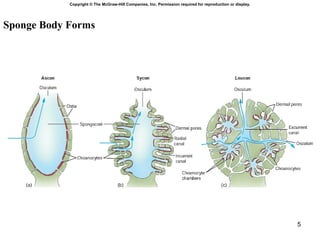
Sponge Body Forms


                                                                                                           5
6
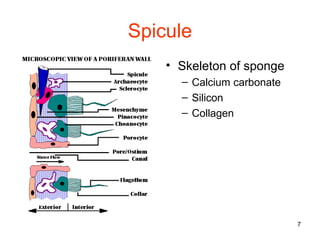
Spicule
    • Skeleton of sponge
      – Calcium carbonate
      – Silicon
      – Collagen


                            7
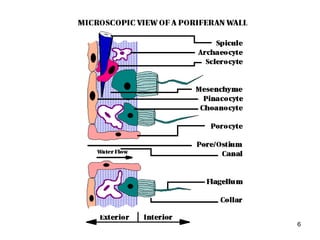
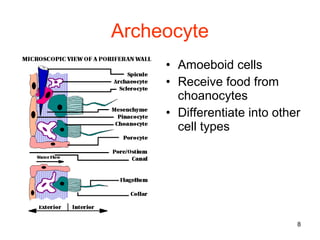
Archeocyte
     • Amoeboid cells
     • Receive food from
       choanocytes
     • Differentiate into other
       cell types


                              8
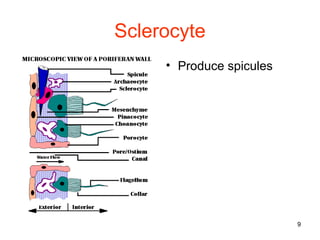
Sclerocyte
     • Produce spicules


                          9
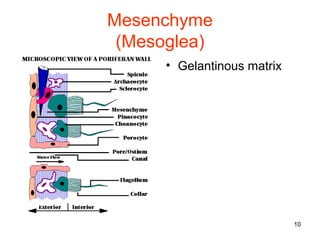
Mesenchyme
 (Mesoglea)
      • Gelantinous matrix


                             10
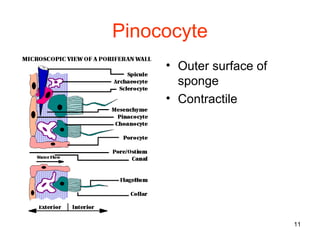
Pinococyte
     • Outer surface of
       sponge
     • Contractile


                          11
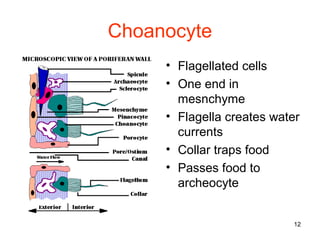
Choanocyte
     • Flagellated cells
     • One end in
       mesnchyme
     • Flagella creates water
       currents
     • Collar traps food
     • Passes food to
       archeocyte


                           12
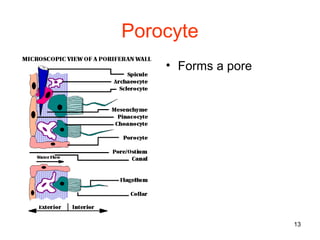
Porocyte
    • Forms a pore


                     13
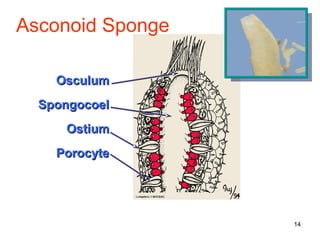
Asconoid Sponge

    Osculum
  Spongocoel
     Ostium
    Porocyte


                  14
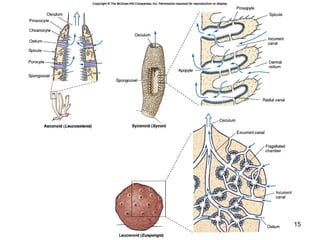
Fig. 12.5


            15
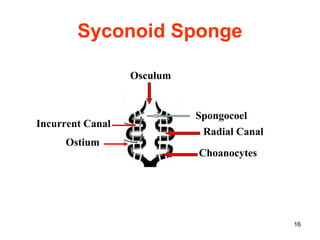
Syconoid Sponge

                  Osculum


                            Spongocoel
Incurrent Canal
                             Radial Canal
     Ostium
                            Choanocytes


                                            16
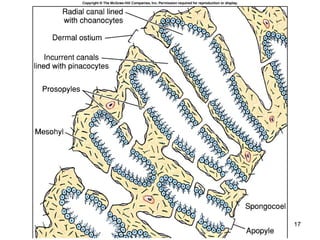
Fig. 12.7


            17
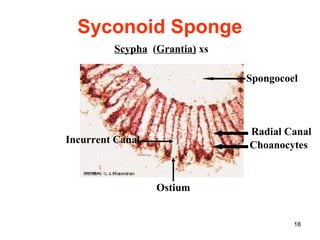
Syconoid Sponge
         Scypha (Grantia) xs

                               Spongocoel


                               Radial Canal
Incurrent Canal                Choanocytes


                  Ostium


                                        18
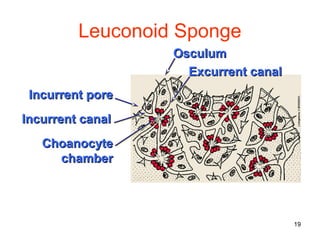
Leuconoid Sponge
                  Osculum
                    Excurrent canal
 Incurrent pore
Incurrent canal
   Choanocyte
     chamber


                                      19
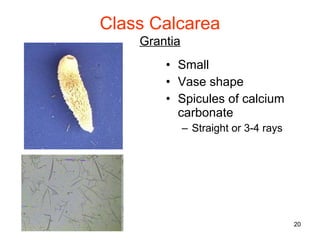
Class Calcarea
    Grantia
        • Small
        • Vase shape
        • Spicules of calcium
          carbonate
              – Straight or 3-4 rays


                                       20
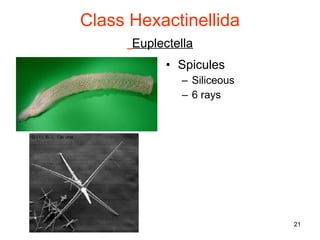
Class Hexactinellida
      Euplectella
            • Spicules
               – Siliceous
               – 6 rays


                             21
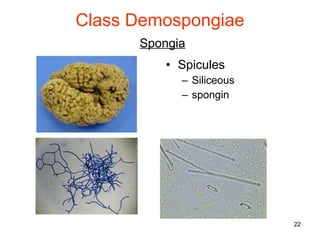
Class Demospongiae
      Spongia
          • Spicules
            – Siliceous
            – spongin


                          22
23
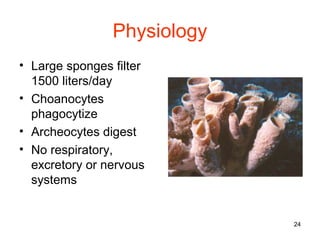
Physiology
• Large sponges filter
  1500 liters/day
• Choanocytes
  phagocytize
• Archeocytes digest
• No respiratory,
  excretory or nervous
  systems


                             24
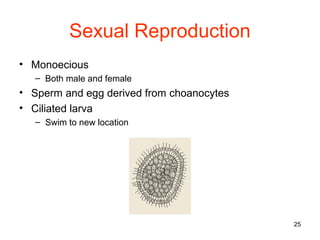
Sexual Reproduction
• Monoecious
   – Both male and female
• Sperm and egg derived from choanocytes
• Ciliated larva
   – Swim to new location


                                           25
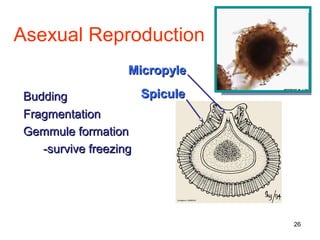
Asexual Reproduction
                  Micropyle

Budding              Spicule
Fragmentation
Gemmule formation
   -survive freezing


                               26
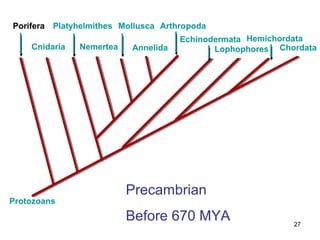
Porifera Platyhelmithes Mollusca Arthropoda
                                     Echinodermata Hemichordata
    Cnidaria   Nemertea   Annelida          Lophophores Chordata


                          Precambrian
Protozoans
                          Before 670 MYA                   27
Copyright © The McGraw-Hill Companies, Inc. Permission required for reproduction or display.


Hypothesis of Multicellularity


                                                                                                             28
CO 12   The
        End


              29

Zoology- Phylum Porifera

  • 1.
  • 2.
    Phylum Porifera • Multicellular • Body with pores (ostia) • No organs or true tissues. • No nervous system • Adults sessile & attached to substratum. • Skeleton of calcareous spicules, siliceous spicules, spongin or a combination. • All aquatic, mostly marine. 2
  • 3.
    Phylum Porifera • Composed of 3 layers – outer layer of flattened contractile cells (pinacocytes) – inner non-living mesoglea containing a variety of specialized cells – collar cells (choanocytes) which capture food, etc. from water flowing through channels. • Exhibit asymmetry or radial symmetry. • Reproduction - asexual by buds & gemmules. Sexual by eggs & sperm. 3
  • 4.
    Copyright © TheMcGraw-Hill Companies, Inc. Permission required for reproduction or display. Simple Sponge Morphology 4
  • 5.
    Copyright © TheMcGraw-Hill Companies, Inc. Permission required for reproduction or display. Sponge Body Forms 5
  • 6.
  • 7.
    Spicule • Skeleton of sponge – Calcium carbonate – Silicon – Collagen 7
  • 8.
    Archeocyte • Amoeboid cells • Receive food from choanocytes • Differentiate into other cell types 8
  • 9.
    Sclerocyte • Produce spicules 9
  • 10.
    Mesenchyme (Mesoglea) • Gelantinous matrix 10
  • 11.
    Pinococyte • Outer surface of sponge • Contractile 11
  • 12.
    Choanocyte • Flagellated cells • One end in mesnchyme • Flagella creates water currents • Collar traps food • Passes food to archeocyte 12
  • 13.
    Porocyte • Forms a pore 13
  • 14.
    Asconoid Sponge Osculum Spongocoel Ostium Porocyte 14
  • 15.
  • 16.
    Syconoid Sponge Osculum Spongocoel Incurrent Canal Radial Canal Ostium Choanocytes 16
  • 17.
  • 18.
    Syconoid Sponge Scypha (Grantia) xs Spongocoel Radial Canal Incurrent Canal Choanocytes Ostium 18
  • 19.
    Leuconoid Sponge Osculum Excurrent canal Incurrent pore Incurrent canal Choanocyte chamber 19
  • 20.
    Class Calcarea Grantia • Small • Vase shape • Spicules of calcium carbonate – Straight or 3-4 rays 20
  • 21.
    Class Hexactinellida Euplectella • Spicules – Siliceous – 6 rays 21
  • 22.
    Class Demospongiae Spongia • Spicules – Siliceous – spongin 22
  • 23.
  • 24.
    Physiology • Large spongesfilter 1500 liters/day • Choanocytes phagocytize • Archeocytes digest • No respiratory, excretory or nervous systems 24
  • 25.
    Sexual Reproduction • Monoecious – Both male and female • Sperm and egg derived from choanocytes • Ciliated larva – Swim to new location 25
  • 26.
    Asexual Reproduction Micropyle Budding Spicule Fragmentation Gemmule formation -survive freezing 26
  • 27.
    Porifera Platyhelmithes MolluscaArthropoda Echinodermata Hemichordata Cnidaria Nemertea Annelida Lophophores Chordata Precambrian Protozoans Before 670 MYA 27
  • 28.
    Copyright © TheMcGraw-Hill Companies, Inc. Permission required for reproduction or display. Hypothesis of Multicellularity 28
  • 29.
    CO 12 The End 29

Editor's Notes