Evolution not just a theory
Miller-Urey, 1953 amino acids, sugars, etc. were produced other mixtures led to formation of nucleotide bases
Protenoids heating organic components to high temps results in structures with a protein like properties (Fox) some engaged in enzyme like behavior (splitting and bonding) some in hormone-like behavior (melanin production) when allowed to cool, some developed a double membrane and selective permeability different in many ways from actual proteins, however
“ Self-Assembly” take the proteins and nucleic acid components of the tobacco mosaic virus together in the right conditions and they spontaneously aggregate into the structure needed to produce the virus components of ribosomes will self-aggregate (Nomura) components of RNA will self-aggregate synthetic RNA will self-replicate (Joyce)
Endosymbiont Hypothesis Chloroplasts and Mitochondria: have their own DNA and their own ribosomes
Endosymbiont Hypothesis Chloroplasts and Mitochondria: have their own DNA and their own ribosomes ribosome structure is different than the ribosomes of eukaryotes
Endosymbiont Hypothesis Chloroplasts and Mitochondria: have their own DNA and their own ribosomes reproduce independently of the cell ribosome structure is different than the ribosomes of eukaryotes
Endosymbiont Hypothesis Chloroplasts and Mitochondria: have their own DNA and their own ribosomes reproduce independently of the cell cells have no other way to make them ribosome structure is different than the ribosomes of eukaryotes
Endosymbiont Hypothesis (cont’d) Chloroplasts and Mitochondria have structural  similarities to:
Endosymbiont Hypothesis (cont’d) Chloroplasts and Mitochondria have structural  similarities to: cyanobacteria
Endosymbiont Hypothesis (cont’d) Chloroplasts and Mitochondria have structural  similarities to: cyanobacteria bacteria
Endosymbiont Hypothesis (cont’d) Chloroplasts and Mitochondria have structural  similarities to: cyanobacteria (autotrophs) bacteria (heterotrophs) Hypothesis :  chloroplasts and mitochondria are descendents of some kind of ancient bacteria
Sugar Rays: the evolution of photosynthesis http://www.pubinfo.vcu.edu/secretsofthesequence/search_frame.asp click the black box to begin movie
end of part 1
part 2
Darwin’s theory of evolution by natural selection
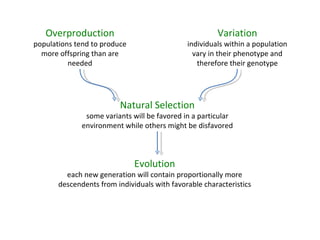
Overproduction populations tend to produce more offspring than are needed Variation individuals within a population vary in their phenotype and therefore their genotype Natural Selection some variants will be favored in a particular environment while others might be disfavored Evolution each new generation will contain proportionally more descendents from individuals with favorable characteristics
Individuals do NOT evolve!!! . . . but  populations  do.
 

Evolution

  • 1.
  • 2.
    Miller-Urey, 1953 aminoacids, sugars, etc. were produced other mixtures led to formation of nucleotide bases
  • 3.
    Protenoids heating organiccomponents to high temps results in structures with a protein like properties (Fox) some engaged in enzyme like behavior (splitting and bonding) some in hormone-like behavior (melanin production) when allowed to cool, some developed a double membrane and selective permeability different in many ways from actual proteins, however
  • 4.
    “ Self-Assembly” takethe proteins and nucleic acid components of the tobacco mosaic virus together in the right conditions and they spontaneously aggregate into the structure needed to produce the virus components of ribosomes will self-aggregate (Nomura) components of RNA will self-aggregate synthetic RNA will self-replicate (Joyce)
  • 5.
    Endosymbiont Hypothesis Chloroplastsand Mitochondria: have their own DNA and their own ribosomes
  • 6.
    Endosymbiont Hypothesis Chloroplastsand Mitochondria: have their own DNA and their own ribosomes ribosome structure is different than the ribosomes of eukaryotes
  • 7.
    Endosymbiont Hypothesis Chloroplastsand Mitochondria: have their own DNA and their own ribosomes reproduce independently of the cell ribosome structure is different than the ribosomes of eukaryotes
  • 8.
    Endosymbiont Hypothesis Chloroplastsand Mitochondria: have their own DNA and their own ribosomes reproduce independently of the cell cells have no other way to make them ribosome structure is different than the ribosomes of eukaryotes
  • 9.
    Endosymbiont Hypothesis (cont’d)Chloroplasts and Mitochondria have structural similarities to:
  • 10.
    Endosymbiont Hypothesis (cont’d)Chloroplasts and Mitochondria have structural similarities to: cyanobacteria
  • 11.
    Endosymbiont Hypothesis (cont’d)Chloroplasts and Mitochondria have structural similarities to: cyanobacteria bacteria
  • 12.
    Endosymbiont Hypothesis (cont’d)Chloroplasts and Mitochondria have structural similarities to: cyanobacteria (autotrophs) bacteria (heterotrophs) Hypothesis : chloroplasts and mitochondria are descendents of some kind of ancient bacteria
  • 13.
    Sugar Rays: theevolution of photosynthesis http://www.pubinfo.vcu.edu/secretsofthesequence/search_frame.asp click the black box to begin movie
  • 14.
  • 15.
  • 16.
    Darwin’s theory ofevolution by natural selection
  • 17.
    Overproduction populations tendto produce more offspring than are needed Variation individuals within a population vary in their phenotype and therefore their genotype Natural Selection some variants will be favored in a particular environment while others might be disfavored Evolution each new generation will contain proportionally more descendents from individuals with favorable characteristics
  • 18.
    Individuals do NOTevolve!!! . . . but populations do.
  • 19.