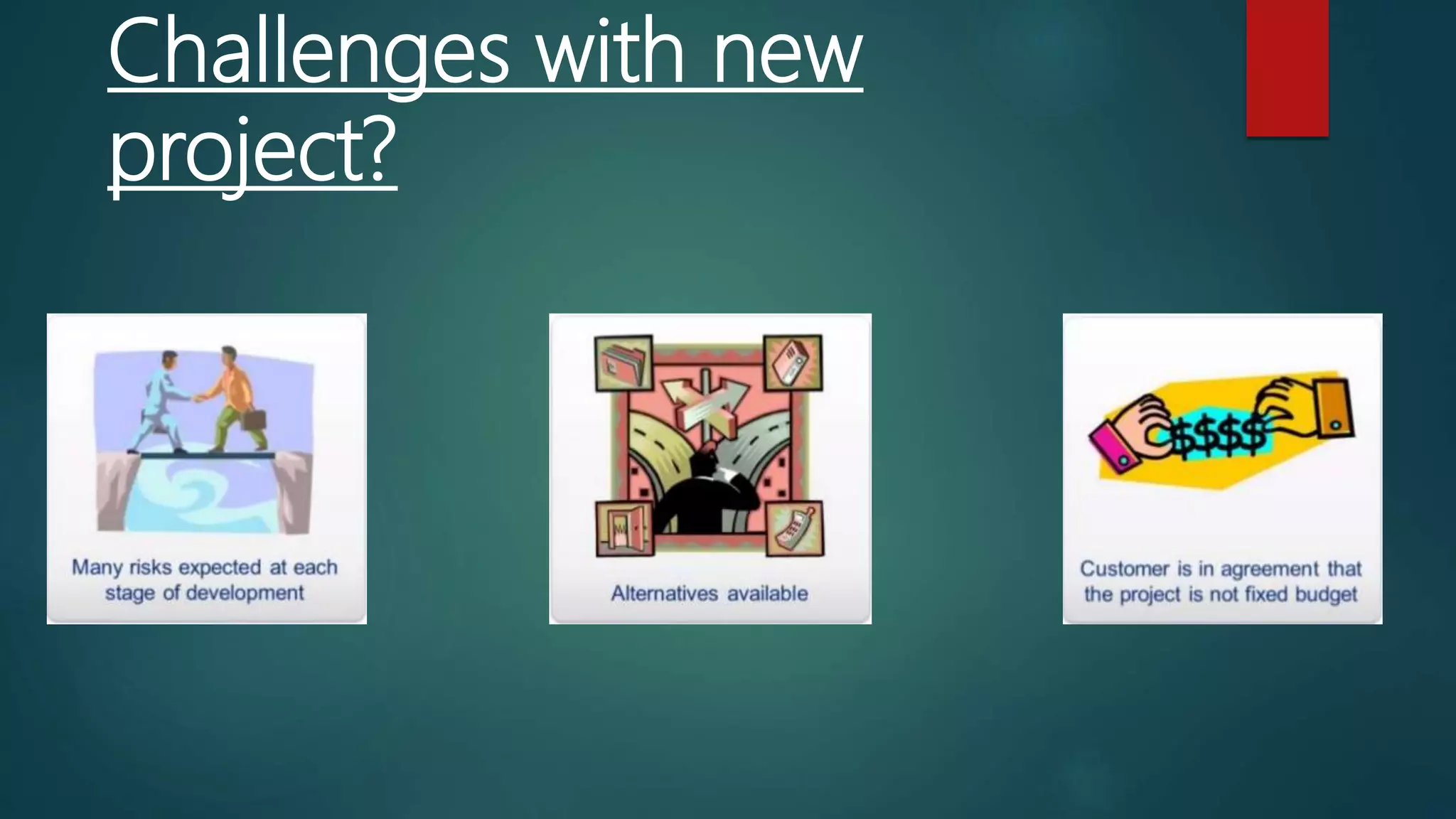
Challenges with new
project?
What is Spiral Model ?
 The Spiral Development ( or Lifecycle) Model is a systems
development method used in information technology.
 It combines the features of the prototyping model and
the waterfall model.
 It is favored for large, expensive, and complicated
models.
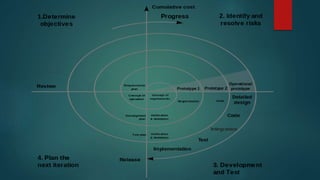
Spiral quadrant : 1
 Objectives: functionality, performance, hardware/software
interface, critical success factors, etc.
 Alternatives: build, reuse, buy, sub-contract, etc.
 Constraints: cost, schedule, interface, etc.
Spiral quadrant : 2
 Study alternatives relative to objectives and constraints
 Identify risks (lack of experience, new technology, tight
schedules, poor process, etc.
 Resolve risks (evaluate if money could be lost by continuing
system development
Spiral quadrant : 3
 Typical activities:
 Create a design
 Review design
 Develop code
 Inspect code
 Test product
Spiral quadrant : 4
 Typical activities:
 Develop project plan
 Develop configuration management plan
 Develop a test plan
 Develop an installation plan
Why are we discussing spiral Model?
 Case Study
 Galaxy Inc. tried to develop a satellite based communication between
mobile handsets.
 The system would work through six dozen of satellites.
 Communication also possible in areas like arctic and Antarctica.
 Any call can be made in the satellite range.
When to use spiral model
 Long-term project commitment unwise because of potential
changes to economic priorities.
 Users are unsure of their needs.
 Requirements are complex.
 New product line .
 Significant changes are expected (research and exploration).
Challenges ahead Galaxy Inc.
 Risks were enormous.
 No publishes material or experienced staff.
 Risks will be identified once the projects kicks off.
 Several million of code had to be written.
What Galaxy Inc. did?
 They had to hire staff that is experienced enough for the project.
 Had to gather the matter and work on the proceedings.
 The transparencies were maintained in respect of the views and
opinions of people.
 They decided to run parallel to SPIRAL model.
When to use spiral model
 Long-term project commitment unwise because of potential
changes to economic priorities.
 Users are unsure of their needs.
 Requirements are complex.
 New product line .
 Significant changes are expected (research and exploration).
Advantages (strengths)
 Estimates of the budget and schedule become more realistic as
work progresses because of the questions that have been raised
 Easier to cope with the changes inherent to software development
 Software engineers can start working on the project earlier rather
than wading through a lengthy early design process.
Disadvantages (weaknesses)
 Time spent for evaluating risks too large for small or low-risk
projects.
 Time spent planning, resetting objectives, doing risk analysis and
prototyping may be excessive.
 The model is complex.
 Risk assessment expertise is required.
Spiral Model in Software Engineering with Case Study

Spiral Model in Software Engineering with Case Study

  • 1.
  • 2.
    What is SpiralModel ?  The Spiral Development ( or Lifecycle) Model is a systems development method used in information technology.  It combines the features of the prototyping model and the waterfall model.  It is favored for large, expensive, and complicated models.
  • 4.
    Spiral quadrant :1  Objectives: functionality, performance, hardware/software interface, critical success factors, etc.  Alternatives: build, reuse, buy, sub-contract, etc.  Constraints: cost, schedule, interface, etc.
  • 5.
    Spiral quadrant :2  Study alternatives relative to objectives and constraints  Identify risks (lack of experience, new technology, tight schedules, poor process, etc.  Resolve risks (evaluate if money could be lost by continuing system development
  • 6.
    Spiral quadrant :3  Typical activities:  Create a design  Review design  Develop code  Inspect code  Test product
  • 7.
    Spiral quadrant :4  Typical activities:  Develop project plan  Develop configuration management plan  Develop a test plan  Develop an installation plan
  • 8.
    Why are wediscussing spiral Model?  Case Study  Galaxy Inc. tried to develop a satellite based communication between mobile handsets.  The system would work through six dozen of satellites.  Communication also possible in areas like arctic and Antarctica.  Any call can be made in the satellite range.
  • 9.
    When to usespiral model  Long-term project commitment unwise because of potential changes to economic priorities.  Users are unsure of their needs.  Requirements are complex.  New product line .  Significant changes are expected (research and exploration).
  • 10.
    Challenges ahead GalaxyInc.  Risks were enormous.  No publishes material or experienced staff.  Risks will be identified once the projects kicks off.  Several million of code had to be written.
  • 11.
    What Galaxy Inc.did?  They had to hire staff that is experienced enough for the project.  Had to gather the matter and work on the proceedings.  The transparencies were maintained in respect of the views and opinions of people.  They decided to run parallel to SPIRAL model.
  • 12.
    When to usespiral model  Long-term project commitment unwise because of potential changes to economic priorities.  Users are unsure of their needs.  Requirements are complex.  New product line .  Significant changes are expected (research and exploration).
  • 13.
    Advantages (strengths)  Estimatesof the budget and schedule become more realistic as work progresses because of the questions that have been raised  Easier to cope with the changes inherent to software development  Software engineers can start working on the project earlier rather than wading through a lengthy early design process.
  • 14.
    Disadvantages (weaknesses)  Timespent for evaluating risks too large for small or low-risk projects.  Time spent planning, resetting objectives, doing risk analysis and prototyping may be excessive.  The model is complex.  Risk assessment expertise is required.