©UFS
©UFS

Insurance and Regulatory Risk
A U.S. G-SII Perspective
Insurance Risk North America Conference
November 5, 2013

Stanley J. Talbi
Executive VP and Chief Risk Officer
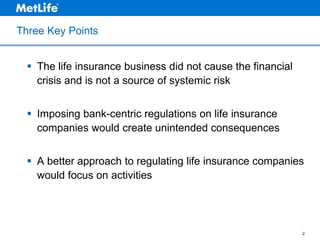
Three Key Points
 The life insurance business did not cause the financial
crisis and is not a source of systemic risk
 Imposing bank-centric regulations on life insurance
companies would create unintended consequences

 A better approach to regulating life insurance companies
would focus on activities

2
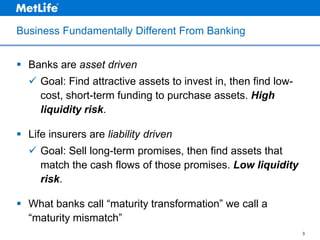
Business Fundamentally Different From Banking
 Banks are asset driven
 Goal: Find attractive assets to invest in, then find lowcost, short-term funding to purchase assets. High
liquidity risk.
 Life insurers are liability driven
 Goal: Sell long-term promises, then find assets that
match the cash flows of those promises. Low liquidity
risk.
 What banks call “maturity transformation” we call a
“maturity mismatch”
3
Life insurance not Systemic
 There has never been a systemic event in the traditional
insurance space
 Executive Life (U.S.)

 Mutual Benefit (U.S.)
 General American (U.S.)
 Confederation Life (Canada)
 Kyoei (Japan)
 Equitable (U.K.)

4
Impact of IAIS/FSB Framework on a U.S. G-SII,
 MetLife was named a G-SII and is being assessed by the
U.S. Financial Stability Oversight Council (FSOC) as a
possible U.S. non-bank SIFI.
 Absent FSOC designation the impact of G-SII designation
is unclear.
 If and when the FSOC designates MetLife a SIFI, we will
be subject to consolidated supervision by the U.S. Federal
Reserve.
 U.S. capital rules for non-bank SIFIs not yet finalized.
5
Observations on assessment methodology and policy
measures.
 Assessment methodology continues to evolve
 Comprehensive supervision and effective resolution regimes make
sense
 should be designed to capture insurance risks and reflect the
unique nature of a liability driven business model

 should target systemically risky activities and recognize
“traditional” management of non-traditional/non-insurance
activities in support of core business
 should recognize that structural separation may concentrate
vs. decrease risk
 Most critical issue is FSB requirement of a backstop capital
requirement (BCR) and quantitative capital standard (QCS)
6
Capital Requirements - Observations
MetLife supports the overall effort to enhance capital regulations.
However,
 Imposing bank centric rules on insurers would harm consumers
 Faced with unnecessarily costly requirements, insurers would
have to:
Raise the price of the products they offer
Stop offering certain products altogether

 Oliver Wyman estimates consumers would pay $5bn – $8bn a
year in higher prices or lower benefits
 Imposing additional requirements on a few institutions instead
of on systemic activities will create an unlevel playing field
7
Sensible Principles for Effective Backstop Capital Requirement
 Tailored and calibrated to the activities of the institution
 Ensures sufficient capital to protect solvency even in
severe stress

 Comprehensively captures entities and risks
 Provides a basis for comparison across jurisdictions and
financial institutions

 Can feasibly be implemented – requires minimal
adjustments, none of them complex

8
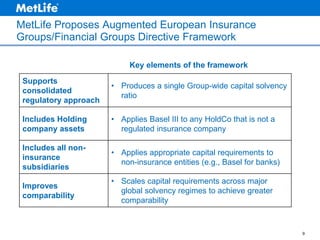
MetLife Proposes Augmented European Insurance
Groups/Financial Groups Directive Framework
Key elements of the framework
Supports
consolidated
regulatory approach

• Produces a single Group-wide capital solvency
ratio

Includes Holding
company assets

• Applies Basel III to any HoldCo that is not a
regulated insurance company

Includes all noninsurance
subsidiaries

• Applies appropriate capital requirements to
non-insurance entities (e.g., Basel for banks)

Improves
comparability

• Scales capital requirements across major
global solvency regimes to achieve greater
comparability

9
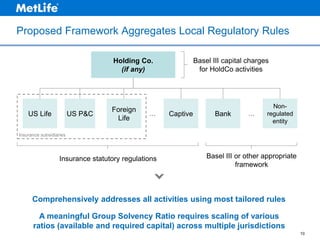
Proposed Framework Aggregates Local Regulatory Rules
Basel III capital charges
for HoldCo activities

Holding Co.
(if any)

US Life

US P&C

Foreign
Life

…

Captive

Bank

…

Nonregulated
entity

Insurance subsidiaries

Insurance statutory regulations

Basel III or other appropriate
framework

Comprehensively addresses all activities using most tailored rules
A meaningful Group Solvency Ratio requires scaling of various
ratios (available and required capital) across multiple jurisdictions
10
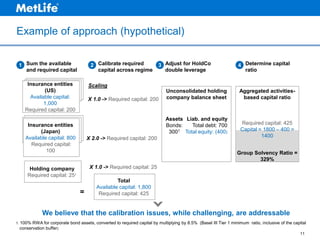
Example of approach (hypothetical)
1 Sum the available
and required capital

2 Calibrate required
capital across regime

Insurance entities
Required Capital: 100
(US)
Available Capital: 500
Available capital:
1,000
Required capital: 200

3 Adjust for HoldCo
double leverage

4 Determine capital
ratio

Scaling
X 1.0 -> Required capital: 200

Unconsolidated holding
company balance sheet

Assets Liab. and equity
Bonds:
Total debt: 700
1
300 Total equity: (400)

Insurance entities
Assets: 300
Assets: 300
(Japan)
Debt: 700
Debt: 700
Available capital: 800
Required capital:
100

X 2.0 -> Required capital: 200

Aggregated activitiesbased capital ratio

Required capital: 425
Capital = 1800 – 400 =
1400
Group Solvency Ratio =
329%

X 1.0 -> Required capital: 25

Holding company
Required capital: 251

=

Total
Available capital: 1,800
Required capital: 425

We believe that the calibration issues, while challenging, are addressable
1. 100%

RWA for corporate bond assets, converted to required capital by multiplying by 8.5% (Basel III Tier 1 minimum ratio, inclusive of the capital
conservation buffer)
11
Key Challenges
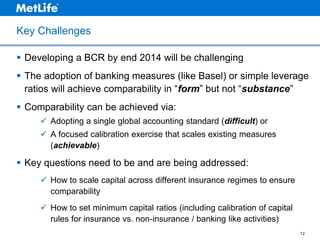
 Developing a BCR by end 2014 will be challenging
 The adoption of banking measures (like Basel) or simple leverage
ratios will achieve comparability in “form” but not “substance”

 Comparability can be achieved via:
 Adopting a single global accounting standard (difficult) or
 A focused calibration exercise that scales existing measures
(achievable)

 Key questions need to be and are being addressed:
 How to scale capital across different insurance regimes to ensure
comparability
 How to set minimum capital ratios (including calibration of capital
rules for insurance vs. non-insurance / banking like activities)
12
Other Insurance Industry Challenges
 ORSA Implementation – NAIC SMI
 ALM in a Low Interest Environment
 Managing Risks in Investment Portfolios
 Model Risk Governance

13
Other Insurance Industry Challenges
 Modeling Economic Capital
 Emerging Risks – Technology
 Stress Testing
 Risk Culture

14
© Oliver Wyman

15

15

Insurance and Regulatory Risk A U.S. G-SII Perspective: Stanley J. Talbi, Executive Vice President, Global Risk Management and Chief Risk Officer, METLIFE

  • 1.
    ©UFS ©UFS Insurance and RegulatoryRisk A U.S. G-SII Perspective Insurance Risk North America Conference November 5, 2013 Stanley J. Talbi Executive VP and Chief Risk Officer
  • 2.
    Three Key Points The life insurance business did not cause the financial crisis and is not a source of systemic risk  Imposing bank-centric regulations on life insurance companies would create unintended consequences  A better approach to regulating life insurance companies would focus on activities 2
  • 3.
    Business Fundamentally DifferentFrom Banking  Banks are asset driven  Goal: Find attractive assets to invest in, then find lowcost, short-term funding to purchase assets. High liquidity risk.  Life insurers are liability driven  Goal: Sell long-term promises, then find assets that match the cash flows of those promises. Low liquidity risk.  What banks call “maturity transformation” we call a “maturity mismatch” 3
  • 4.
    Life insurance notSystemic  There has never been a systemic event in the traditional insurance space  Executive Life (U.S.)  Mutual Benefit (U.S.)  General American (U.S.)  Confederation Life (Canada)  Kyoei (Japan)  Equitable (U.K.) 4
  • 5.
    Impact of IAIS/FSBFramework on a U.S. G-SII,  MetLife was named a G-SII and is being assessed by the U.S. Financial Stability Oversight Council (FSOC) as a possible U.S. non-bank SIFI.  Absent FSOC designation the impact of G-SII designation is unclear.  If and when the FSOC designates MetLife a SIFI, we will be subject to consolidated supervision by the U.S. Federal Reserve.  U.S. capital rules for non-bank SIFIs not yet finalized. 5
  • 6.
    Observations on assessmentmethodology and policy measures.  Assessment methodology continues to evolve  Comprehensive supervision and effective resolution regimes make sense  should be designed to capture insurance risks and reflect the unique nature of a liability driven business model  should target systemically risky activities and recognize “traditional” management of non-traditional/non-insurance activities in support of core business  should recognize that structural separation may concentrate vs. decrease risk  Most critical issue is FSB requirement of a backstop capital requirement (BCR) and quantitative capital standard (QCS) 6
  • 7.
    Capital Requirements -Observations MetLife supports the overall effort to enhance capital regulations. However,  Imposing bank centric rules on insurers would harm consumers  Faced with unnecessarily costly requirements, insurers would have to: Raise the price of the products they offer Stop offering certain products altogether  Oliver Wyman estimates consumers would pay $5bn – $8bn a year in higher prices or lower benefits  Imposing additional requirements on a few institutions instead of on systemic activities will create an unlevel playing field 7
  • 8.
    Sensible Principles forEffective Backstop Capital Requirement  Tailored and calibrated to the activities of the institution  Ensures sufficient capital to protect solvency even in severe stress  Comprehensively captures entities and risks  Provides a basis for comparison across jurisdictions and financial institutions  Can feasibly be implemented – requires minimal adjustments, none of them complex 8
  • 9.
    MetLife Proposes AugmentedEuropean Insurance Groups/Financial Groups Directive Framework Key elements of the framework Supports consolidated regulatory approach • Produces a single Group-wide capital solvency ratio Includes Holding company assets • Applies Basel III to any HoldCo that is not a regulated insurance company Includes all noninsurance subsidiaries • Applies appropriate capital requirements to non-insurance entities (e.g., Basel for banks) Improves comparability • Scales capital requirements across major global solvency regimes to achieve greater comparability 9
  • 10.
    Proposed Framework AggregatesLocal Regulatory Rules Basel III capital charges for HoldCo activities Holding Co. (if any) US Life US P&C Foreign Life … Captive Bank … Nonregulated entity Insurance subsidiaries Insurance statutory regulations Basel III or other appropriate framework Comprehensively addresses all activities using most tailored rules A meaningful Group Solvency Ratio requires scaling of various ratios (available and required capital) across multiple jurisdictions 10
  • 11.
    Example of approach(hypothetical) 1 Sum the available and required capital 2 Calibrate required capital across regime Insurance entities Required Capital: 100 Required Capital: 100 (US) Available Capital: 500 Available Capital: 500 Available capital: 1,000 Required capital: 200 3 Adjust for HoldCo double leverage 4 Determine capital ratio Scaling X 1.0 -> Required capital: 200 Unconsolidated holding company balance sheet Assets Liab. and equity Bonds: Total debt: 700 1 300 Total equity: (400) Insurance entities Assets: 300 Assets: 300 (Japan) Debt: 700 Debt: 700 Available capital: 800 Required capital: 100 X 2.0 -> Required capital: 200 Aggregated activitiesbased capital ratio Required capital: 425 Capital = 1800 – 400 = 1400 Group Solvency Ratio = 329% X 1.0 -> Required capital: 25 Holding company Required capital: 251 = Total Available capital: 1,800 Required capital: 425 We believe that the calibration issues, while challenging, are addressable 1. 100% RWA for corporate bond assets, converted to required capital by multiplying by 8.5% (Basel III Tier 1 minimum ratio, inclusive of the capital conservation buffer) 11
  • 12.
    Key Challenges  Developinga BCR by end 2014 will be challenging  The adoption of banking measures (like Basel) or simple leverage ratios will achieve comparability in “form” but not “substance”  Comparability can be achieved via:  Adopting a single global accounting standard (difficult) or  A focused calibration exercise that scales existing measures (achievable)  Key questions need to be and are being addressed:  How to scale capital across different insurance regimes to ensure comparability  How to set minimum capital ratios (including calibration of capital rules for insurance vs. non-insurance / banking like activities) 12
  • 13.
    Other Insurance IndustryChallenges  ORSA Implementation – NAIC SMI  ALM in a Low Interest Environment  Managing Risks in Investment Portfolios  Model Risk Governance 13
  • 14.
    Other Insurance IndustryChallenges  Modeling Economic Capital  Emerging Risks – Technology  Stress Testing  Risk Culture 14
  • 15.