Spiral Model
SOFTWARE DEVELOPMENT LIFE CYCLE (SDLC)
Bilal Bashir, Roll no: 09
Syed Shahzaib Sohail, Roll no: 19
Khuram Junaid, Roll no: 22
Antiquity
 Spiral Model was first described by "Barry Boehm"
in his 1986 paper "A Spiral Model of Software
Development and Enhancement".
 Boehm describes the spiral model as a "Process
Model Generator".
 Later in 1988, Boehm published a similar paper to
wider audience.
Spiral Model?
 Spiral model is a SDLC model used in
Information Technology.
 It combines the features of prototyping and
waterfall model.
 It is best suitable for complex, expensive and
large projects.
Spiral Model
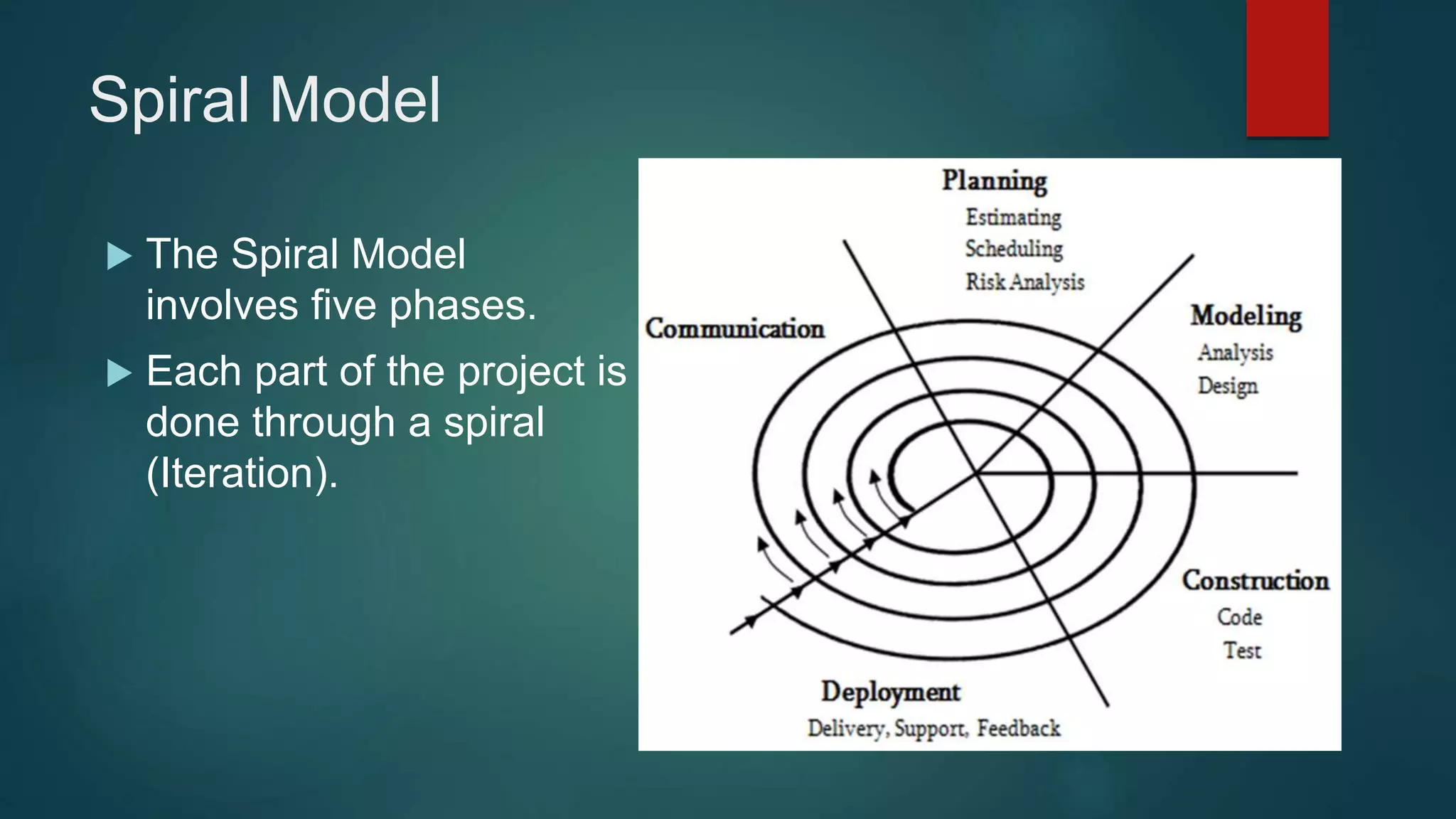
 The Spiral Model
involves five phases.
 Each part of the project is
done through a spiral
(Iteration).
Spiral Model
Communication:
Tasks required to establish effective
communication between developer and customer.
Planning:
Tasks required to define resources, timelines and
other project related information.
Modeling:
Tasks required in building one or more
representations of the application.
Spiral Model
Construction and Release:
Tasks required to construct, test, install.
Deployment:
Tasks required to deliver the software, getting
feedbacks etc.
Spiral Model
 Based on a customer evaluation, the
development process enters into next iteration.
 Following the feedback suggested by the
customer.
 The process of iteration along the spiral
continues throughout the life of the software.
Advantages
 Provides early indication of risks, without much
cost.
 Users the systems early.
 Early and frequent feedback from users.
 Emphasize flexibility and extensibility.
 High quality product can be produced.
Disadvantages
 Time spent for evaluating risks too large for small or
low-risk projects.
 Time spent for planning, resetting objectives, doing risk
analysis and prototyping may be unnecessary.
 Risk assessment expertise required.
 Spiral may continue indefinitely.
 In fixed budget development, spiral model can be a
problem.
When To Use?
 When costs and risk evaluation is important.
 From medium to high risk projects.
 Long term project commitment.
 Users are unsure of their needs.
Spiral model

Spiral model

  • 1.
    Spiral Model SOFTWARE DEVELOPMENTLIFE CYCLE (SDLC) Bilal Bashir, Roll no: 09 Syed Shahzaib Sohail, Roll no: 19 Khuram Junaid, Roll no: 22
  • 2.
    Antiquity  Spiral Modelwas first described by "Barry Boehm" in his 1986 paper "A Spiral Model of Software Development and Enhancement".  Boehm describes the spiral model as a "Process Model Generator".  Later in 1988, Boehm published a similar paper to wider audience.
  • 3.
    Spiral Model?  Spiralmodel is a SDLC model used in Information Technology.  It combines the features of prototyping and waterfall model.  It is best suitable for complex, expensive and large projects.
  • 4.
    Spiral Model  TheSpiral Model involves five phases.  Each part of the project is done through a spiral (Iteration).
  • 5.
    Spiral Model Communication: Tasks requiredto establish effective communication between developer and customer. Planning: Tasks required to define resources, timelines and other project related information. Modeling: Tasks required in building one or more representations of the application.
  • 6.
    Spiral Model Construction andRelease: Tasks required to construct, test, install. Deployment: Tasks required to deliver the software, getting feedbacks etc.
  • 7.
    Spiral Model  Basedon a customer evaluation, the development process enters into next iteration.  Following the feedback suggested by the customer.  The process of iteration along the spiral continues throughout the life of the software.
  • 8.
    Advantages  Provides earlyindication of risks, without much cost.  Users the systems early.  Early and frequent feedback from users.  Emphasize flexibility and extensibility.  High quality product can be produced.
  • 9.
    Disadvantages  Time spentfor evaluating risks too large for small or low-risk projects.  Time spent for planning, resetting objectives, doing risk analysis and prototyping may be unnecessary.  Risk assessment expertise required.  Spiral may continue indefinitely.  In fixed budget development, spiral model can be a problem.
  • 10.
    When To Use? When costs and risk evaluation is important.  From medium to high risk projects.  Long term project commitment.  Users are unsure of their needs.