 Spiral process model
 Introduction ,history
 Working(design)
 resources utilized
 Advantages
 Disadvantages
 example projects Roll # Name
185 Khushbu
Saleem
196 Aroosa Razzaq
197 Maham Salar
 This model was first described by Barry Boehm in his 1986 paper and published
in 1988 [BOE88] in his similar article.
 it was the first model to explain why the iteration matters were typically 6 months
to 2 years long.
 It is a systems development method (SDM) used in information technology.
 Spiral model is a risk-driven model with a combination of iterative development
process model and sequential linear development model combines the features
of the prototyping model and the waterfall model.
 The spiral model has four phases(Identification , Design ,Construct , Evaluation
and Risk)
 Each phase starts with a design goal and ends with the client (who may be
internal) reviewing the progress thus far.
 Analysis and engineering efforts are applied at each phase of the project, with an
eye toward the end goal of the project.
 Based on the customer evaluation, software development process enters into the
next iteration and subsequently follows the linear approach to implement the
feedback suggested by the customer. The process of iterations along the spiral
continues throughout the life of the software.
 Spiral model is also called meta mode because it comprises with other models of
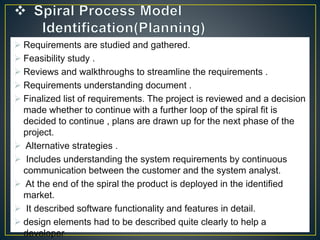
 Requirements are studied and gathered.
 Feasibility study .
 Reviews and walkthroughs to streamline the requirements .
 Requirements understanding document .
 Finalized list of requirements. The project is reviewed and a decision
made whether to continue with a further loop of the spiral fit is
decided to continue , plans are drawn up for the next phase of the
project.
 Alternative strategies .
 Includes understanding the system requirements by continuous
communication between the customer and the system analyst.
 At the end of the spiral the product is deployed in the identified
market.
 It described software functionality and features in detail.
 design elements had to be described quite clearly to help a
developer
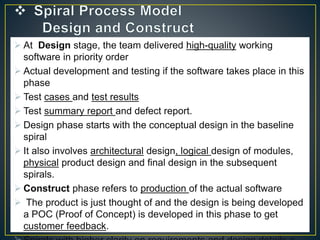
 At Design stage, the team delivered high-quality working
software in priority order
 Actual development and testing if the software takes place in this
phase
 Test cases and test results
 Test summary report and defect report.
 Design phase starts with the conceptual design in the baseline
spiral
 It also involves architectural design, logical design of modules,
physical product design and final design in the subsequent
spirals.
 Construct phase refers to production of the actual software
 The product is just thought of and the design is being developed
a POC (Proof of Concept) is developed in this phase to get
customer feedback.
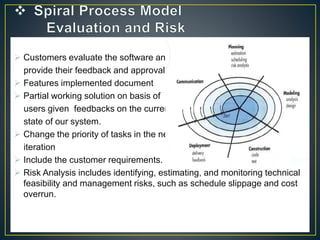
 Customers evaluate the software and
provide their feedback and approval
 Features implemented document
 Partial working solution on basis of
users given feedbacks on the current
state of our system.
 Change the priority of tasks in the next
iteration
 Include the customer requirements.
 Risk Analysis includes identifying, estimating, and monitoring technical
feasibility and management risks, such as schedule slippage and cost
overrun.
 Development is fast in Larger
projects/software are created and
handled in a strategic way
 Risk evaluation is proper.
 Control towards all the phases of
development.
 More and more features are
added in a systematic way.
 Software is produced early.
 Has room for customer feedback
and the changes are implemented
faster. Risk reduction mechanisms
are in placed.
 Supports iteration and reflects
real-world practices– Systematic
approach
 Development can be divided into
smaller parts and more risky parts
can be developed earlier which
helps better risk management.
•
 Risk analysis is important phases
of requires expert people.
 Is not beneficial for smaller
projects.
 Spiral may go infinitely.
 Documentation is more as it has
intermediate phases.
 Complex, relatively difficult to
follow strictly.
 Applicable only to larges systems
 It is costly for smaller projects.
 Management is more complex and
more time consuming
 Large number of intermediate
stages
requires excessive documentation
 FCS [Future Combat System] and games are example of spiral model
 The US military had adopted the spiral model for its Future Combat Systems pr
ogram. The FCS project was cancelled after six yeas (2003_2009), it had a tw
o year iteration (spiral)
 In 2010 with the collaboration of Microsoft Research ,Bangalore, India and Uni
versity of Toronto Canada made a project with spiral.

software engineering (spiral process model)

  • 1.
     Spiral processmodel  Introduction ,history  Working(design)  resources utilized  Advantages  Disadvantages  example projects Roll # Name 185 Khushbu Saleem 196 Aroosa Razzaq 197 Maham Salar
  • 2.
     This modelwas first described by Barry Boehm in his 1986 paper and published in 1988 [BOE88] in his similar article.  it was the first model to explain why the iteration matters were typically 6 months to 2 years long.  It is a systems development method (SDM) used in information technology.  Spiral model is a risk-driven model with a combination of iterative development process model and sequential linear development model combines the features of the prototyping model and the waterfall model.  The spiral model has four phases(Identification , Design ,Construct , Evaluation and Risk)  Each phase starts with a design goal and ends with the client (who may be internal) reviewing the progress thus far.  Analysis and engineering efforts are applied at each phase of the project, with an eye toward the end goal of the project.  Based on the customer evaluation, software development process enters into the next iteration and subsequently follows the linear approach to implement the feedback suggested by the customer. The process of iterations along the spiral continues throughout the life of the software.  Spiral model is also called meta mode because it comprises with other models of
  • 3.
     Requirements arestudied and gathered.  Feasibility study .  Reviews and walkthroughs to streamline the requirements .  Requirements understanding document .  Finalized list of requirements. The project is reviewed and a decision made whether to continue with a further loop of the spiral fit is decided to continue , plans are drawn up for the next phase of the project.  Alternative strategies .  Includes understanding the system requirements by continuous communication between the customer and the system analyst.  At the end of the spiral the product is deployed in the identified market.  It described software functionality and features in detail.  design elements had to be described quite clearly to help a developer
  • 4.
     At Designstage, the team delivered high-quality working software in priority order  Actual development and testing if the software takes place in this phase  Test cases and test results  Test summary report and defect report.  Design phase starts with the conceptual design in the baseline spiral  It also involves architectural design, logical design of modules, physical product design and final design in the subsequent spirals.  Construct phase refers to production of the actual software  The product is just thought of and the design is being developed a POC (Proof of Concept) is developed in this phase to get customer feedback.
  • 5.
     Customers evaluatethe software and provide their feedback and approval  Features implemented document  Partial working solution on basis of users given feedbacks on the current state of our system.  Change the priority of tasks in the next iteration  Include the customer requirements.  Risk Analysis includes identifying, estimating, and monitoring technical feasibility and management risks, such as schedule slippage and cost overrun.
  • 6.
     Development isfast in Larger projects/software are created and handled in a strategic way  Risk evaluation is proper.  Control towards all the phases of development.  More and more features are added in a systematic way.  Software is produced early.  Has room for customer feedback and the changes are implemented faster. Risk reduction mechanisms are in placed.  Supports iteration and reflects real-world practices– Systematic approach  Development can be divided into smaller parts and more risky parts can be developed earlier which helps better risk management. •  Risk analysis is important phases of requires expert people.  Is not beneficial for smaller projects.  Spiral may go infinitely.  Documentation is more as it has intermediate phases.  Complex, relatively difficult to follow strictly.  Applicable only to larges systems  It is costly for smaller projects.  Management is more complex and more time consuming  Large number of intermediate stages requires excessive documentation
  • 7.
     FCS [FutureCombat System] and games are example of spiral model  The US military had adopted the spiral model for its Future Combat Systems pr ogram. The FCS project was cancelled after six yeas (2003_2009), it had a tw o year iteration (spiral)  In 2010 with the collaboration of Microsoft Research ,Bangalore, India and Uni versity of Toronto Canada made a project with spiral.