YARNYARNPART III:PART III:
SPINNING, YARN DEFECTS & SEWING THREADSSPINNING, YARN DEFECTS & SEWING THREADS
Dr. S. Aishwariya
INSPIRE Fellow (DST) & Assistant Professor
Department of Textiles and Clothing
Avinashilingam University for Women, Coimbatore
SPINNING
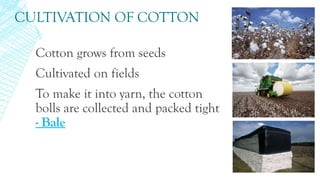
CULTIVATION OF COTTON
Cotton grows from seeds
Cultivated on fields
To make it into yarn, the cotton
bolls are collected and packed tight
- Bale
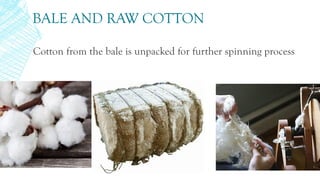
BALE AND RAW COTTON
Cotton from the bale is unpacked for further spinning process
GINNING - SEED REMOVED
Ginning is the process in which
the cotton collected from field is
processed to remove the fibre and
trash (waste) separately
SPINNING
SPINNING MILL
1. BLOW ROOM
After ginning the fibres reach the spinning mill, where the fibre is
made into a yarn
Here the bale (fibres) are opened
The suction moves over the bale, and starts opening the sucked
fibres by using rush of air
OPENING – CLEANING – BLENDING – MIXING
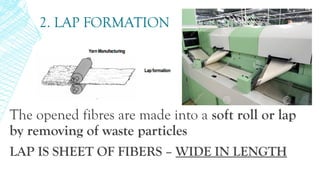
2. LAP FORMATION
The opened fibres are made into a soft roll or lap
by removing of waste particles
LAP IS SHEET OF FIBERS – WIDE IN LENGTH
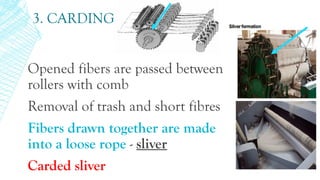
3. CARDING
Opened fibers are passed between
rollers with comb
Removal of trash and short fibres
Fibers drawn together are made
into a loose rope - sliver
Carded sliver
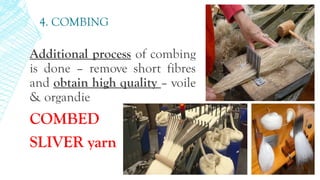
4. COMBING
Additional process of combing
is done – remove short fibres
and obtain high quality – voile
& organdie
COMBED
SLIVER yarn
5. DRAFTING / DRAWING
The combed/ carded
lap is reduced in
diameter
Slivers are combined –
smoothened &
stretched
6. ROVING
▪ Yarn diameter is reduced to
diameter of a pencil led
▪ Bobbins are placed on roving frame
where further drawing and twisting
is done
DRAFTED YARN
SLIVER
DRAFTING
ROVING
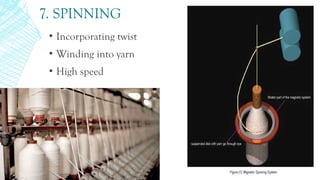
7. SPINNING
▪ Incorporating twist
▪ Winding into yarn
▪ High speed
STEPS IN SPINNING
1. BLOW ROOM
2. LAP FORMATION
3. CARDING SLIVER
4. COMBED SLIVER
5. DRAFTING AND DRAWING
6. ROVING
7. SPINNING
YARN DEFECTSYARN DEFECTS
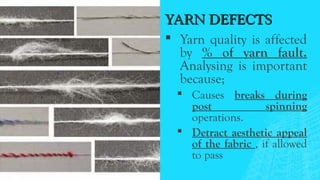
 Yarn quality is affected
by % of yarn fault.
Analysing is important
because;
 Causes breaks during
post spinning
operations.
 Detract aesthetic appeal
of the fabric , if allowed
to pass
YARN DEFECTSYARN DEFECTS
 Appearance and strength is affected by yarn quality
 Spinning ability and fabric appearance is affected by yarn
quality
 Yarn quality decides on acceptance/ rejection of the piece
 A fault-free thread is important, because every unwanted
yarn can create a problem.
 With poor yarn quality good quality fabric cannot be
made
 FAULT FREE – IMPOSSIBLE, but defects can be
reduced by keeping machine clean and process control.
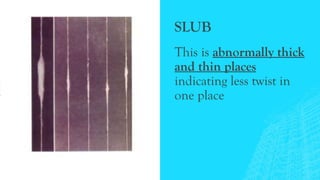
SLUB
This is abnormally thick
and thin places
indicating less twist in
one place
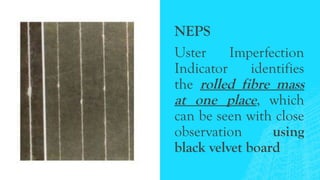
NEPS
Uster Imperfection
Indicator identifies
the rolled fibre mass
at one place, which
can be seen with close
observation using
black velvet board
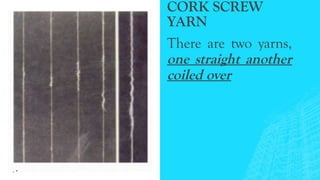
CORK SCREW
YARN
There are two yarns,
one straight another
coiled over
SPUN IN FLY
Fluff of yarns are
either spun/ loosely
embedded into the
yarn
SOFT YARN/
SNARL
Yarn with less twist and
indicating weakness
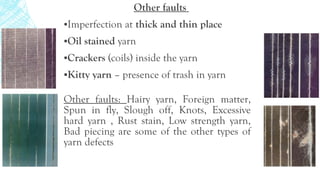
Other faults
▪Imperfection at thick and thin place
▪Oil stained yarn
▪Crackers (coils) inside the yarn
▪Kitty yarn – presence of trash in yarn
Other faults: Hairy yarn, Foreign matter,
Spun in fly, Slough off, Knots, Excessive
hard yarn , Rust stain, Low strength yarn,
Bad piecing are some of the other types of
yarn defects
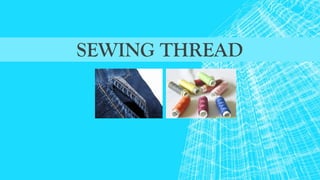
SEWING THREAD
 Leather industry
 Upholstery
 Car seat
 Rainwear
 Hospital and surgery
 Defence and police
 Fireman – bullet
proof, dress, shoe
 Aircraft seat
 Horse rug
 Hot air balloon
 Sports-ball/racket
 Fishing lines
 Bed mattress/ quilt
 Air bag
 Spare wheel cover
Sewing thread is
flexible, small diameter
yarn
that is given surface
coating or lubricant
or both,
that helps in stitching
one or more pieces of
fabric/ material/ object
together
SEWING THREAD - INTRODUCTION
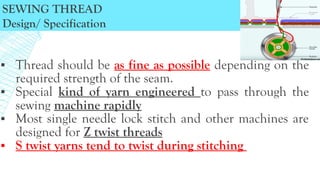
▪ Thread should be as fine as possible depending on the
required strength of the seam.
▪ Special kind of yarn engineered to pass through the
sewing machine rapidly
▪ Most single needle lock stitch and other machines are
designed for Z twist threads
▪ S twist yarns tend to twist during stitching
SEWING THREAD
Design/ Specification
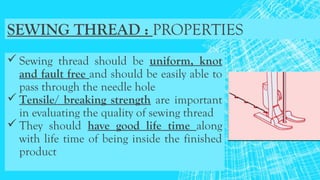
SEWING THREAD : PROPERTIES
 Sewing thread should be uniform, knot
and fault free and should be easily able to
pass through the needle hole
 Tensile/ breaking strength are important
in evaluating the quality of sewing thread
 They should have good life time along
with life time of being inside the finished
product
▪ Industry power operated machines
performance is based on sewing threads quality
▪ Quality of sewing thread affect the seam quality
and production cost
▪ Material to sew, sewing technique, end use
determines the sewing performance.
▪ Ability to give the required aesthetics and
serviceability are important in a sewing thread
SEWING THREAD : PROPERTIES
QUALITIES OF GOOD SEWING THREAD
 Uniform thickness/ diameter – successful smooth sewing
 Good colour fastness – good thread should sustain washing, sun drying
and still hold same colour
 Good abrasion resistance – enable good sewing and high productivity
 Good resistance to chemicals and perspiration (sweat)
 Washing, bleaching and dry cleaning – chemicals used in that
SEWING THREAD
▪ Overall thickness of the thread - size of
sewing thread denoted by ticket
number/ Tex/ count
FIBRES USED
Natural :
Cotton is the common fibre in sewing thread and mostly used in industrial sewing
Man made:
High tenacity
High resistance to abrasion
Good resistance to chemicals
Not affected by moisture, rot and mildew – appreciable properties
Eg1: Spun polyester: Commonly used, variety of size and colour
Eg 2: Core Spun thread: core-polyester/ wound by cotton/polyester
THANK YOU!

Spinning,yarn defects,sewing thread dr.ash

  • 1.
    YARNYARNPART III:PART III: SPINNING,YARN DEFECTS & SEWING THREADSSPINNING, YARN DEFECTS & SEWING THREADS Dr. S. Aishwariya INSPIRE Fellow (DST) & Assistant Professor Department of Textiles and Clothing Avinashilingam University for Women, Coimbatore
  • 2.
  • 3.
    CULTIVATION OF COTTON Cottongrows from seeds Cultivated on fields To make it into yarn, the cotton bolls are collected and packed tight - Bale
  • 4.
    BALE AND RAWCOTTON Cotton from the bale is unpacked for further spinning process
  • 5.
    GINNING - SEEDREMOVED Ginning is the process in which the cotton collected from field is processed to remove the fibre and trash (waste) separately
  • 6.
  • 7.
    SPINNING MILL 1. BLOWROOM After ginning the fibres reach the spinning mill, where the fibre is made into a yarn Here the bale (fibres) are opened The suction moves over the bale, and starts opening the sucked fibres by using rush of air OPENING – CLEANING – BLENDING – MIXING
  • 8.
    2. LAP FORMATION Theopened fibres are made into a soft roll or lap by removing of waste particles LAP IS SHEET OF FIBERS – WIDE IN LENGTH
  • 9.
    3. CARDING Opened fibersare passed between rollers with comb Removal of trash and short fibres Fibers drawn together are made into a loose rope - sliver Carded sliver
  • 10.
    4. COMBING Additional processof combing is done – remove short fibres and obtain high quality – voile & organdie COMBED SLIVER yarn
  • 11.
    5. DRAFTING /DRAWING The combed/ carded lap is reduced in diameter Slivers are combined – smoothened & stretched
  • 12.
    6. ROVING ▪ Yarndiameter is reduced to diameter of a pencil led ▪ Bobbins are placed on roving frame where further drawing and twisting is done DRAFTED YARN
  • 13.
  • 14.
    7. SPINNING ▪ Incorporatingtwist ▪ Winding into yarn ▪ High speed
  • 15.
    STEPS IN SPINNING 1.BLOW ROOM 2. LAP FORMATION 3. CARDING SLIVER 4. COMBED SLIVER 5. DRAFTING AND DRAWING 6. ROVING 7. SPINNING
  • 16.
    YARN DEFECTSYARN DEFECTS Yarn quality is affected by % of yarn fault. Analysing is important because;  Causes breaks during post spinning operations.  Detract aesthetic appeal of the fabric , if allowed to pass
  • 17.
    YARN DEFECTSYARN DEFECTS Appearance and strength is affected by yarn quality  Spinning ability and fabric appearance is affected by yarn quality  Yarn quality decides on acceptance/ rejection of the piece  A fault-free thread is important, because every unwanted yarn can create a problem.  With poor yarn quality good quality fabric cannot be made  FAULT FREE – IMPOSSIBLE, but defects can be reduced by keeping machine clean and process control.
  • 18.
    SLUB This is abnormallythick and thin places indicating less twist in one place
  • 19.
    NEPS Uster Imperfection Indicator identifies therolled fibre mass at one place, which can be seen with close observation using black velvet board
  • 20.
    CORK SCREW YARN There aretwo yarns, one straight another coiled over
  • 21.
    SPUN IN FLY Fluffof yarns are either spun/ loosely embedded into the yarn
  • 22.
    SOFT YARN/ SNARL Yarn withless twist and indicating weakness
  • 23.
    Other faults ▪Imperfection atthick and thin place ▪Oil stained yarn ▪Crackers (coils) inside the yarn ▪Kitty yarn – presence of trash in yarn Other faults: Hairy yarn, Foreign matter, Spun in fly, Slough off, Knots, Excessive hard yarn , Rust stain, Low strength yarn, Bad piecing are some of the other types of yarn defects
  • 24.
  • 25.
     Leather industry Upholstery  Car seat  Rainwear  Hospital and surgery  Defence and police  Fireman – bullet proof, dress, shoe  Aircraft seat  Horse rug  Hot air balloon  Sports-ball/racket  Fishing lines  Bed mattress/ quilt  Air bag  Spare wheel cover
  • 26.
    Sewing thread is flexible,small diameter yarn that is given surface coating or lubricant or both, that helps in stitching one or more pieces of fabric/ material/ object together SEWING THREAD - INTRODUCTION
  • 27.
    ▪ Thread shouldbe as fine as possible depending on the required strength of the seam. ▪ Special kind of yarn engineered to pass through the sewing machine rapidly ▪ Most single needle lock stitch and other machines are designed for Z twist threads ▪ S twist yarns tend to twist during stitching SEWING THREAD Design/ Specification
  • 28.
    SEWING THREAD :PROPERTIES  Sewing thread should be uniform, knot and fault free and should be easily able to pass through the needle hole  Tensile/ breaking strength are important in evaluating the quality of sewing thread  They should have good life time along with life time of being inside the finished product
  • 29.
    ▪ Industry poweroperated machines performance is based on sewing threads quality ▪ Quality of sewing thread affect the seam quality and production cost ▪ Material to sew, sewing technique, end use determines the sewing performance. ▪ Ability to give the required aesthetics and serviceability are important in a sewing thread SEWING THREAD : PROPERTIES
  • 30.
    QUALITIES OF GOODSEWING THREAD  Uniform thickness/ diameter – successful smooth sewing  Good colour fastness – good thread should sustain washing, sun drying and still hold same colour  Good abrasion resistance – enable good sewing and high productivity  Good resistance to chemicals and perspiration (sweat)  Washing, bleaching and dry cleaning – chemicals used in that
  • 31.
    SEWING THREAD ▪ Overallthickness of the thread - size of sewing thread denoted by ticket number/ Tex/ count
  • 32.
    FIBRES USED Natural : Cottonis the common fibre in sewing thread and mostly used in industrial sewing Man made: High tenacity High resistance to abrasion Good resistance to chemicals Not affected by moisture, rot and mildew – appreciable properties Eg1: Spun polyester: Commonly used, variety of size and colour Eg 2: Core Spun thread: core-polyester/ wound by cotton/polyester
  • 33.