 Yarn
 It is a long continues length of interlocked fibers twisted which is used in
weaving, knitting, sewing, crochet, embroidery.. Etc.
 Yarn twist
 The amount of twist is the important factor in finished consumer’s goods.
It determines the appearance and durability of the fabric.
 Fine yarns needs more twist than the coarse yarn (e.g.).: warp needs more
twist than the weft.
 Twist setting finish is given to retain the twist with heat or moisture.
 Amount of twist also depends upon the fabric to be woven.
 Soft surface fabric needs slack twist, they are called soft twist yarns.
 Smooth surface fabric needs more twist which gives strength,
smoothness, elasticity, and wrinkle resistance.
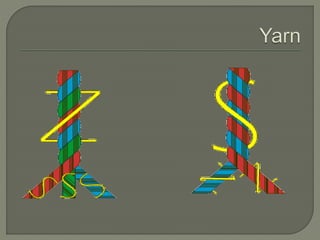
 By holding the yarn in a vertical position we can observe the direction of
twist.
 There are two types of twist "S" and "Z"
 Simple yarn:
 When the staple of filament fibers are twisted together it forms a simple yarn.
 The yarn strength will not be high as it is just twisted with the fibers.
 Ply yarn:
 When two or more yarns simple yarns are twisted together they are called ply
yarns. They are called as 2 ply, 3 ply and so on..
 Cabled yarn:
 When two or more ply yarns are twisted they are called cabled yarn.
 It is considered by twisting the plied yarns around each other in opposite
direction. (e.g.) Z/S/Z or S/Z/S.
 Opposite twist direction make the plies to grip each other. These yarns will be
hard, rough, strong
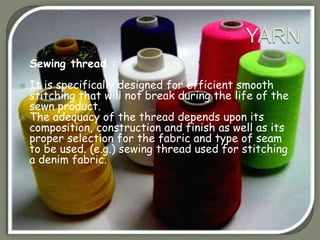
 Sewing thread :
 It is specifically designed for efficient smooth
stitching that will not break during the life of the
sewn product.
 The adequacy of the thread depends upon its
composition, construction and finish as well as its
proper selection for the fabric and type of seam
to be used. (e.g.) sewing thread used for stitching
a denim fabric.
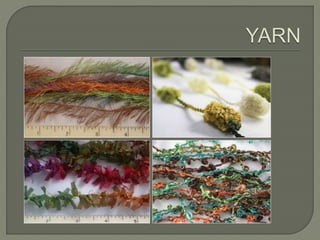
 Novelty yarn:
 The spinning process can produce different
decorative effects by varying the amount of
twist or by twisting different diameter of yarn
together.
 These yarns gives a texture effect on the
fabric surface with different color
combinations.
 The fabric with these yarns cannot be durable
as fabric made of uniform yarns.
 Fabric making introduction:
There are so many different ways in fabric making
like…
 Weaving
 Knitting
 Non woven
 Braiding
 Knotting
 Felting
 Leather
 Fur
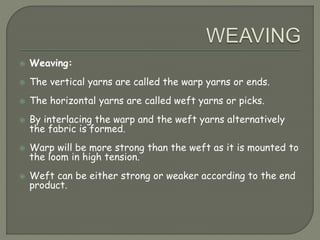
 Weaving:
 The vertical yarns are called the warp yarns or ends.
 The horizontal yarns are called weft yarns or picks.
 By interlacing the warp and the weft yarns alternatively
the fabric is formed.
 Warp will be more strong than the weft as it is mounted to
the loom in high tension.
 Weft can be either strong or weaker according to the end
product.
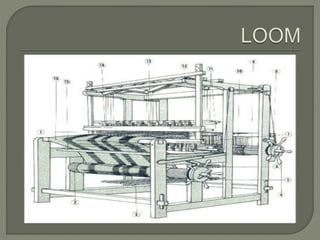
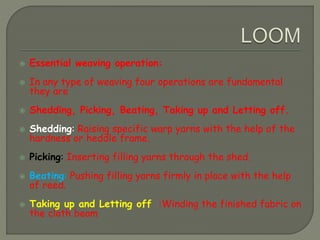
 Essential weaving operation:
 In any type of weaving four operations are fundamental
they are
 Shedding, Picking, Beating, Taking up and Letting off.
 Shedding: Raising specific warp yarns with the help of the
hardness or heddle frame.
 Picking: Inserting filling yarns through the shed.
 Beating: Pushing filling yarns firmly in place with the help
of reed.
 Taking up and Letting off :Winding the finished fabric on
the cloth beam
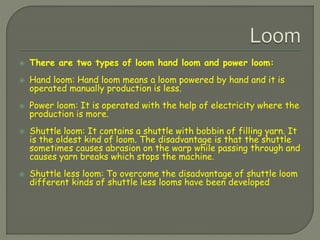
 There are two types of loom hand loom and power loom:
 Hand loom: Hand loom means a loom powered by hand and it is
operated manually production is less.
 Power loom: It is operated with the help of electricity where the
production is more.
 Shuttle loom: It contains a shuttle with bobbin of filling yarn. It
is the oldest kind of loom. The disadvantage is that the shuttle
sometimes causes abrasion on the warp while passing through and
causes yarn breaks which stops the machine.
 Shuttle less loom: To overcome the disadvantage of shuttle loom
different kinds of shuttle less looms have been developed
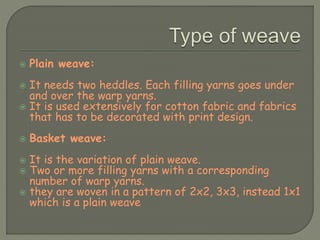
 Plain weave:
 It needs two heddles. Each filling yarns goes under
and over the warp yarns.
 It is used extensively for cotton fabric and fabrics
that has to be decorated with print design.
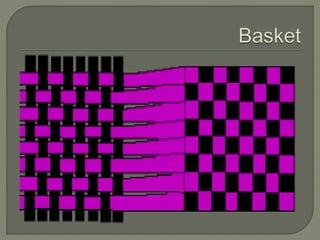
 Basket weave:
 It is the variation of plain weave.
 Two or more filling yarns with a corresponding
number of warp yarns.
 they are woven in a pattern of 2x2, 3x3, instead 1x1
which is a plain weave
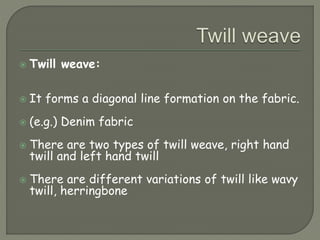
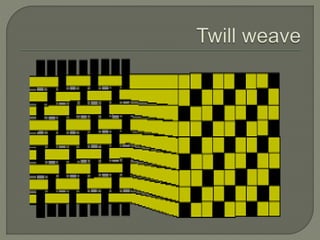
 Twill weave:
 It forms a diagonal line formation on the fabric.
 (e.g.) Denim fabric
 There are two types of twill weave, right hand
twill and left hand twill
 There are different variations of twill like wavy
twill, herringbone
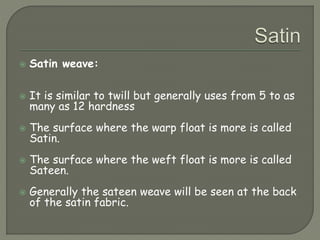
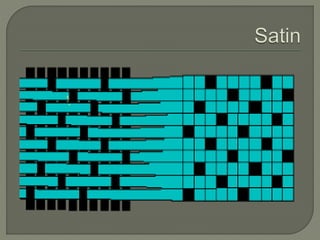
 Satin weave:
 It is similar to twill but generally uses from 5 to as
many as 12 hardness
 The surface where the warp float is more is called
Satin.
 The surface where the weft float is more is called
Sateen.
 Generally the sateen weave will be seen at the back
of the satin fabric.
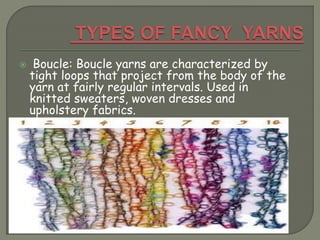
 Boucle: Boucle yarns are characterized by
tight loops that project from the body of the
yarn at fairly regular intervals. Used in
knitted sweaters, woven dresses and
upholstery fabrics.
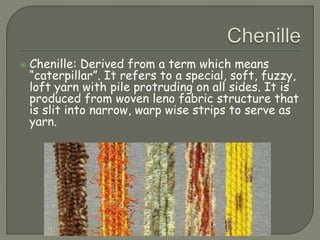
 Chenille: Derived from a term which means
“caterpillar”. It refers to a special, soft, fuzzy,
loft yarn with pile protruding on all sides. It is
produced from woven leno fabric structure that
is slit into narrow, warp wise strips to serve as
yarn.
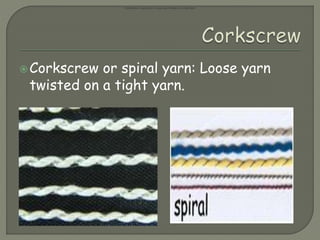
Corkscrew or spiral yarn: Loose yarn
twisted on a tight yarn.
•Corkscrew or spiral yarn: Loose yarn twisted on a tight yarn.
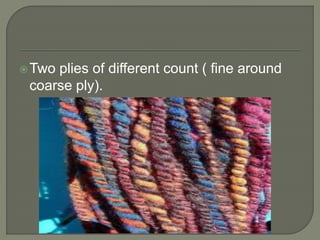
Two plies of different count ( fine around
coarse ply).
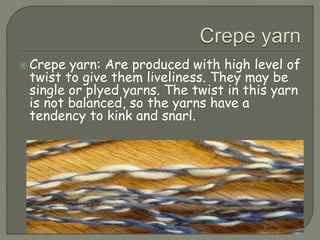
 Crepe yarn: Are produced with high level of
twist to give them liveliness. They may be
single or plyed yarns. The twist in this yarn
is not balanced, so the yarns have a
tendency to kink and snarl.
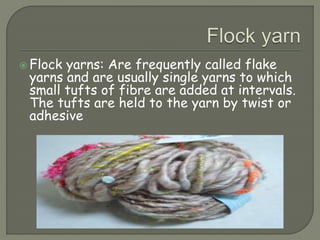
 Flock yarns: Are frequently called flake
yarns and are usually single yarns to which
small tufts of fibre are added at intervals.
The tufts are held to the yarn by twist or
adhesive
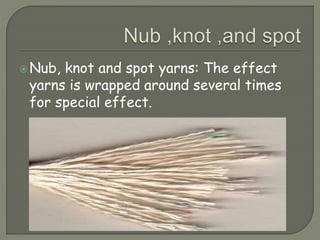
Nub, knot and spot yarns: The effect
yarns is wrapped around several times
for special effect.
Slub yarns: Produced by uneven twisting.
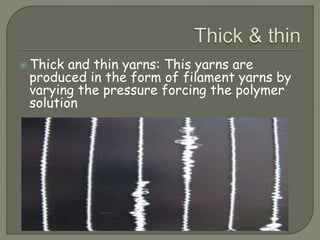
 Thick and thin yarns: This yarns are
produced in the form of filament yarns by
varying the pressure forcing the polymer
solution
Basic of textile

Basic of textile

  • 1.
     Yarn  Itis a long continues length of interlocked fibers twisted which is used in weaving, knitting, sewing, crochet, embroidery.. Etc.  Yarn twist  The amount of twist is the important factor in finished consumer’s goods. It determines the appearance and durability of the fabric.  Fine yarns needs more twist than the coarse yarn (e.g.).: warp needs more twist than the weft.  Twist setting finish is given to retain the twist with heat or moisture.  Amount of twist also depends upon the fabric to be woven.  Soft surface fabric needs slack twist, they are called soft twist yarns.  Smooth surface fabric needs more twist which gives strength, smoothness, elasticity, and wrinkle resistance.  By holding the yarn in a vertical position we can observe the direction of twist.  There are two types of twist "S" and "Z"
  • 2.
     Simple yarn: When the staple of filament fibers are twisted together it forms a simple yarn.  The yarn strength will not be high as it is just twisted with the fibers.  Ply yarn:  When two or more yarns simple yarns are twisted together they are called ply yarns. They are called as 2 ply, 3 ply and so on..  Cabled yarn:  When two or more ply yarns are twisted they are called cabled yarn.  It is considered by twisting the plied yarns around each other in opposite direction. (e.g.) Z/S/Z or S/Z/S.  Opposite twist direction make the plies to grip each other. These yarns will be hard, rough, strong
  • 4.
     Sewing thread:  It is specifically designed for efficient smooth stitching that will not break during the life of the sewn product.  The adequacy of the thread depends upon its composition, construction and finish as well as its proper selection for the fabric and type of seam to be used. (e.g.) sewing thread used for stitching a denim fabric.
  • 5.
     Novelty yarn: The spinning process can produce different decorative effects by varying the amount of twist or by twisting different diameter of yarn together.  These yarns gives a texture effect on the fabric surface with different color combinations.  The fabric with these yarns cannot be durable as fabric made of uniform yarns.
  • 7.
     Fabric makingintroduction: There are so many different ways in fabric making like…  Weaving  Knitting  Non woven  Braiding  Knotting  Felting  Leather  Fur
  • 8.
     Weaving:  Thevertical yarns are called the warp yarns or ends.  The horizontal yarns are called weft yarns or picks.  By interlacing the warp and the weft yarns alternatively the fabric is formed.  Warp will be more strong than the weft as it is mounted to the loom in high tension.  Weft can be either strong or weaker according to the end product.
  • 10.
     Essential weavingoperation:  In any type of weaving four operations are fundamental they are  Shedding, Picking, Beating, Taking up and Letting off.  Shedding: Raising specific warp yarns with the help of the hardness or heddle frame.  Picking: Inserting filling yarns through the shed.  Beating: Pushing filling yarns firmly in place with the help of reed.  Taking up and Letting off :Winding the finished fabric on the cloth beam
  • 11.
     There aretwo types of loom hand loom and power loom:  Hand loom: Hand loom means a loom powered by hand and it is operated manually production is less.  Power loom: It is operated with the help of electricity where the production is more.  Shuttle loom: It contains a shuttle with bobbin of filling yarn. It is the oldest kind of loom. The disadvantage is that the shuttle sometimes causes abrasion on the warp while passing through and causes yarn breaks which stops the machine.  Shuttle less loom: To overcome the disadvantage of shuttle loom different kinds of shuttle less looms have been developed
  • 12.
     Plain weave: It needs two heddles. Each filling yarns goes under and over the warp yarns.  It is used extensively for cotton fabric and fabrics that has to be decorated with print design.  Basket weave:  It is the variation of plain weave.  Two or more filling yarns with a corresponding number of warp yarns.  they are woven in a pattern of 2x2, 3x3, instead 1x1 which is a plain weave
  • 14.
     Twill weave: It forms a diagonal line formation on the fabric.  (e.g.) Denim fabric  There are two types of twill weave, right hand twill and left hand twill  There are different variations of twill like wavy twill, herringbone
  • 16.
     Satin weave: It is similar to twill but generally uses from 5 to as many as 12 hardness  The surface where the warp float is more is called Satin.  The surface where the weft float is more is called Sateen.  Generally the sateen weave will be seen at the back of the satin fabric.
  • 19.
     Boucle: Boucleyarns are characterized by tight loops that project from the body of the yarn at fairly regular intervals. Used in knitted sweaters, woven dresses and upholstery fabrics.
  • 20.
     Chenille: Derivedfrom a term which means “caterpillar”. It refers to a special, soft, fuzzy, loft yarn with pile protruding on all sides. It is produced from woven leno fabric structure that is slit into narrow, warp wise strips to serve as yarn.
  • 21.
    Corkscrew or spiralyarn: Loose yarn twisted on a tight yarn. •Corkscrew or spiral yarn: Loose yarn twisted on a tight yarn.
  • 22.
    Two plies ofdifferent count ( fine around coarse ply).
  • 23.
     Crepe yarn:Are produced with high level of twist to give them liveliness. They may be single or plyed yarns. The twist in this yarn is not balanced, so the yarns have a tendency to kink and snarl.
  • 24.
     Flock yarns:Are frequently called flake yarns and are usually single yarns to which small tufts of fibre are added at intervals. The tufts are held to the yarn by twist or adhesive
  • 25.
    Nub, knot andspot yarns: The effect yarns is wrapped around several times for special effect.
  • 26.
    Slub yarns: Producedby uneven twisting.
  • 27.
     Thick andthin yarns: This yarns are produced in the form of filament yarns by varying the pressure forcing the polymer solution