Lumbar InstabilityLumbar Instability
Causes - Diagnosis - ManagementCauses - Diagnosis - Management
George SapkasGeorge Sapkas
Asc. ProfessorAsc. Professor
11stst
Orthopaedic DepartmentOrthopaedic Department
Athens Medical SchoolAthens Medical School
Lumbar Instability
• Clinical
• Radiological
Clinical Lumbar Instability
• Not any specific definition
• … the condition that the
patient feels that his back
is unstable
White A. & Panjabi M.
Clinical Biomechanics of the Spine 1980
Radiological Instability
• Spondylolysis
• Spondylolisthesis
• Adult Degenerative
Scoliosis
• Post-Laminectomy
Lumbar Instability
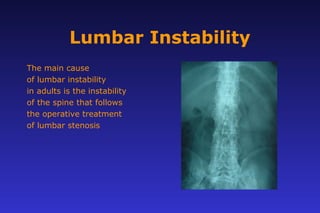
The main cause
of lumbar instability
in adults is the instability
of the spine that follows
the operative treatment
of lumbar stenosis
ETIOLOGY
OF THE
LUMBAR
STENOSIS
Lumbar Stenosis
-
Developmental
Lumbar
Stenosis
-
Degenerative
Spondylolisthesis
Lumbar Stenosis
-
Isthmic Spondylolisthesis
Lumbar Stenosis
-
Congenital
Lumbar Stenosis
-
Degenerative Adult Scoliosis
Etiology of Lumbar Stenosis
AdultAdult
scoliosisscoliosis
Congenital
Congenital
DevelopmentalDevelopmental
IsthmicIsthmic
SpondyloSpondylo
listhesislisthesis
DegenerativeDegenerative
SpondylolisthesisSpondylolisthesis
Foramen
Interverterbral Disc Space -
Foramen
LUMBAR STENOSIS
TREATMENT
• CONSERVATIVE
• OPERATIVE
Conservative treatment
• NSAIDS
• Injections - Facet’s Block
• Epidural - Caudal injection
• Brace
• Psychological support
• Social support
Operative
treatment
Laminectomy without stabilization
Laminectomy
associated with
Transpedicular Stabilization
Laminectomy associated with PLIF
Laminectomy
associated with
PLIF and Transpedicular stabilization
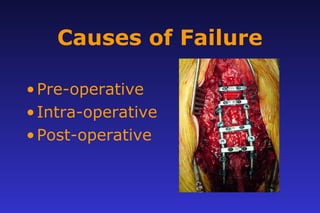
Causes of Failure
•Pre-operative
•Intra-operative
•Post-operative
Preoperative causes of failure
•Wrong diagnosis
•Pre-existing conditions
associated with
increased operative risk
or
difficulties
Wrong diagnosis
• Infection
• Tumor
• Other causes of pain
• Psychological –
social problems
Infection Tumor
Other causes of pain
Psychological – Social
problems
Pre-existing conditions associated with
increased operative risk or difficulties
I. Deformities e.g. scoliosis,
spondylolysis,
spondylisthesis
II. Infections or tumors
III. Previous discectomies
IV. Previous laminectomies
V. Previous lumbar fusions
VI. Previous operated spinal
deformities
VII. Pre existing instabilities
VIII.Inadequate investigation
• Clinical
• Radiological
Intra-operative causes of failure
• Hemorrhage
• Facets’ – pedicles’
destruction
• Screws misplacement
• Battered nerve roots
• Osteoporosis
• Graft’s quality and
quantity
• Inadequate
decompression
Post-operative
causes of failure
Early post-operative causes of failure
(0 – 3 wks)
•Haematoma
•Infection
•Implants’
failure
Late post-operative causes of failure
(a. 3wks – 3mths)
• Implants‘ failure
– Screws
• loosening
• Broken
• Dislodged
– Rods
• Broken
• Destabilization
• Infection
Late post-operative causes of failure
(b. > 3mths)
• Implants failure
• Destabilization
– at the level(s) of the operation
– at the level above -//-
– at the level below -//-
• Pseudarthrosis
• Recurrence of stenosis
• Late infection
Consequences
Intra-operative
• Removal of the
ligamentous and bony
structures destabilizes
the lumbar spine
• Instability discovered
intra-operatively extends
the operative time.
• In case of pre-existed
pathology e.g.
osteoporosis,
tumor,
infection
• The fixation of the
implants is not safe
• The dissemination
(malignant tumor)
is very likely
Post-operative
•Immediate
•Early
•Late
Immediate / early
post operative
• Unchanged symptoms
• Recurrence of -//-
• Deterioration of -//-
Late post-operative
a. Instability
b. Recurrence of
stenosis
±
neurologic deficit
c. Pain
Post-operative failures due to:
–Buttered nerve roots
–Muscles destruction
–Implants failure
–Instability
cause
a. considerable
back and leg pain
b. disability
Neurologic compromise:
•Recurrence of stenosis
•Instability
– May lead to anterioposterior or lateral
subluxation – displacement.
The abnormal spatial relationship is
achieved at the cost of spaces
through which the nerve roots of
the cauda equina travel in their
course from the spinal cord
to and through the neural foramen:
injury to the nerve root(s)
may result.
Management
Investigations
•Clinical
•Radiological
•Psychological - Social
Clinical examination
• Medical evaluation
• Neurological
investigation
Radiological investigation
• Plain x-rays
• Dynamic x-rays
• CT- scan
• M.R.I.
• Discograms
• Scanning
• Local injections
Conservative treatment
• NSAIDS
• Brace
• Injections – Facets’ Blocks
• Epidural – Caudal injections
• Epidural endoscopy
(pain management)
• Back schools
• Psychological – Social support
Local injections
• Epidural
• Caudal
• Facet’s block
Unpredictable results
Temporary improvement
and
Limited satisfaction
Operative treatment
Intra-operative:
• When the spinal
instability is recognized
intra-operatively
consideration should be
given to perform
spondylodesia
with or without
instrumentation
Post Laminectomy Instability
Revision surgery
for
post-laminectomy instability
Revision surgery
for
post-operative
instability
(above or below
the operated level)
Cases
1st case
Degenerative Spondylolisthesis – Lumbar Stenosis
Instability at the level above the spondylodesia
Extension of the spondylodesia
2nd case
Lumbar Fracture Laminectomy & Plif without
internal fixation
Facetectomies - Lumbar Instability
Facetectomies
Lumbar Instability
Lumbar Instability
Treatment: Transpedicular Internal Fixation
3rd case
Post Facetectomies – Laminectomies
Instability
Extensive Facetectomies
Post Laminectomy Lumbar Instability
Treatment: Transpedicular Internal Fixation
4th case
Post Laminectomies - Facetectomies
Instability
Facetectomies
Lumbar Instability
Treatment: Transpedicular Stabilization
Conclusions
I. Careful pre-operative evaluation is
mandatory to realize the underlying
pathology
II. The frequency of
instability
complicating lumbar
laminectomy is higher
in patients with:
• pre-existing pars defect
(spondylolysis -
sthesis)
• Spondylolisthesis
• Congenital or
developmental lumbar
stenosis
III. Removal of the least
possible of the bone
(facets) and soft
tissues (ligaments &
facets capsule)
is essential in the
prevention of
instability following
lumbar laminectomy
IV. Instability complicating
lumbar laminectomy
can be avoided if the
surgeon proceeds in
spondylodesia of the
affected levels with or
without
instrumentation
in case that instability
is encountered
intra-operatively
V.V. PLIF + Internal Stabilization providesPLIF + Internal Stabilization provides
stable Post Laminectomy spinal levelsstable Post Laminectomy spinal levels
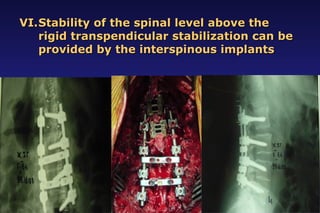
VI.VI.Stability of the spinal level above theStability of the spinal level above the
rigid transpendicular stabilization can berigid transpendicular stabilization can be
provided by the interspinous implantsprovided by the interspinous implants
VII.The stabilization
of the affected
level is associated
with better results
in the following
conditions:
A. Lumbar stenosis associated with
degenerative spondylolisthesis
B. Lumbar stenosis associatedB. Lumbar stenosis associated
with adult scoliosiswith adult scoliosis
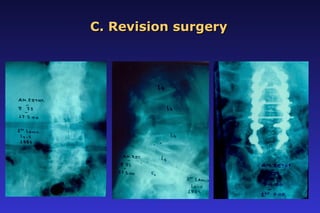
C. Revision surgeryC. Revision surgery
Lumbar Instability  Causes - Diagnosis - Management

Lumbar Instability Causes - Diagnosis - Management