K WIRE FIXATION-BASICS
Dr. AKSHAI GEORGE PAUL
Introduced in 1909
by Martin Kirschner,
the wires are now widely
used in orthopedics.
He introduced it as SS (Stainless Steel) Wires
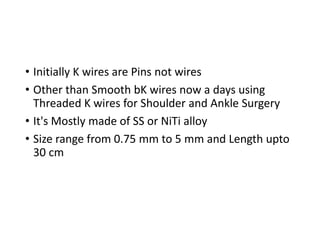
• Initially K wires are Pins not wires
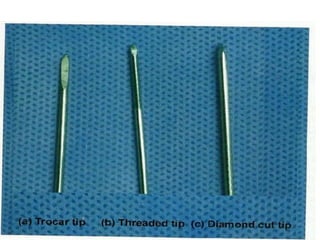
• Other than Smooth bK wires now a days using
Threaded K wires for Shoulder and Ankle Surgery
• It's Mostly made of SS or NiTi alloy
• Size range from 0.75 mm to 5 mm and Length upto
30 cm
Indications
• Fixing Small Bone # and Dislocation
• Transfixing unstable dislocation
• Arthrodesis
• Splint for Soft Tissue Healing
• Deformity and Contracture corrections
• Temporary Fixation
• Maintain deformity correction
• Correct malunion, Non Union
• K wire Traction in Illizarov
• Marker used in C arm
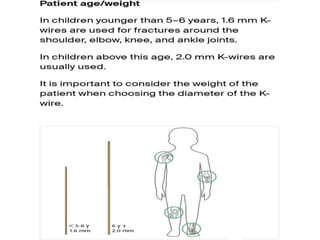
Size of K wire
General Technique
• Appropriate Size to be Taken
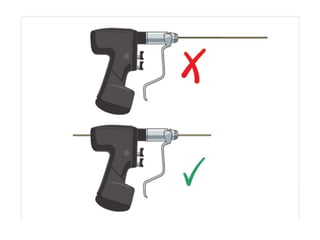
• Working length of K wire on Drill bit should not be
Too Long
• Mostly Done under C arm guidance
• Feel of Piercing bone and C arm guidance is
Important in reaching K wires at Desired Location
• While bending K wires No force to be Transmitted
to it
• Saline irrigation to be done at site to avoid thermal
necrosis bof Bone
• Most cases K wires passed from Free fragment into
main Fragment
• K wire to be entered via a Stab insertion
• Multiple drilling to be mostly avoided
• K removal Mostly done 4-6 wks- Based on the
Check Xray
Complications from K wiring
• Loss of Fixation
• Loss of Reduction
• Migration of K wire
• Break of K wire
• Pin tract Infection
• Skin teathering
• Stiffness
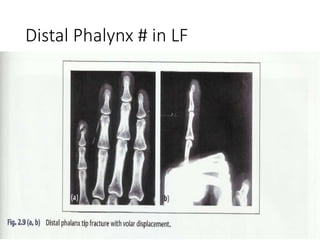
Distal Phalynx # in LF
HAND
Introduction
• One of the most important methods of fixation of
small bones of hand.
• Stiffness, pain and Deformity are the major
concerns during this treatment.
• One should know the safe corridors to pass K wires,
So that to start active range of motion at the
earliest.
• On Table active examination test-To Rule out soft
tissue tethering
• Most cases are done under Digital /Wrist block
• Show the patients the complete range of
movements done by him in OT-Boost patients
confidence to work on post operative
physiotherapy
Indications
• Unstable #
• Fractures with rotation and angulation and
shortening
• Multiple phalangeal # in same hand
• Open #
• Avulsion # (Central slip avulsion,Mallet finger)
• Failed conservative management
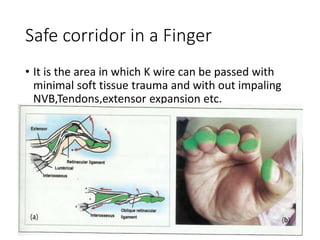
Safe corridor in a Finger
• It is the area in which K wire can be passed with
minimal soft tissue trauma and with out impaling
NVB,Tendons,extensor expansion etc.
Proximal Phalanx
1)A Triangular wide area of safe zone is present
dorsolaterally and dorsomedially on either side of
extensor tendon in base of proximal phalanx.
2)PPX shaft is dangerous zone it has ligaments and
NVB in proximity.
3)In PPX Head dorsomedial and dorsolateral small
triangular area is safe in flexion and obliterates in
extension.
Middle Phalanx
1)Base-Small triangular safe corridor in flexionof PIPJ
dorsomedially and dorsolaterally between the
central slip and lateral band
2)Shaft-Dangerous area,Lateral band and ORL
3)Head-Wide safe zone dorsomedially and
dorsolaterally in both flexion and extension
Distal phalanx
1)Tip – Safe
2)Dorsal and volar insertion points of long flexor and
extensor tendons respectively
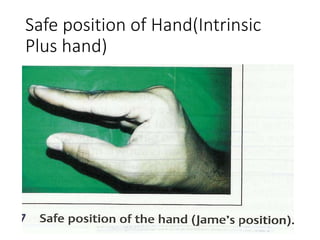
Safe position of Hand(Intrinsic
Plus hand)
• Position of immobilisation should be leads to the
least amount of stiffness and early functional
recovery of the joint
• MCPJ are in 70 degree flexion,PIPJ and DIPJ in full
extension,Thumb in abduction such that collateral
ligaments are at maximum stretched position in
this posture and wrist in 30 degree dorsiflexion
DISTAL PHALANX
Distal phalanx # In Little finger
• DPX # at waist level lead to the flexion of distal
fragment and extension of base,which is caused by
the extensor expansion insertion
• Lead to nailbed disruption and can cause
cosmetically scarred nail if not managed properly
• At the point of entry one must spend some time for
a perfect position under C arm guidance before
advancing intramedullary
• Once wrong tract is created, it is literally difficult to
change tract
• Slow advancement with 0.75 mm K wire is ideal
Open DPX # Of MF with Closed
Mallet Finger deformity
• In the DPX # was transfixed spanning across the
DIPJ in extension for correction of mallet finger
deformity-K wire removed after 6 weeks
• Mallet night splinting was given for another 6
weeks
Open distal Phalanx # with Nail
bed laceration
• Viability of distal tip to be assessed carefully with
not to injure the healthy digital artery
• In an anterograde manner K wire is inserted into
the proximal part of DPX under C arm guidance
DIPJ
Mallet Finger with Arthritis-DIPJ
Fusion of MF
• Post mallet finger with arthritis treated with DIPJ
fusion
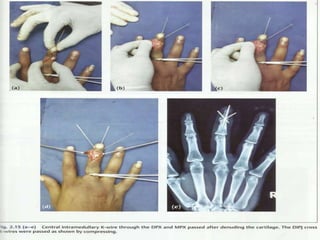
• Fused in 0 degree extension by passing an axial K
wires
• Compression ant arthrodesis site is maintained by 2
cross K wires
• Wires are maintained for 10-12 wks
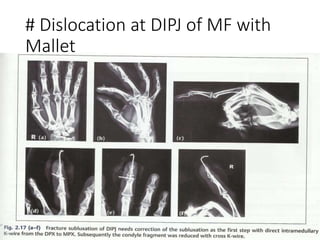
# Dislocation at DIPJ of MF with
Mallet
MIDDLE PHALANX
Displaced Central slip avulsion #
• K wire is passed through small fragment and
manipulated and get a perfect reduction in
extension
Central slip avulsion with
Boutonniere Deformity
• Joint trans fixation K wire in extension of PIPJ
• Additional K wire to transfix the avulsed fragment
• Movements were started immediate post op
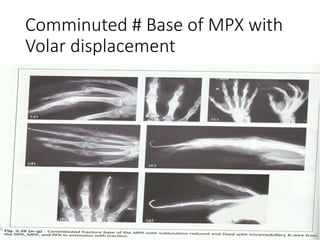
Comminuted # Base of MPX with
Volar displacement
• K wire is passed from DPX tip intra medullary into
the DPX,DIPJ,MPX,PIPJ and PPX head
• Splaying out of base was avoided by gentle
compression of Comminuted fragment
• With Ligamentotaxis principle Fragments are
arranged in distraction.
PIPJ
PIPJ dislocation with central slip
avulsion
• PIPJ dislocation reduced and maintained by Cross k
wires passed from MPX distal to proximal at PPX
head
• It was left for 4 weeks then vigorous mobilization
started
PROXIMAL PHALANX
Transverse # Neck of PPX
• 2 parallel K wires were passed parallel from PPX
base negotiating the # into the PPX head and
parked subchondrally
Long oblique # of Proximal
phalanx
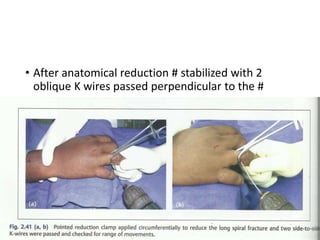
• After anatomical reduction # stabilized with 2
oblique K wires passed perpendicular to the #
MCPJ
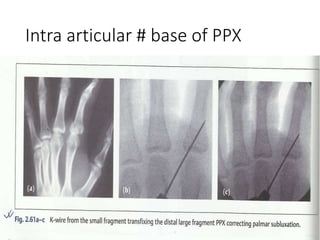
Intra articular # base of PPX
• K wires must be passed engaging the fragment and
transfixed to the distal fragment
METACARPAL
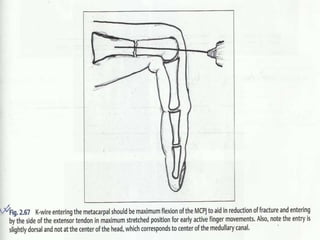
• K wiring of MC # from MCPJ is done in a distal to
proximal direction starting from the center point of
entry an intra medullary wire
• Spike jetting out dorsally is clearly visible in the true
lateral view
Rolando #-Comminuted intra
articular # base of first MC
• Traction, abduction is exerted by the surgeon using
his fingers and thumb
• K wire is introduced into distal fragment using
surgeons other hand parallel to the thumbnail of
the traction hand into the trapezium
Bennet #-Fracture subluxation of
First metacarpal base
K WIRE FIXATION-Basics.pptx

K WIRE FIXATION-Basics.pptx

  • 1.
    K WIRE FIXATION-BASICS Dr.AKSHAI GEORGE PAUL
  • 2.
    Introduced in 1909 byMartin Kirschner, the wires are now widely used in orthopedics. He introduced it as SS (Stainless Steel) Wires
  • 3.
    • Initially Kwires are Pins not wires • Other than Smooth bK wires now a days using Threaded K wires for Shoulder and Ankle Surgery • It's Mostly made of SS or NiTi alloy • Size range from 0.75 mm to 5 mm and Length upto 30 cm
  • 5.
    Indications • Fixing SmallBone # and Dislocation • Transfixing unstable dislocation • Arthrodesis • Splint for Soft Tissue Healing • Deformity and Contracture corrections
  • 6.
    • Temporary Fixation •Maintain deformity correction • Correct malunion, Non Union • K wire Traction in Illizarov • Marker used in C arm
  • 8.
  • 12.
    General Technique • AppropriateSize to be Taken • Working length of K wire on Drill bit should not be Too Long • Mostly Done under C arm guidance
  • 14.
    • Feel ofPiercing bone and C arm guidance is Important in reaching K wires at Desired Location • While bending K wires No force to be Transmitted to it • Saline irrigation to be done at site to avoid thermal necrosis bof Bone
  • 15.
    • Most casesK wires passed from Free fragment into main Fragment • K wire to be entered via a Stab insertion • Multiple drilling to be mostly avoided • K removal Mostly done 4-6 wks- Based on the Check Xray
  • 16.
    Complications from Kwiring • Loss of Fixation • Loss of Reduction • Migration of K wire • Break of K wire • Pin tract Infection
  • 17.
  • 18.
  • 20.
  • 21.
    Introduction • One ofthe most important methods of fixation of small bones of hand. • Stiffness, pain and Deformity are the major concerns during this treatment. • One should know the safe corridors to pass K wires, So that to start active range of motion at the earliest.
  • 22.
    • On Tableactive examination test-To Rule out soft tissue tethering • Most cases are done under Digital /Wrist block • Show the patients the complete range of movements done by him in OT-Boost patients confidence to work on post operative physiotherapy
  • 23.
    Indications • Unstable # •Fractures with rotation and angulation and shortening • Multiple phalangeal # in same hand • Open # • Avulsion # (Central slip avulsion,Mallet finger) • Failed conservative management
  • 24.
    Safe corridor ina Finger • It is the area in which K wire can be passed with minimal soft tissue trauma and with out impaling NVB,Tendons,extensor expansion etc.
  • 25.
    Proximal Phalanx 1)A Triangularwide area of safe zone is present dorsolaterally and dorsomedially on either side of extensor tendon in base of proximal phalanx. 2)PPX shaft is dangerous zone it has ligaments and NVB in proximity. 3)In PPX Head dorsomedial and dorsolateral small triangular area is safe in flexion and obliterates in extension.
  • 26.
    Middle Phalanx 1)Base-Small triangularsafe corridor in flexionof PIPJ dorsomedially and dorsolaterally between the central slip and lateral band 2)Shaft-Dangerous area,Lateral band and ORL 3)Head-Wide safe zone dorsomedially and dorsolaterally in both flexion and extension
  • 27.
    Distal phalanx 1)Tip –Safe 2)Dorsal and volar insertion points of long flexor and extensor tendons respectively
  • 28.
    Safe position ofHand(Intrinsic Plus hand)
  • 29.
    • Position ofimmobilisation should be leads to the least amount of stiffness and early functional recovery of the joint • MCPJ are in 70 degree flexion,PIPJ and DIPJ in full extension,Thumb in abduction such that collateral ligaments are at maximum stretched position in this posture and wrist in 30 degree dorsiflexion
  • 30.
  • 31.
    Distal phalanx #In Little finger
  • 32.
    • DPX #at waist level lead to the flexion of distal fragment and extension of base,which is caused by the extensor expansion insertion • Lead to nailbed disruption and can cause cosmetically scarred nail if not managed properly
  • 34.
    • At thepoint of entry one must spend some time for a perfect position under C arm guidance before advancing intramedullary • Once wrong tract is created, it is literally difficult to change tract • Slow advancement with 0.75 mm K wire is ideal
  • 35.
    Open DPX #Of MF with Closed Mallet Finger deformity
  • 36.
    • In theDPX # was transfixed spanning across the DIPJ in extension for correction of mallet finger deformity-K wire removed after 6 weeks • Mallet night splinting was given for another 6 weeks
  • 37.
    Open distal Phalanx# with Nail bed laceration
  • 38.
    • Viability ofdistal tip to be assessed carefully with not to injure the healthy digital artery • In an anterograde manner K wire is inserted into the proximal part of DPX under C arm guidance
  • 39.
  • 40.
    Mallet Finger withArthritis-DIPJ Fusion of MF
  • 41.
    • Post malletfinger with arthritis treated with DIPJ fusion • Fused in 0 degree extension by passing an axial K wires • Compression ant arthrodesis site is maintained by 2 cross K wires • Wires are maintained for 10-12 wks
  • 43.
    # Dislocation atDIPJ of MF with Mallet
  • 45.
  • 46.
  • 47.
    • K wireis passed through small fragment and manipulated and get a perfect reduction in extension
  • 48.
    Central slip avulsionwith Boutonniere Deformity
  • 49.
    • Joint transfixation K wire in extension of PIPJ • Additional K wire to transfix the avulsed fragment • Movements were started immediate post op
  • 50.
    Comminuted # Baseof MPX with Volar displacement
  • 51.
    • K wireis passed from DPX tip intra medullary into the DPX,DIPJ,MPX,PIPJ and PPX head • Splaying out of base was avoided by gentle compression of Comminuted fragment • With Ligamentotaxis principle Fragments are arranged in distraction.
  • 52.
  • 53.
    PIPJ dislocation withcentral slip avulsion
  • 54.
    • PIPJ dislocationreduced and maintained by Cross k wires passed from MPX distal to proximal at PPX head • It was left for 4 weeks then vigorous mobilization started
  • 55.
  • 56.
  • 57.
    • 2 parallelK wires were passed parallel from PPX base negotiating the # into the PPX head and parked subchondrally
  • 58.
    Long oblique #of Proximal phalanx
  • 59.
    • After anatomicalreduction # stabilized with 2 oblique K wires passed perpendicular to the #
  • 60.
  • 61.
    Intra articular #base of PPX
  • 62.
    • K wiresmust be passed engaging the fragment and transfixed to the distal fragment
  • 63.
  • 65.
    • K wiringof MC # from MCPJ is done in a distal to proximal direction starting from the center point of entry an intra medullary wire • Spike jetting out dorsally is clearly visible in the true lateral view
  • 66.
  • 67.
    • Traction, abductionis exerted by the surgeon using his fingers and thumb • K wire is introduced into distal fragment using surgeons other hand parallel to the thumbnail of the traction hand into the trapezium
  • 68.
    Bennet #-Fracture subluxationof First metacarpal base