Epidural anesthesia
Presenter: Brenda Richard
Supervisor: Dr Lugano
Overview
• Introduction
• Applied anatomy
• Technique
• Indications & contraindications
• Complications
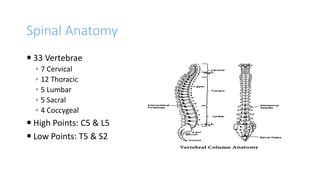
Spinal Anatomy
 33 Vertebrae
◦ 7 Cervical
◦ 12 Thoracic
◦ 5 Lumbar
◦ 5 Sacral
◦ 4 Coccygeal
 High Points: C5 & L5
 Low Points: T5 & S2
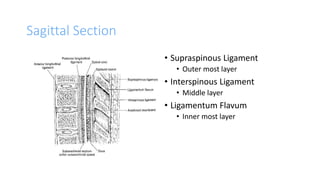
Sagittal Section
• Supraspinous Ligament
• Outer most layer
• Interspinous Ligament
• Middle layer
• Ligamentum Flavum
• Inner most layer
Spinal Cord
• Spinal Cord
• Adult
• Begins: Foramen Magnum
• Ends: L1
• Newborn
• Begins: Foramen Magnum
• Ends: L3
• Terminal End: Conus Medullaris
• Filum Terminale: Anchors in sacral region
• Cauda Equina: Nerve group of lower dural sac
Epidural Space
• Potential Space that surrounds the spinal meninges
• Ligamentum Flavum
• Binds epidural space posteriorly
• Widest at Level L2 (5-6mm)
• Narrowest at Level C5 (1-1.5mm)
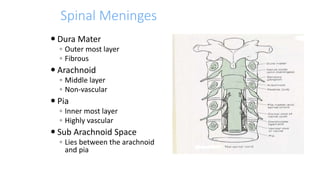
Spinal Meninges
 Dura Mater
◦ Outer most layer
◦ Fibrous
 Arachnoid
◦ Middle layer
◦ Non-vascular
 Pia
◦ Inner most layer
◦ Highly vascular
 Sub Arachnoid Space
◦ Lies between the arachnoid
and pia
Technique
• It is given in sitting or lateral position
• The epidural space is most commonly located by loss of resistance
technique. Another technique is hanging drop technique (rarely used
in current practice)
• Once the needle is confirmed in epidural space, a test dose of 2-3mls
of lignocaine 1-2% with adrenaline 5mcg/ml is given. If in 5mins there
are no signs of either spinal block or intravascular injection, further
dose can be injected 15-20mls.
• An epidural catheter is then passed through the needle(3-4cm of the
catheter should be in epidural space)
Standard Epidural needle is typically 17 to 18 gauge, 3-3.5inches long
and has a blunt bevel with a gentle curve of 15 to 30degrees. Tuohy
needle is the most commonly used
Placing a catheter into epidural space allows for continuous infusion or
intermittent bolus technique which is useful for intraoperative epidural
anesthesia and postoperative analgesia
Distances from Skin to Epidural Space
• Average adult: 4-6cm
• Obese adult: up to 8cm
• Thin adult: 3cm
Indications
All surgeries which can e performed under spinal anesthesia can be
performed under epidural block.
However in clinical practice epidural block in mainly used in
• Postoperative pain management
• Chronic pain management
Others include
• Upper abdominal surgery
• Thoracic surgery
• Neck surgery
contraindications
• Raised intracranial pressure
• Patient refusal
• Severe hypovolemia and hypotension
• Coagulopathy
Physiologic effects of epidural block
1. Cardiovascular system
Blockade of Sympathetic Preganglionic Neurons
• Send signals to both arteries and veins
• Predominant action is venodilation
• Reduces:
• Venous return
• Stroke volume
• Cardiac output
• Blood pressure
T1-T4 Blockade
• Causes unopposed vagal stimulation
• Bradycardia
• Associated with decrease venous return & cardioaccelerator fibers blockade
• Decreased venous return to right atrium causes decreased stretch receptor
response
2. Respiratory system
• Healthy Patients
• Appropriate epidural blockade has little effect on ventilation
• High Spinal
• Decrease functional residual capacity (FRC)
• Paralysis of abdominal muscles
• Intercostal muscle paralysis interferes with coughing and
clearing secretions
• Apnea is due to hypoperfusion of respiratory center
Factors affecting the spread(level) of block
• Volume of the drug
• Age
• Length of vertebral column
• Patient position
Complications
• Failed epidural anesthesia
• High or total spinal anesthesia
• Nerve injury
• Postdural puncture headache
• Back pain
• Infection
References
• Morgan & Mikhail’s clinical anesthesiology 6th edition
• A short textbook of anesthesia Ajay Yadav 6th edition
• UpTodate

EPIDURAL ANAESTHESIA.pptx

  • 1.
    Epidural anesthesia Presenter: BrendaRichard Supervisor: Dr Lugano
  • 2.
    Overview • Introduction • Appliedanatomy • Technique • Indications & contraindications • Complications
  • 3.
    Spinal Anatomy  33Vertebrae ◦ 7 Cervical ◦ 12 Thoracic ◦ 5 Lumbar ◦ 5 Sacral ◦ 4 Coccygeal  High Points: C5 & L5  Low Points: T5 & S2
  • 4.
    Sagittal Section • SupraspinousLigament • Outer most layer • Interspinous Ligament • Middle layer • Ligamentum Flavum • Inner most layer
  • 5.
    Spinal Cord • SpinalCord • Adult • Begins: Foramen Magnum • Ends: L1 • Newborn • Begins: Foramen Magnum • Ends: L3 • Terminal End: Conus Medullaris • Filum Terminale: Anchors in sacral region • Cauda Equina: Nerve group of lower dural sac
  • 6.
    Epidural Space • PotentialSpace that surrounds the spinal meninges • Ligamentum Flavum • Binds epidural space posteriorly • Widest at Level L2 (5-6mm) • Narrowest at Level C5 (1-1.5mm)
  • 7.
    Spinal Meninges  DuraMater ◦ Outer most layer ◦ Fibrous  Arachnoid ◦ Middle layer ◦ Non-vascular  Pia ◦ Inner most layer ◦ Highly vascular  Sub Arachnoid Space ◦ Lies between the arachnoid and pia
  • 8.
    Technique • It isgiven in sitting or lateral position • The epidural space is most commonly located by loss of resistance technique. Another technique is hanging drop technique (rarely used in current practice) • Once the needle is confirmed in epidural space, a test dose of 2-3mls of lignocaine 1-2% with adrenaline 5mcg/ml is given. If in 5mins there are no signs of either spinal block or intravascular injection, further dose can be injected 15-20mls. • An epidural catheter is then passed through the needle(3-4cm of the catheter should be in epidural space)
  • 9.
    Standard Epidural needleis typically 17 to 18 gauge, 3-3.5inches long and has a blunt bevel with a gentle curve of 15 to 30degrees. Tuohy needle is the most commonly used Placing a catheter into epidural space allows for continuous infusion or intermittent bolus technique which is useful for intraoperative epidural anesthesia and postoperative analgesia Distances from Skin to Epidural Space • Average adult: 4-6cm • Obese adult: up to 8cm • Thin adult: 3cm
  • 10.
    Indications All surgeries whichcan e performed under spinal anesthesia can be performed under epidural block. However in clinical practice epidural block in mainly used in • Postoperative pain management • Chronic pain management Others include • Upper abdominal surgery • Thoracic surgery • Neck surgery
  • 11.
    contraindications • Raised intracranialpressure • Patient refusal • Severe hypovolemia and hypotension • Coagulopathy
  • 12.
    Physiologic effects ofepidural block 1. Cardiovascular system Blockade of Sympathetic Preganglionic Neurons • Send signals to both arteries and veins • Predominant action is venodilation • Reduces: • Venous return • Stroke volume • Cardiac output • Blood pressure T1-T4 Blockade • Causes unopposed vagal stimulation • Bradycardia • Associated with decrease venous return & cardioaccelerator fibers blockade • Decreased venous return to right atrium causes decreased stretch receptor response
  • 13.
    2. Respiratory system •Healthy Patients • Appropriate epidural blockade has little effect on ventilation • High Spinal • Decrease functional residual capacity (FRC) • Paralysis of abdominal muscles • Intercostal muscle paralysis interferes with coughing and clearing secretions • Apnea is due to hypoperfusion of respiratory center
  • 14.
    Factors affecting thespread(level) of block • Volume of the drug • Age • Length of vertebral column • Patient position
  • 15.
    Complications • Failed epiduralanesthesia • High or total spinal anesthesia • Nerve injury • Postdural puncture headache • Back pain • Infection
  • 16.
    References • Morgan &Mikhail’s clinical anesthesiology 6th edition • A short textbook of anesthesia Ajay Yadav 6th edition • UpTodate