Negative pattern fabrication using laser exposure of positive 
photoresist 
Boris Kobrin and Colleen Hagen 
Rochester Photonics Corporation 
330 Clay Road, Rochester, NY 14623 
ABSTRACT 
The method of simultaneous positive and negative pattern formation on a single positive photoresist layer 
is described. A negative photoresist pattern was fabricated by using local laser exposure to crosslink a 
positive resist layer, consecutive UV flood exposure, and resist developing. The positive pattern is 
obtained on the same photoresist layer in the areas masked from the UV flood exposure. Effects of laser 
energy and resist processing parameters on height and width of negative type resist structures were 
investigated. Metal line grid structures with lines in the region of 3 to 30 pm in width were manufactured 
on a 5"x 5" glass substrate using this technique. The proposed method of positive/negative pattern 
formation significantly reduces the number of technological steps in the fabrication of diffractive elements 
for dual-wavelength applications. 
Key words: photoresist, negative pattern, positive pattern, laser exposure, crosslinking, diffractive 
elements. 
1. INTRODUCTION 
Laser direct write lithography is a powerful method for fast prototype fabrication of arbitrary relief patterns 
in photoresist. This technique does not require the manufacture of a photomask or series of masks, as in 
the case of conventional contact printing or stepper exposure. Laser writing also does not require the high 
vacuum processing and super-cleanliness that E-beam writing methods do. However, laser direct writing 
techniques can have long write times depending upon the resolution required. Consequently, it is desirable 
to decrease the writing time as much as possible. The laser writing time to manufacture a grid pattern, for 
example, can be reduced drastically by using a negative type method of resist processing. In this case the 
laser will only expose a small part of the entire area and the process can be accomplished much faster. 
It is known that negative resists possess lower sensitivity than positive ones, and corner rounding is a very 
pronounced feature of negative resists.' An image reversal (IR) scheme is an opportunity to obtain a 
negative pattern using positive photoresist. 
The JR capability is obtained by using a special crosslinking agent in the resist formulation which becomes 
active only in the exposed areas of the resist. The crosslinking agent, together with the exposed 
photoactive compound, leads to an almost insoluble substance in developer which is no longer light 
sensitive. The unexposed areas still behave like normal unexposed positive photoresist. After a flood 
exposure, these areas are dissolved in standard developer for positive photoresist, and the crosslinked areas 
remain. The overall result is a negative image pattern. 
Many different IR techniques are published. Among them are methods which use special chemical 
formulations of resist that give positive or negative patterns depending on the type of developer solution 
used.2'3 Other JR techniques treat the exposed areas of resist with different chemicals4'5 or an ion beam 
* Further author information- 
B .K.: E-mail: kobrin @rphotonics.com; BorisKobrin @worldnet.att.net; 
C.H.: E-mail: hagen@rphotonics.com; 
http://www.rphotonics.com Telephone: 716-272-3010 Fax: 716-272-9374 
1426 I SPIE Vol. 3333 0277-786X198/$1O.OO
shower6 to change the type of resulting pattern. The image reversal scheme7 includes the image exposure of 
a positive resist and subsequent UV flood exposure. The negative image is then obtained by using a 
solvent to remove the resist material which was not exposed originally. 
An article about the laser writing crosslinking process used for the fabrication of a negative mask for 
Integrated Optics was published by OPN.8 A Korean team found that the laser beam crosslinking process is 
not sensitive to dust, vibration, or intensity variation. 
The goal for the present experiment is to perform an image reversal process on a positive photoresist layer 
using laser beam exposure. This process utilizes the cross-linking characteristics of photoresist through 
laser exposure. Different degrees of the cross-linking process can be achieved depending on the dosage of 
laser exposure. The cross-linked areas of the resist are soluble in the developer at a rate that is much slower 
than the regularly exposed areas. For extremely high dosages of crosslinking exposure, the crosslinked 
areas are insoluble in the developer. As a result of further UV flood exposure of the resist, the regions 
without laser exposure are removed by the developing process. Only the negative resist pattern remains on 
the substrate. 
'jU7 :1..J —) ..1 
4- -: —::: 
5 6 
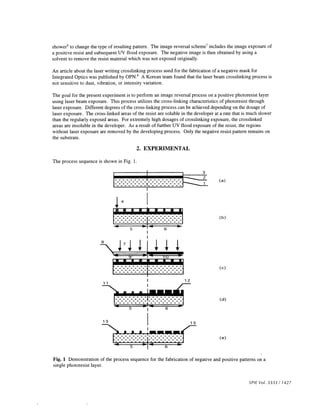
Fig. 1 Demonstration of the process sequence for the fabrication of negative and positive patterns on a 
single photoresist layer. 
SPIE Vol. 3333 / 1427 
2. EXPERIMENTAL 
The process sequence is shown in Fig. 1. 
. (a) 
(b) 
(C) 
(d) 
(e)
a) The substrate ( I) with a metal layer (2) is coated with positive pliotoresist (3 
h The laser beam (4) exposes photoresist locally in accordance with the negative (5) and positive (6) 
pattern structures. 
c) The photoresist layer is exposed with IJV light (7> through a pholomask (8 . The photomask has 
transparent (9) and opaque (10) areas which correspond to the negative (5) and posItive(6) type pattern areas 
needed. 
After development of the photoresist layer, negative ( I I) and positive (12) pliotoresist patterns arc 
created in resist on the metal surface. 
The patterns are etched into the metal layer. The negative (13) and positive ) 14) type metal patterns are 
created on the substrate surface. 
Standard glass plates. I 'x 1" to 5" x 5" in site were used. The substrates were cleaned and dehydration 
baked. Next the substrates were spin coated with positive photoresist. Different layer thicknesses were 
applied by varying the spin speed and resist viscosity. In the current RP(' laserwriting system. a helium-cadmium 
laser operating at 441 nm is used to expose the resist coated substrate, which is niounted on an 
r-O air hearing spindle. Machine hardware and environment are sublect to closed-loop control to maintain 
feature placement accuracy in the PPfl1 range. A 0.7pin laser beam spot site was used and the exposure 
energ varied from 0.05 J/cm to 2.4 J/cm. Theexposure energy at fects the width of the exposed area as 
well as the height of the negative photoresist pattern on the substrate. For experimental parts the 
laserwriter was programmed to write a (qtni wide ring every S0pni. 
The parts covered by chrome and gold layers were etched in chromium and gold etch solutions, respectively. 
Results were obtained using optical profilometrv Zygo New View white-light surface profilomctem1 and 
optical microscopy (Nomarski microscope). 
3. RESULTS AND DISCUSSION 
Figure 2 shows the results of an experimental part. The trenches on the positive pattern (bottom of the 
picture) become the rectangular steps on the negative pattern (top of the picture. The top halt of the 
pattern I Fig. 2h)] is the portion where the crosslinked resist behaves like a negative pattern The bottom 
half of the pattern Fig. 2(c )I was masked during the UV flood exposure. The laser written pattern on this 
part of the sample behaves like positive tone resist. 
Fig. 2(a) Optical profilomctrv data of an experimental part. 
(428 .SP)L t'oI. 3333
The height of the negative pattern is O.7311m [Fig. 2(h)], while the depth of the positive pattern is I 
[Fig. 2(c)]. This gives a ratio of 1:2.7 for the negative to positive step tahncatcd by the laser beam 
crosslinking method. This ratio can he controlled by varying the parameters of the process. e.g. the laser 
exposure energy. the intermediate hake temperature and duration, and the UV 1100(1 exposure energy. The 
intersect region between the positive and negative pattern areas can he inininiiied by providing a vacuum 
contact between the mask and substrate during the UV flood exposure step. Various resist thicknesses. 
writing parameters. intermediate hake parameters. flood exposure dosages. and developriient times were used 
for process optimization. Because the height of the negative resist pattern that can be obtained with this 
method is typically only a fraction (1/2 to 1/3) ot the initial resist layer thickness, it is difficult to control 
the exposure and development parameters required to produce resist layers that are less than lllin in 
thickness. On the other hand, for resist layers greater than 5pm in thickness, it is difficult to clear the flood 
exposed areas completely because of resist hardening during the intermediate hake. A resist thickness of 3 
to 511m is optimal for the reliable fabrication of the negative-type resist patterns. 
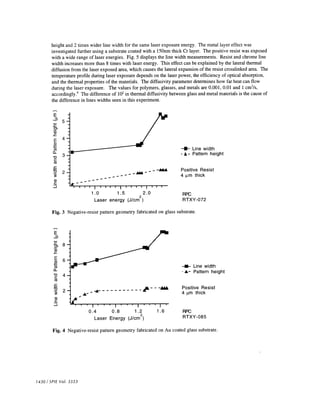
The results in Fig. 3 show how laser power affects the negative pattern height and line width. For the 
range of laser energies investigated, the height changed by ôO'3 and line width by 7ft/ . Further 
investigations showed that this effect is stronger when the resist layer is spun on a metal-coated substrate. 
Fig. 4 displays the results of such dependence for the same type of resist as in Fig. 3. hut spun on a 
substrate coated with a 200 nm thick cold layer. The gold layer causes approximately a 5 times larger 
iii  i. 
)ptical profilometry data of the UV flood exposed area (negative-type pattern. 
Fig. 2(c) Optical profilometrv data of the unexposed UV flood exposure area positi'e-type pattern).
height and 2 times wider line width for the same laser exposure energy. The metal layer effect was 
investigated further using a substrate coated with a l5Onm thick Cr layer. The positive resist was exposed 
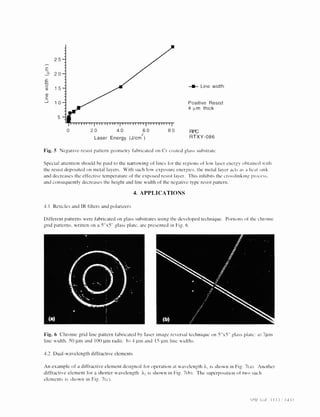
with a wide range of laser energies. Fig. 5 displays the line width measurements. Resist and chrome line 
width increases more than 8 times with laser energy. This effect can be explained by the lateral thermal 
diffusion from the laser exposed area, which causes the lateral expansion of the resist crosslinked area. The 
temperature profile during laser exposure depends on the laser power, the efficiency of optical absorption, 
and the thermal properties of the materials. The diffusivity parameter determines how far heat can flow 
during the laser exposure. The values for polymers, glasses, and metals are 0.001, 0.01 and 1 cm2/s, 
accordingly.9 The difference of 102 in thermal diffusivity between glass and metal materials is the cause of 
the difference in lines widths seen in this experiment. 
5 
4 
E 
:1 
.c: 
C) 
ci) 
C 
ci) 
cci 
C 
cci 
0 
ci) C 
-J 
3 
2 
Fig. 4 Negative-resist pattern geometry fabricated on Au coated glass substrate. 
1430 / SPIE Vol. 3333 
1.0 1.5 22.0 
Laser energy (J/cm 
—II— Line width 
-A- Pattern height 
Positive Resist 
4 im thick 
RPC 
RTXY-072 
Fig. 3 Negative-resist pattern geometry fabricated on glass substrate. 
E 
C) 
ci) .C 
C 
—— Line width 
C 4 - A- Pattern height 
2 Positive Resist 
4 im thick 
ci) C 
-J 
RPC 
RTXY-085 
0.4 0.8 1.2 
Laser Energy (J/cm2) 
1.6
80 RPC 
RTXY-086 
Fig. 5 Negative—resist pattern Oeonietry fabricated on Cr coated class suhstratc. 
Special attention should he paid to the narrowing of lines for the regions of low laser energy obtained with 
the resist deposited on metal layers. With such low exposure energies. the metal layer acts as a heat sink 
and decreases the effective temperature of the exposed resist layer. This inhibits the crosslinkinc process. 
and consequently decreases the height and line width of the negative-type resist pattern. 
4. APPLICATIONS 
Different patterns were fabricated on glass substrates using the developed technique. Portions of the chrome 
grid patterns, written on a 5x5" glass plate. are presented in Fig. 6. 
F'ig. 6 Chrome grid line pattern fabricated by laser image reversal technique on 5x5" glass plate: a) 7piii 
line width. 50 pni and IOU pm radii h 4 pm and IS pm line v idths. 
4.2 Dual-wavelength diffractive elements 
An exaniple of a diffractive element designed for operation at wavelength i is shown in Fig. 7(a). Another 
diffractive element for a shorter wavelength X is shown in Fig. 7(h. The superposition of two such 
elements is shown in Fig. 7(c). 
SPIt 3 14 / 
E 
r'0 
ci, 
-J 
25 
20 
15 
10 
5 
—U-- Line width 
Positive Resist 
4 pm thick 
0 20 40 60 
2 Laser Energy (J/cm 
4.1 Reticles and IR filters and polarizers
I I I I I I 
(a) 
I Ii fl fl fl fl fl rir n n n n nfl n n n n nfl n n n n ii n 
_____________________________________I 
ptInntl poonci panuq 
ru Innnnnl Innnnnl Ii, 
(c) 
Fig. 7 Schematic representation of diffractive optical elements (DOEs): a) DOE for relatively long 
wavelength; b) DOE for relatively short wavelength; c) dual-wavelength DOE. 
The conventional method of fabrication for such elements consists of two lithography steps with an 
alignment process in-between, and two etching processes: 
First cycle: 
1 . The substrate is coated with a resist layer and softbaked. 
2. The resist layer is exposed through the first photomask, corresponding to pattern P2 
3. The resist layer is developed in developer solution and hardbaked. 
4. The substrate is etched by either a wet or dry etching process. 
5. The resist is stripped from the surface of the substrate. 
Second cycle: 
6. The substrate is coated with a resist layer and softbaked. 
7. The resist layer is exposed through the first photomask, corresponding to pattern P1. 
8. The resist layer is developed in developer solution and hardbaked. 
9. The substrate is etched in a wet or dry etching process. 
10. The resist is stripped from the surface of the substrate. 
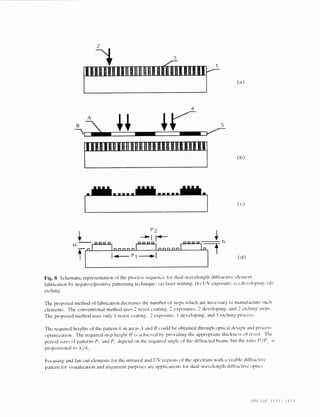
Using the proposed method of positive/negative pattern fabrication on a single resist layer, the dual-wavelength 
diffractive element can be manufactured by following this sequence of steps (Fig. 8): 
1. The substrate is coated with a resist layer and softbaked. 
2. The resist layer (1) is exposed with a laser beam (2) which creates the pattern (3) corresponding 
to period P2 [Fig. 8(a)]. 
3. The resist layer is baked. 
4. The resist layer is exposed by UV light (4) through a photomask (5), which contains opaque 
regions (A) and transparent regions (B), corresponding to pattern P1 [Figure 8(b)]; 
5. The resist layer is developed in a developer solution and hardbaked [Fig. 8(c)]. 
6. The resist pattern is etched into the substrate by a dry etching process [Fig. 8(d)]. 
1432/SPIE Vol. 3333
3 
IIIIMUIHNHHHUII 1 
5 
(a) 
H 
_ _ _ _ — 
.... 
— — — — — 
.... 
— 
DD 
P2 
D—ODøDIt--- DODD h 
Irinrinril I nnn nfl In 
Lm Pi .I 
(c) 
(d) 
Fig. 8 Schematic representation of the process sequence for dual-wavelength diliractive element 
fabrication by negative/positive patterning technique: (a) laser writing: (h UV exposure: (c developing: tdt 
etching. 
The proposed method of fabrication decreases the number of steps which are necessary to nianulacture such 
elements. The conventional method uses 2 resist coating. 2 exposures. 2 developing, and 2 etching steps. 
The proposed method uses only I resist coatIng. 2 exposure. I developing, and I etching process. 
The required heights of the pattern Ii in areas A and B could he obtained through optical design and process 
optimization. The required step height 11 is achieved h' providing the appropriate thickness of resist. '['he 
period sites of patterns P1 and I' depend on the required angle of the diffracted beam, hut the ratioJ'1/P is 
proportional to HI. 
l-'ocusing and fan-out elements for the infrared and I.TV regtons of the spectrum with a visible diffractive 
pattern for visualization and alignment purposes are applications for dual—wavelength dill raclive optics. 
I'/I oI 14 
A 
-B'__ 
IImwulluII1 i nmnt 
(b)
For example, CO2 laser material processing with 2 = 1O.2im requires P1/P,=16.l1 for pointing with 
HeNe laser light. Such a dual-wavelength diffractive element can be fabricated in ZnSe material. In this 
case, the step height H is 3.64tm and the pattern height h is n x O.l97jtm, where n=l,3,... Another 
example of an JR/visible pair is Nd:Yag and HeCd, where ?1=l.O6.tm and A2=O.442im. This element can 
be fabricated in IR-grade Fused Silica with the corresponding parameters of the structure P1/P2=2.4, 
H=1.l8im, and h=n x O.48im. An example of a UV/visible pair is an ArF excimer laser with 
A1=O.193jim and HeNe a laser with 22=O.6328im. A diffractive optical element fabricated in UV-grade 
fused silica will have the following parameters: P1/P2=3.28, H=O.69im, and h=n x O.l82im. 
5. SUMMARY 
Photoresist crosslinking is a practical method to reduce the writing time of some phase masks. By 
exposing a pattern with laser light and then backflooding the pattern with UV light, a negative image is 
formed on a positive photoresist layer. The area of resist inversion can be controlled with a mask during 
the UV flood step of the process. This allows the laserwriter beam to cover the smallest amount of area for 
a desired pattern. By utilizing this technique, the manufacturing time of wire grid patterns can be 
significantly reduced. Similarly, the manufacturing steps necessary to produce a multiple wavelength 
diffractive element can be reduced. 
The use of different materials and thickness for the metal layer under the resist gives additional flexibility in 
the process design of negative-type resist pattern fabrication. The line width of the pattern can be controlled 
not only by the laser scanning program, but also by using the effect of the metal layer. In the case of line 
widening it can be used to conserve laser writing time. The effect of line narrowing will provide the 
possibility to reach submicron resolution for laser written patterns, which is the subject of future 
development. 
Image reversal was used in this experiment to successfully create metal grid patterns on glass substrates. 
By controlling the process parameters, the grid patterns varied in width from 3 to 3Oim. 
6. ACKNOWLEDGMENTS 
The authors would like to thank Dr. D. Raguin for his insightful discussions concerning this work. 
This work was supported by the Physical Optics Program of the DARPA consortium (Contract MDA 972- 
96-C-0801). 
7. REFERENCES 
1 . P. I. L. Hagouel, A. R. Neureuther, and A. M. Zenk, "Negative resist corner rounding. Envelope 
volume modeling", J. Vac. Sci. Technol, B14, pp. 4257, 1996. 
2. T. Yoichi and M. Saito, "Method for making a dry etching resistant positive and negative photoresist", 
U.S. Patent 5,550,008, Aug. 27, 1996. 
3. Y. Yamashita, R. Kawazu, T. Itoh, T. Asano, and K. Kobayashi, "Method of forming a photoresist 
pattern", U.S. Patent 4,801,518, Jan 31, 1989. 
4. M. McFarland, "Image reversal", U.S. Patent 4,775,609, Oct. 4, 1988. 
5. J. Thackeray and A. W. McCullough, "Method of forming positive images through organometallic 
treatment of negative acid hardening cross-linked photoresist formulations", U.S. Patent 5,079,131, Jan. 7, 
1992. . 
1434 /SPIE Vol. 3333
6. K. Hashimoto, K. Yamashita, and N. Nomura, "Fine pattern forming method", U.S. Patent 5,186,788, 
Feb. 16, 1993. 
7. H. Moritz and G. Paal, "Method of making a negative photoresist image", U.S. Patent 4,104,070, Aug. 
1, 1978. 
8. K. H. Park, Y. T. Byun, M. W. Kim, S. H. Kim, S. S. Choi, W. R. Cho, S. H. Park, and U. Kim, 
"Negative mask fabrication technique by laser writing for integrated optics", OPN 8, pp. 49, 1997. 
9. A. Marchant, "Optical Recording", Addison Wesley, 1990. 
SPIE Vol. 3333 / 1435

SPIE Vol. 3333

  • 1.
    Negative pattern fabricationusing laser exposure of positive photoresist Boris Kobrin and Colleen Hagen Rochester Photonics Corporation 330 Clay Road, Rochester, NY 14623 ABSTRACT The method of simultaneous positive and negative pattern formation on a single positive photoresist layer is described. A negative photoresist pattern was fabricated by using local laser exposure to crosslink a positive resist layer, consecutive UV flood exposure, and resist developing. The positive pattern is obtained on the same photoresist layer in the areas masked from the UV flood exposure. Effects of laser energy and resist processing parameters on height and width of negative type resist structures were investigated. Metal line grid structures with lines in the region of 3 to 30 pm in width were manufactured on a 5"x 5" glass substrate using this technique. The proposed method of positive/negative pattern formation significantly reduces the number of technological steps in the fabrication of diffractive elements for dual-wavelength applications. Key words: photoresist, negative pattern, positive pattern, laser exposure, crosslinking, diffractive elements. 1. INTRODUCTION Laser direct write lithography is a powerful method for fast prototype fabrication of arbitrary relief patterns in photoresist. This technique does not require the manufacture of a photomask or series of masks, as in the case of conventional contact printing or stepper exposure. Laser writing also does not require the high vacuum processing and super-cleanliness that E-beam writing methods do. However, laser direct writing techniques can have long write times depending upon the resolution required. Consequently, it is desirable to decrease the writing time as much as possible. The laser writing time to manufacture a grid pattern, for example, can be reduced drastically by using a negative type method of resist processing. In this case the laser will only expose a small part of the entire area and the process can be accomplished much faster. It is known that negative resists possess lower sensitivity than positive ones, and corner rounding is a very pronounced feature of negative resists.' An image reversal (IR) scheme is an opportunity to obtain a negative pattern using positive photoresist. The JR capability is obtained by using a special crosslinking agent in the resist formulation which becomes active only in the exposed areas of the resist. The crosslinking agent, together with the exposed photoactive compound, leads to an almost insoluble substance in developer which is no longer light sensitive. The unexposed areas still behave like normal unexposed positive photoresist. After a flood exposure, these areas are dissolved in standard developer for positive photoresist, and the crosslinked areas remain. The overall result is a negative image pattern. Many different IR techniques are published. Among them are methods which use special chemical formulations of resist that give positive or negative patterns depending on the type of developer solution used.2'3 Other JR techniques treat the exposed areas of resist with different chemicals4'5 or an ion beam * Further author information- B .K.: E-mail: kobrin @rphotonics.com; BorisKobrin @worldnet.att.net; C.H.: E-mail: hagen@rphotonics.com; http://www.rphotonics.com Telephone: 716-272-3010 Fax: 716-272-9374 1426 I SPIE Vol. 3333 0277-786X198/$1O.OO
  • 2.
    shower6 to changethe type of resulting pattern. The image reversal scheme7 includes the image exposure of a positive resist and subsequent UV flood exposure. The negative image is then obtained by using a solvent to remove the resist material which was not exposed originally. An article about the laser writing crosslinking process used for the fabrication of a negative mask for Integrated Optics was published by OPN.8 A Korean team found that the laser beam crosslinking process is not sensitive to dust, vibration, or intensity variation. The goal for the present experiment is to perform an image reversal process on a positive photoresist layer using laser beam exposure. This process utilizes the cross-linking characteristics of photoresist through laser exposure. Different degrees of the cross-linking process can be achieved depending on the dosage of laser exposure. The cross-linked areas of the resist are soluble in the developer at a rate that is much slower than the regularly exposed areas. For extremely high dosages of crosslinking exposure, the crosslinked areas are insoluble in the developer. As a result of further UV flood exposure of the resist, the regions without laser exposure are removed by the developing process. Only the negative resist pattern remains on the substrate. 'jU7 :1..J —) ..1 4- -: —::: 5 6 Fig. 1 Demonstration of the process sequence for the fabrication of negative and positive patterns on a single photoresist layer. SPIE Vol. 3333 / 1427 2. EXPERIMENTAL The process sequence is shown in Fig. 1. . (a) (b) (C) (d) (e)
  • 3.
    a) The substrate( I) with a metal layer (2) is coated with positive pliotoresist (3 h The laser beam (4) exposes photoresist locally in accordance with the negative (5) and positive (6) pattern structures. c) The photoresist layer is exposed with IJV light (7> through a pholomask (8 . The photomask has transparent (9) and opaque (10) areas which correspond to the negative (5) and posItive(6) type pattern areas needed. After development of the photoresist layer, negative ( I I) and positive (12) pliotoresist patterns arc created in resist on the metal surface. The patterns are etched into the metal layer. The negative (13) and positive ) 14) type metal patterns are created on the substrate surface. Standard glass plates. I 'x 1" to 5" x 5" in site were used. The substrates were cleaned and dehydration baked. Next the substrates were spin coated with positive photoresist. Different layer thicknesses were applied by varying the spin speed and resist viscosity. In the current RP(' laserwriting system. a helium-cadmium laser operating at 441 nm is used to expose the resist coated substrate, which is niounted on an r-O air hearing spindle. Machine hardware and environment are sublect to closed-loop control to maintain feature placement accuracy in the PPfl1 range. A 0.7pin laser beam spot site was used and the exposure energ varied from 0.05 J/cm to 2.4 J/cm. Theexposure energy at fects the width of the exposed area as well as the height of the negative photoresist pattern on the substrate. For experimental parts the laserwriter was programmed to write a (qtni wide ring every S0pni. The parts covered by chrome and gold layers were etched in chromium and gold etch solutions, respectively. Results were obtained using optical profilometrv Zygo New View white-light surface profilomctem1 and optical microscopy (Nomarski microscope). 3. RESULTS AND DISCUSSION Figure 2 shows the results of an experimental part. The trenches on the positive pattern (bottom of the picture) become the rectangular steps on the negative pattern (top of the picture. The top halt of the pattern I Fig. 2h)] is the portion where the crosslinked resist behaves like a negative pattern The bottom half of the pattern Fig. 2(c )I was masked during the UV flood exposure. The laser written pattern on this part of the sample behaves like positive tone resist. Fig. 2(a) Optical profilomctrv data of an experimental part. (428 .SP)L t'oI. 3333
  • 4.
    The height ofthe negative pattern is O.7311m [Fig. 2(h)], while the depth of the positive pattern is I [Fig. 2(c)]. This gives a ratio of 1:2.7 for the negative to positive step tahncatcd by the laser beam crosslinking method. This ratio can he controlled by varying the parameters of the process. e.g. the laser exposure energy. the intermediate hake temperature and duration, and the UV 1100(1 exposure energy. The intersect region between the positive and negative pattern areas can he inininiiied by providing a vacuum contact between the mask and substrate during the UV flood exposure step. Various resist thicknesses. writing parameters. intermediate hake parameters. flood exposure dosages. and developriient times were used for process optimization. Because the height of the negative resist pattern that can be obtained with this method is typically only a fraction (1/2 to 1/3) ot the initial resist layer thickness, it is difficult to control the exposure and development parameters required to produce resist layers that are less than lllin in thickness. On the other hand, for resist layers greater than 5pm in thickness, it is difficult to clear the flood exposed areas completely because of resist hardening during the intermediate hake. A resist thickness of 3 to 511m is optimal for the reliable fabrication of the negative-type resist patterns. The results in Fig. 3 show how laser power affects the negative pattern height and line width. For the range of laser energies investigated, the height changed by ôO'3 and line width by 7ft/ . Further investigations showed that this effect is stronger when the resist layer is spun on a metal-coated substrate. Fig. 4 displays the results of such dependence for the same type of resist as in Fig. 3. hut spun on a substrate coated with a 200 nm thick cold layer. The gold layer causes approximately a 5 times larger iii i. )ptical profilometry data of the UV flood exposed area (negative-type pattern. Fig. 2(c) Optical profilometrv data of the unexposed UV flood exposure area positi'e-type pattern).
  • 5.
    height and 2times wider line width for the same laser exposure energy. The metal layer effect was investigated further using a substrate coated with a l5Onm thick Cr layer. The positive resist was exposed with a wide range of laser energies. Fig. 5 displays the line width measurements. Resist and chrome line width increases more than 8 times with laser energy. This effect can be explained by the lateral thermal diffusion from the laser exposed area, which causes the lateral expansion of the resist crosslinked area. The temperature profile during laser exposure depends on the laser power, the efficiency of optical absorption, and the thermal properties of the materials. The diffusivity parameter determines how far heat can flow during the laser exposure. The values for polymers, glasses, and metals are 0.001, 0.01 and 1 cm2/s, accordingly.9 The difference of 102 in thermal diffusivity between glass and metal materials is the cause of the difference in lines widths seen in this experiment. 5 4 E :1 .c: C) ci) C ci) cci C cci 0 ci) C -J 3 2 Fig. 4 Negative-resist pattern geometry fabricated on Au coated glass substrate. 1430 / SPIE Vol. 3333 1.0 1.5 22.0 Laser energy (J/cm —II— Line width -A- Pattern height Positive Resist 4 im thick RPC RTXY-072 Fig. 3 Negative-resist pattern geometry fabricated on glass substrate. E C) ci) .C C —— Line width C 4 - A- Pattern height 2 Positive Resist 4 im thick ci) C -J RPC RTXY-085 0.4 0.8 1.2 Laser Energy (J/cm2) 1.6
  • 6.
    80 RPC RTXY-086 Fig. 5 Negative—resist pattern Oeonietry fabricated on Cr coated class suhstratc. Special attention should he paid to the narrowing of lines for the regions of low laser energy obtained with the resist deposited on metal layers. With such low exposure energies. the metal layer acts as a heat sink and decreases the effective temperature of the exposed resist layer. This inhibits the crosslinkinc process. and consequently decreases the height and line width of the negative-type resist pattern. 4. APPLICATIONS Different patterns were fabricated on glass substrates using the developed technique. Portions of the chrome grid patterns, written on a 5x5" glass plate. are presented in Fig. 6. F'ig. 6 Chrome grid line pattern fabricated by laser image reversal technique on 5x5" glass plate: a) 7piii line width. 50 pni and IOU pm radii h 4 pm and IS pm line v idths. 4.2 Dual-wavelength diffractive elements An exaniple of a diffractive element designed for operation at wavelength i is shown in Fig. 7(a). Another diffractive element for a shorter wavelength X is shown in Fig. 7(h. The superposition of two such elements is shown in Fig. 7(c). SPIt 3 14 / E r'0 ci, -J 25 20 15 10 5 —U-- Line width Positive Resist 4 pm thick 0 20 40 60 2 Laser Energy (J/cm 4.1 Reticles and IR filters and polarizers
  • 7.
    I I II I I (a) I Ii fl fl fl fl fl rir n n n n nfl n n n n nfl n n n n ii n _____________________________________I ptInntl poonci panuq ru Innnnnl Innnnnl Ii, (c) Fig. 7 Schematic representation of diffractive optical elements (DOEs): a) DOE for relatively long wavelength; b) DOE for relatively short wavelength; c) dual-wavelength DOE. The conventional method of fabrication for such elements consists of two lithography steps with an alignment process in-between, and two etching processes: First cycle: 1 . The substrate is coated with a resist layer and softbaked. 2. The resist layer is exposed through the first photomask, corresponding to pattern P2 3. The resist layer is developed in developer solution and hardbaked. 4. The substrate is etched by either a wet or dry etching process. 5. The resist is stripped from the surface of the substrate. Second cycle: 6. The substrate is coated with a resist layer and softbaked. 7. The resist layer is exposed through the first photomask, corresponding to pattern P1. 8. The resist layer is developed in developer solution and hardbaked. 9. The substrate is etched in a wet or dry etching process. 10. The resist is stripped from the surface of the substrate. Using the proposed method of positive/negative pattern fabrication on a single resist layer, the dual-wavelength diffractive element can be manufactured by following this sequence of steps (Fig. 8): 1. The substrate is coated with a resist layer and softbaked. 2. The resist layer (1) is exposed with a laser beam (2) which creates the pattern (3) corresponding to period P2 [Fig. 8(a)]. 3. The resist layer is baked. 4. The resist layer is exposed by UV light (4) through a photomask (5), which contains opaque regions (A) and transparent regions (B), corresponding to pattern P1 [Figure 8(b)]; 5. The resist layer is developed in a developer solution and hardbaked [Fig. 8(c)]. 6. The resist pattern is etched into the substrate by a dry etching process [Fig. 8(d)]. 1432/SPIE Vol. 3333
  • 8.
    3 IIIIMUIHNHHHUII 1 5 (a) H _ _ _ _ — .... — — — — — .... — DD P2 D—ODøDIt--- DODD h Irinrinril I nnn nfl In Lm Pi .I (c) (d) Fig. 8 Schematic representation of the process sequence for dual-wavelength diliractive element fabrication by negative/positive patterning technique: (a) laser writing: (h UV exposure: (c developing: tdt etching. The proposed method of fabrication decreases the number of steps which are necessary to nianulacture such elements. The conventional method uses 2 resist coating. 2 exposures. 2 developing, and 2 etching steps. The proposed method uses only I resist coatIng. 2 exposure. I developing, and I etching process. The required heights of the pattern Ii in areas A and B could he obtained through optical design and process optimization. The required step height 11 is achieved h' providing the appropriate thickness of resist. '['he period sites of patterns P1 and I' depend on the required angle of the diffracted beam, hut the ratioJ'1/P is proportional to HI. l-'ocusing and fan-out elements for the infrared and I.TV regtons of the spectrum with a visible diffractive pattern for visualization and alignment purposes are applications for dual—wavelength dill raclive optics. I'/I oI 14 A -B'__ IImwulluII1 i nmnt (b)
  • 9.
    For example, CO2laser material processing with 2 = 1O.2im requires P1/P,=16.l1 for pointing with HeNe laser light. Such a dual-wavelength diffractive element can be fabricated in ZnSe material. In this case, the step height H is 3.64tm and the pattern height h is n x O.l97jtm, where n=l,3,... Another example of an JR/visible pair is Nd:Yag and HeCd, where ?1=l.O6.tm and A2=O.442im. This element can be fabricated in IR-grade Fused Silica with the corresponding parameters of the structure P1/P2=2.4, H=1.l8im, and h=n x O.48im. An example of a UV/visible pair is an ArF excimer laser with A1=O.193jim and HeNe a laser with 22=O.6328im. A diffractive optical element fabricated in UV-grade fused silica will have the following parameters: P1/P2=3.28, H=O.69im, and h=n x O.l82im. 5. SUMMARY Photoresist crosslinking is a practical method to reduce the writing time of some phase masks. By exposing a pattern with laser light and then backflooding the pattern with UV light, a negative image is formed on a positive photoresist layer. The area of resist inversion can be controlled with a mask during the UV flood step of the process. This allows the laserwriter beam to cover the smallest amount of area for a desired pattern. By utilizing this technique, the manufacturing time of wire grid patterns can be significantly reduced. Similarly, the manufacturing steps necessary to produce a multiple wavelength diffractive element can be reduced. The use of different materials and thickness for the metal layer under the resist gives additional flexibility in the process design of negative-type resist pattern fabrication. The line width of the pattern can be controlled not only by the laser scanning program, but also by using the effect of the metal layer. In the case of line widening it can be used to conserve laser writing time. The effect of line narrowing will provide the possibility to reach submicron resolution for laser written patterns, which is the subject of future development. Image reversal was used in this experiment to successfully create metal grid patterns on glass substrates. By controlling the process parameters, the grid patterns varied in width from 3 to 3Oim. 6. ACKNOWLEDGMENTS The authors would like to thank Dr. D. Raguin for his insightful discussions concerning this work. This work was supported by the Physical Optics Program of the DARPA consortium (Contract MDA 972- 96-C-0801). 7. REFERENCES 1 . P. I. L. Hagouel, A. R. Neureuther, and A. M. Zenk, "Negative resist corner rounding. Envelope volume modeling", J. Vac. Sci. Technol, B14, pp. 4257, 1996. 2. T. Yoichi and M. Saito, "Method for making a dry etching resistant positive and negative photoresist", U.S. Patent 5,550,008, Aug. 27, 1996. 3. Y. Yamashita, R. Kawazu, T. Itoh, T. Asano, and K. Kobayashi, "Method of forming a photoresist pattern", U.S. Patent 4,801,518, Jan 31, 1989. 4. M. McFarland, "Image reversal", U.S. Patent 4,775,609, Oct. 4, 1988. 5. J. Thackeray and A. W. McCullough, "Method of forming positive images through organometallic treatment of negative acid hardening cross-linked photoresist formulations", U.S. Patent 5,079,131, Jan. 7, 1992. . 1434 /SPIE Vol. 3333
  • 10.
    6. K. Hashimoto,K. Yamashita, and N. Nomura, "Fine pattern forming method", U.S. Patent 5,186,788, Feb. 16, 1993. 7. H. Moritz and G. Paal, "Method of making a negative photoresist image", U.S. Patent 4,104,070, Aug. 1, 1978. 8. K. H. Park, Y. T. Byun, M. W. Kim, S. H. Kim, S. S. Choi, W. R. Cho, S. H. Park, and U. Kim, "Negative mask fabrication technique by laser writing for integrated optics", OPN 8, pp. 49, 1997. 9. A. Marchant, "Optical Recording", Addison Wesley, 1990. SPIE Vol. 3333 / 1435