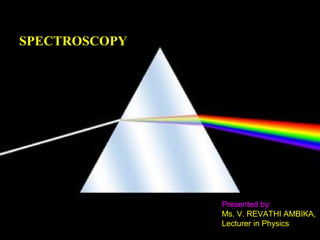
SPECTROSCOPY


               Presented by:
               Ms. V. REVATHI AMBIKA,
               Lecturer in Physics
SPECTROSCOP
             Y
   Color can be related to spectroscopy.

   It is the study of the interaction between matter
    and radiated energy.

   It is the study of visible light dispersed according
    to its wavelenth or frequency.
ELECTROMAGNETIC
SPECTRUM
    Examples: X rays, microwaves,
     radio waves, visible light, IR, and
     UV.


                                               Chapter 12
    Frequency and wavelength are
     inversely proportional.

    c = λν , where c is the speed of
     light.

    Energy per photon = hν, where h
     is Planck’s constant.
                                           4
VARIETIES OF
SPECTROSCOPY
UV         XRD   RAMAN
VARIETIES OF SPECTROSCOPY
   Optical spectroscopy,

   Infrared spectroscopy (FTIR, FT-NIRS),

   Nuclear magnetic resonance (NMR) and Magnetic
    resonance spectroscopic imaging (MRSI)

                            and

   Mass spectrometry and Electron spin resonance
    spectroscopy
SPECTROSCOPY
FOURIER TRANSFORM
SPECTROSCOPY
 Has    better sensitivity.

 Less   energy is needed from source.

 Completes    a scan in 1-2 seconds.

 Takes    several scans and averages
them.

 Has a laser beam that keeps the
 instrument accurately calibrated
X-RAY SCATTERING TECHNIQUES
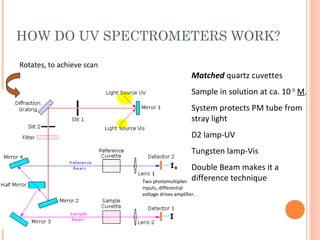
HOW DO UV SPECTROMETERS WORK?

Rotates, to achieve scan
                                                  Matched quartz cuvettes
                                                  Sample in solution at ca. 10-5 M.
                                                  System protects PM tube from
                                                  stray light
                                                  D2 lamp-UV
                                                  Tungsten lamp-Vis
                                                  Double Beam makes it a
                           Two photomultiplier    difference technique
                           inputs, differential
                           voltage drives amplifier.
USE OF IR SPECTRA
 Identification   of functional groups

 Spectral
         matching - by computer
 software and library spectra

 Quantitative   analysis
ANALYTICAL
     ATOMIC
     SPECTROMETRY
•   Aim:
•   To identify Elements and
    Quantify their Concentrations,


•   Inductively Coupled Plasma-
    Atomic Emission Spectroscopy
    (ICP-AES) is one of Several
    techniques available in analytical
    atomic spectroscopy.
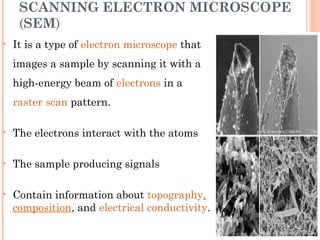
SCANNING ELECTRON MICROSCOPE
     (SEM)
•   It is a type of electron microscope that
    images a sample by scanning it with a
    high-energy beam of electrons in a
    raster scan pattern.

•   The electrons interact with the atoms

•   The sample producing signals

•   Contain information about topography,
    composition, and electrical conductivity.
TRANSMISSION ELECTRON MICROSCOPY
(TEM)
    It is a microscopy technique,
    A beam of electrons is transmitted,
  An image is formed from the
 interaction,

   The image is magnified and
 focused onto an imaging device,


 such as:
   a fluorescent screen,
  on a layer of photographic film,

                  or
  to be detected by a sensor such
   as a CCD camera.
TOXICITY
HEAVY METAL - INTRODUCTION
PROPERTIES OF HEAVY METALS
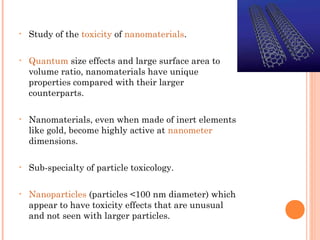
•   Study of the toxicity of nanomaterials.

•   Quantum size effects and large surface area to
    volume ratio, nanomaterials have unique
    properties compared with their larger
    counterparts.

•   Nanomaterials, even when made of inert elements
    like gold, become highly active at nanometer
    dimensions.

•   Sub-specialty of particle toxicology.

•   Nanoparticles (particles <100 nm diameter) which
    appear to have toxicity effects that are unusual
    and not seen with larger particles.
•   It is the process in which
GERMINATION       a plant or fungus
                  emerges from a seed or
                  spore, respectively, and
                  begins growth.

              •   The most common
                  example of germination is
                  the sprouting of a
                  seedling from a seed of an
                  angiosperm or
                  gymnosperm.
ENVIRONMENTAL FACTORS AND SEED
GERMINATION


            Water,     Light,
            Temperature,
            Oxygen,   Smoke
SEED GERMINATION
FACTORS AFFECTING SEED
GERMINATION
•   Various plants require different
    variables

•   It depends on the individual seed
    variety

•   It is closely linked to the
    ecological conditions of a plant's
    natural habitat.

•   Future germination is affected by
    environmental conditions during
    seed formation; most often these
    responses are types of
    seed dormancy.
EDIBLE PLANTS
EDIBLE PLANTS PROTEIN
                          STUDY


•   Plants are one of the major sources of proteins. Potentially, plants
    provide a cheap source of industrial enzymes, and biopharmaceuticals.

•   Proteins have considerable technological importance since they affect the
    stability and sensory quality of plant foods.

•   Research on bioactive peptide/proteins has been increasing including
    work on the development of pathogen resistant and antimicrobial
    compounds
•   The plants Arum maculatum, Portulaca oleracia Semicarpus
    anacardium, Carissa karandus, Cordia myxa, Solanum indicum and
    Chlorophytum comosum are widely available in the wild in many regions
    of Iran. These are consumed as fruits and vegetables.
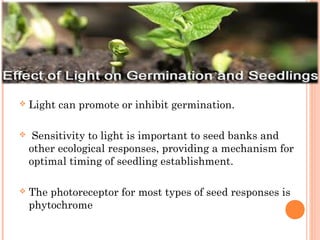
EFFECTS OF LIGHT ON SEED
GERMINATION


   Light can promote or inhibit germination.

    Sensitivity to light is important to seed banks and
    other ecological responses, providing a mechanism for
    optimal timing of seedling establishment.

   The photoreceptor for most types of seed responses is
    phytochrome
HIGH PROTEIN
    IN NUTS & SEEDS
   Peanut butter, 2 Tablespoons - 8
    grams protein
   Almonds, ¼ cup – 8 grams
   Peanuts, ¼ cup – 9 grams
   Cashews, ¼ cup – 5 grams
   Pecans, ¼ cup – 2.5 grams
   Sunflower seeds, ¼ cup – 6 grams
   Pumpkin seeds, ¼ cup – 8 grams
   seeds – ¼ cup – 8 gram
   Heavy metal
    contamination of soils is
    the major global
    environmental problem.


   It has increased
    considerably in last
    several years and a part is
    responsible for limiting
    the crop production.
   Essential (Co and Ni) and non-essential (Pb, Cd and Cr).

   Cd and Pb are considered as the most toxic metals.

   Plants are affected by the increasing levels of these
    metals in the soil environment.
OUR AIM

   The aim of this present study is to assess the tolerance of
    pollutant elements (Co, Ni, Cd, Cr and Pb) on visible foliar
    symptoms, tissue concentration and some biochemical
    parameters in sunflower or groundnut plants.
Spectroscopy

Spectroscopy

  • 1.
    SPECTROSCOPY Presented by: Ms. V. REVATHI AMBIKA, Lecturer in Physics
  • 3.
    SPECTROSCOP Y  Color can be related to spectroscopy.  It is the study of the interaction between matter and radiated energy.  It is the study of visible light dispersed according to its wavelenth or frequency.
  • 4.
    ELECTROMAGNETIC SPECTRUM  Examples: X rays, microwaves, radio waves, visible light, IR, and UV. Chapter 12  Frequency and wavelength are inversely proportional.  c = λν , where c is the speed of light.  Energy per photon = hν, where h is Planck’s constant. 4
  • 5.
  • 6.
    VARIETIES OF SPECTROSCOPY  Optical spectroscopy,  Infrared spectroscopy (FTIR, FT-NIRS),  Nuclear magnetic resonance (NMR) and Magnetic resonance spectroscopic imaging (MRSI) and  Mass spectrometry and Electron spin resonance spectroscopy
  • 7.
  • 8.
    FOURIER TRANSFORM SPECTROSCOPY  Has better sensitivity.  Less energy is needed from source.  Completes a scan in 1-2 seconds.  Takes several scans and averages them.  Has a laser beam that keeps the instrument accurately calibrated
  • 9.
  • 10.
    HOW DO UVSPECTROMETERS WORK? Rotates, to achieve scan Matched quartz cuvettes Sample in solution at ca. 10-5 M. System protects PM tube from stray light D2 lamp-UV Tungsten lamp-Vis Double Beam makes it a Two photomultiplier difference technique inputs, differential voltage drives amplifier.
  • 11.
    USE OF IRSPECTRA  Identification of functional groups  Spectral matching - by computer software and library spectra  Quantitative analysis
  • 12.
    ANALYTICAL ATOMIC SPECTROMETRY • Aim: • To identify Elements and Quantify their Concentrations, • Inductively Coupled Plasma- Atomic Emission Spectroscopy (ICP-AES) is one of Several techniques available in analytical atomic spectroscopy.
  • 13.
    SCANNING ELECTRON MICROSCOPE (SEM) • It is a type of electron microscope that images a sample by scanning it with a high-energy beam of electrons in a raster scan pattern. • The electrons interact with the atoms • The sample producing signals • Contain information about topography, composition, and electrical conductivity.
  • 14.
    TRANSMISSION ELECTRON MICROSCOPY (TEM)  It is a microscopy technique,  A beam of electrons is transmitted,  An image is formed from the interaction,  The image is magnified and focused onto an imaging device, such as:  a fluorescent screen,  on a layer of photographic film, or  to be detected by a sensor such as a CCD camera.
  • 15.
  • 16.
    HEAVY METAL -INTRODUCTION
  • 17.
  • 18.
    Study of the toxicity of nanomaterials. • Quantum size effects and large surface area to volume ratio, nanomaterials have unique properties compared with their larger counterparts. • Nanomaterials, even when made of inert elements like gold, become highly active at nanometer dimensions. • Sub-specialty of particle toxicology. • Nanoparticles (particles <100 nm diameter) which appear to have toxicity effects that are unusual and not seen with larger particles.
  • 19.
    It is the process in which GERMINATION a plant or fungus emerges from a seed or spore, respectively, and begins growth. • The most common example of germination is the sprouting of a seedling from a seed of an angiosperm or gymnosperm.
  • 20.
    ENVIRONMENTAL FACTORS ANDSEED GERMINATION Water, Light, Temperature, Oxygen, Smoke
  • 21.
  • 22.
    FACTORS AFFECTING SEED GERMINATION • Various plants require different variables • It depends on the individual seed variety • It is closely linked to the ecological conditions of a plant's natural habitat. • Future germination is affected by environmental conditions during seed formation; most often these responses are types of seed dormancy.
  • 23.
  • 24.
    EDIBLE PLANTS PROTEIN STUDY • Plants are one of the major sources of proteins. Potentially, plants provide a cheap source of industrial enzymes, and biopharmaceuticals. • Proteins have considerable technological importance since they affect the stability and sensory quality of plant foods. • Research on bioactive peptide/proteins has been increasing including work on the development of pathogen resistant and antimicrobial compounds • The plants Arum maculatum, Portulaca oleracia Semicarpus anacardium, Carissa karandus, Cordia myxa, Solanum indicum and Chlorophytum comosum are widely available in the wild in many regions of Iran. These are consumed as fruits and vegetables.
  • 25.
    EFFECTS OF LIGHTON SEED GERMINATION  Light can promote or inhibit germination.  Sensitivity to light is important to seed banks and other ecological responses, providing a mechanism for optimal timing of seedling establishment.  The photoreceptor for most types of seed responses is phytochrome
  • 26.
    HIGH PROTEIN IN NUTS & SEEDS  Peanut butter, 2 Tablespoons - 8 grams protein  Almonds, ¼ cup – 8 grams  Peanuts, ¼ cup – 9 grams  Cashews, ¼ cup – 5 grams  Pecans, ¼ cup – 2.5 grams  Sunflower seeds, ¼ cup – 6 grams  Pumpkin seeds, ¼ cup – 8 grams  seeds – ¼ cup – 8 gram
  • 28.
    Heavy metal contamination of soils is the major global environmental problem.  It has increased considerably in last several years and a part is responsible for limiting the crop production.
  • 29.
    Essential (Co and Ni) and non-essential (Pb, Cd and Cr).  Cd and Pb are considered as the most toxic metals.  Plants are affected by the increasing levels of these metals in the soil environment.
  • 30.
    OUR AIM  The aim of this present study is to assess the tolerance of pollutant elements (Co, Ni, Cd, Cr and Pb) on visible foliar symptoms, tissue concentration and some biochemical parameters in sunflower or groundnut plants.