Conducting surfaces can support and
enhance a range of cell lines:
• Bone re-growth
– Supronowicz et. al. J. Biomed. Mat. Res. 2002, 59, 499-506.
• Enhancing wound healing
– Zhao et. al. J. Cell Sci. 2004, 117, 397-405.
• Promoting nerve regeneration
– Schmidt et. al. P Natl. Acad. Sci. USA, 1997, 94, 8948-8953.
Materials used have included metal
electrodes, conducting polymers and
more recently carbon nanotubes
Title of the Project:
Antibody functionalization of novel electrically conducting
biomaterials to improve biocompatibility.
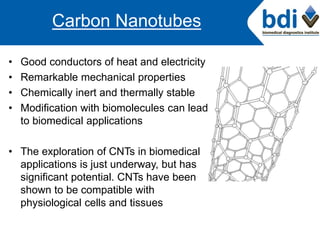
• Good conductors of heat and electricity
• Remarkable mechanical properties
• Chemically inert and thermally stable
• Modification with biomolecules can lead
to biomedical applications
• The exploration of CNTs in biomedical
applications is just underway, but has
significant potential. CNTs have been
shown to be compatible with
physiological cells and tissues
Carbon Nanotubes
Project aims
• Functional modification of CNTs to achieve
biocompatibility
– Functionalise with antibodies to cell adhesion molecules
– Compare covalent attachment vs. physical adsorption
• Investigate whether these antibody-modified CNT
materials are good platforms for cell culture
Project outline
 CNT film preparation and functionalisation:
 Layer by layer deposition of CNTs
 Antibody functionalisation
 Film characterization :
Raman and UV spectroscopy
Fluorescent microscopy and scanning
Electrochemical analysis
Cell culture studies with CNT-films:
Antibody staining and fluorescent microscopy
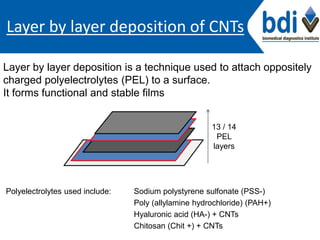
Layer by layer deposition of CNTs
13 / 14
PEL
layers
Layer by layer deposition is a technique used to attach oppositely
charged polyelectrolytes (PEL) to a surface.
It forms functional and stable films
Polyelectrolytes used include: Sodium polystyrene sulfonate (PSS-)
Poly (allylamine hydrochloride) (PAH+)
Hyaluronic acid (HA-) + CNTs
Chitosan (Chit +) + CNTs
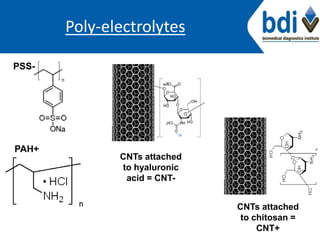
Poly-electrolytes
PSS-
PAH+
CNTs attached
to hyaluronic
acid = CNT-
CNTs attached
to chitosan =
CNT+
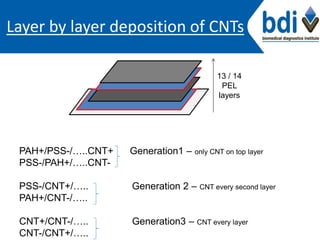
Layer by layer deposition of CNTs
PAH+/PSS-/…..CNT+ Generation1 – only CNT on top layer
PSS-/PAH+/…..CNT-
PSS-/CNT+/….. Generation 2 – CNT every second layer
PAH+/CNT-/…..
CNT+/CNT-/….. Generation3 – CNT every layer
CNT-/CNT+/…..
13 / 14
PEL
layers
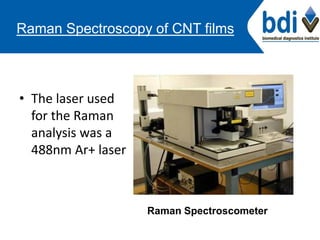
Raman Spectroscopy of CNT films
• The laser used
for the Raman
analysis was a
488nm Ar+ laser
Raman Spectroscometer
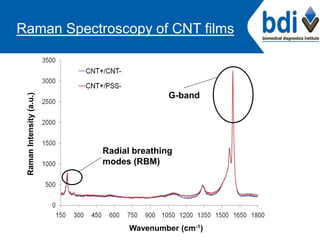
Raman Spectroscopy of CNT films
Wavenumber (cm-1)
RamanIntensity(a.u.)
Radial breathing
modes (RBM)
G-band
Antibody (Ab) immobilisation
Antibodies
• Anti-mouse FITC
• Anti- human Cy5
• Anti-mouse HRP
• Anti-Epcam
Method of immobilisation
Two methods were used:
1. Covalent attachment.
2. Physical adsorption.
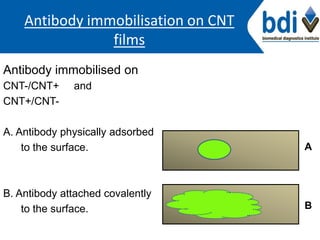
Antibody immobilisation on CNT
films
Antibody immobilised on
CNT-/CNT+ and
CNT+/CNT-
A. Antibody physically adsorbed
to the surface.
B. Antibody attached covalently
to the surface.
A
B
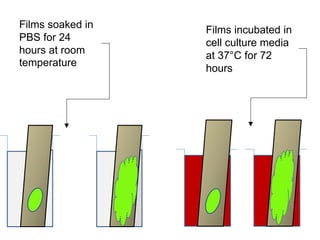
Films soaked in
PBS for 24
hours at room
temperature
Films incubated in
cell culture media
at 37°C for 72
hours
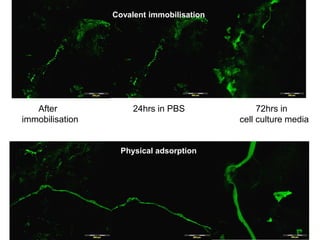
After 24hrs in PBS 72hrs in
immobilisation cell culture media
Covalent immobilisation
Physical adsorption
Results
- Covalently attached antibody spread well over the
surface area of the film.
- CNT- PEL films are stable under physiological pH (7.0).
- CNT- PEL films are bio-compatible.
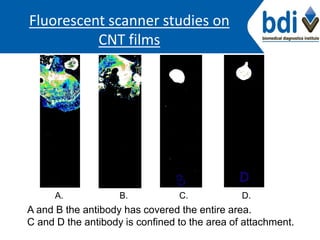
Fluorescent scanner studies on
CNT films
A. B. C. D.
A and B the antibody has covered the entire area.
C and D the antibody is confined to the area of attachment.
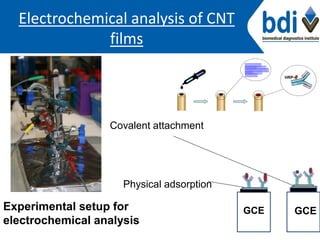
Electrochemical analysis of CNT
films
HRP-
Experimental setup for
electrochemical analysis
Physical adsorption
Covalent attachment
GCE GCE
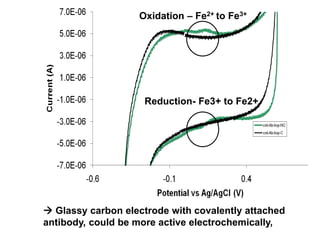
Reduction- Fe3+ to Fe2+
Oxidation – Fe2+ to Fe3+
 Glassy carbon electrode with covalently attached
antibody, could be more active electrochemically,
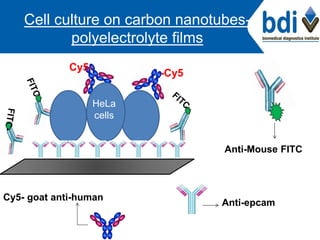
Cell culture on carbon nanotubes-
polyelectrolyte films
HeLa
cells
-Cy5
Cy5-
Cy5- goat anti-human
Anti-epcam
Anti-Mouse FITC
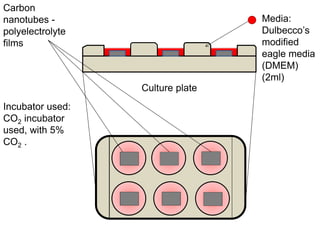
Culture plate
Media:
Dulbecco’s
modified
eagle media
(DMEM)
(2ml)
Carbon
nanotubes -
polyelectrolyte
films
Incubator used:
CO2 incubator
used, with 5%
CO2 .
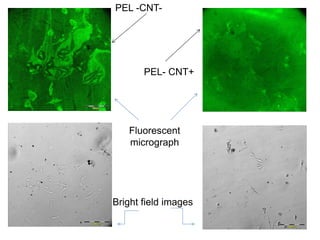
PEL -CNT-
PEL- CNT+
Fluorescent
micrograph
Bright field images
Observations and Results
- Hyaluronic acid attached to CNTs seems to be a better surface
for cell attachment and proliferation.
- Covalent attachment seems to be better surface for antibody
attachment, as the it covers more surface area of the slide.
- Physically attached antibody doesn’t cover the entire area of
the slide and was confined to the spot were it was dropped.
PEL/ CNT thin
films
HRP-
A
B
C
G-band
Radial breathing
modes (RBM)
D
E
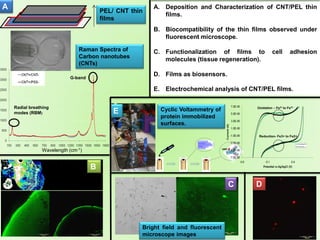
A. Deposition and Characterization of CNT/PEL thin
films.
B. Biocompatibility of the thin films observed under
fluorescent microscope.
C. Functionalization of films to cell adhesion
molecules (tissue regeneration).
D. Films as biosensors.
E. Electrochemical analysis of CNT/PEL films.
Wavelength (cm-1)
Raman Spectra of
Carbon nanotubes
(CNTs)
Cyclic Voltammetry of
protein immobilized
surfaces.
Bright field and fluorescent
microscope images

Carbon nanotubes as Biosensors

  • 1.
    Conducting surfaces cansupport and enhance a range of cell lines: • Bone re-growth – Supronowicz et. al. J. Biomed. Mat. Res. 2002, 59, 499-506. • Enhancing wound healing – Zhao et. al. J. Cell Sci. 2004, 117, 397-405. • Promoting nerve regeneration – Schmidt et. al. P Natl. Acad. Sci. USA, 1997, 94, 8948-8953. Materials used have included metal electrodes, conducting polymers and more recently carbon nanotubes Title of the Project: Antibody functionalization of novel electrically conducting biomaterials to improve biocompatibility.
  • 2.
    • Good conductorsof heat and electricity • Remarkable mechanical properties • Chemically inert and thermally stable • Modification with biomolecules can lead to biomedical applications • The exploration of CNTs in biomedical applications is just underway, but has significant potential. CNTs have been shown to be compatible with physiological cells and tissues Carbon Nanotubes
  • 3.
    Project aims • Functionalmodification of CNTs to achieve biocompatibility – Functionalise with antibodies to cell adhesion molecules – Compare covalent attachment vs. physical adsorption • Investigate whether these antibody-modified CNT materials are good platforms for cell culture
  • 4.
    Project outline  CNTfilm preparation and functionalisation:  Layer by layer deposition of CNTs  Antibody functionalisation  Film characterization : Raman and UV spectroscopy Fluorescent microscopy and scanning Electrochemical analysis Cell culture studies with CNT-films: Antibody staining and fluorescent microscopy
  • 5.
    Layer by layerdeposition of CNTs 13 / 14 PEL layers Layer by layer deposition is a technique used to attach oppositely charged polyelectrolytes (PEL) to a surface. It forms functional and stable films Polyelectrolytes used include: Sodium polystyrene sulfonate (PSS-) Poly (allylamine hydrochloride) (PAH+) Hyaluronic acid (HA-) + CNTs Chitosan (Chit +) + CNTs
  • 6.
    Poly-electrolytes PSS- PAH+ CNTs attached to hyaluronic acid= CNT- CNTs attached to chitosan = CNT+
  • 7.
    Layer by layerdeposition of CNTs PAH+/PSS-/…..CNT+ Generation1 – only CNT on top layer PSS-/PAH+/…..CNT- PSS-/CNT+/….. Generation 2 – CNT every second layer PAH+/CNT-/….. CNT+/CNT-/….. Generation3 – CNT every layer CNT-/CNT+/….. 13 / 14 PEL layers
  • 8.
    Raman Spectroscopy ofCNT films • The laser used for the Raman analysis was a 488nm Ar+ laser Raman Spectroscometer
  • 9.
    Raman Spectroscopy ofCNT films Wavenumber (cm-1) RamanIntensity(a.u.) Radial breathing modes (RBM) G-band
  • 10.
    Antibody (Ab) immobilisation Antibodies •Anti-mouse FITC • Anti- human Cy5 • Anti-mouse HRP • Anti-Epcam Method of immobilisation Two methods were used: 1. Covalent attachment. 2. Physical adsorption.
  • 11.
    Antibody immobilisation onCNT films Antibody immobilised on CNT-/CNT+ and CNT+/CNT- A. Antibody physically adsorbed to the surface. B. Antibody attached covalently to the surface. A B
  • 12.
    Films soaked in PBSfor 24 hours at room temperature Films incubated in cell culture media at 37°C for 72 hours
  • 13.
    After 24hrs inPBS 72hrs in immobilisation cell culture media Covalent immobilisation Physical adsorption
  • 14.
    Results - Covalently attachedantibody spread well over the surface area of the film. - CNT- PEL films are stable under physiological pH (7.0). - CNT- PEL films are bio-compatible.
  • 15.
    Fluorescent scanner studieson CNT films A. B. C. D. A and B the antibody has covered the entire area. C and D the antibody is confined to the area of attachment.
  • 16.
    Electrochemical analysis ofCNT films HRP- Experimental setup for electrochemical analysis Physical adsorption Covalent attachment GCE GCE
  • 17.
    Reduction- Fe3+ toFe2+ Oxidation – Fe2+ to Fe3+  Glassy carbon electrode with covalently attached antibody, could be more active electrochemically,
  • 18.
    Cell culture oncarbon nanotubes- polyelectrolyte films HeLa cells -Cy5 Cy5- Cy5- goat anti-human Anti-epcam Anti-Mouse FITC
  • 19.
    Culture plate Media: Dulbecco’s modified eagle media (DMEM) (2ml) Carbon nanotubes- polyelectrolyte films Incubator used: CO2 incubator used, with 5% CO2 .
  • 20.
  • 21.
    Observations and Results -Hyaluronic acid attached to CNTs seems to be a better surface for cell attachment and proliferation. - Covalent attachment seems to be better surface for antibody attachment, as the it covers more surface area of the slide. - Physically attached antibody doesn’t cover the entire area of the slide and was confined to the spot were it was dropped.
  • 22.
    PEL/ CNT thin films HRP- A B C G-band Radialbreathing modes (RBM) D E A. Deposition and Characterization of CNT/PEL thin films. B. Biocompatibility of the thin films observed under fluorescent microscope. C. Functionalization of films to cell adhesion molecules (tissue regeneration). D. Films as biosensors. E. Electrochemical analysis of CNT/PEL films. Wavelength (cm-1) Raman Spectra of Carbon nanotubes (CNTs) Cyclic Voltammetry of protein immobilized surfaces. Bright field and fluorescent microscope images