
Optical Sensing of Soil
Macronutrient
Presented by:
Jyoti Singh
4/24/2017 1
Introduction
• Great Demand for Soil Property Data.
• Methods for soil attributes measurement relies mainly upon
the use of laboratory methods (More samples and
measurements, time consuming).
• Problem with field measurement is the variation in soil
moisture content and surface roughness.
4/24/2017 2
Soil NPK Sensing Techniques
• Standard Soil Testing Laboratory
– time consuming, Laborious, use of chemical and
reagents which effect human health and
environment, costly, do not consider spatial
variation in the field.
• Electrochemical Sensing
– Ion Selective Electrodes
– Ion Sensitive Field Effect Transistor
• Optical Spectroscopy
– NIR Spectroscopy
4/24/2017 3
Optical Spectroscopy
4/24/2017 4
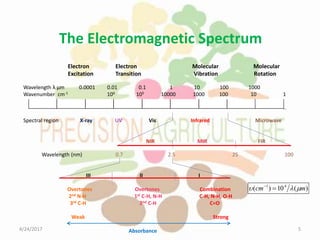
The Electromagnetic Spectrum
Electron Electron Molecular Molecular
Excitation Transition Vibration Rotation
Wavelength λ µm 0.0001 0.01 0.1 1 10 100 1000
Wavenumber cm-1 106 105 10000 1000 100 10 1
Spectral region X-ray UV Vis Infrared Microwave
NIR MIR FIR
Wavelength (nm) 0.7 2.5 25 100
III II I
Overtones Overtones Combination
2nd N-H 1st C-H, N-H C-H, N-H, O-H
3rd C-H 2nd C-H C=O
Weak Strong
Absorbance
)(10)( 41
mcm  
4/24/2017 5
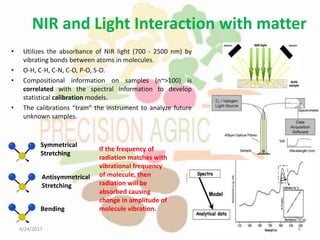
NIR and Light Interaction with matter
If the frequency of
radiation matches with
vibrational frequency
of molecule, then
radiation will be
absorbed causing
change in amplitude of
molecule vibration.
Symmetrical
Stretching
Antisymmetrical
Stretching
Bending
• Utilizes the absorbance of NIR light (700 - 2500 nm) by
vibrating bonds between atoms in molecules.
• O-H, C-H, C-N, C-O, P-O, S-O.
• Compositional information on samples (n~>100) is
correlated with the spectral information to develop
statistical calibration models.
• The calibrations “train” the instrument to analyze future
unknown samples.
4/24/2017 6
Extracting information from
spectral data
• Signal processing is used to transform spectral data prior to analysis.
• Data pretreatment
-Local filters
-Smoothing
-Derivatives
-Baseline correction
-Multiplicative Scatter Correction (MSC)
-Orthogonal Scatter Correction (OSC)
1. Qualitative information grouping and classification of spectral objects
from samples into supervised and non-supervised learning methods.
2. Quantitative information relationships between spectral data and
parameter(s) of interest.
How to extract the information?
1. Multivariate analysis (MVA)
Principal Component Analysis (PCA), Projection to Latent
Structures (PLS), PLS-Discriminant Analysis (PLS-DA), …
2. Two dimensional correlation spectroscopy
Homo-correlation, Hetero-correlation
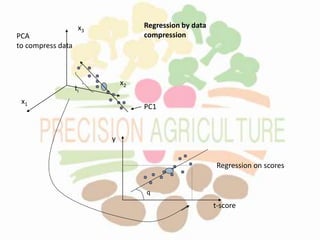
Regression by data
compression
Regression on scores
PC1
t-score
y
q
ti
PCA
to compress data
x1
x2
x3
4/24/2017 13
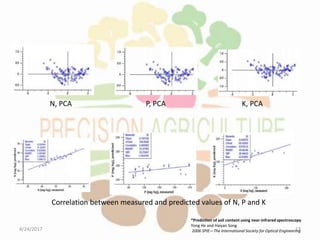
*Prediction of soil content using near-infrared spectroscopy
Yong He and Haiyan Song
2006 SPIE—The International Society for Optical Engineering
N, PCA P, PCA K, PCA
Correlation between measured and predicted values of N, P and K
NIR Spectroscopy
Advantages
• Minimal to no sample preparation.
• Able to measure many constituents
simultaneously with high scan
Speed ( < 1sec).
• Quantitative and Qualitative
results.
• No phase constraints – gas, liquid
or solid.
• Non Destructive, non contact.
• Faster, safer working environment
that does not require chemicals.
• The availability of efficient
chemometric evaluation tools and
software as well as light-fiber optics
has made NIRS to an invaluable tool
for academic research and
industrial quality control.
Disadvantages
• Less information contained in
spectra and Spectra is affected by
particle size, moisture etc.
• Combination and overtone bands
make association with individual
chemical groups more difficult.
• Generally can’t indentify
components of less than 1% in
product hence need more robust
calibration techniques.
• Chemometrics – PCA, PLS.
• Robustness of calibrations needs to
be monitored.
4/24/2017 14
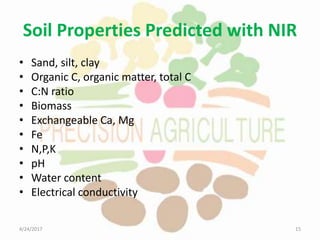
Soil Properties Predicted with NIR
• Sand, silt, clay
• Organic C, organic matter, total C
• C:N ratio
• Biomass
• Exchangeable Ca, Mg
• Fe
• N,P,K
• pH
• Water content
• Electrical conductivity
4/24/2017 15
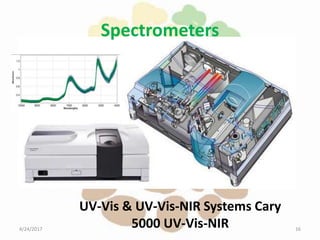
UV-Vis & UV-Vis-NIR Systems Cary
5000 UV-Vis-NIR4/24/2017 16
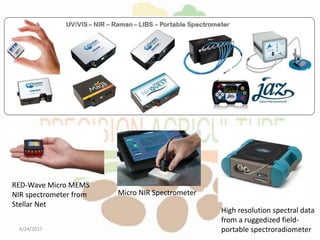
Spectrometers
RED-Wave Micro MEMS
NIR spectrometer from
Stellar Net
Micro NIR Spectrometer
High resolution spectral data
from a ruggedized field-
portable spectroradiometer4/24/2017 17
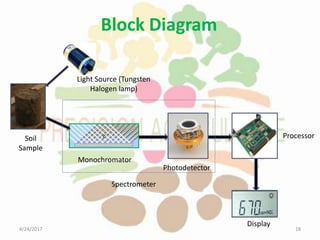
Block Diagram
r
Light Source (Tungsten
Halogen lamp)
Monochromator
Soil
Sample
Photodetector
Processor
Display
Spectrometer
4/24/2017 18
4/24/2017 19
References
[1] R. A. Viscarra Rossel, D. J. J. Walvoort, A. B. McBratney, L. J. Janik, and J. O. Skjemstad, “Visible,
near infrared, mid infrared or combined diffuse reflectance spectroscopy for simultaneous
assessment of various soil properties”, Geoderma, Vol. 131, No. 1–2, pp. 59–75, 2006.
[2] Y. Qiao and S. Zhang, “Near-infrared spectroscopy technology for soil nutrients detection based
on LS-SVM”, IFIP Advances in Information and Communication Technology, Vol. 368, pp. 325–335,
2012.
[3] D. F. Malley, L. Yesmin, D. Wray, and S. Edwards, “Application of near-infrared spectroscopy in
analysis of soil mineral nutrients”, Communication in Soil Scence and Plant Anaysis, Vol. 30, No.
7–8, pp. 999–1012, 1999.
[4] S. Borchert, J. Henck, and H. Siesler, “Near-Infrared-Spectroscopic Investigations of Solid
Pharmaceutical Formulations”, Camo.Com, pp. 3–7, 2003.
[5] B. Stenberg, R. V Rossel, M. Mouazen, and J. Wetterlind, “Visible and Near Infrared Spectroscopy
in Soil Science”, Advances in Agronomy. Vol 107, No. 10, pp. 163–215, 2010.
[6] X. Shao, M. Zhang, and W. Cai, “Multivariate calibration of near-infrared spectra by using
influential variables”, Analtical Methods, Vol. 4, No. 2, p. 467, Feb. 2012.
[7] D. Bertrand and C. N. G. Scotter, “Application of Multivariate Analyses to NIR Spectra of
Gelatinized Starch”, Applied Spectroscopy, Vol. 46, No. 9, pp. 1420–1425, 1992.
4/24/2017 20
References
[8] M. Urbano-Cuadrado, M. D. Luque De Castro, P. M. Pérez-Juan, J. García-Olmo, and M. A.
Gómez-Nieto, “Near infrared reflectance spectroscopy and multivariate analysis in enology:
Determination or screening of fifteen parameters in different types of wines”, Analytica
Chimica Acta, Vol. 527, No. 1, pp. 81–88, 2004.
[9] K. Wiesner, K. Fuchs, A. M. Gigler, and R. Pastusiak, “Trends in near infrared spectroscopy and
multivariate data analysis from an industrial perspective”, Procedia Engineering, Vol. 87, pp.
867–870, 2014.
[10]P. R. G. Hein, “Multivariate regression methods for estimating basic density in Eucalyptus
wood from near infrared spectroscopic data”, Cerne, Vol. 16, No. 3, pp. 90–96, 2010.
[11]V. Baeten and P. Dardenne, “Spectroscopy: Developments in instrumentation and analysis”,
Grasas y Aceites, Vol. 53, No. 1, pp. 45–63, 2002.
[12]C. Pasquini, “Near Infrared Spectroscopy: fundamentals, practical aspects and analytical
applications”, Journal of the Brazilian Chemical Society, Vol. 14, No. 2, pp. 198–219, 2003.
[13]N. A. O’Brien, C. A. Hulse, D. M. Friedrich, F. J. Van Milligen, M. K. von Gunten, F. Pfeifer, and
H. W. Siesler, “Miniature near-infrared (NIR) spectrometer engine for handheld applications”,
in SPIE Defense, Security, and Sensing, Vol. 8374 , 2012.
[14]D. M. Friedrich, C. A. Hulse, M. Von Gunten, E. P. Williamson, C. G. Pederson, N. A. O. Brien, J.
Corporation, and S. Rosa, “Miniature near-infrared spectrometer for point-of-use chemical
analysis”, SPIE proceedings Vol. 8992, 2014.
4/24/2017 21
4/24/2017 22

Optical sensing of soil macronutrient

  • 1.
    Optical Sensing ofSoil Macronutrient Presented by: Jyoti Singh 4/24/2017 1
  • 2.
    Introduction • Great Demandfor Soil Property Data. • Methods for soil attributes measurement relies mainly upon the use of laboratory methods (More samples and measurements, time consuming). • Problem with field measurement is the variation in soil moisture content and surface roughness. 4/24/2017 2
  • 3.
    Soil NPK SensingTechniques • Standard Soil Testing Laboratory – time consuming, Laborious, use of chemical and reagents which effect human health and environment, costly, do not consider spatial variation in the field. • Electrochemical Sensing – Ion Selective Electrodes – Ion Sensitive Field Effect Transistor • Optical Spectroscopy – NIR Spectroscopy 4/24/2017 3
  • 4.
  • 5.
    The Electromagnetic Spectrum ElectronElectron Molecular Molecular Excitation Transition Vibration Rotation Wavelength λ µm 0.0001 0.01 0.1 1 10 100 1000 Wavenumber cm-1 106 105 10000 1000 100 10 1 Spectral region X-ray UV Vis Infrared Microwave NIR MIR FIR Wavelength (nm) 0.7 2.5 25 100 III II I Overtones Overtones Combination 2nd N-H 1st C-H, N-H C-H, N-H, O-H 3rd C-H 2nd C-H C=O Weak Strong Absorbance )(10)( 41 mcm   4/24/2017 5
  • 6.
    NIR and LightInteraction with matter If the frequency of radiation matches with vibrational frequency of molecule, then radiation will be absorbed causing change in amplitude of molecule vibration. Symmetrical Stretching Antisymmetrical Stretching Bending • Utilizes the absorbance of NIR light (700 - 2500 nm) by vibrating bonds between atoms in molecules. • O-H, C-H, C-N, C-O, P-O, S-O. • Compositional information on samples (n~>100) is correlated with the spectral information to develop statistical calibration models. • The calibrations “train” the instrument to analyze future unknown samples. 4/24/2017 6
  • 7.
  • 8.
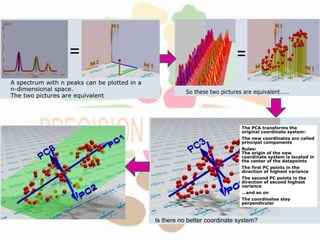
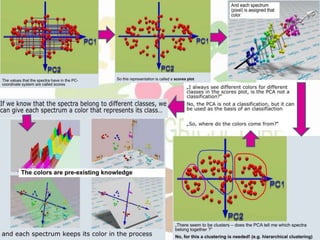
    • Signal processingis used to transform spectral data prior to analysis. • Data pretreatment -Local filters -Smoothing -Derivatives -Baseline correction -Multiplicative Scatter Correction (MSC) -Orthogonal Scatter Correction (OSC) 1. Qualitative information grouping and classification of spectral objects from samples into supervised and non-supervised learning methods. 2. Quantitative information relationships between spectral data and parameter(s) of interest. How to extract the information? 1. Multivariate analysis (MVA) Principal Component Analysis (PCA), Projection to Latent Structures (PLS), PLS-Discriminant Analysis (PLS-DA), … 2. Two dimensional correlation spectroscopy Homo-correlation, Hetero-correlation
  • 12.
    Regression by data compression Regressionon scores PC1 t-score y q ti PCA to compress data x1 x2 x3
  • 13.
    4/24/2017 13 *Prediction ofsoil content using near-infrared spectroscopy Yong He and Haiyan Song 2006 SPIE—The International Society for Optical Engineering N, PCA P, PCA K, PCA Correlation between measured and predicted values of N, P and K
  • 14.
    NIR Spectroscopy Advantages • Minimalto no sample preparation. • Able to measure many constituents simultaneously with high scan Speed ( < 1sec). • Quantitative and Qualitative results. • No phase constraints – gas, liquid or solid. • Non Destructive, non contact. • Faster, safer working environment that does not require chemicals. • The availability of efficient chemometric evaluation tools and software as well as light-fiber optics has made NIRS to an invaluable tool for academic research and industrial quality control. Disadvantages • Less information contained in spectra and Spectra is affected by particle size, moisture etc. • Combination and overtone bands make association with individual chemical groups more difficult. • Generally can’t indentify components of less than 1% in product hence need more robust calibration techniques. • Chemometrics – PCA, PLS. • Robustness of calibrations needs to be monitored. 4/24/2017 14
  • 15.
    Soil Properties Predictedwith NIR • Sand, silt, clay • Organic C, organic matter, total C • C:N ratio • Biomass • Exchangeable Ca, Mg • Fe • N,P,K • pH • Water content • Electrical conductivity 4/24/2017 15
  • 16.
    UV-Vis & UV-Vis-NIRSystems Cary 5000 UV-Vis-NIR4/24/2017 16 Spectrometers
  • 17.
    RED-Wave Micro MEMS NIRspectrometer from Stellar Net Micro NIR Spectrometer High resolution spectral data from a ruggedized field- portable spectroradiometer4/24/2017 17
  • 18.
    Block Diagram r Light Source(Tungsten Halogen lamp) Monochromator Soil Sample Photodetector Processor Display Spectrometer 4/24/2017 18
  • 19.
  • 20.
    References [1] R. A.Viscarra Rossel, D. J. J. Walvoort, A. B. McBratney, L. J. Janik, and J. O. Skjemstad, “Visible, near infrared, mid infrared or combined diffuse reflectance spectroscopy for simultaneous assessment of various soil properties”, Geoderma, Vol. 131, No. 1–2, pp. 59–75, 2006. [2] Y. Qiao and S. Zhang, “Near-infrared spectroscopy technology for soil nutrients detection based on LS-SVM”, IFIP Advances in Information and Communication Technology, Vol. 368, pp. 325–335, 2012. [3] D. F. Malley, L. Yesmin, D. Wray, and S. Edwards, “Application of near-infrared spectroscopy in analysis of soil mineral nutrients”, Communication in Soil Scence and Plant Anaysis, Vol. 30, No. 7–8, pp. 999–1012, 1999. [4] S. Borchert, J. Henck, and H. Siesler, “Near-Infrared-Spectroscopic Investigations of Solid Pharmaceutical Formulations”, Camo.Com, pp. 3–7, 2003. [5] B. Stenberg, R. V Rossel, M. Mouazen, and J. Wetterlind, “Visible and Near Infrared Spectroscopy in Soil Science”, Advances in Agronomy. Vol 107, No. 10, pp. 163–215, 2010. [6] X. Shao, M. Zhang, and W. Cai, “Multivariate calibration of near-infrared spectra by using influential variables”, Analtical Methods, Vol. 4, No. 2, p. 467, Feb. 2012. [7] D. Bertrand and C. N. G. Scotter, “Application of Multivariate Analyses to NIR Spectra of Gelatinized Starch”, Applied Spectroscopy, Vol. 46, No. 9, pp. 1420–1425, 1992. 4/24/2017 20
  • 21.
    References [8] M. Urbano-Cuadrado,M. D. Luque De Castro, P. M. Pérez-Juan, J. García-Olmo, and M. A. Gómez-Nieto, “Near infrared reflectance spectroscopy and multivariate analysis in enology: Determination or screening of fifteen parameters in different types of wines”, Analytica Chimica Acta, Vol. 527, No. 1, pp. 81–88, 2004. [9] K. Wiesner, K. Fuchs, A. M. Gigler, and R. Pastusiak, “Trends in near infrared spectroscopy and multivariate data analysis from an industrial perspective”, Procedia Engineering, Vol. 87, pp. 867–870, 2014. [10]P. R. G. Hein, “Multivariate regression methods for estimating basic density in Eucalyptus wood from near infrared spectroscopic data”, Cerne, Vol. 16, No. 3, pp. 90–96, 2010. [11]V. Baeten and P. Dardenne, “Spectroscopy: Developments in instrumentation and analysis”, Grasas y Aceites, Vol. 53, No. 1, pp. 45–63, 2002. [12]C. Pasquini, “Near Infrared Spectroscopy: fundamentals, practical aspects and analytical applications”, Journal of the Brazilian Chemical Society, Vol. 14, No. 2, pp. 198–219, 2003. [13]N. A. O’Brien, C. A. Hulse, D. M. Friedrich, F. J. Van Milligen, M. K. von Gunten, F. Pfeifer, and H. W. Siesler, “Miniature near-infrared (NIR) spectrometer engine for handheld applications”, in SPIE Defense, Security, and Sensing, Vol. 8374 , 2012. [14]D. M. Friedrich, C. A. Hulse, M. Von Gunten, E. P. Williamson, C. G. Pederson, N. A. O. Brien, J. Corporation, and S. Rosa, “Miniature near-infrared spectrometer for point-of-use chemical analysis”, SPIE proceedings Vol. 8992, 2014. 4/24/2017 21
  • 22.