Electron Beam
characteristics and
applications
Presented by
Adarsh M.Kalla
outlines
Introduction
E-beam processing
E-beam equipment
Application
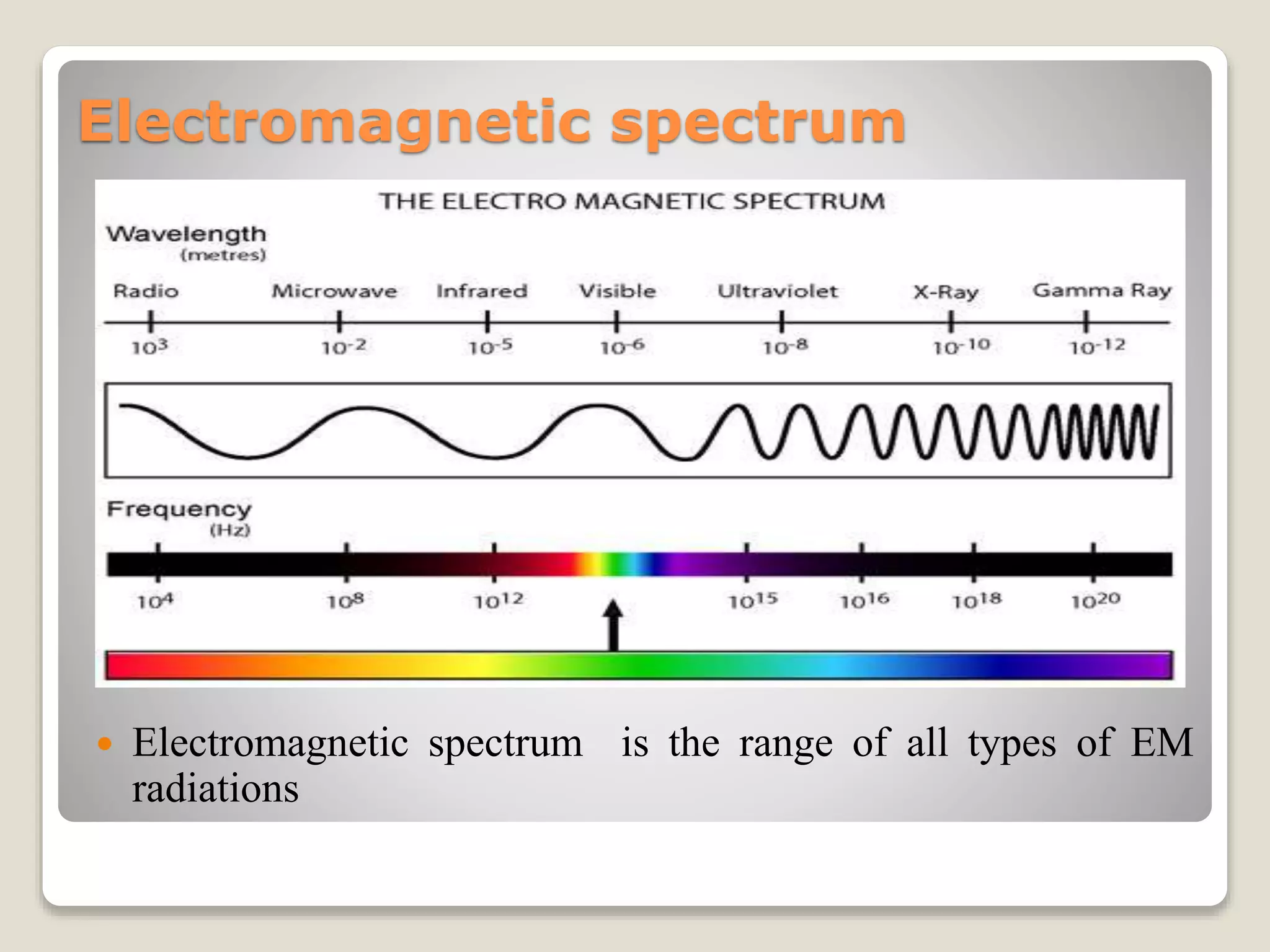
Electromagnetic spectrum
 Electromagnetic spectrum is the range of all types of EM
radiations
Concept of photon
 Photon is fundamental particle of EM waves
 Sir Isaac Newton was one of the first scientist to theorize that
light consists of particles
 Each photon consist of same particular energy that depends on
the frequency.
 E=hf
 Photons travel through empty space at speed of light.
 Energy of photon is measured in terms of eV
Ionizing and non-ionizing radiations
 Non ionizing radiation- long wavelength and low frequency
 They have enough energy to excite molecule or atom causing
them to vibrate faster creating heat
 E.g.: radio wave, microwave
 Ionizing radiation- shorter wavelength and high frequency
 They have high energy enough to cause chemical changes by
breaking chemical bonds, and cause damage to tissue.
 Radiation has enough energy to strip away an electron from
atom
 E.g.: x-rays, gamma rays
Radioactive decay
 It is a spontaneous emission of extremely powerful radiations
from an unstable nuclei to form a stable nuclei
 There are 3 ways by which radioactive nucleus can become
stable. Each result in different type of radiation
 If it emit alpha particles- alpha decay
 If it emits beta particles- beta decay
 If it emits gamma radiation- gamma decay
Ionizing radiations
 Properties of radiations to be used as food irradiation include
 should have good Penetrating power but do not produce
radioactivity.
 Do not produce significant heat in foods (cold
preservation).
 beta particles and gamma rays are used most often used
for food irradiation.
Radioactive units
 The strength of a radioactive source = number of
disintegrations of its radioactivity per second.
 Becquerel (Bq) = one disintegration per second.
 Curie (Ci) : 1 Ci=3.7x10¹⁰ Bq.
 The measure of absorbed radiation dose is gray (Gy).
 Rad: 1 Gy = 100 rad
 The sievert (Sv) is the unit used to asses the effects of
ionising radiation on living cells, especially human beings.
The sievert replaces the rem (1 Sv=100rems).
 The intensity or energy level of beta particles emitted from
a linear electron accelerator is defined in terms of joules or
electron volts.
 Ionizing radiation is a broad term describing any radiation
with sufficient energy to cause electrons to be released from
atoms.
 Codex general standard allows the use of following types of
ionizing radiation
 Gamma rays from the radionuclides Co and Cs
 X-rays generated by machine sources operated at or below an
energy level of 5MeV
 Electrons generated by machine sources operated at or below
an energy level of 10MeV
History of irradiation
 In 1895, Dr. Roentgen discovered the X-ray, while he
was researching the cathode ray, which is also an
electron beam in a broad sense.
 Dr. Becquerel discovered that uranium compounds
are emitting something similar to the X-ray he named
the invisible beam Becquerel ray.
 It was found out afterward that the Becquerel ray can
be divided into three kinds: α-ray (alpha ray), β-ray
(beta ray), and γ-ray (gamma ray). Dr. Becquerel
confirmed that β-ray was an electron.
 Mr. and Mrs. Curie discovered polonium and radium
from uranium ore in 1898, and since then the use of
radiation and radioactive substances have been
expanded in the fields of science, medicine, and
engineering.
 Radiation use was entirely limited to the one
generated from the radioisotope demand for
artificially generating radiation became strong
because of the problems of handling.
 Then various designs of electron accelerators were
discovered
E-beam
 Gamma irradiation relies on radioactive sources such
as Co-60 and Cs-137, IAEA has attempted to replace
isotope-based technology with linear accelerator-
based e-beam and X-ray technologies.
 the limited availability of cobalt-60
 the cost of purchasing cobalt-60,
 the cost of safeguarding cobalt-60
 and the cost of replenishing and disposing cobalt-60
 all prevent gamma irradiation technologies having
any economic value in the future.
Electron beam
 E- beam is a flow of electrons with energy and is an ionizing
radiation.
 However, the primary difference as compared to gamma
irradiation is that e-beam and X-ray are not based on
radioactive source materials.
 E-beam and X-ray technology are generated from commercial
electricity and therefore are truly on–off technologies.
 The equipment that generates e-beams and X-rays are
generally called ‘‘linear accelerators’’
shows the comparison between various electromagnetic
waves and their energy.
 Worldwide, the maximum
energy for E-beam technology
that can be used for food
irradiation is 10 MeV.
 The reason for this upper limit
on energy is that higher energies
could potentially induce
radioactivity in material.
 In the US, E-beam energies as
high as 7.5 MeV can be used to
generate X-rays for food
irradiation. However, worldwide
the maximum energy for X-ray
is still set at 5 MeV.
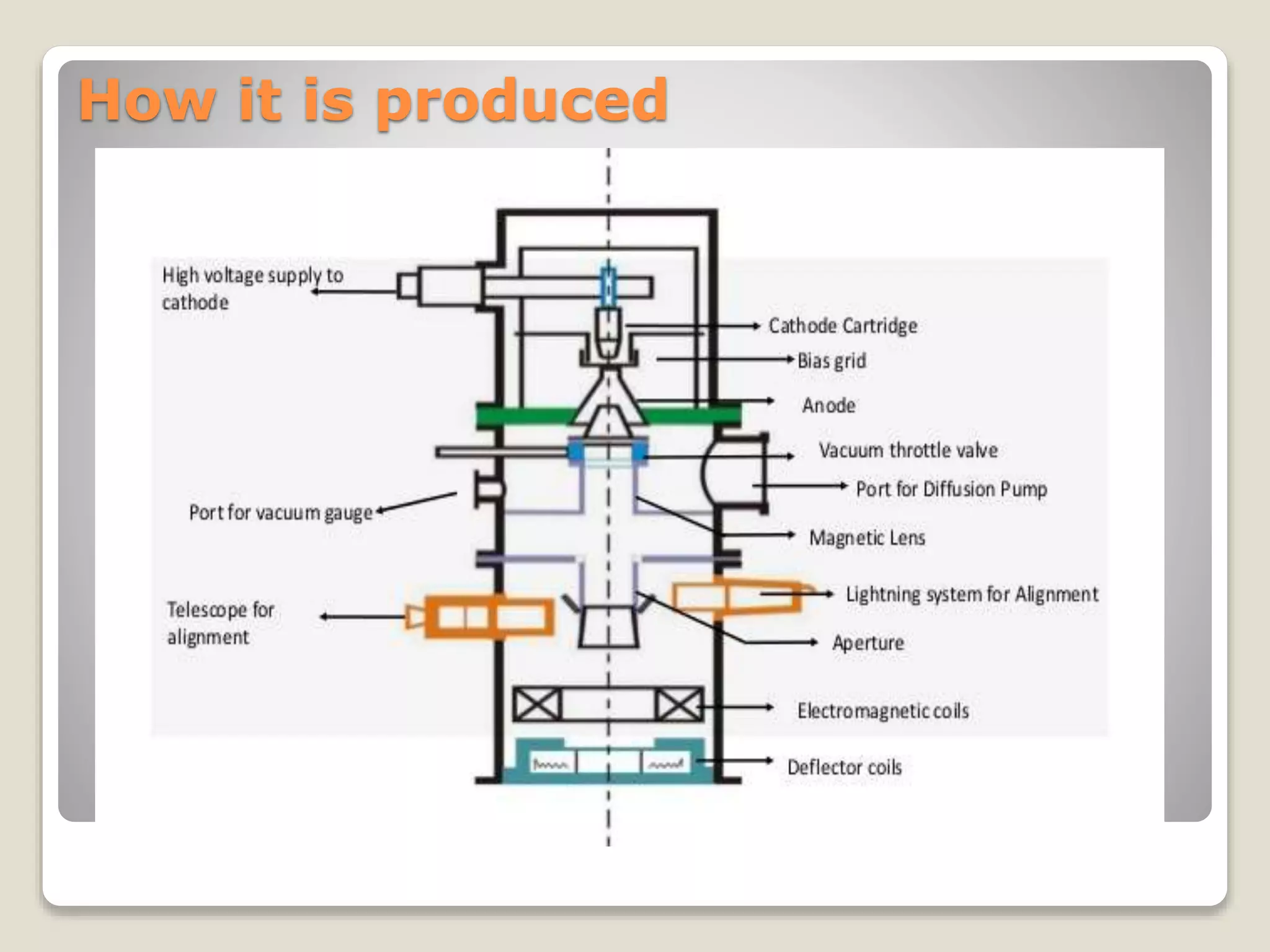
How it is produced
components
 Electron gun
 Cathode- made of tungsten or tantalum, it is a filament type
cathode.
 Potential difference is applied across the filament so that the
filament temperature goes around 2500˚C.
 At such temperature there would be emission of electrons.
 Cathode is negative biased hence they are repelled by
cathode.
 Bias grid: -ve biased and controls the flow of electrons.
 Anode: (+ve biased), due to P.D difference between the anode
and cathode electrons are accelerated.
 Magnetic lenses: to concentrate or focus the beam of
electrons.
 Aperture: it will capture stray electrons, so electrons which
emerge are very much concentrated and focused.
 Electromagnetic lens: it ultimately focuses electrons on your
product.
 Illumination system and telescope: to align the electron beam
with the product.
 Vacuum port: to measure vacuum
 Diffusion pump port: to produce vacuum
vacuum
 Why operated under vacuum..?
 Vacuum:10-4 – 10-6 torr
 We would hardly get electron emission
 If we had also, the electrons would collide with air
molecules they would not be accelerated to that
extent and their would be more collision and lose
their energy.
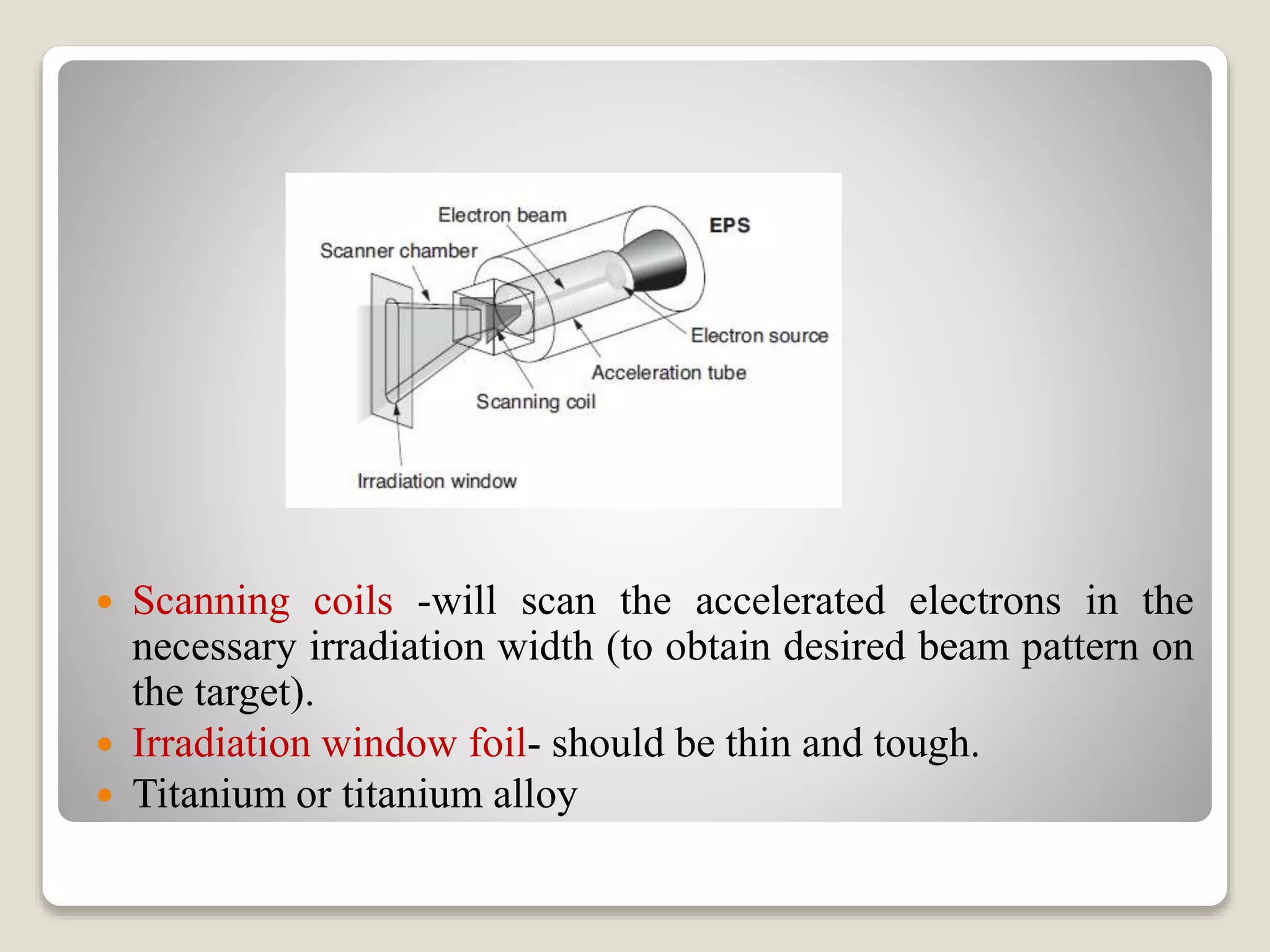
 Scanning coils -will scan the accelerated electrons in the
necessary irradiation width (to obtain desired beam pattern on
the target).
 Irradiation window foil- should be thin and tough.
 Titanium or titanium alloy
EPS system classification
 They can be related to state of water forced through shower
head
 Scanning type- has small faucet and swings to spread water to
necessary area
 Non scanning type- has a enlarged faucet that cavers the
necessary area
Effect of Ionizing Radiation
 Direct effect-occurs when the photons or electrons directly
encounter the DNA molecule and cause single and double
strand breaks
 Indirect effect-When ionizing radiation encounters water
molecules, free radicals (hydrogen and hydroxyl radicals) are
produced due to radiolysis of water.
 Other food constituents, can also be affected by free radicals.
Therefore, attempts to minimize changes in foods during
irradiation have been focused on limiting indirect effects.
 Irradiation in frozen state
 Irradiation in vacuum
 Addition of free radical scavengers (ascorbic acid)
Sterilization by an electron beam has the following
features
 It is processed at room temperature, and can be
applied to heat sensitive materials.
 As the absorbed dose rate is high, the processing time
can be shortened.
 Because of the high directionality in the irradiation,
the utilization efficiency of a radiation source is high.
 Radiation source replacement or waste radiation
source control is avoided
 Facilities are safe because electron beams stop
immediately when the power switch is turned off.
 The selection of the installation location is easy.
 The oxidative deterioration in a plastic material is
small because of the high dose rate irradiation.
Application of E-beam
 Crosslinking by E-beam technology is a key application area
of this technology.
 Crosslinking is the bond that links one polymer chain to
another in order to improve the polymer physical properties,
such as heat resistance.
 Role of E-beam processing in biodegradable packaging
 A common biodegradable plastics is polylactic acid (PLA) It
offers a wider range of benefits.
 However, PLA suffers from poor mechanical properties,
which can be improved by E-beam crosslinking to provide
more rigidity.
 Cellulose acetate are not easily hydrated and therefore cannot
be easily hydrolyzed by enzymes.
 However, if the acetate side groups can be cleaved off, the
compound becomes more susceptible to enzymatic reactions.
 application of E-beam processing of cellulose acetate may
achieve cleaving-off of the acetate group.
Waste management
 Current strategies of managing food and agricultural wastes
are either land filling, incineration, anaerobic digestion,
composting, or feeding livestock.
 E-beam technology can help break down these wastes to help
recover some of these high value products.
 For example, E-beam technology was used to aid in the
extraction of tamarind seed polysaccharide. It also led to
increase in antioxidant properties of the extracted TSP
 E-beam technology is a effective approach for
decontaminating liquid food wastes and effluents from
industries.
 It can reduce microbial population in drinking water.
 Formation of free radicals in liquid wastes are very effective
at microbial inactivation.
 E-beam reduces estrogenic activity
 Chemical that mimics human estrogen
Space foods
 Mercury program (1958–1963)-foods consisted primarily of
bite-sized cubes, freeze-dried powders, and liquids in
aluminum tubes.
 Consist of thermal-stabilized foods, irradiated foods, and
vitamin D supplements.
 For long-duration missions, NASA has categorized two
different food systems, namely “
 transit foods
 surface foods.
 Transit foods- for use when travelling to distant bodies.
expected to have a 3–5 year shelf life.
 Surface foods are foods that are most likely grown on the
surface of the celestial bodies.
 NASA currently uses irradiation (cobalt-60) for achieving
food sterility,
 And is actively exploring the possibility of employing other
technologies such as E-beam, HPP, and microwave
sterilization.
Regulations governing commercial
food irradiation
 They are covered by Sections 1.2 and 2.13 of the FSSAI.
 In India, like the US, all irradiated foods have to be labeled
with the radura logo in green with information about the
product identity, purpose of radiation processing, radiation
processing facility, and date of processing.
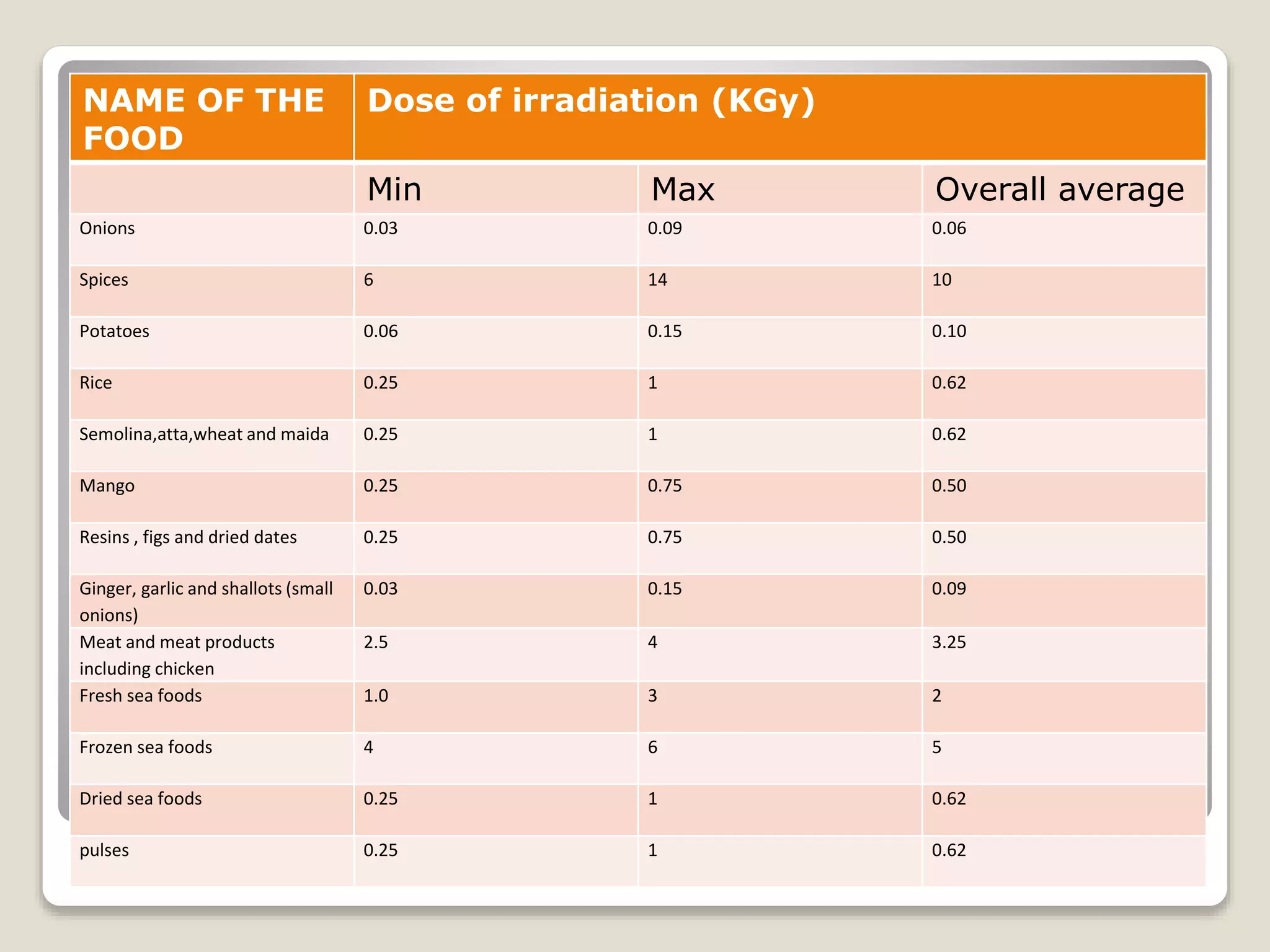
NAME OF THE
FOOD
Dose of irradiation (KGy)
Min Max Overall average
Onions 0.03 0.09 0.06
Spices 6 14 10
Potatoes 0.06 0.15 0.10
Rice 0.25 1 0.62
Semolina,atta,wheat and maida 0.25 1 0.62
Mango 0.25 0.75 0.50
Resins , figs and dried dates 0.25 0.75 0.50
Ginger, garlic and shallots (small
onions)
0.03 0.15 0.09
Meat and meat products
including chicken
2.5 4 3.25
Fresh sea foods 1.0 3 2
Frozen sea foods 4 6 5
Dried sea foods 0.25 1 0.62
pulses 0.25 1 0.62
Requirement for the process of irradiation
 No irradiation facility shall be used for the treatment of food
unless it has been approve and licensed under the atomic
energy (control of irradiation of foods) rules 1991;
 Foods once irradiated shall not be re-irradiated.
 No irradiated food shall leave the irradiation facility unless it
has been irradiated in accordance with the provisions of
department of atomic energy.
Consumer Acceptance of Food Irradiation
 Many years ago, there was a ‘‘hand wringing’’ that consumers
will not accept irradiated foods.
 There is an exponentially growing market for irradiated foods
in Asia, especially in China and India.
 The studies in the US, Mexico, and elsewhere on the
willingness of well informed consumers to purchase irradiated
foods has increased and are willing even to pay a premium
for irradiated foods.
References
 Choi, J., Kim, J.-K., Srinivasan, P., Kim, J.-H., Park, H.-J., Byn, M.-W. and Lee, J.-
W. (2009). Comparison of gamma ray and electron beam irradiation on extraction
yield, morphological and antioxidant properties of polysaccharides from tamarind
seed. Radiation Physics and Chemistry, 78 : 605–609.
 Pillai, D.S. and Shayanfar, S. (2016). Electron Beam Technology and Other
Irradiation Technology Applications in the Food Industry. Top Curr Chem, 375:6
 Shinyama, K. and Fujita, S. (2004). Electrical Properties of Biodegradable
Plastics, International Conference on Electrical Engineering (ICEE) , Sapporo,
Japan, 4–8 July.
 Sun, D.-W. (2005) Emerging Technologies for Food Processing , Elsevier,
Academic Press, San Diego, CA, USA.
 Praveen, C., Dancho, B.A., Kingsley, D.H., Calci, K.R., Meade, G.K., Mena, K.D.
and Pillai, S.D. (2013). Susceptibility of murine norovirus and hepatitis A virus to
electron beam irradiation in oysters and quantifying the reduction in potential
infection risks. Applied and Environmental Microbiology , 79 : 3796–3801.
E- beam technology
 E-beam

Electron beam technology

  • 1.
  • 2.
  • 3.
    Electromagnetic spectrum  Electromagneticspectrum is the range of all types of EM radiations
  • 4.
    Concept of photon Photon is fundamental particle of EM waves  Sir Isaac Newton was one of the first scientist to theorize that light consists of particles  Each photon consist of same particular energy that depends on the frequency.  E=hf  Photons travel through empty space at speed of light.  Energy of photon is measured in terms of eV
  • 5.
    Ionizing and non-ionizingradiations  Non ionizing radiation- long wavelength and low frequency  They have enough energy to excite molecule or atom causing them to vibrate faster creating heat  E.g.: radio wave, microwave  Ionizing radiation- shorter wavelength and high frequency  They have high energy enough to cause chemical changes by breaking chemical bonds, and cause damage to tissue.  Radiation has enough energy to strip away an electron from atom  E.g.: x-rays, gamma rays
  • 6.
    Radioactive decay  Itis a spontaneous emission of extremely powerful radiations from an unstable nuclei to form a stable nuclei  There are 3 ways by which radioactive nucleus can become stable. Each result in different type of radiation  If it emit alpha particles- alpha decay  If it emits beta particles- beta decay  If it emits gamma radiation- gamma decay
  • 7.
    Ionizing radiations  Propertiesof radiations to be used as food irradiation include  should have good Penetrating power but do not produce radioactivity.  Do not produce significant heat in foods (cold preservation).  beta particles and gamma rays are used most often used for food irradiation.
  • 8.
    Radioactive units  Thestrength of a radioactive source = number of disintegrations of its radioactivity per second.  Becquerel (Bq) = one disintegration per second.  Curie (Ci) : 1 Ci=3.7x10¹⁰ Bq.  The measure of absorbed radiation dose is gray (Gy).  Rad: 1 Gy = 100 rad  The sievert (Sv) is the unit used to asses the effects of ionising radiation on living cells, especially human beings. The sievert replaces the rem (1 Sv=100rems).  The intensity or energy level of beta particles emitted from a linear electron accelerator is defined in terms of joules or electron volts.
  • 9.
     Ionizing radiationis a broad term describing any radiation with sufficient energy to cause electrons to be released from atoms.  Codex general standard allows the use of following types of ionizing radiation  Gamma rays from the radionuclides Co and Cs  X-rays generated by machine sources operated at or below an energy level of 5MeV  Electrons generated by machine sources operated at or below an energy level of 10MeV
  • 10.
    History of irradiation In 1895, Dr. Roentgen discovered the X-ray, while he was researching the cathode ray, which is also an electron beam in a broad sense.  Dr. Becquerel discovered that uranium compounds are emitting something similar to the X-ray he named the invisible beam Becquerel ray.  It was found out afterward that the Becquerel ray can be divided into three kinds: α-ray (alpha ray), β-ray (beta ray), and γ-ray (gamma ray). Dr. Becquerel confirmed that β-ray was an electron.
  • 11.
     Mr. andMrs. Curie discovered polonium and radium from uranium ore in 1898, and since then the use of radiation and radioactive substances have been expanded in the fields of science, medicine, and engineering.  Radiation use was entirely limited to the one generated from the radioisotope demand for artificially generating radiation became strong because of the problems of handling.  Then various designs of electron accelerators were discovered
  • 12.
    E-beam  Gamma irradiationrelies on radioactive sources such as Co-60 and Cs-137, IAEA has attempted to replace isotope-based technology with linear accelerator- based e-beam and X-ray technologies.  the limited availability of cobalt-60  the cost of purchasing cobalt-60,  the cost of safeguarding cobalt-60  and the cost of replenishing and disposing cobalt-60  all prevent gamma irradiation technologies having any economic value in the future.
  • 13.
    Electron beam  E-beam is a flow of electrons with energy and is an ionizing radiation.  However, the primary difference as compared to gamma irradiation is that e-beam and X-ray are not based on radioactive source materials.  E-beam and X-ray technology are generated from commercial electricity and therefore are truly on–off technologies.  The equipment that generates e-beams and X-rays are generally called ‘‘linear accelerators’’
  • 14.
    shows the comparisonbetween various electromagnetic waves and their energy.  Worldwide, the maximum energy for E-beam technology that can be used for food irradiation is 10 MeV.  The reason for this upper limit on energy is that higher energies could potentially induce radioactivity in material.  In the US, E-beam energies as high as 7.5 MeV can be used to generate X-rays for food irradiation. However, worldwide the maximum energy for X-ray is still set at 5 MeV.
  • 15.
    How it isproduced
  • 16.
    components  Electron gun Cathode- made of tungsten or tantalum, it is a filament type cathode.  Potential difference is applied across the filament so that the filament temperature goes around 2500˚C.  At such temperature there would be emission of electrons.  Cathode is negative biased hence they are repelled by cathode.  Bias grid: -ve biased and controls the flow of electrons.  Anode: (+ve biased), due to P.D difference between the anode and cathode electrons are accelerated.
  • 17.
     Magnetic lenses:to concentrate or focus the beam of electrons.  Aperture: it will capture stray electrons, so electrons which emerge are very much concentrated and focused.  Electromagnetic lens: it ultimately focuses electrons on your product.  Illumination system and telescope: to align the electron beam with the product.  Vacuum port: to measure vacuum  Diffusion pump port: to produce vacuum
  • 18.
    vacuum  Why operatedunder vacuum..?  Vacuum:10-4 – 10-6 torr  We would hardly get electron emission  If we had also, the electrons would collide with air molecules they would not be accelerated to that extent and their would be more collision and lose their energy.
  • 19.
     Scanning coils-will scan the accelerated electrons in the necessary irradiation width (to obtain desired beam pattern on the target).  Irradiation window foil- should be thin and tough.  Titanium or titanium alloy
  • 20.
    EPS system classification They can be related to state of water forced through shower head  Scanning type- has small faucet and swings to spread water to necessary area  Non scanning type- has a enlarged faucet that cavers the necessary area
  • 21.
    Effect of IonizingRadiation  Direct effect-occurs when the photons or electrons directly encounter the DNA molecule and cause single and double strand breaks  Indirect effect-When ionizing radiation encounters water molecules, free radicals (hydrogen and hydroxyl radicals) are produced due to radiolysis of water.  Other food constituents, can also be affected by free radicals. Therefore, attempts to minimize changes in foods during irradiation have been focused on limiting indirect effects.  Irradiation in frozen state  Irradiation in vacuum  Addition of free radical scavengers (ascorbic acid)
  • 22.
    Sterilization by anelectron beam has the following features  It is processed at room temperature, and can be applied to heat sensitive materials.  As the absorbed dose rate is high, the processing time can be shortened.  Because of the high directionality in the irradiation, the utilization efficiency of a radiation source is high.  Radiation source replacement or waste radiation source control is avoided
  • 23.
     Facilities aresafe because electron beams stop immediately when the power switch is turned off.  The selection of the installation location is easy.  The oxidative deterioration in a plastic material is small because of the high dose rate irradiation.
  • 24.
    Application of E-beam Crosslinking by E-beam technology is a key application area of this technology.  Crosslinking is the bond that links one polymer chain to another in order to improve the polymer physical properties, such as heat resistance.  Role of E-beam processing in biodegradable packaging  A common biodegradable plastics is polylactic acid (PLA) It offers a wider range of benefits.  However, PLA suffers from poor mechanical properties, which can be improved by E-beam crosslinking to provide more rigidity.
  • 25.
     Cellulose acetateare not easily hydrated and therefore cannot be easily hydrolyzed by enzymes.  However, if the acetate side groups can be cleaved off, the compound becomes more susceptible to enzymatic reactions.  application of E-beam processing of cellulose acetate may achieve cleaving-off of the acetate group.
  • 26.
    Waste management  Currentstrategies of managing food and agricultural wastes are either land filling, incineration, anaerobic digestion, composting, or feeding livestock.  E-beam technology can help break down these wastes to help recover some of these high value products.  For example, E-beam technology was used to aid in the extraction of tamarind seed polysaccharide. It also led to increase in antioxidant properties of the extracted TSP
  • 27.
     E-beam technologyis a effective approach for decontaminating liquid food wastes and effluents from industries.  It can reduce microbial population in drinking water.  Formation of free radicals in liquid wastes are very effective at microbial inactivation.  E-beam reduces estrogenic activity  Chemical that mimics human estrogen
  • 28.
    Space foods  Mercuryprogram (1958–1963)-foods consisted primarily of bite-sized cubes, freeze-dried powders, and liquids in aluminum tubes.  Consist of thermal-stabilized foods, irradiated foods, and vitamin D supplements.  For long-duration missions, NASA has categorized two different food systems, namely “  transit foods  surface foods.
  • 29.
     Transit foods-for use when travelling to distant bodies. expected to have a 3–5 year shelf life.  Surface foods are foods that are most likely grown on the surface of the celestial bodies.  NASA currently uses irradiation (cobalt-60) for achieving food sterility,  And is actively exploring the possibility of employing other technologies such as E-beam, HPP, and microwave sterilization.
  • 30.
    Regulations governing commercial foodirradiation  They are covered by Sections 1.2 and 2.13 of the FSSAI.  In India, like the US, all irradiated foods have to be labeled with the radura logo in green with information about the product identity, purpose of radiation processing, radiation processing facility, and date of processing.
  • 31.
    NAME OF THE FOOD Doseof irradiation (KGy) Min Max Overall average Onions 0.03 0.09 0.06 Spices 6 14 10 Potatoes 0.06 0.15 0.10 Rice 0.25 1 0.62 Semolina,atta,wheat and maida 0.25 1 0.62 Mango 0.25 0.75 0.50 Resins , figs and dried dates 0.25 0.75 0.50 Ginger, garlic and shallots (small onions) 0.03 0.15 0.09 Meat and meat products including chicken 2.5 4 3.25 Fresh sea foods 1.0 3 2 Frozen sea foods 4 6 5 Dried sea foods 0.25 1 0.62 pulses 0.25 1 0.62
  • 32.
    Requirement for theprocess of irradiation  No irradiation facility shall be used for the treatment of food unless it has been approve and licensed under the atomic energy (control of irradiation of foods) rules 1991;  Foods once irradiated shall not be re-irradiated.  No irradiated food shall leave the irradiation facility unless it has been irradiated in accordance with the provisions of department of atomic energy.
  • 33.
    Consumer Acceptance ofFood Irradiation  Many years ago, there was a ‘‘hand wringing’’ that consumers will not accept irradiated foods.  There is an exponentially growing market for irradiated foods in Asia, especially in China and India.  The studies in the US, Mexico, and elsewhere on the willingness of well informed consumers to purchase irradiated foods has increased and are willing even to pay a premium for irradiated foods.
  • 34.
    References  Choi, J.,Kim, J.-K., Srinivasan, P., Kim, J.-H., Park, H.-J., Byn, M.-W. and Lee, J.- W. (2009). Comparison of gamma ray and electron beam irradiation on extraction yield, morphological and antioxidant properties of polysaccharides from tamarind seed. Radiation Physics and Chemistry, 78 : 605–609.  Pillai, D.S. and Shayanfar, S. (2016). Electron Beam Technology and Other Irradiation Technology Applications in the Food Industry. Top Curr Chem, 375:6  Shinyama, K. and Fujita, S. (2004). Electrical Properties of Biodegradable Plastics, International Conference on Electrical Engineering (ICEE) , Sapporo, Japan, 4–8 July.  Sun, D.-W. (2005) Emerging Technologies for Food Processing , Elsevier, Academic Press, San Diego, CA, USA.  Praveen, C., Dancho, B.A., Kingsley, D.H., Calci, K.R., Meade, G.K., Mena, K.D. and Pillai, S.D. (2013). Susceptibility of murine norovirus and hepatitis A virus to electron beam irradiation in oysters and quantifying the reduction in potential infection risks. Applied and Environmental Microbiology , 79 : 3796–3801.
  • 36.