Speckle tracking
Dr Madhur Jain
Interventional Cardiologist
Introduction
⦿ TDI uses Doppler shift data from the myocardium
to obtain qualitative and quantitative information
on myocardial wall motion.
⦿ Measures the velocity of myocardial wall motion
❖ Low velocity
⦿ 5 to 20 cm/s
⦿ 10 times slower than velocity of blood flow
❖ High amplitude
⦿ Approximately 40 decibels higher than blood
flow
IntJ of Card Imaging 2001;17::8
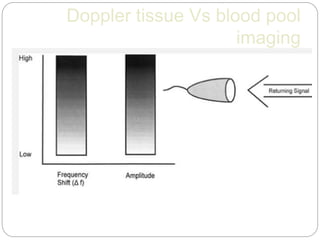
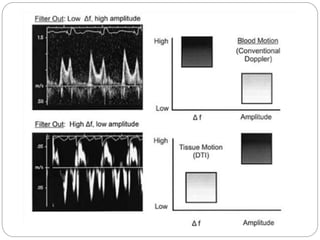
Doppler tissue Vs blood pool
imaging
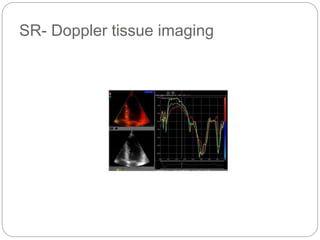
SR- Doppler tissue imaging
Limitations
⦿Accuracy of velocities dependent on angle
of ultrasound beam.
⦿Not all wall velocity obtainable from every
view.
⦿Wide range of normal values.
⦿Even non contractile myocardium will be
pulled by near by segments resulting in
apparent velocity component.
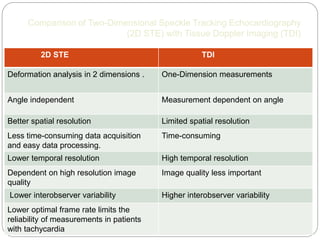
Comparison of Two-Dimensional Speckle Tracking Echocardiography
(2D STE) with Tissue Doppler Imaging (TDI)
2D STE TDI
Deformation analysis in 2 dimensions . One-Dimension measurements
Angle independent Measurement dependent on angle
Better spatial resolution Limited spatial resolution
Less time-consuming data acquisition
and easy data processing.
Time-consuming
Lower temporal resolution High temporal resolution
Dependent on high resolution image
quality
Image quality less important
Lower interobserver variability Higher interobserver variability
Lower optimal frame rate limits the
reliability of measurements in patients
with tachycardia
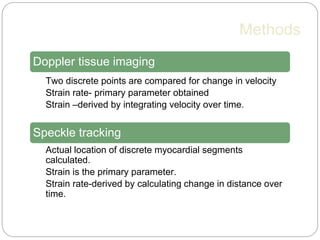
Methods
Doppler tissue imaging
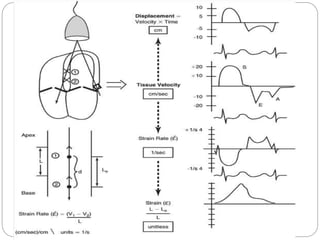
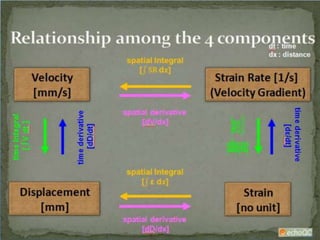
• Two discrete points are compared for change in velocity
• Strain rate- primary parameter obtained
• Strain –derived by integrating velocity over time.
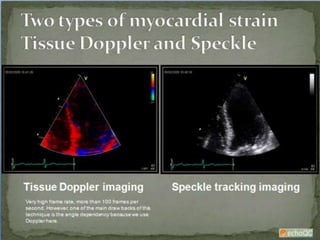
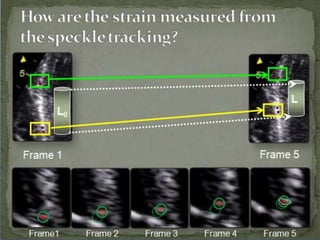
Speckle tracking
• Actual location of discrete myocardial segments
calculated.
• Strain is the primary parameter.
• Strain rate-derived by calculating change in distance over
time.
TWO DIMENSIONAL SPECKLE TRACKING
ECHOCARDIOGRAPHY: BASIC PRINCIPLES
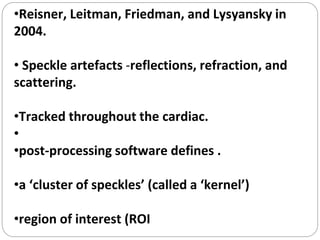
•Reisner, Leitman, Friedman, and Lysyansky in
2004.
• Speckle artefacts -reflections, refraction, and
scattering.
•Tracked throughout the cardiac.
•
•post-processing software defines .
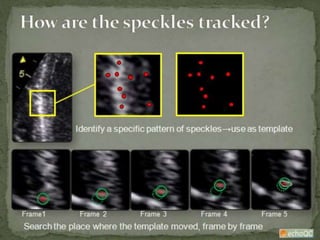
•a ‘cluster of speckles’ (called a ‘kernel’)
•region of interest (ROI
Speckle tracking
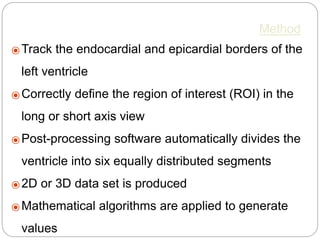
⦿ ‘Speckles’ are small dots or groups of myocardial
pixels that are created by the interaction of
ultrasonic beams and the myocardium.
⦿ Considered as acoustic fingerprint for that region.
⦿ This enables to judge the direction of movement,
the speed of such movement, and the distance of
such movement of any points in the myocardium.
Speckle
Method
⦿ Track the endocardial and epicardial borders of the
left ventricle
⦿ Correctly define the region of interest (ROI) in the
long or short axis view
⦿ Post-processing software automatically divides the
ventricle into six equally distributed segments
⦿ 2D or 3D data set is produced
⦿ Mathematical algorithms are applied to generate
values
⦿ Strain is not uniform among all myocardial
segments.
⦿ Radial strain-Magnitude of basal parameters are
higher than the apical values.
⦿ Longitudinal strain- less variability fron apex to
base.
⦿ Circumferential strain- higher in anterior and
lateral walls compared to posterior and septal.
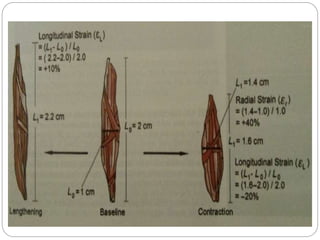
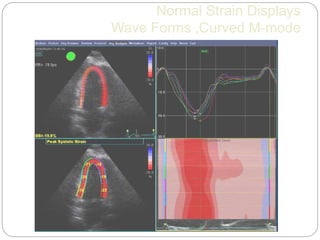
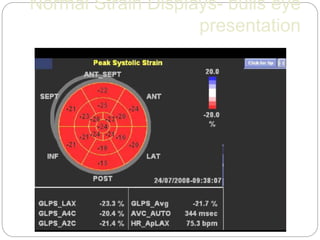
⦿ Normal longitudinal strain averages -20%
⦿ Normal radial strain about +40%
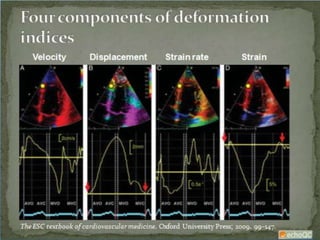
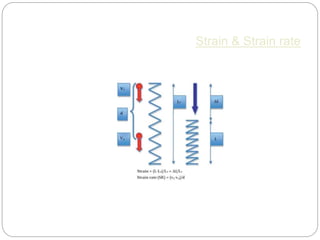
Strain and strain rate
Imaging
Strain & Strain rate
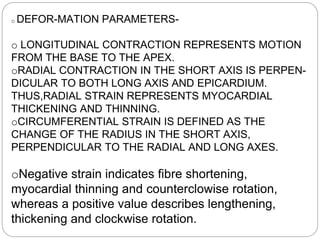
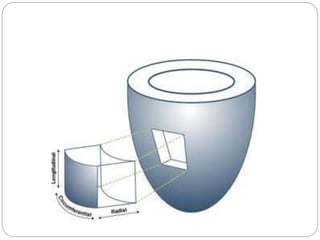
o DEFOR-MATION PARAMETERS-
o LONGITUDINAL CONTRACTION REPRESENTS MOTION
FROM THE BASE TO THE APEX.
oRADIAL CONTRACTION IN THE SHORT AXIS IS PERPEN-
DICULAR TO BOTH LONG AXIS AND EPICARDIUM.
THUS,RADIAL STRAIN REPRESENTS MYOCARDIAL
THICKENING AND THINNING.
oCIRCUMFERENTIAL STRAIN IS DEFINED AS THE
CHANGE OF THE RADIUS IN THE SHORT AXIS,
PERPENDICULAR TO THE RADIAL AND LONG AXES.
oNegative strain indicates fibre shortening,
myocardial thinning and counterclowise rotation,
whereas a positive value describes lengthening,
thickening and clockwise rotation.
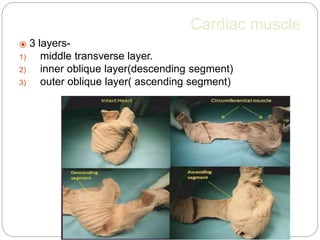
Cardiac muscle
⦿ 3 layers-
1) middle transverse layer.
2) inner oblique layer(descending segment)
3) outer oblique layer( ascending segment)
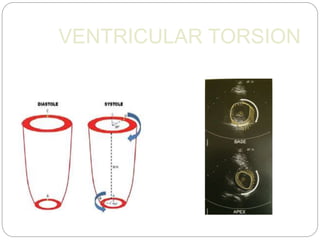
VENTRICULAR TORSION
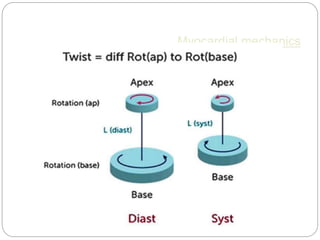
Myocardial mechanics
VENTRICULAR TORSION
⦿ Similar to the winding and Unwinding of a towel.
⦿ Isovolumetric contraction -the apex and base rotates in
counterclockwise direction.
⦿ Ejection phase apex rotates counterclockwise & base
rotates clockwise when viewed from the apex
⦿ Diastole - relaxation of myocardial fibres - recoiling -
clockwise apical rotation.
⦿ Isovolumetric relaxation- both apex and base rotates in
clockwise direction.
Introduction
⦿ Evaluation of a myocardial region with reference to an
adjacent myocardial segment.
⦿ Deformation analysis- analysis of ventricular mechanics
or shapes during cardiac cycle.
⦿ Myocardial strain, strain rate, torsion.
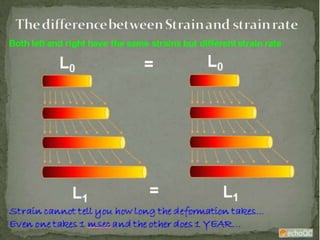
⦿ Strain- percentage thickening or deformation of the
myocardium during the cardiac cycle.
⦿ Change of strain per unit of time is referred to as strain
rate
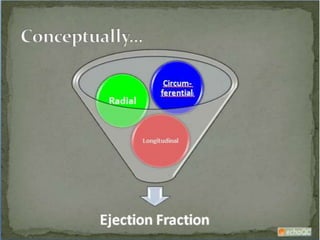
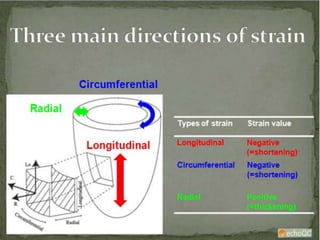
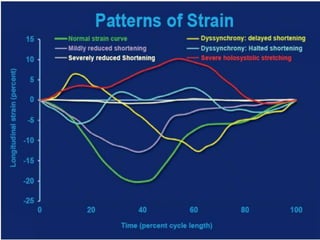
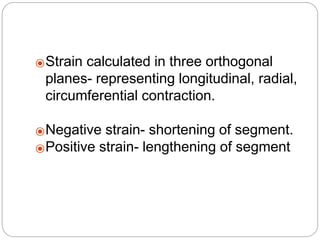
⦿Strain calculated in three orthogonal
planes- representing longitudinal, radial,
circumferential contraction.
⦿Negative strain- shortening of segment.
⦿Positive strain- lengthening of segment
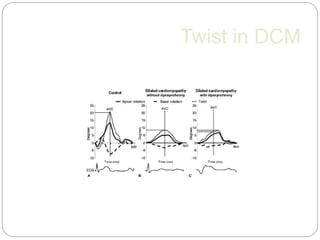
Twist in DCM
Am J Cardiol 2008;101:1163–1169, 2008
Normal Strain Displays
Wave Forms ,Curved M-mode
Normal Strain Displays- bulls eye
presentation
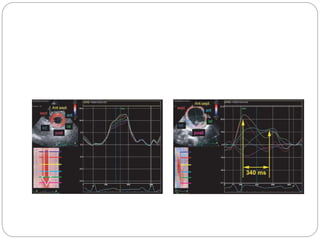
NORMAL PATTERN
DILATED
CARDIOMYOPATHY
DYSSYNCHRONY
⦿ Rotation - Measure of the rotational movement of the
myocardium in relation to an imaginary long axis line
from apex to base drawn through the middle of LV
cavity.
⦿ Twist (degrees) is the net difference between apical
and basal rotation
⦿ Torsion - Twist divided by the vertical distance
between the apex and base and is expressed as
degrees/cm.
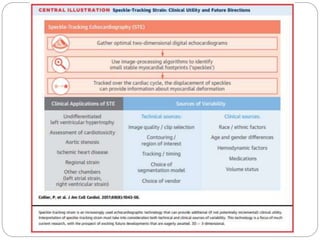
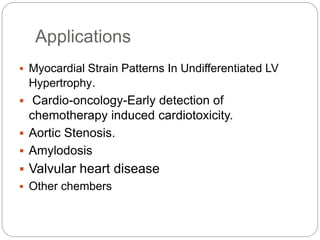
Applications
 Myocardial Strain Patterns In Undifferentiated LV
Hypertrophy.
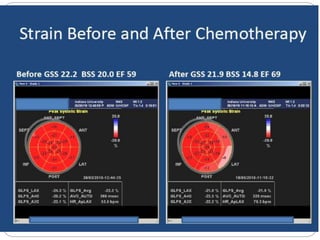
 Cardio-oncology-Early detection of
chemotherapy induced cardiotoxicity.
 Aortic Stenosis.
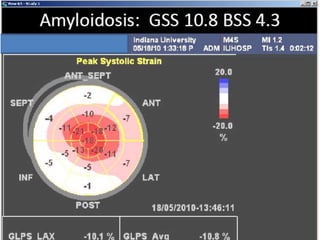
 Amylodosis
 Valvular heart disease
 Other chembers
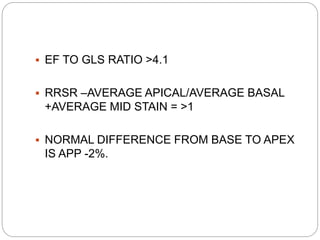
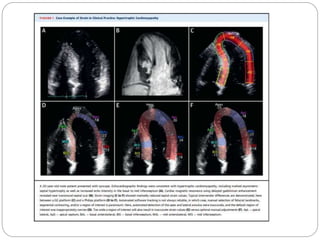
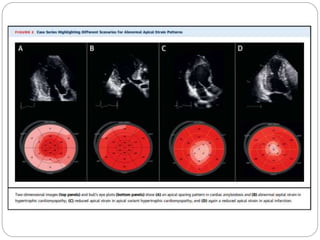
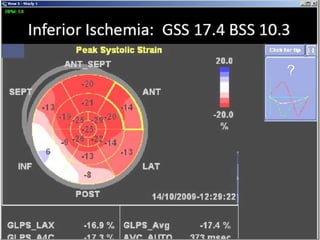
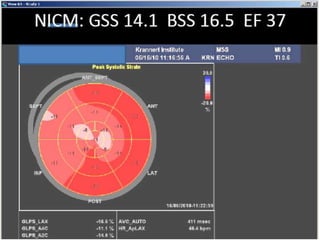
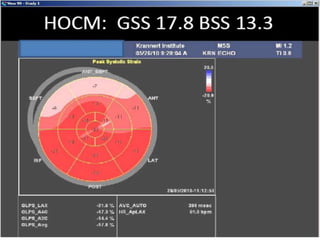
Myocardial Strain Patterns In Undifferentiated LV
Hypertrophy
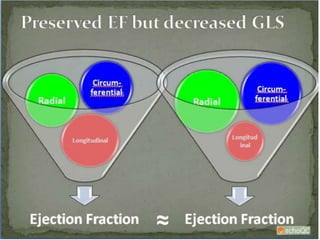
 EF TO GLS RATIO >4.1
 RRSR –AVERAGE APICAL/AVERAGE BASAL
+AVERAGE MID STAIN = >1
 NORMAL DIFFERENCE FROM BASE TO APEX
IS APP -2%.
CAD- Myocardial ischemia, Myocardial
infarction, Myocardial viability
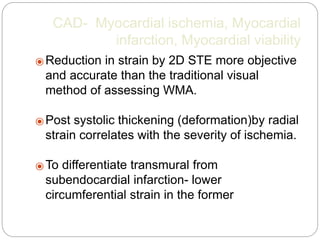
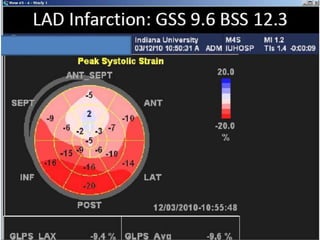
⦿ Reduction in strain by 2D STE more objective
and accurate than the traditional visual
method of assessing WMA.
⦿ Post systolic thickening (deformation)by radial
strain correlates with the severity of ischemia.
⦿ To differentiate transmural from
subendocardial infarction- lower
circumferential strain in the former
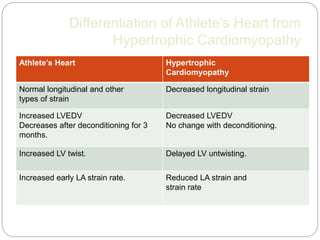
Differentiation of Athlete’s Heart from
Hypertrophic Cardiomyopathy
Athlete’s Heart Hypertrophic
Cardiomyopathy
Normal longitudinal and other
types of strain
Decreased longitudinal strain
Increased LVEDV
Decreases after deconditioning for 3
months.
Decreased LVEDV
No change with deconditioning.
Increased LV twist. Delayed LV untwisting.
Increased early LA strain rate. Reduced LA strain and
strain rate
Thank You

Speckle Tracking Echocardiography

  • 1.
    Speckle tracking Dr MadhurJain Interventional Cardiologist
  • 10.
    Introduction ⦿ TDI usesDoppler shift data from the myocardium to obtain qualitative and quantitative information on myocardial wall motion. ⦿ Measures the velocity of myocardial wall motion ❖ Low velocity ⦿ 5 to 20 cm/s ⦿ 10 times slower than velocity of blood flow ❖ High amplitude ⦿ Approximately 40 decibels higher than blood flow IntJ of Card Imaging 2001;17::8
  • 11.
    Doppler tissue Vsblood pool imaging
  • 13.
  • 16.
    Limitations ⦿Accuracy of velocitiesdependent on angle of ultrasound beam. ⦿Not all wall velocity obtainable from every view. ⦿Wide range of normal values. ⦿Even non contractile myocardium will be pulled by near by segments resulting in apparent velocity component.
  • 17.
    Comparison of Two-DimensionalSpeckle Tracking Echocardiography (2D STE) with Tissue Doppler Imaging (TDI) 2D STE TDI Deformation analysis in 2 dimensions . One-Dimension measurements Angle independent Measurement dependent on angle Better spatial resolution Limited spatial resolution Less time-consuming data acquisition and easy data processing. Time-consuming Lower temporal resolution High temporal resolution Dependent on high resolution image quality Image quality less important Lower interobserver variability Higher interobserver variability Lower optimal frame rate limits the reliability of measurements in patients with tachycardia
  • 18.
    Methods Doppler tissue imaging •Two discrete points are compared for change in velocity • Strain rate- primary parameter obtained • Strain –derived by integrating velocity over time. Speckle tracking • Actual location of discrete myocardial segments calculated. • Strain is the primary parameter. • Strain rate-derived by calculating change in distance over time.
  • 19.
    TWO DIMENSIONAL SPECKLETRACKING ECHOCARDIOGRAPHY: BASIC PRINCIPLES
  • 20.
    •Reisner, Leitman, Friedman,and Lysyansky in 2004. • Speckle artefacts -reflections, refraction, and scattering. •Tracked throughout the cardiac. • •post-processing software defines . •a ‘cluster of speckles’ (called a ‘kernel’) •region of interest (ROI
  • 22.
    Speckle tracking ⦿ ‘Speckles’are small dots or groups of myocardial pixels that are created by the interaction of ultrasonic beams and the myocardium. ⦿ Considered as acoustic fingerprint for that region. ⦿ This enables to judge the direction of movement, the speed of such movement, and the distance of such movement of any points in the myocardium.
  • 23.
  • 24.
    Method ⦿ Track theendocardial and epicardial borders of the left ventricle ⦿ Correctly define the region of interest (ROI) in the long or short axis view ⦿ Post-processing software automatically divides the ventricle into six equally distributed segments ⦿ 2D or 3D data set is produced ⦿ Mathematical algorithms are applied to generate values
  • 25.
    ⦿ Strain isnot uniform among all myocardial segments. ⦿ Radial strain-Magnitude of basal parameters are higher than the apical values. ⦿ Longitudinal strain- less variability fron apex to base. ⦿ Circumferential strain- higher in anterior and lateral walls compared to posterior and septal. ⦿ Normal longitudinal strain averages -20% ⦿ Normal radial strain about +40%
  • 26.
    Strain and strainrate Imaging
  • 28.
  • 29.
    o DEFOR-MATION PARAMETERS- oLONGITUDINAL CONTRACTION REPRESENTS MOTION FROM THE BASE TO THE APEX. oRADIAL CONTRACTION IN THE SHORT AXIS IS PERPEN- DICULAR TO BOTH LONG AXIS AND EPICARDIUM. THUS,RADIAL STRAIN REPRESENTS MYOCARDIAL THICKENING AND THINNING. oCIRCUMFERENTIAL STRAIN IS DEFINED AS THE CHANGE OF THE RADIUS IN THE SHORT AXIS, PERPENDICULAR TO THE RADIAL AND LONG AXES. oNegative strain indicates fibre shortening, myocardial thinning and counterclowise rotation, whereas a positive value describes lengthening, thickening and clockwise rotation.
  • 31.
    Cardiac muscle ⦿ 3layers- 1) middle transverse layer. 2) inner oblique layer(descending segment) 3) outer oblique layer( ascending segment)
  • 32.
  • 33.
  • 34.
    VENTRICULAR TORSION ⦿ Similarto the winding and Unwinding of a towel. ⦿ Isovolumetric contraction -the apex and base rotates in counterclockwise direction. ⦿ Ejection phase apex rotates counterclockwise & base rotates clockwise when viewed from the apex ⦿ Diastole - relaxation of myocardial fibres - recoiling - clockwise apical rotation. ⦿ Isovolumetric relaxation- both apex and base rotates in clockwise direction.
  • 37.
    Introduction ⦿ Evaluation ofa myocardial region with reference to an adjacent myocardial segment. ⦿ Deformation analysis- analysis of ventricular mechanics or shapes during cardiac cycle. ⦿ Myocardial strain, strain rate, torsion. ⦿ Strain- percentage thickening or deformation of the myocardium during the cardiac cycle. ⦿ Change of strain per unit of time is referred to as strain rate
  • 38.
    ⦿Strain calculated inthree orthogonal planes- representing longitudinal, radial, circumferential contraction. ⦿Negative strain- shortening of segment. ⦿Positive strain- lengthening of segment
  • 39.
    Twist in DCM AmJ Cardiol 2008;101:1163–1169, 2008
  • 41.
    Normal Strain Displays WaveForms ,Curved M-mode
  • 42.
    Normal Strain Displays-bulls eye presentation
  • 43.
  • 44.
    ⦿ Rotation -Measure of the rotational movement of the myocardium in relation to an imaginary long axis line from apex to base drawn through the middle of LV cavity. ⦿ Twist (degrees) is the net difference between apical and basal rotation ⦿ Torsion - Twist divided by the vertical distance between the apex and base and is expressed as degrees/cm.
  • 46.
    Applications  Myocardial StrainPatterns In Undifferentiated LV Hypertrophy.  Cardio-oncology-Early detection of chemotherapy induced cardiotoxicity.  Aortic Stenosis.  Amylodosis  Valvular heart disease  Other chembers
  • 47.
    Myocardial Strain PatternsIn Undifferentiated LV Hypertrophy  EF TO GLS RATIO >4.1  RRSR –AVERAGE APICAL/AVERAGE BASAL +AVERAGE MID STAIN = >1  NORMAL DIFFERENCE FROM BASE TO APEX IS APP -2%.
  • 49.
    CAD- Myocardial ischemia,Myocardial infarction, Myocardial viability ⦿ Reduction in strain by 2D STE more objective and accurate than the traditional visual method of assessing WMA. ⦿ Post systolic thickening (deformation)by radial strain correlates with the severity of ischemia. ⦿ To differentiate transmural from subendocardial infarction- lower circumferential strain in the former
  • 50.
    Differentiation of Athlete’sHeart from Hypertrophic Cardiomyopathy Athlete’s Heart Hypertrophic Cardiomyopathy Normal longitudinal and other types of strain Decreased longitudinal strain Increased LVEDV Decreases after deconditioning for 3 months. Decreased LVEDV No change with deconditioning. Increased LV twist. Delayed LV untwisting. Increased early LA strain rate. Reduced LA strain and strain rate
  • 58.