Recommendations for Cardiac Chamber
Quantification by Echocardiography in
Adults
An Update from the American Society of Echocardiography and the
European Association of Cardiovascular Imaging
CHAMBER QUANTIFICATION
• All measurements described in this document should be performed
on more than one cardiac cycle to account for inter-beat variability.
The committee suggests the average of three beats for patients in
normal sinus rhythm and a minimum of five beats in patients with
atrial fibrillation
The Left Ventricle
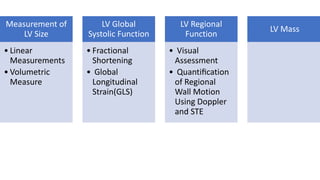
Measurement of
LV Size
• Linear
Measurements
• Volumetric
Measure
LV Global
Systolic Function
• Fractional
Shortening
• Global
Longitudinal
Strain(GLS)
LV Regional
Function
• Visual
Assessment
• Quantification
of Regional
Wall Motion
Using Doppler
and STE
LV Mass
1. Measurement of LV Size
• most commonly - linear internal dimensions and volumes - end-
diastole and end-systole
• To allow comparison among individuals with different body sizes,
chamber measurements should be reported indexed to BSA
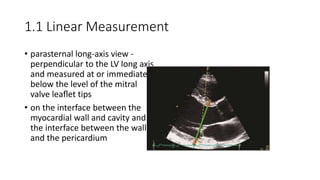
1.1 Linear Measurement
• parasternal long-axis view -
perpendicular to the LV long axis
and measured at or immediately
below the level of the mitral
valve leaflet tips
• on the interface between the
myocardial wall and cavity and
the interface between the wall
and the pericardium
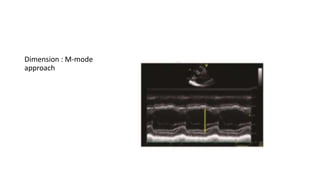
Dimension : M-mode
approach
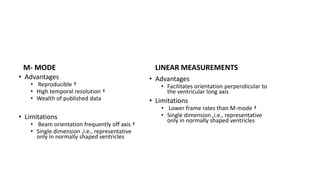
M- MODE
• Advantages
• Reproducible †
• High temporal resolution †
• Wealth of published data
• Limitations
• Beam orientation frequently off axis †
• Single dimension ,i.e., representative
only in normally shaped ventricles
LINEAR MEASUREMENTS
• Advantages
• Facilitates orientation perpendicular to
the ventricular long axis
• Limitations
• Lower frame rates than M-mode †
• Single dimension ,i.e., representative
only in normally shaped ventricles
1.2. Volumetric Measurement
• LV volumes are measured using 2DE or 3DE.
• Volume calculations derived from linear measurements may be
inaccurate, because they rely on the assumption of a fixed geometric
LV shape
• Teichholz and Quinones methods for calculating LV volumes from LV
linear dimensions are no longer recommended for clinical use
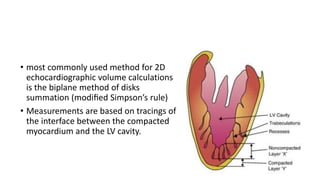
• most commonly used method for 2D
echocardiographic volume calculations
is the biplane method of disks
summation (modified Simpson’s rule)
• Measurements are based on tracings of
the interface between the compacted
myocardium and the LV cavity.
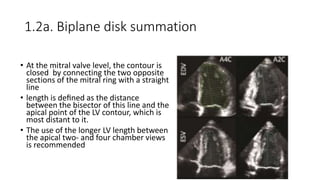
1.2a. Biplane disk summation
• At the mitral valve level, the contour is
closed by connecting the two opposite
sections of the mitral ring with a straight
line
• length is defined as the distance
between the bisector of this line and the
apical point of the LV contour, which is
most distant to it.
• The use of the longer LV length between
the apical two- and four chamber views
is recommended
1.2b. Area-length method
• alternative method to calculate LV volumes when apical endocardial
definition precludes accurate tracing is the area-length method, in
which the LV is assumed to be bullet shaped.
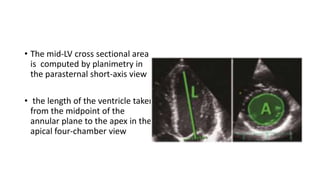
• The mid-LV cross sectional area
is computed by planimetry in
the parasternal short-axis view
• the length of the ventricle taken
from the midpoint of the
annular plane to the apex in the
apical four-chamber view
Biplane disk summation
• Advantages
• Corrects for shape distortions †
• Less geometrical assumptions
compared with linear dimension
• Limitations
• Apex frequently fore-shortened †
• Endocardial dropout †
• Blind to shape distortions not
visualized in the apical two- and
four-chamber planes
Area-length
• Advantages
• Partial correction for shape
distortion †
• Limitations
• Apex frequently fore-shortened †
• Heavily based on geometrical
assumptions †
• Limited published data on normal
population
3D echo
• One of the advantages of 3D echocardiographic volume
measurements is that they do not rely on geometric assumptions
• 3D image acquisition should focus primarily on including the entire
left ventricle within the pyramidal dataset
• For accurate identification of end-systole, the temporal resolution of
3D imaging should be maximized
• 3D echocardiographic LV volumes were investigated in one study,
which reported that LV volumes were smaller among Asian Indians
than white Europeans, but EF did not differ among ethnic groups
• 3D echocardiographic LV volumes were larger than 2D
echocardiographic values
• Weak to moderate negative correlations were seen between age and
LV volumes, while EF did not change significantly with age.
Recommendation
• LV size should be routinely assessed on 2DE by calculating volumes
using the biplane method of disks summation technique
• 3D measurement and reporting of LV volumes is recommended when
feasible
• LV size and volume measurements should be reported indexed to
BSA.
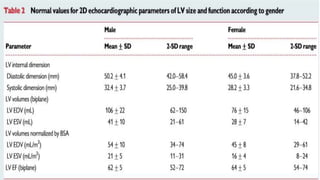
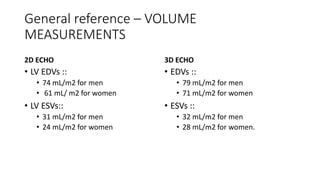
General reference – VOLUME
MEASUREMENTS
2D ECHO
• LV EDVs ::
• 74 mL/m2 for men
• 61 mL/ m2 for women
• LV ESVs::
• 31 mL/m2 for men
• 24 mL/m2 for women
3D ECHO
• EDVs ::
• 79 mL/m2 for men
• 71 mL/m2 for women
• ESVs ::
• 32 mL/m2 for men
• 28 mL/m2 for women.
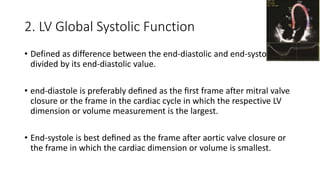
2. LV Global Systolic Function
• Defined as difference between the end-diastolic and end-systolic
divided by its end-diastolic value.
• end-diastole is preferably defined as the first frame after mitral valve
closure or the frame in the cardiac cycle in which the respective LV
dimension or volume measurement is the largest.
• End-systole is best defined as the frame after aortic valve closure or
the frame in which the cardiac dimension or volume is smallest.
• timing of valve openings and closures derived from M-mode
echocardiography, pulsed-wave (PW) or continuous-wave Doppler
may be used for accurate definitions of ventricular time intervals
2.1 Fractional Shortening
• Fractional shortening can be derived from 2D-guided M-mode
imaging or preferably from linear measurements obtained from 2D
images.
2.2. EF [ejection fraction]
• EF=(EDV−ESV)/EDV
• 3DE-basedEFmeasurementsareaccurateandreproducible and should
be used when available and feasible
• 3DE - based EF measurements are accurate and reproducible and
should be used when available and feasible
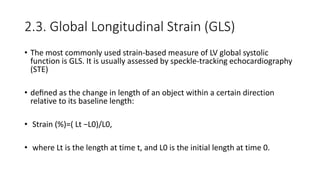
2.3. Global Longitudinal Strain (GLS)
• The most commonly used strain-based measure of LV global systolic
function is GLS. It is usually assessed by speckle-tracking echocardiography
(STE)
• defined as the change in length of an object within a certain direction
relative to its baseline length:
• Strain (%)=( Lt −L0)/L0,
• where Lt is the length at time t, and L0 is the initial length at time 0.
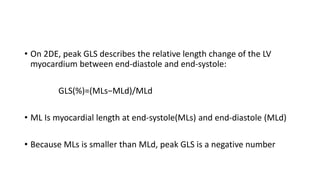
• On 2DE, peak GLS describes the relative length change of the LV
myocardium between end-diastole and end-systole:
GLS(%)=(MLs−MLd)/MLd
• ML Is myocardial length at end-systole(MLs) and end-diastole (MLd)
• Because MLs is smaller than MLd, peak GLS is a negative number
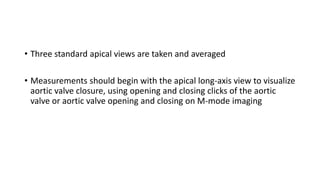
• Three standard apical views are taken and averaged
• Measurements should begin with the apical long-axis view to visualize
aortic valve closure, using opening and closing clicks of the aortic
valve or aortic valve opening and closing on M-mode imaging
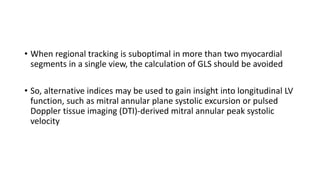
• When regional tracking is suboptimal in more than two myocardial
segments in a single view, the calculation of GLS should be avoided
• So, alternative indices may be used to gain insight into longitudinal LV
function, such as mitral annular plane systolic excursion or pulsed
Doppler tissue imaging (DTI)-derived mitral annular peak systolic
velocity
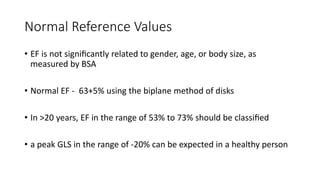
Normal Reference Values
• EF is not significantly related to gender, age, or body size, as
measured by BSA
• Normal EF - 63+5% using the biplane method of disks
• In >20 years, EF in the range of 53% to 73% should be classified
• a peak GLS in the range of -20% can be expected in a healthy person
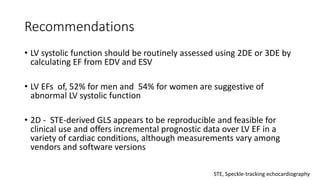
Recommendations
• LV systolic function should be routinely assessed using 2DE or 3DE by
calculating EF from EDV and ESV
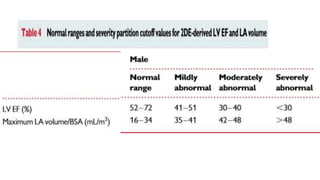
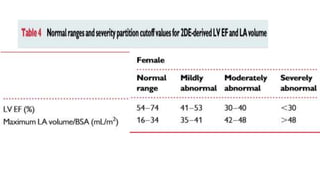
• LV EFs of, 52% for men and 54% for women are suggestive of
abnormal LV systolic function
• 2D - STE-derived GLS appears to be reproducible and feasible for
clinical use and offers incremental prognostic data over LV EF in a
variety of cardiac conditions, although measurements vary among
vendors and software versions
STE, Speckle-tracking echocardiography
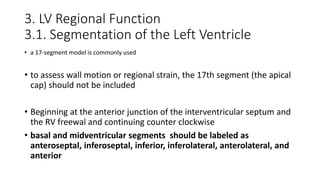
3. LV Regional Function
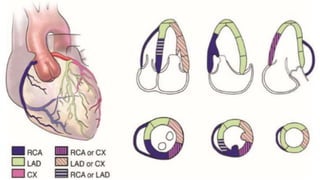
3.1. Segmentation of the Left Ventricle
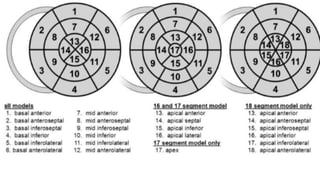
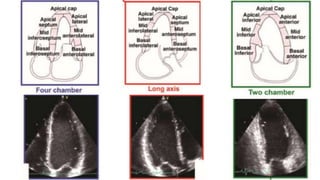
• a 17-segment model is commonly used
• to assess wall motion or regional strain, the 17th segment (the apical
cap) should not be included
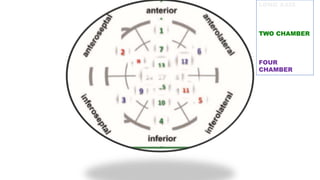
• Beginning at the anterior junction of the interventricular septum and
the RV freewal and continuing counter clockwise
• basal and midventricular segments should be labeled as
anteroseptal, inferoseptal, inferior, inferolateral, anterolateral, and
anterior
LONG AXIS
TWO CHAMBER
FOUR
CHAMBER
Visual Assessment
• observed wall thickening and endocardial motion of the myocardial
segment
• each segment be analyzed individually in multiple views.
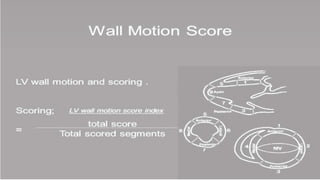
• A semiquantitative wall motion score can be assigned to each
segment to calculate the LV wall motion score index
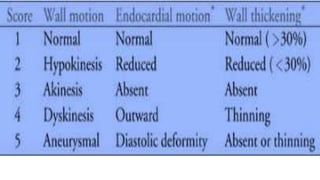
• The following scoring system is recommended:
• (1) normal or hyperkinetic,
• (2) hypokinetic (reduced thickening),
• (3) akinetic (absent or negligible thickening, e.g., scar),and
• (4)dyskinetic (systolic thinning or stretching, e.g., aneurysm).
• Aneurysm is a morphologic entity that demonstrates focal dilatation
and thinning (remodeling) with either akinetic or dyskinetic systolic
deformation
• refrains from assigning a separate wall motion score for aneurysm
Regional Abnormalities in the Absence of
Coronary Artery
• myocarditis,
• sarcoidosis,
• stress-induced (takotsubo) cardiomyopathy
• postoperatively
• in the presence of a left bundle branch block
• epicardial pacing,
• RV dysfunction caused by RV pressure or volume
overload.
• conduction delays
This regional
dysfunction is
due to the
abnormal
sequence of
myocardial
activation
LV Mass
• A strong predictor of , cardiovascular events
• M-mode echocardiography, 2DE, and 3DE
• All measurements should be performed at the end of diastole (the
frame before mitral valve closure or the frame in the cardiac cycle in
which the ventricular dimension or volume is largest).
• Linear method::
• Cube formula
• LV mass=0.8·1.04·[(IVS+LVID+PWT)3 −LVID3]+0.6g
• Where IVS is interventricular septum;
• LVID is LV internal diameter, and PWT is inferolateral wall thickness.
• Convert the volume to mass by multiplying the volume of
myocardium by the myocardial density (approximately 1.05 g/mL
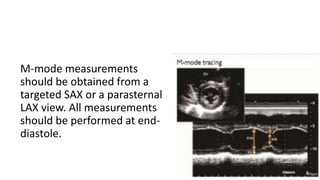
M-mode measurements
should be obtained from a
targeted SAX or a parasternal
LAX view. All measurements
should be performed at end-
diastole.
• M-mode – quick – simple – accurate
• However, caveats need to be mentioned- it is critical that the wall
thickness and LV dimensions measured be truly perpendicular to the
long axis of the left ventricle.
• formula includes a correction for the 20% overestimation that was
found during the original validation studies of the M-mode technique
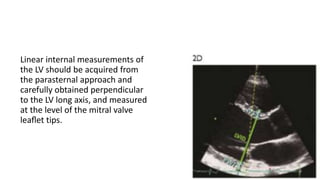
Linear internal measurements of
the LV should be acquired from
the parasternal approach and
carefully obtained perpendicular
to the LV long axis, and measured
at the level of the mitral valve
leaflet tips.
• patients with upper septal hypertrophy, the linear dimension
methods, which use basal ventricular measurements, result in over
estimation of the true mass, because the thickest region of the
interventricular septum is in-corporated in the measurement
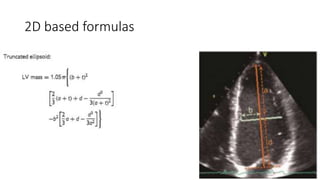
2D based formulas
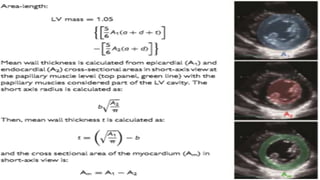
• area-length method, which uses mid-ventricular measurements,
underestimates LV mass, because the thickest part of the
interventricular septum is not included
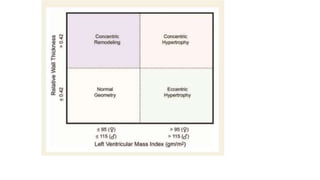
• calculation of relative wall thickness (RWT) with the formula ::
• (2×posterior wall thickness) / (LV internal diameter at end diastole)
permits categorization of an increase in LV mass as either ::
concentric (RWT >0.42) or
eccentric (RWT≤0.42) hypertrophy
and allows the identification of concentric remodeling (normal LV mass
with increased RWT)
Recommendations
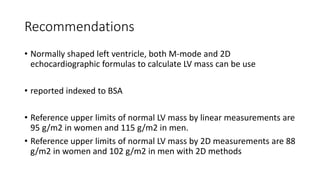
• Normally shaped left ventricle, both M-mode and 2D
echocardiographic formulas to calculate LV mass can be use
• reported indexed to BSA
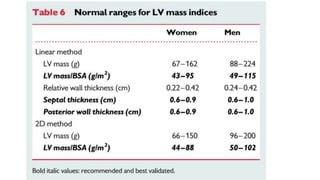
• Reference upper limits of normal LV mass by linear measurements are
95 g/m2 in women and 115 g/m2 in men.
• Reference upper limits of normal LV mass by 2D measurements are 88
g/m2 in women and 102 g/m2 in men with 2D methods

Lv chamber quantifications.2015

  • 1.
    Recommendations for CardiacChamber Quantification by Echocardiography in Adults An Update from the American Society of Echocardiography and the European Association of Cardiovascular Imaging
  • 2.
    CHAMBER QUANTIFICATION • Allmeasurements described in this document should be performed on more than one cardiac cycle to account for inter-beat variability. The committee suggests the average of three beats for patients in normal sinus rhythm and a minimum of five beats in patients with atrial fibrillation
  • 3.
  • 4.
    Measurement of LV Size •Linear Measurements • Volumetric Measure LV Global Systolic Function • Fractional Shortening • Global Longitudinal Strain(GLS) LV Regional Function • Visual Assessment • Quantification of Regional Wall Motion Using Doppler and STE LV Mass
  • 5.
    1. Measurement ofLV Size • most commonly - linear internal dimensions and volumes - end- diastole and end-systole • To allow comparison among individuals with different body sizes, chamber measurements should be reported indexed to BSA
  • 6.
    1.1 Linear Measurement •parasternal long-axis view - perpendicular to the LV long axis and measured at or immediately below the level of the mitral valve leaflet tips • on the interface between the myocardial wall and cavity and the interface between the wall and the pericardium
  • 7.
  • 8.
    M- MODE • Advantages •Reproducible † • High temporal resolution † • Wealth of published data • Limitations • Beam orientation frequently off axis † • Single dimension ,i.e., representative only in normally shaped ventricles LINEAR MEASUREMENTS • Advantages • Facilitates orientation perpendicular to the ventricular long axis • Limitations • Lower frame rates than M-mode † • Single dimension ,i.e., representative only in normally shaped ventricles
  • 9.
    1.2. Volumetric Measurement •LV volumes are measured using 2DE or 3DE. • Volume calculations derived from linear measurements may be inaccurate, because they rely on the assumption of a fixed geometric LV shape • Teichholz and Quinones methods for calculating LV volumes from LV linear dimensions are no longer recommended for clinical use
  • 10.
    • most commonlyused method for 2D echocardiographic volume calculations is the biplane method of disks summation (modified Simpson’s rule) • Measurements are based on tracings of the interface between the compacted myocardium and the LV cavity.
  • 11.
    1.2a. Biplane disksummation • At the mitral valve level, the contour is closed by connecting the two opposite sections of the mitral ring with a straight line • length is defined as the distance between the bisector of this line and the apical point of the LV contour, which is most distant to it. • The use of the longer LV length between the apical two- and four chamber views is recommended
  • 12.
    1.2b. Area-length method •alternative method to calculate LV volumes when apical endocardial definition precludes accurate tracing is the area-length method, in which the LV is assumed to be bullet shaped.
  • 13.
    • The mid-LVcross sectional area is computed by planimetry in the parasternal short-axis view • the length of the ventricle taken from the midpoint of the annular plane to the apex in the apical four-chamber view
  • 14.
    Biplane disk summation •Advantages • Corrects for shape distortions † • Less geometrical assumptions compared with linear dimension • Limitations • Apex frequently fore-shortened † • Endocardial dropout † • Blind to shape distortions not visualized in the apical two- and four-chamber planes Area-length • Advantages • Partial correction for shape distortion † • Limitations • Apex frequently fore-shortened † • Heavily based on geometrical assumptions † • Limited published data on normal population
  • 16.
    3D echo • Oneof the advantages of 3D echocardiographic volume measurements is that they do not rely on geometric assumptions • 3D image acquisition should focus primarily on including the entire left ventricle within the pyramidal dataset • For accurate identification of end-systole, the temporal resolution of 3D imaging should be maximized
  • 17.
    • 3D echocardiographicLV volumes were investigated in one study, which reported that LV volumes were smaller among Asian Indians than white Europeans, but EF did not differ among ethnic groups • 3D echocardiographic LV volumes were larger than 2D echocardiographic values • Weak to moderate negative correlations were seen between age and LV volumes, while EF did not change significantly with age.
  • 18.
    Recommendation • LV sizeshould be routinely assessed on 2DE by calculating volumes using the biplane method of disks summation technique • 3D measurement and reporting of LV volumes is recommended when feasible • LV size and volume measurements should be reported indexed to BSA.
  • 19.
    General reference –VOLUME MEASUREMENTS 2D ECHO • LV EDVs :: • 74 mL/m2 for men • 61 mL/ m2 for women • LV ESVs:: • 31 mL/m2 for men • 24 mL/m2 for women 3D ECHO • EDVs :: • 79 mL/m2 for men • 71 mL/m2 for women • ESVs :: • 32 mL/m2 for men • 28 mL/m2 for women.
  • 20.
    2. LV GlobalSystolic Function • Defined as difference between the end-diastolic and end-systolic divided by its end-diastolic value. • end-diastole is preferably defined as the first frame after mitral valve closure or the frame in the cardiac cycle in which the respective LV dimension or volume measurement is the largest. • End-systole is best defined as the frame after aortic valve closure or the frame in which the cardiac dimension or volume is smallest.
  • 21.
    • timing ofvalve openings and closures derived from M-mode echocardiography, pulsed-wave (PW) or continuous-wave Doppler may be used for accurate definitions of ventricular time intervals
  • 22.
    2.1 Fractional Shortening •Fractional shortening can be derived from 2D-guided M-mode imaging or preferably from linear measurements obtained from 2D images.
  • 23.
    2.2. EF [ejectionfraction] • EF=(EDV−ESV)/EDV • 3DE-basedEFmeasurementsareaccurateandreproducible and should be used when available and feasible • 3DE - based EF measurements are accurate and reproducible and should be used when available and feasible
  • 24.
    2.3. Global LongitudinalStrain (GLS) • The most commonly used strain-based measure of LV global systolic function is GLS. It is usually assessed by speckle-tracking echocardiography (STE) • defined as the change in length of an object within a certain direction relative to its baseline length: • Strain (%)=( Lt −L0)/L0, • where Lt is the length at time t, and L0 is the initial length at time 0.
  • 25.
    • On 2DE,peak GLS describes the relative length change of the LV myocardium between end-diastole and end-systole: GLS(%)=(MLs−MLd)/MLd • ML Is myocardial length at end-systole(MLs) and end-diastole (MLd) • Because MLs is smaller than MLd, peak GLS is a negative number
  • 26.
    • Three standardapical views are taken and averaged • Measurements should begin with the apical long-axis view to visualize aortic valve closure, using opening and closing clicks of the aortic valve or aortic valve opening and closing on M-mode imaging
  • 27.
    • When regionaltracking is suboptimal in more than two myocardial segments in a single view, the calculation of GLS should be avoided • So, alternative indices may be used to gain insight into longitudinal LV function, such as mitral annular plane systolic excursion or pulsed Doppler tissue imaging (DTI)-derived mitral annular peak systolic velocity
  • 28.
    Normal Reference Values •EF is not significantly related to gender, age, or body size, as measured by BSA • Normal EF - 63+5% using the biplane method of disks • In >20 years, EF in the range of 53% to 73% should be classified • a peak GLS in the range of -20% can be expected in a healthy person
  • 31.
    Recommendations • LV systolicfunction should be routinely assessed using 2DE or 3DE by calculating EF from EDV and ESV • LV EFs of, 52% for men and 54% for women are suggestive of abnormal LV systolic function • 2D - STE-derived GLS appears to be reproducible and feasible for clinical use and offers incremental prognostic data over LV EF in a variety of cardiac conditions, although measurements vary among vendors and software versions STE, Speckle-tracking echocardiography
  • 32.
    3. LV RegionalFunction 3.1. Segmentation of the Left Ventricle • a 17-segment model is commonly used • to assess wall motion or regional strain, the 17th segment (the apical cap) should not be included • Beginning at the anterior junction of the interventricular septum and the RV freewal and continuing counter clockwise • basal and midventricular segments should be labeled as anteroseptal, inferoseptal, inferior, inferolateral, anterolateral, and anterior
  • 35.
  • 37.
    Visual Assessment • observedwall thickening and endocardial motion of the myocardial segment • each segment be analyzed individually in multiple views. • A semiquantitative wall motion score can be assigned to each segment to calculate the LV wall motion score index
  • 38.
    • The followingscoring system is recommended: • (1) normal or hyperkinetic, • (2) hypokinetic (reduced thickening), • (3) akinetic (absent or negligible thickening, e.g., scar),and • (4)dyskinetic (systolic thinning or stretching, e.g., aneurysm). • Aneurysm is a morphologic entity that demonstrates focal dilatation and thinning (remodeling) with either akinetic or dyskinetic systolic deformation • refrains from assigning a separate wall motion score for aneurysm
  • 41.
    Regional Abnormalities inthe Absence of Coronary Artery • myocarditis, • sarcoidosis, • stress-induced (takotsubo) cardiomyopathy • postoperatively • in the presence of a left bundle branch block • epicardial pacing, • RV dysfunction caused by RV pressure or volume overload. • conduction delays This regional dysfunction is due to the abnormal sequence of myocardial activation
  • 42.
    LV Mass • Astrong predictor of , cardiovascular events • M-mode echocardiography, 2DE, and 3DE • All measurements should be performed at the end of diastole (the frame before mitral valve closure or the frame in the cardiac cycle in which the ventricular dimension or volume is largest).
  • 43.
    • Linear method:: •Cube formula • LV mass=0.8·1.04·[(IVS+LVID+PWT)3 −LVID3]+0.6g • Where IVS is interventricular septum; • LVID is LV internal diameter, and PWT is inferolateral wall thickness. • Convert the volume to mass by multiplying the volume of myocardium by the myocardial density (approximately 1.05 g/mL
  • 44.
    M-mode measurements should beobtained from a targeted SAX or a parasternal LAX view. All measurements should be performed at end- diastole.
  • 45.
    • M-mode –quick – simple – accurate • However, caveats need to be mentioned- it is critical that the wall thickness and LV dimensions measured be truly perpendicular to the long axis of the left ventricle. • formula includes a correction for the 20% overestimation that was found during the original validation studies of the M-mode technique
  • 46.
    Linear internal measurementsof the LV should be acquired from the parasternal approach and carefully obtained perpendicular to the LV long axis, and measured at the level of the mitral valve leaflet tips.
  • 47.
    • patients withupper septal hypertrophy, the linear dimension methods, which use basal ventricular measurements, result in over estimation of the true mass, because the thickest region of the interventricular septum is in-corporated in the measurement
  • 48.
  • 50.
    • area-length method,which uses mid-ventricular measurements, underestimates LV mass, because the thickest part of the interventricular septum is not included
  • 51.
    • calculation ofrelative wall thickness (RWT) with the formula :: • (2×posterior wall thickness) / (LV internal diameter at end diastole) permits categorization of an increase in LV mass as either :: concentric (RWT >0.42) or eccentric (RWT≤0.42) hypertrophy and allows the identification of concentric remodeling (normal LV mass with increased RWT)
  • 54.
    Recommendations • Normally shapedleft ventricle, both M-mode and 2D echocardiographic formulas to calculate LV mass can be use • reported indexed to BSA • Reference upper limits of normal LV mass by linear measurements are 95 g/m2 in women and 115 g/m2 in men. • Reference upper limits of normal LV mass by 2D measurements are 88 g/m2 in women and 102 g/m2 in men with 2D methods