TYPES OF REACTION Neutralisation or Acid-Base Precipitation Redox Suitable for Upper Secondary Students Author: Toh Chui Hoon
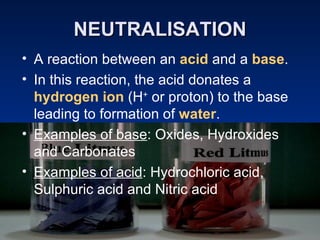
NEUTRALISATION A reaction between an  acid  and a  base . In this reaction, the acid donates a  hydrogen ion  (H +  or proton) to the base leading to formation of  water . Examples of base : Oxides, Hydroxides and Carbonates Examples of acid : Hydrochloric acid, Sulphuric acid and Nitric acid
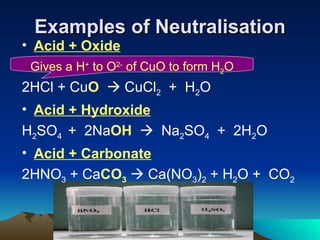
Examples of Neutralisation Acid + Oxide 2HCl + Cu O     CuCl 2   +  H 2 O Acid + Hydroxide H 2 SO 4  +  2Na OH      Na 2 SO 4   +  2H 2 O Acid + Carbonate 2HNO 3  + Ca CO 3     Ca(NO 3 ) 2  + H 2 O +  CO 2 Gives a H +  to O 2-  of CuO to form H 2 O
QUIZ Which of the following basic ions can be identified using products from acid-base reaction? A : OH -   B : O 2-   C : CO 3 2-   D : Cl - ANSWER :  Yes, it is C .  When acid is added to carbonates,  bubbling or effervescence  can be seen due to production of CO 2  gas which will turn limewater, Ca(OH) 2 , cloudy. This is caused by production of CaCO 3  as a result of acid-base reaction between aqueous CO 2  and Ca(OH) 2 . Ca(OH) 2  + CO 2      CaCO 3   +  H 2 O Hint: There must visible change in the reaction.
PRECIPITATION This reaction involves 2  water-soluble compounds  leading to formation of a  water-insoluble compound .  Examples of water-soluble compounds : all Nitrates, most Sulphates except BaSO 4  and PbSO 4 , most Chlorides except AgCl and PbCl 2 . Examples of water-insoluble compounds :  Oxides, Hydroxides and Carbonates except those of Na + , K +  and NH 4 + .
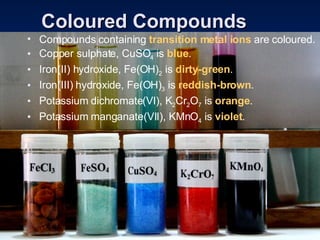
Coloured Compounds Compounds containing  transition metal ions  are coloured. Copper sulphate, CuSO 4  is  blue . Iron(II) hydroxide, Fe(OH) 2  is  dirty-green . Iron(III) hydroxide, Fe(OH) 3  is  reddish-brown . Potassium dichromate(VI), K 2 Cr 2 O 7  is  orange . Potassium manganate(VII), KMnO 4  is  violet .
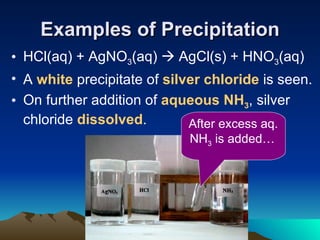
Examples of Precipitation HCl(aq) + AgNO 3 (aq)    AgCl(s) + HNO 3 (aq) A  white   precipitate of  silver chloride  is seen. On further addition of  aqueous NH 3 , silver chloride  dissolved . After excess aq. NH 3  is added…
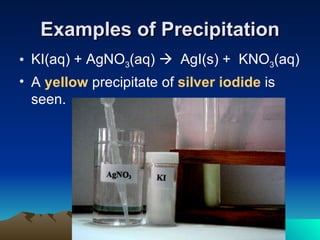
Examples of Precipitation KI(aq) + AgNO 3 (aq)     AgI(s) +  KNO 3 (aq) A  yellow  precipitate of  silver iodide  is seen.
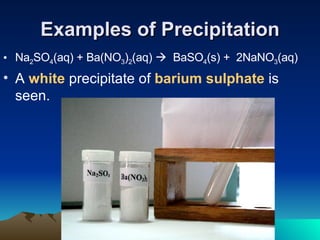
Examples of Precipitation Na 2 SO 4 (aq) + Ba(NO 3 ) 2 (aq)     BaSO 4 (s) +  2NaNO 3 (aq) A  white  precipitate of  barium sulphate  is seen.
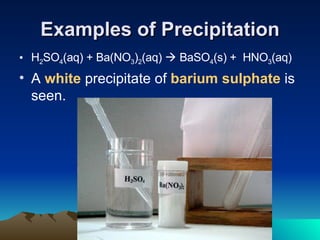
Examples of Precipitation H 2 SO 4 (aq) + Ba(NO 3 ) 2 (aq)    BaSO 4 (s) +  HNO 3 (aq) A  white  precipitate of  barium sulphate  is seen.

Types Of Reaction 1

  • 1.
    TYPES OF REACTIONNeutralisation or Acid-Base Precipitation Redox Suitable for Upper Secondary Students Author: Toh Chui Hoon
  • 2.
    NEUTRALISATION A reactionbetween an acid and a base . In this reaction, the acid donates a hydrogen ion (H + or proton) to the base leading to formation of water . Examples of base : Oxides, Hydroxides and Carbonates Examples of acid : Hydrochloric acid, Sulphuric acid and Nitric acid
  • 3.
    Examples of NeutralisationAcid + Oxide 2HCl + Cu O  CuCl 2 + H 2 O Acid + Hydroxide H 2 SO 4 + 2Na OH  Na 2 SO 4 + 2H 2 O Acid + Carbonate 2HNO 3 + Ca CO 3  Ca(NO 3 ) 2 + H 2 O + CO 2 Gives a H + to O 2- of CuO to form H 2 O
  • 4.
    QUIZ Which ofthe following basic ions can be identified using products from acid-base reaction? A : OH - B : O 2- C : CO 3 2- D : Cl - ANSWER : Yes, it is C . When acid is added to carbonates, bubbling or effervescence can be seen due to production of CO 2 gas which will turn limewater, Ca(OH) 2 , cloudy. This is caused by production of CaCO 3 as a result of acid-base reaction between aqueous CO 2 and Ca(OH) 2 . Ca(OH) 2 + CO 2  CaCO 3 + H 2 O Hint: There must visible change in the reaction.
  • 5.
    PRECIPITATION This reactioninvolves 2 water-soluble compounds leading to formation of a water-insoluble compound . Examples of water-soluble compounds : all Nitrates, most Sulphates except BaSO 4 and PbSO 4 , most Chlorides except AgCl and PbCl 2 . Examples of water-insoluble compounds : Oxides, Hydroxides and Carbonates except those of Na + , K + and NH 4 + .
  • 6.
    Coloured Compounds Compoundscontaining transition metal ions are coloured. Copper sulphate, CuSO 4 is blue . Iron(II) hydroxide, Fe(OH) 2 is dirty-green . Iron(III) hydroxide, Fe(OH) 3 is reddish-brown . Potassium dichromate(VI), K 2 Cr 2 O 7 is orange . Potassium manganate(VII), KMnO 4 is violet .
  • 7.
    Examples of PrecipitationHCl(aq) + AgNO 3 (aq)  AgCl(s) + HNO 3 (aq) A white precipitate of silver chloride is seen. On further addition of aqueous NH 3 , silver chloride dissolved . After excess aq. NH 3 is added…
  • 8.
    Examples of PrecipitationKI(aq) + AgNO 3 (aq)  AgI(s) + KNO 3 (aq) A yellow precipitate of silver iodide is seen.
  • 9.
    Examples of PrecipitationNa 2 SO 4 (aq) + Ba(NO 3 ) 2 (aq)  BaSO 4 (s) + 2NaNO 3 (aq) A white precipitate of barium sulphate is seen.
  • 10.
    Examples of PrecipitationH 2 SO 4 (aq) + Ba(NO 3 ) 2 (aq)  BaSO 4 (s) + HNO 3 (aq) A white precipitate of barium sulphate is seen.