

Public Speaking Session I Speech; Fears  & Anxieties
Introduction Speeches are given to  inform the audience,  persuade the audience, Share thoughts,  or to integrate the members of an audience. Effective public speaking is INFLUENCE. INFLUENCE IS LEADERSHIP!! And for a MBA????
So do we agree that learning Public Speaking skills is very important?
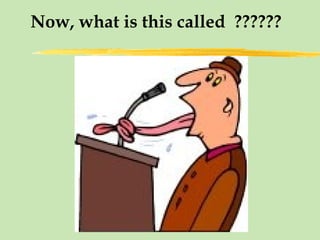
Now, what is this called  ??????
Fear of Public Speaking Population  Fear No. 3=Death Fear No.2=Snakes  No.1 fear=Public Speaking
Public Speaking Anxiety: Public Speaking Anxiety (PSA):  The  fear or anxiety associated with actual or anticipated communication as a speaker to an audience. Causes: Lack of Experience Conscious on being the Center of Attention Communication Apprehension.
The Roots of Public Speaking Anxiety : Lack of Experience Anxious anticipation is a natural reaction to new experiences
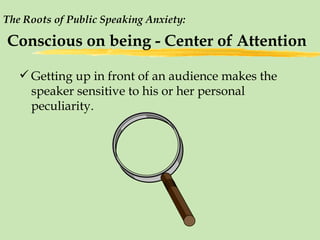
The Roots of Public Speaking Anxiety:  Conscious on being - Center of Attention Getting up in front of an audience makes the speaker sensitive to his or her personal peculiarity.
The Roots of Public Speaking Anxiety : Communication Apprehension General fear or anxiety associated with real or anticipated communication with one or more people. Language-Based Communication Apprehension Audience-Specific Communication Apprehension Situational Communication
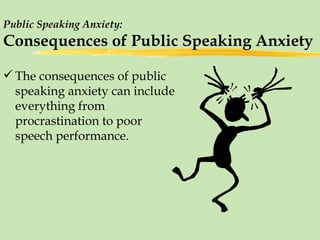
Public Speaking Anxiety: Consequences of Public Speaking Anxiety The consequences of public speaking anxiety can include everything from procrastination to poor speech performance.
But do we want to look like ???
Public Speaking Part II GETTING  STARTED WITH CONFIDENCE
Strategies For Getting Started With Confidence Prepare (Needless to say) Practice Modify Thoughts and Attitudes Visualize Success Use Relaxation Techniques Breathing Natural Gestures  Freedom to walk Depersonalize the Speech Evaluation Seek Pleasure in the Occasion Analyze the Audience
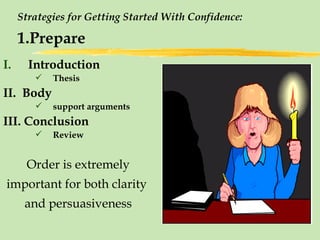
Strategies for Getting Started With Confidence: 1.Prepare Introduction Thesis II.  Body support arguments III. Conclusion Review Order is extremely important for both clarity  and persuasiveness
Strategies for Getting Started With Confidence: 2. Practice Things that need practice: Your Smile Gestures Head and Eyes Sincerity
Strategies for Getting Started With Confidence:   3.Modify Thoughts And Attitudes Regard your speech as a valuable, worthwhile, and challenging activity View public speaking as an opportunity, not a threat.
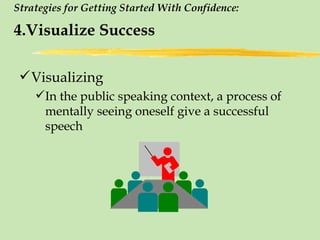
Strategies for Getting Started With Confidence:   4.Visualize Success Visualizing In the public speaking context, a process of mentally seeing oneself give a successful speech
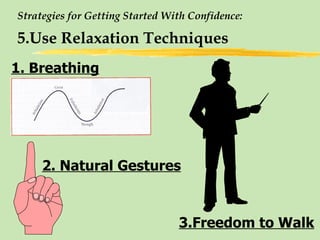
Strategies for Getting Started With Confidence:   5.Use Relaxation Techniques 2. Natural Gestures 1. Breathing 3.Freedom to Walk
Strategies for Getting Started With Confidence:   6.Depersonalize The Speech Evaluation
Strategies for Getting Started With Confidence:   7. Seek Pleasure in the Occasion
8.Analyze the Audience Keep in mind the following 3 questions when analyzing your audience: To whom am I going to speak/address? What do I want them to know, believe, or do as a result of my speech? 3. What is the most effective way of composing or presenting my speech to accomplish my aim?
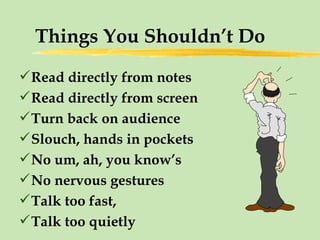
Things You Shouldn’t Do Read directly from notes Read directly from screen Turn back on audience Slouch, hands in pockets No um, ah, you know’s No nervous gestures Talk too fast,  Talk too quietly
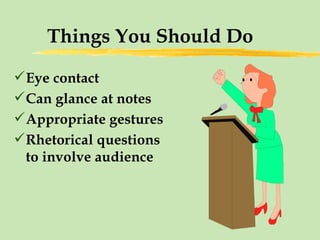
Things You Should Do Eye contact Can glance at notes Appropriate gestures Rhetorical questions to involve audience
Ten Successful Tips Control the “Butterflies” Know the room Know the audience Know your material Relaxation Visualize giving your speech People want you to succeed Don’t apologize Concentrate on your message Gain experience Involve audience
Giving it a Try: DOING A FIRST SPEECH IN CLASS   Select a Topic Analyze the Audience State the Speech Purpose To inform, persuade, entertain, etc. Develop the Main Points Gather Supporting Materials
Voila! You’re ready to go!

Public Speaking

  • 1.
    Public Speaking SessionI Speech; Fears & Anxieties
  • 2.
    Introduction Speeches aregiven to inform the audience, persuade the audience, Share thoughts, or to integrate the members of an audience. Effective public speaking is INFLUENCE. INFLUENCE IS LEADERSHIP!! And for a MBA????
  • 3.
    So do weagree that learning Public Speaking skills is very important?
  • 4.
    Now, what isthis called ??????
  • 5.
    Fear of PublicSpeaking Population Fear No. 3=Death Fear No.2=Snakes No.1 fear=Public Speaking
  • 6.
    Public Speaking Anxiety:Public Speaking Anxiety (PSA): The fear or anxiety associated with actual or anticipated communication as a speaker to an audience. Causes: Lack of Experience Conscious on being the Center of Attention Communication Apprehension.
  • 7.
    The Roots ofPublic Speaking Anxiety : Lack of Experience Anxious anticipation is a natural reaction to new experiences
  • 8.
    The Roots ofPublic Speaking Anxiety: Conscious on being - Center of Attention Getting up in front of an audience makes the speaker sensitive to his or her personal peculiarity.
  • 9.
    The Roots ofPublic Speaking Anxiety : Communication Apprehension General fear or anxiety associated with real or anticipated communication with one or more people. Language-Based Communication Apprehension Audience-Specific Communication Apprehension Situational Communication
  • 10.
    Public Speaking Anxiety:Consequences of Public Speaking Anxiety The consequences of public speaking anxiety can include everything from procrastination to poor speech performance.
  • 11.
    But do wewant to look like ???
  • 12.
    Public Speaking PartII GETTING STARTED WITH CONFIDENCE
  • 13.
    Strategies For GettingStarted With Confidence Prepare (Needless to say) Practice Modify Thoughts and Attitudes Visualize Success Use Relaxation Techniques Breathing Natural Gestures Freedom to walk Depersonalize the Speech Evaluation Seek Pleasure in the Occasion Analyze the Audience
  • 14.
    Strategies for GettingStarted With Confidence: 1.Prepare Introduction Thesis II. Body support arguments III. Conclusion Review Order is extremely important for both clarity and persuasiveness
  • 15.
    Strategies for GettingStarted With Confidence: 2. Practice Things that need practice: Your Smile Gestures Head and Eyes Sincerity
  • 16.
    Strategies for GettingStarted With Confidence: 3.Modify Thoughts And Attitudes Regard your speech as a valuable, worthwhile, and challenging activity View public speaking as an opportunity, not a threat.
  • 17.
    Strategies for GettingStarted With Confidence: 4.Visualize Success Visualizing In the public speaking context, a process of mentally seeing oneself give a successful speech
  • 18.
    Strategies for GettingStarted With Confidence: 5.Use Relaxation Techniques 2. Natural Gestures 1. Breathing 3.Freedom to Walk
  • 19.
    Strategies for GettingStarted With Confidence: 6.Depersonalize The Speech Evaluation
  • 20.
    Strategies for GettingStarted With Confidence: 7. Seek Pleasure in the Occasion
  • 21.
    8.Analyze the AudienceKeep in mind the following 3 questions when analyzing your audience: To whom am I going to speak/address? What do I want them to know, believe, or do as a result of my speech? 3. What is the most effective way of composing or presenting my speech to accomplish my aim?
  • 22.
    Things You Shouldn’tDo Read directly from notes Read directly from screen Turn back on audience Slouch, hands in pockets No um, ah, you know’s No nervous gestures Talk too fast, Talk too quietly
  • 23.
    Things You ShouldDo Eye contact Can glance at notes Appropriate gestures Rhetorical questions to involve audience
  • 24.
    Ten Successful TipsControl the “Butterflies” Know the room Know the audience Know your material Relaxation Visualize giving your speech People want you to succeed Don’t apologize Concentrate on your message Gain experience Involve audience
  • 25.
    Giving it aTry: DOING A FIRST SPEECH IN CLASS Select a Topic Analyze the Audience State the Speech Purpose To inform, persuade, entertain, etc. Develop the Main Points Gather Supporting Materials
  • 26.