Identify myths about communication Describe the sender-receiver model Describe effective feedback Summarize barriers to effective communication
Difference between speaking and public speaking Describe common barriers to listening Describe the importance of non verbal communication Understand  Kinesics  Understand public speaking
Did you experience discomfort in silence? Has anyone ever said things without really saying them? Have you ever heard the sound of silence?
... yet we talk all the time. Importance of speech is noted when we experience silence. Silence can be very confusing to us and sometimes even intimidating. Talking , however, seems easier.   But..talking is different from speaking
We are all here because we are speakers and not just talkers. We, perhaps understand the value of speech and the fact that 5 minutes is a long time when you are making a speech. The same 5 minutes pass so quickly when you are chatting with a friend. All of us here understand this .
Organize your thoughts  - Giving someone directions to your house   Tailor your message to the audience Your 5 year old asks you where babies come from Your 14 year old asks you where babies come from Your 22 year old asks the same question Telling a story for maximum impact- Don’t tell the “punch line” of a story first Adapting to listener feedback - Watch for non-verbal feedback – looks of confusion, looks of pain or hurtfulness  
  PS is more structured   Usually time limited Questions not allowed to  interrupt the speech,  usually left for at end (time permitting) PS requires more formal language No slang, jargon or bad grammar Speeches should be something special so that they qualify as life events and are remembered  PS requires a different method for delivery More formal delivery-  No vocalized pauses – “uh”, “ah”, “um” Don’t use stock phrases repeatedly – “you know”, “basically”, “I mean”  
Speaker  - speech communication starts here Message  - whatever is communicated Channel  – means by which a message is communicated Listener  – the receiver of the communicated message Feedback  – comes in many forms and must be understood Interference  - anything impeding the communication of the message Situation  – the time and place of occurrence
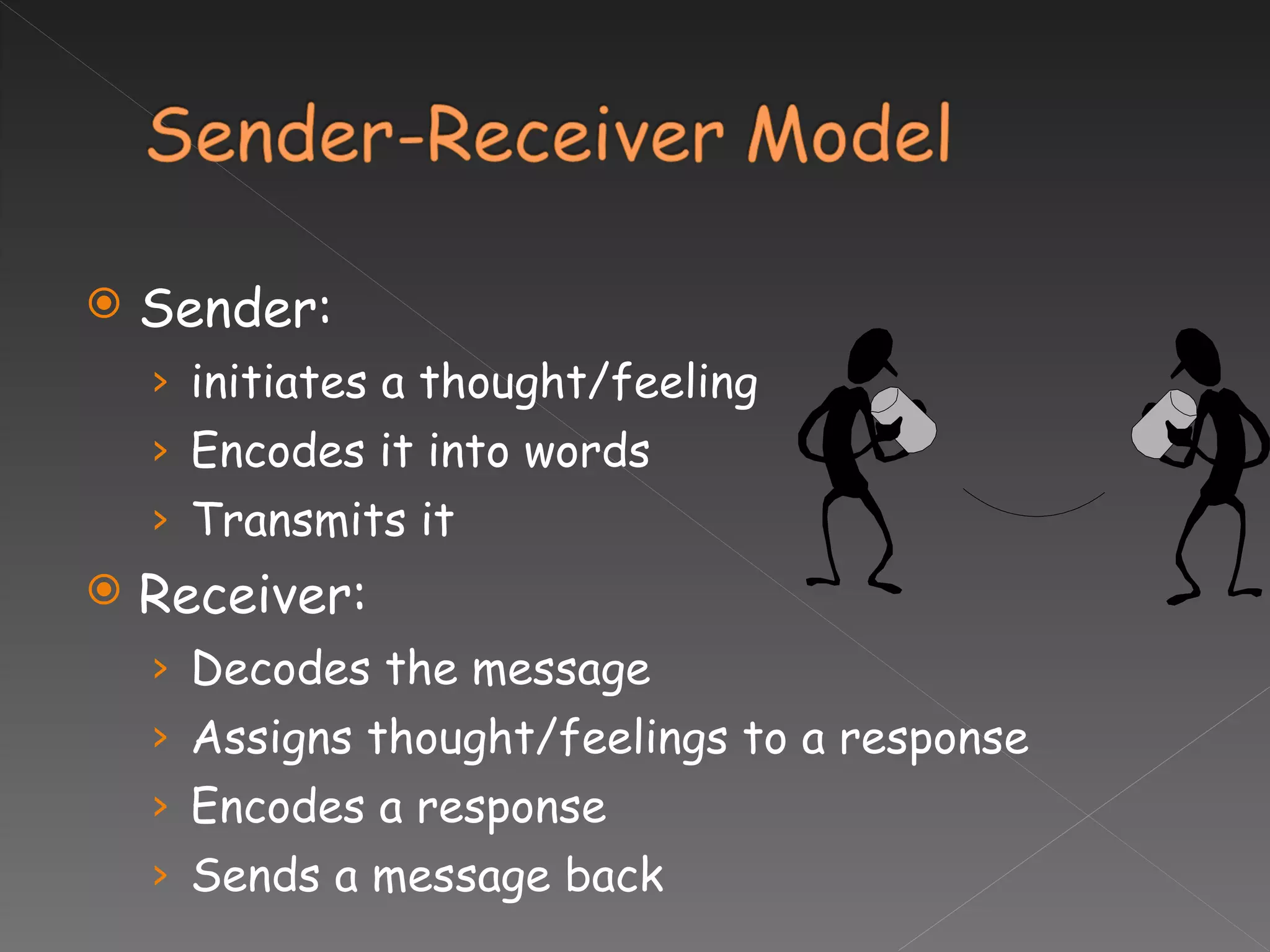
Sender:  initiates a thought/feeling Encodes it into words Transmits it Receiver: Decodes the message Assigns thought/feelings to a response Encodes a response Sends a message back
We only communicate when we want to communicate Words mean the same to both the speaker and the listener We communicate chiefly with words Nonverbal communication is silent communication Communication is a one way street The message we communicate is the message that the listener receives
Misinterpretation Evaluation of sender Projection Stereotyping Arrogance and superiority Defensiveness Inarticulateness Hidden agendas Status Environment Emotions Differences in backgrounds Poor timing Personality conflicts
There are four types of listening: Appreciative Listening for pleasure or enjoyment Music, movies, comedy, plays… Empathetic Listening to provide emotional support for speaker shrink listens to a patient; you listen to a friend’s rant  Comprehensive Listening to understand the speakers message Direction to a friend’s house; in a class or seminar Critical Listening to evaluate a message A campaign speech; a peer’s research paper Critical Thinking Comprehensive and Critical Thinking require you to think and evaluate while listening, this helps develop Critical Thinking ski lls
 
Fraudulent   – pseudo listeners (nodders) Monopolistic –  always want to be listened to, but never want to listen Completers  – fill in missed gaps with manufactured information Selective  – zero in only on parts that interest them Avoiders  – close their ears to information they’d rather not deal with Defensive  – assume others are criticizing Attackers  – wait for you to make a mistake
Not Concentrating Daydreaming, mind wandering, dozing Listening Too Hard Trying to remember every fact, no matter how minute Jumping To Conclusions Putting words into the speakers mouth; interrupting speaker, anticipating what speaker will say/do next Focusing On Delivery Instead Of Message Speakers  accent, clothes, stuttering, presentation tools
Take Listening Seriously Like any skill it takes practice and self-discipline Resist Distractions When you catch your mind wandering make a conscious effort to pull it back on track Don’t be Diverted by Appearance or Delivery Lincoln and Gandhi were strange in appearance but  Were excellent speakers Suspend Judgment
A passage will be read out. You have to listen to it.
It’s up to the speaker to make the audience choose to pay attention. Every speech contains two messages: One from the speaker One received by the listener “ People hear what they want to hear and disregard the rest.”  People are egocentric Egocentrism – the tendency for people to be most interested in themselves, their own problems and the way to solve them. They pay closest attention to what affects their own values, beliefs and well being.
Through the speech communication process we understand that communication begins the moment the speech starts. However, we have also experienced that many times we communicate best without speaking. In order to illustrate this let us participate in another activity. Charades.
Group members will participate in a game of charades. Remember that you must convey meaning without using  words. 7 dyads will be made. After the group finishes,  note specific examples of the various types of non-verbal communication.
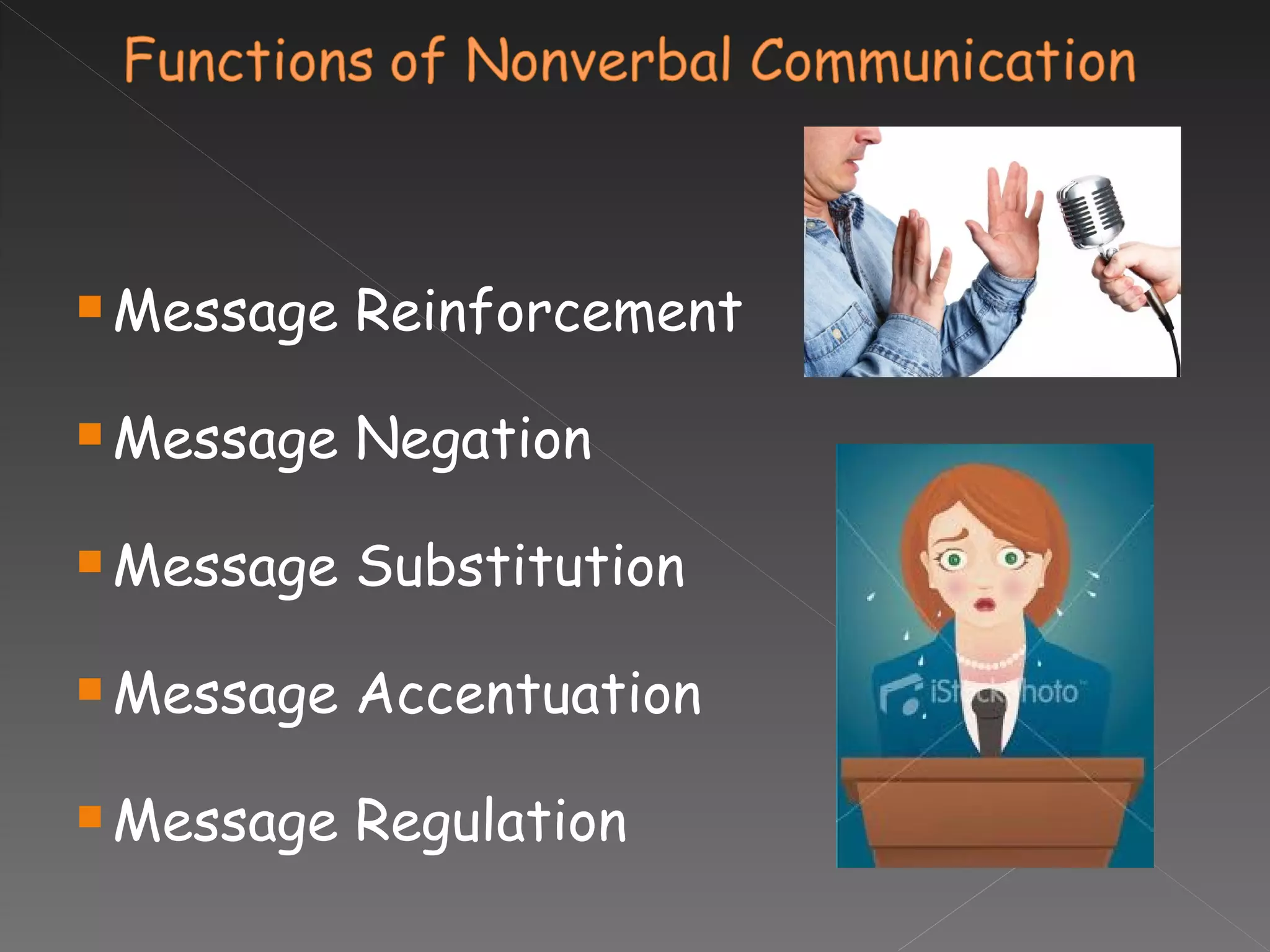
Message Reinforcement Message Negation Message Substitution Message Accentuation Message Regulation
Nonverbal Communication–  all elements of communication that do not involve words Four basic types Proxemics  –  an individual’s perception and use of space Kinesics  –  study of body movements, including posture Facial and Eye Behavior  –  movements that add cues for the receiver Paralanguage  –  variations in speech, such as pitch, loudness, tempo, tone, duration, laughing, and crying
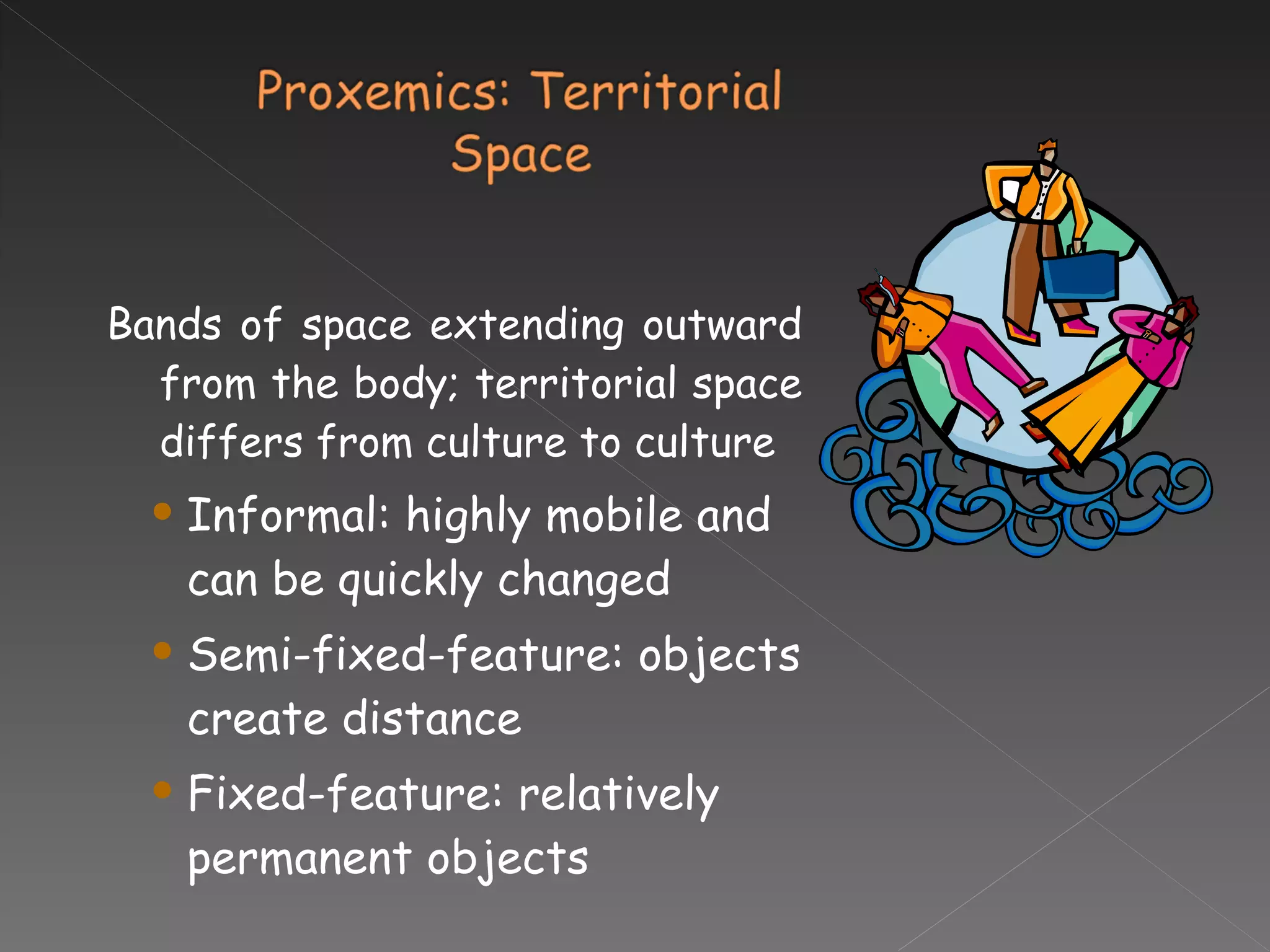
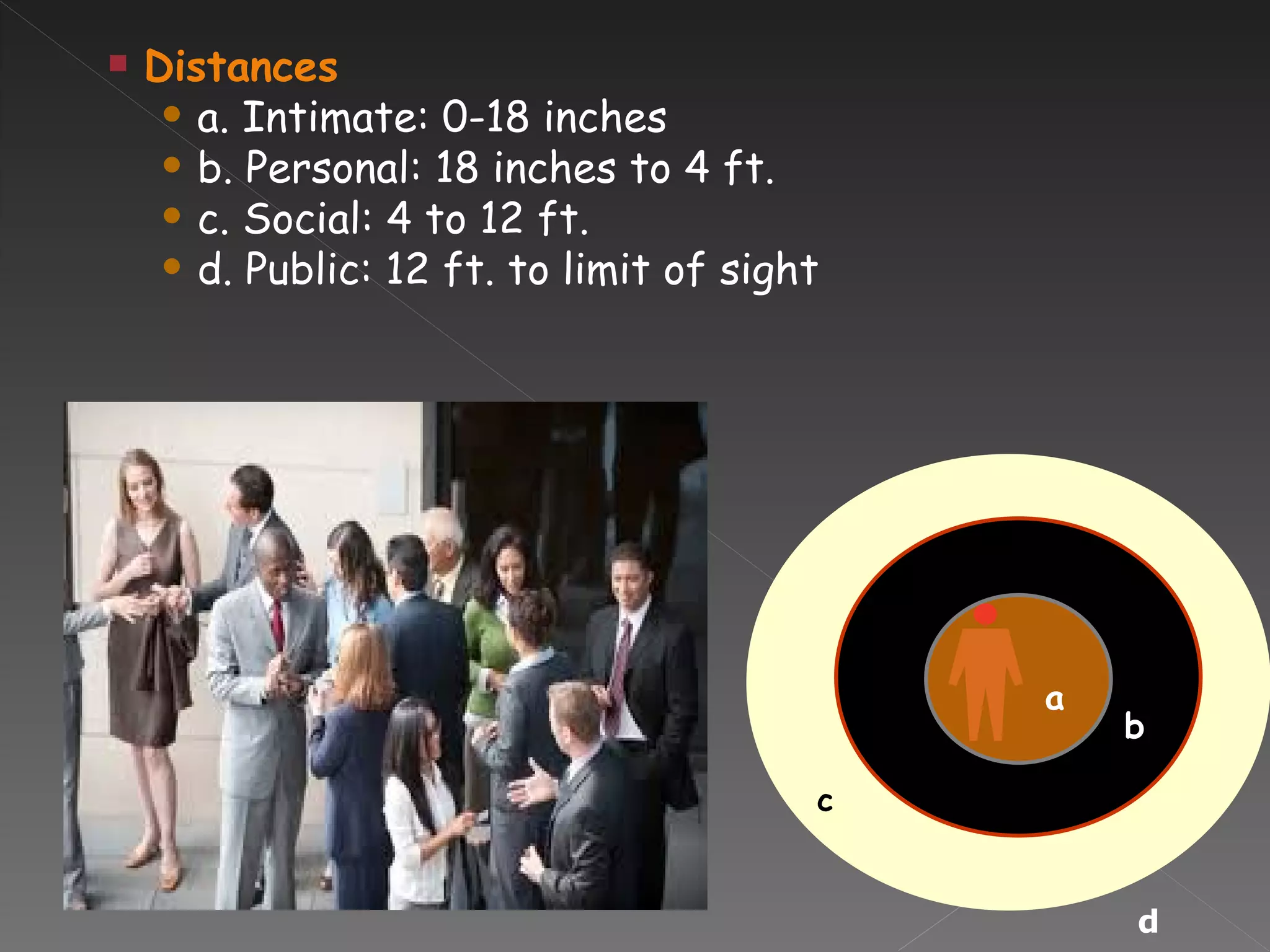
Bands of space extending outward from the body; territorial space differs from culture to culture Informal: highly mobile and can be quickly changed Semi-fixed-feature: objects create distance Fixed-feature: relatively permanent objects
d Distances a. Intimate: 0-18 inches b. Personal: 18 inches to 4 ft. c. Social: 4 to 12 ft. d. Public: 12 ft. to limit of sight c c b a
Kinesics involves the study of bodily movement. Ekman and Friesen (1 969) developed a classification system identifying five types of body movements which have communication functions.
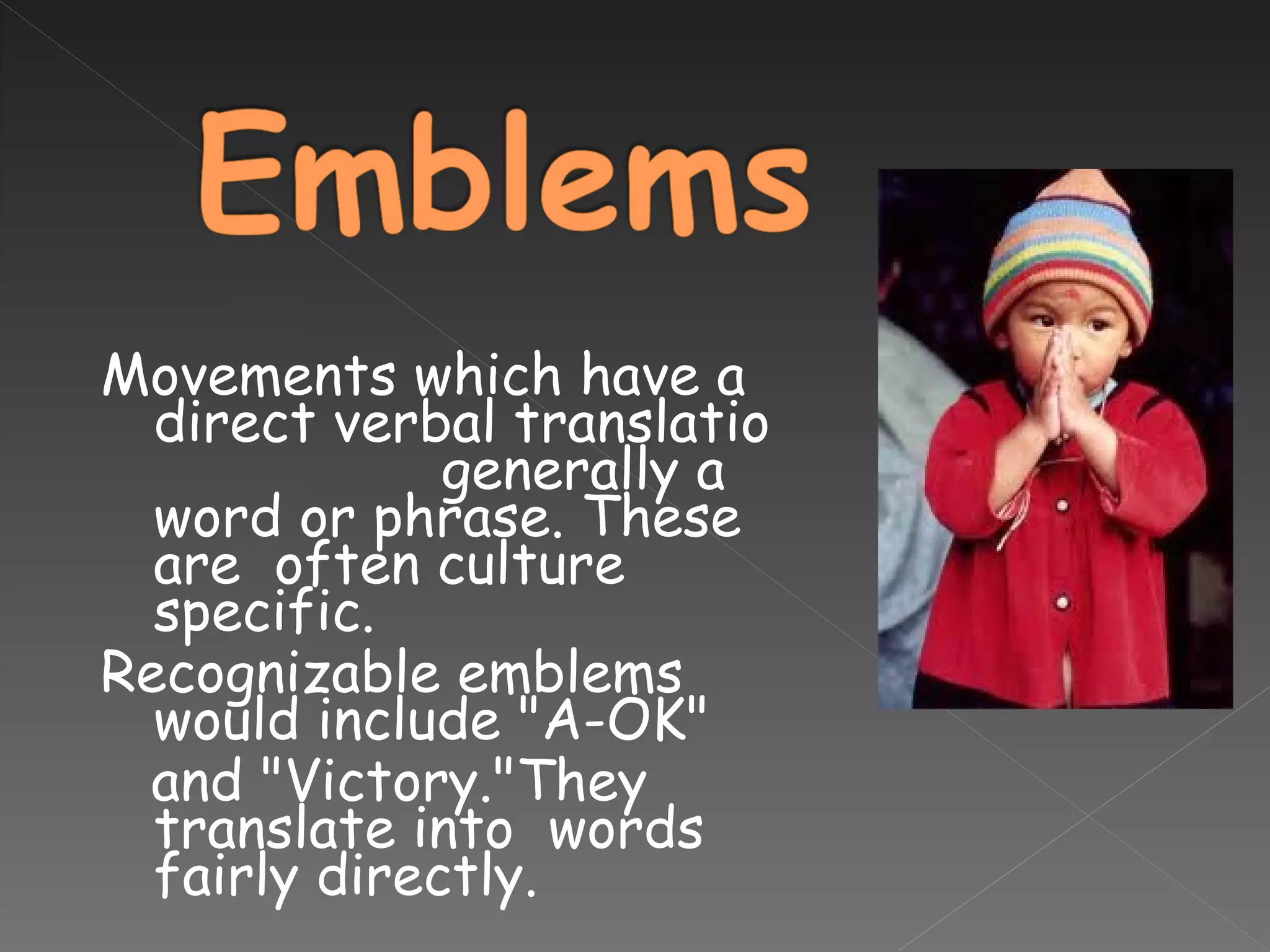
Movements which have a direct verbal translatio  generally a word or phrase. These are  often culture specific.  Recognizable emblems would include "A-OK"  and "Victory."They translate into  words fairly directly.
Nonverbal cues directly linked with words. They  reinforce verbal communication and  allow us to accent or emphasize words or ideas.  We also use illustrators to help describe something, as  in "It was this wide."They  mostly, accompany and illustrate the verbal message
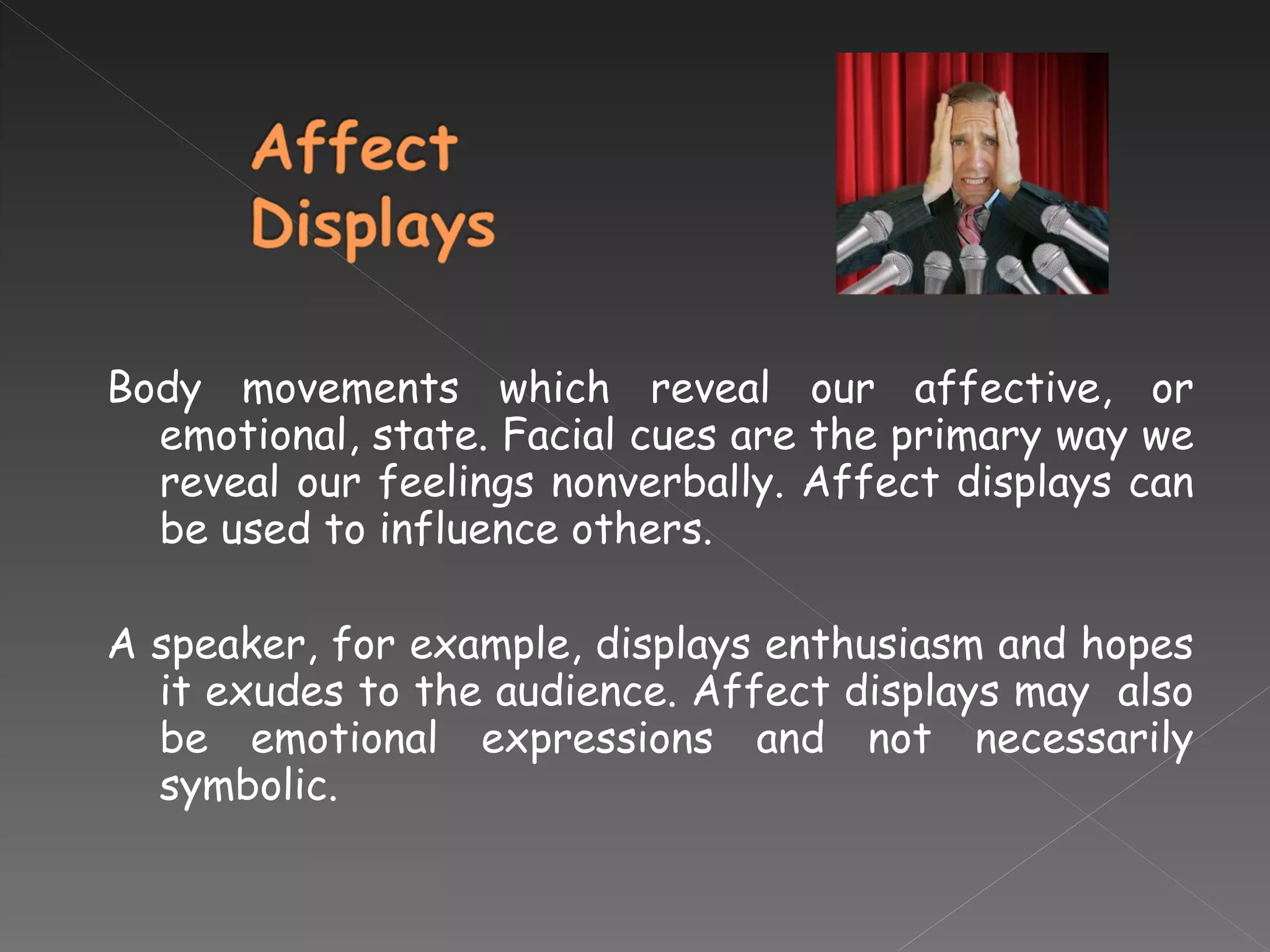
Body movements which reveal our affective, or emotional, state. Facial cues are the primary way we reveal our feelings nonverbally. Affect displays can be used to influence others.  A speaker, for example, displays enthusiasm and hopes it exudes to the audience. Affect displays may  also be emotional expressions and not necessarily symbolic.
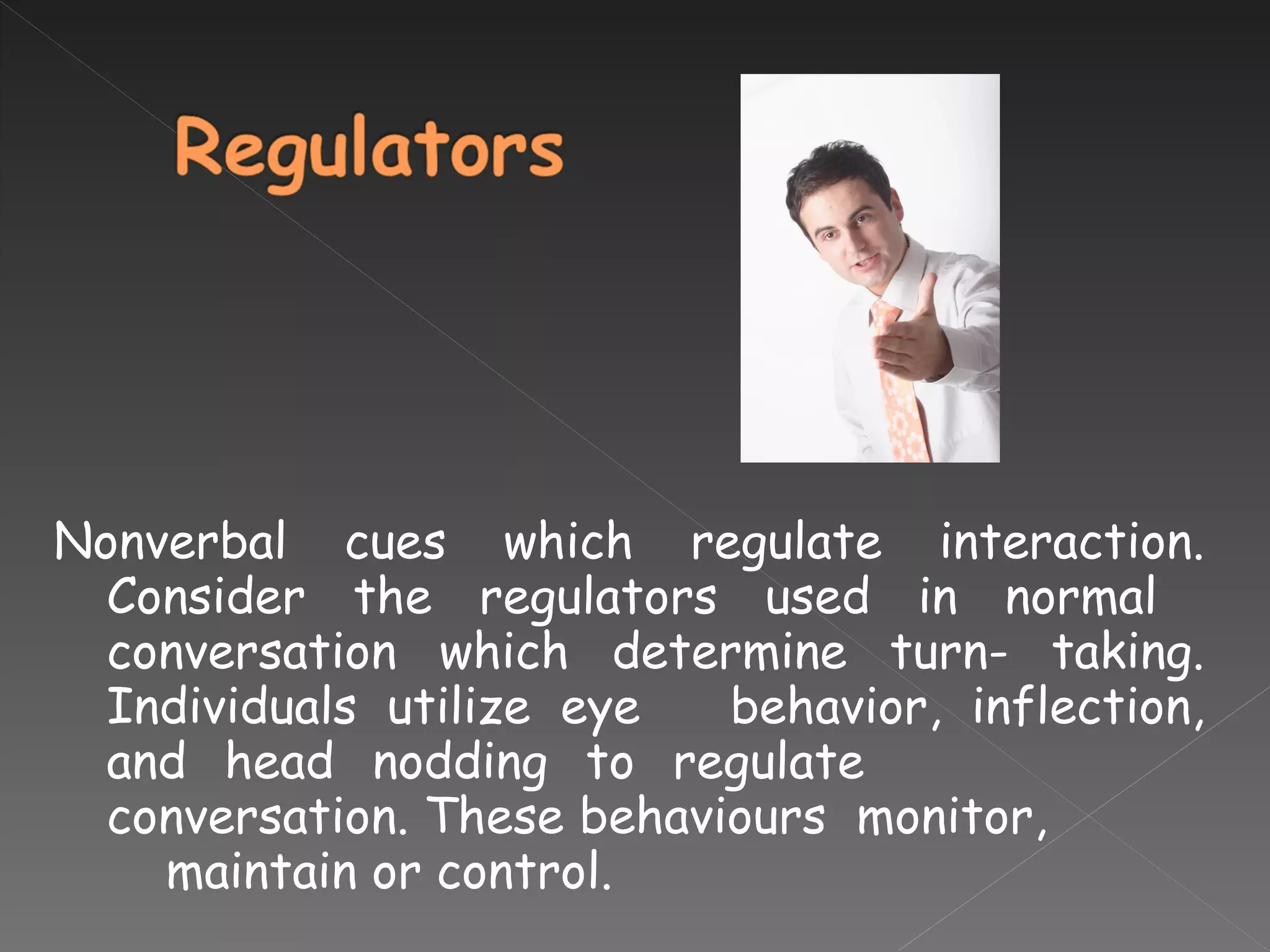
Nonverbal cues which regulate interaction. Consider the regulators used in normal  conversation which determine turn- taking. Individuals utilize eye  behavior, inflection, and head nodding to regulate  conversation. These behaviours  monitor,    maintain or control.
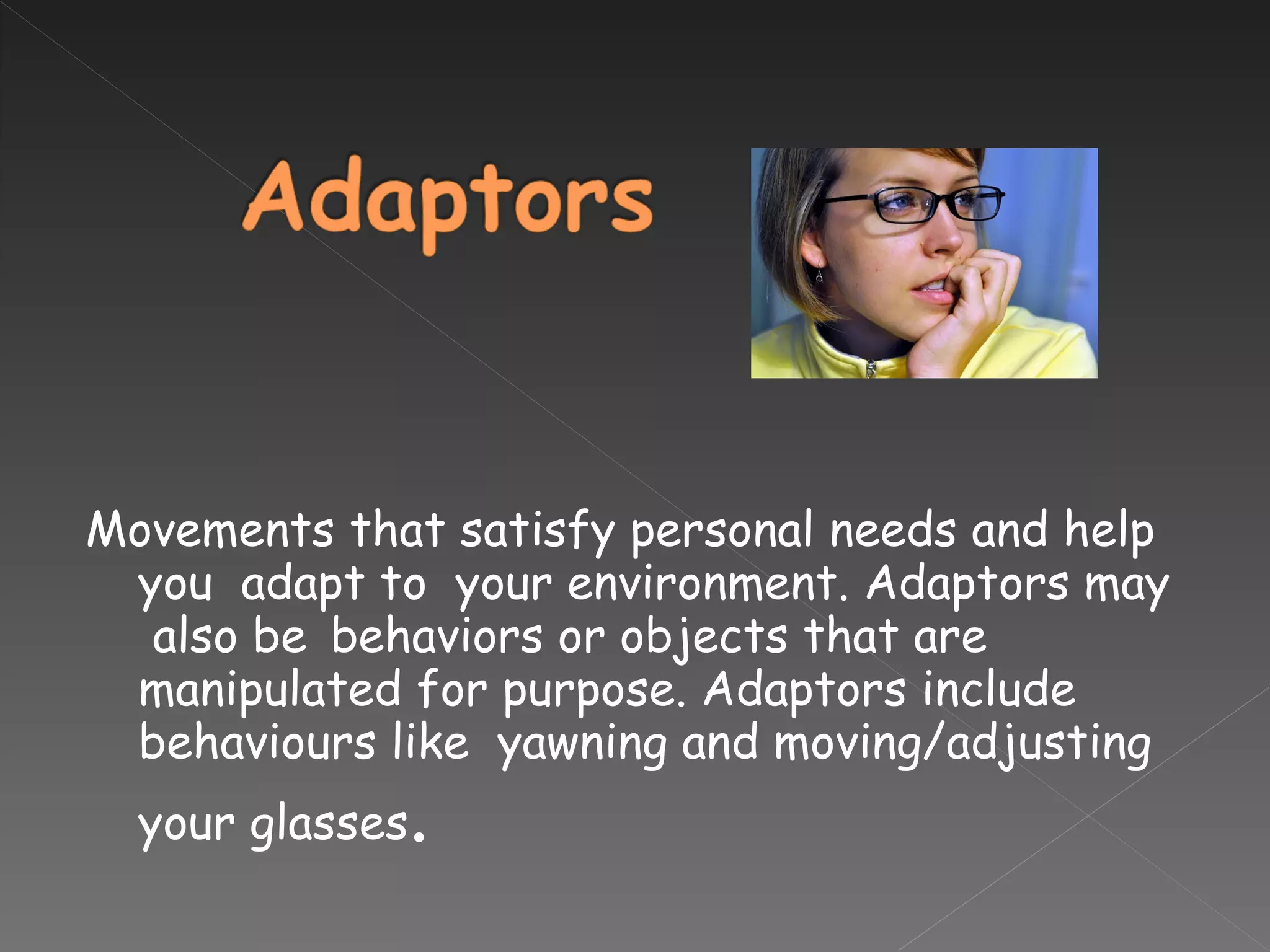
Movements that satisfy personal needs and help you  adapt to  your environment. Adaptors may  also be  behaviors or objects that are manipulated for purpose. Adaptors include behaviours like  yawning and moving/adjusting your glasses .
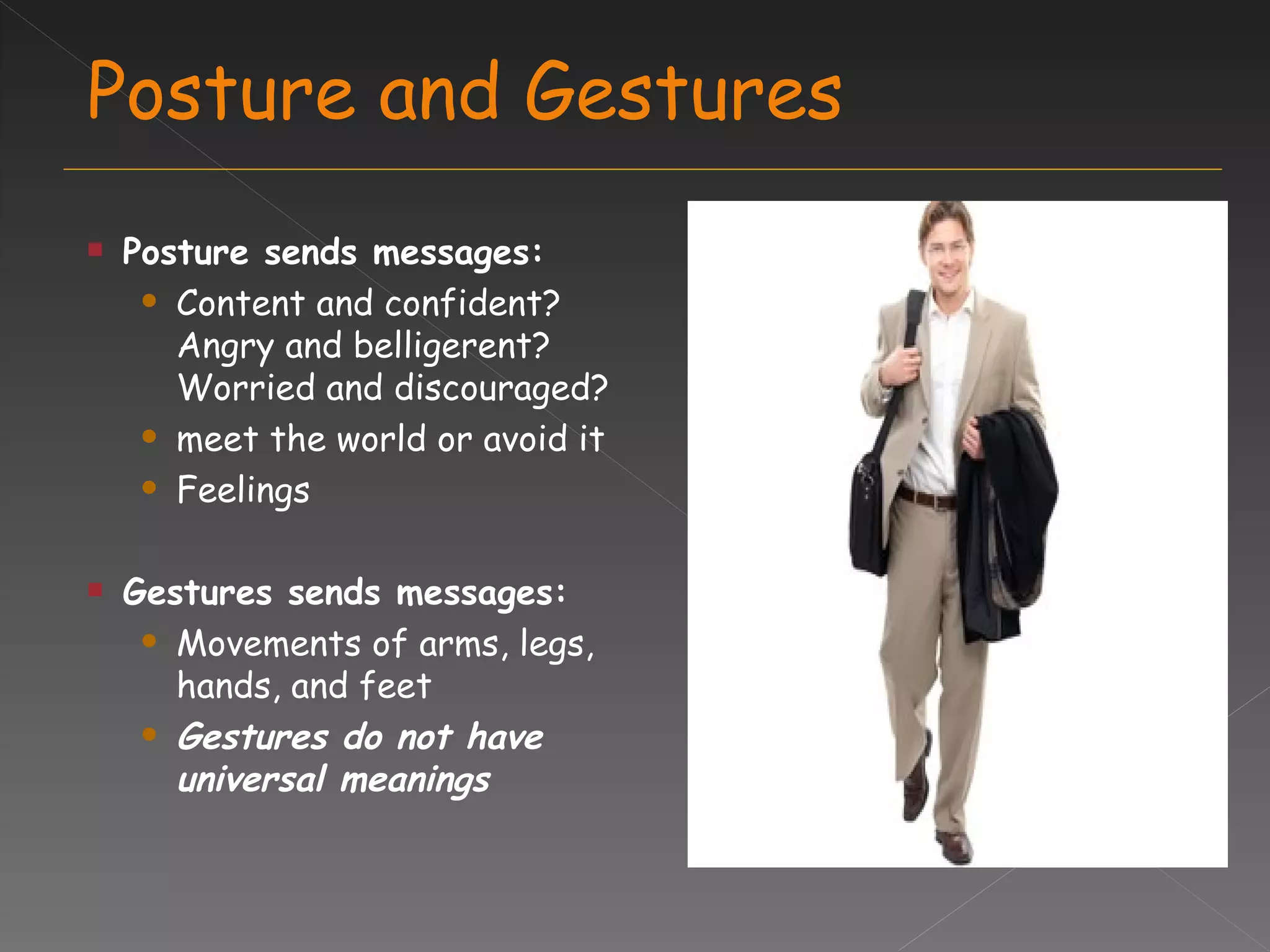
Posture and Gestures Posture sends messages: Content and confident?  Angry and belligerent? Worried and discouraged? meet the world or avoid it Feelings Gestures sends messages: Movements of arms, legs, hands, and feet  Gestures do not have universal meanings
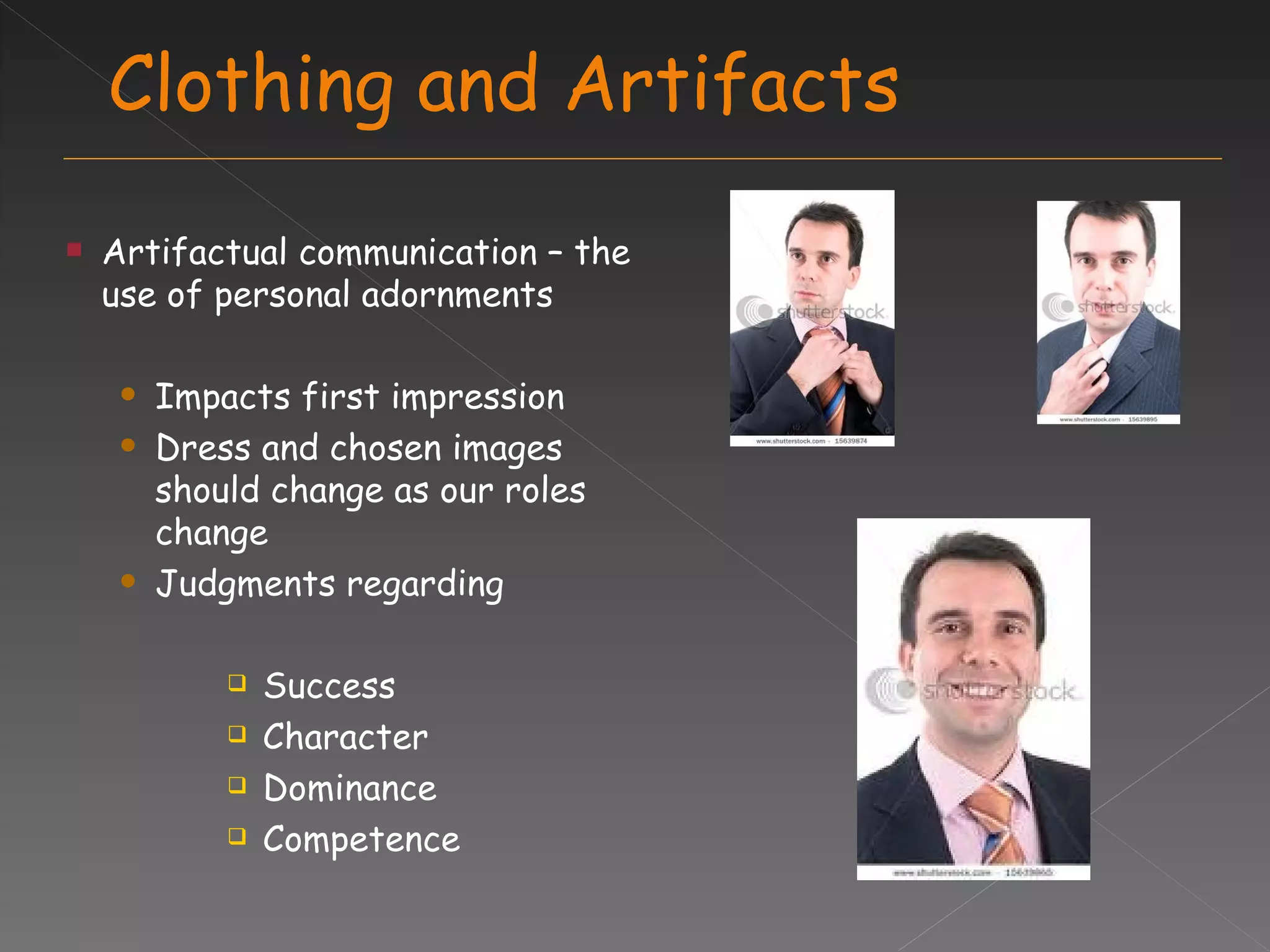
Clothing and Artifacts Artifactual communication – the use of personal adornments  Impacts first impression Dress and chosen images should change as our roles change Judgments regarding  Success Character Dominance Competence
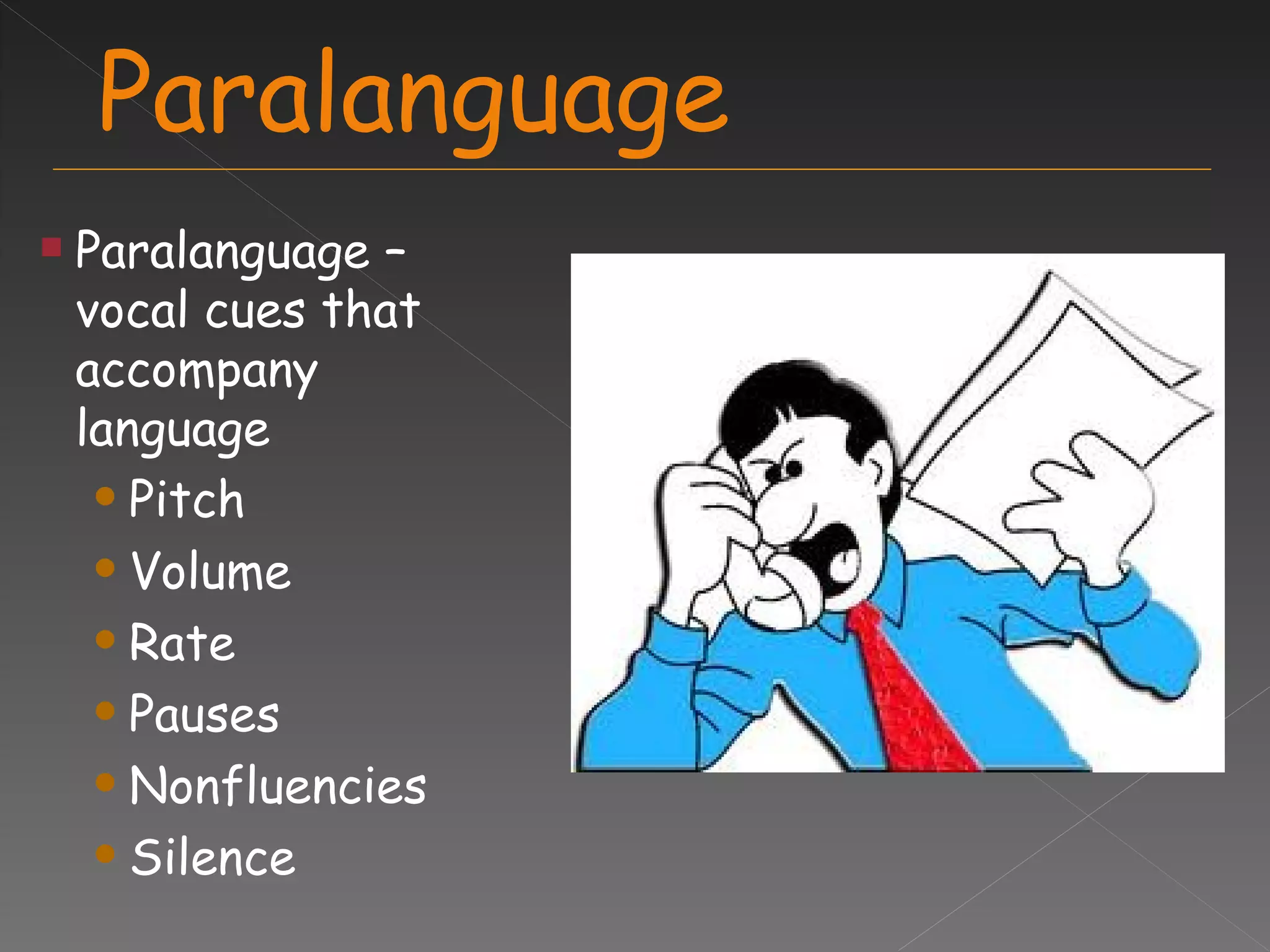
Paralanguage Paralanguage – vocal cues that accompany language Pitch Volume Rate Pauses Nonfluencies Silence
Colours Colour affects us emotionally and physiologically Can trigger: Excitement Warmth Passion and sensuality Happiness Relaxation Persuasion
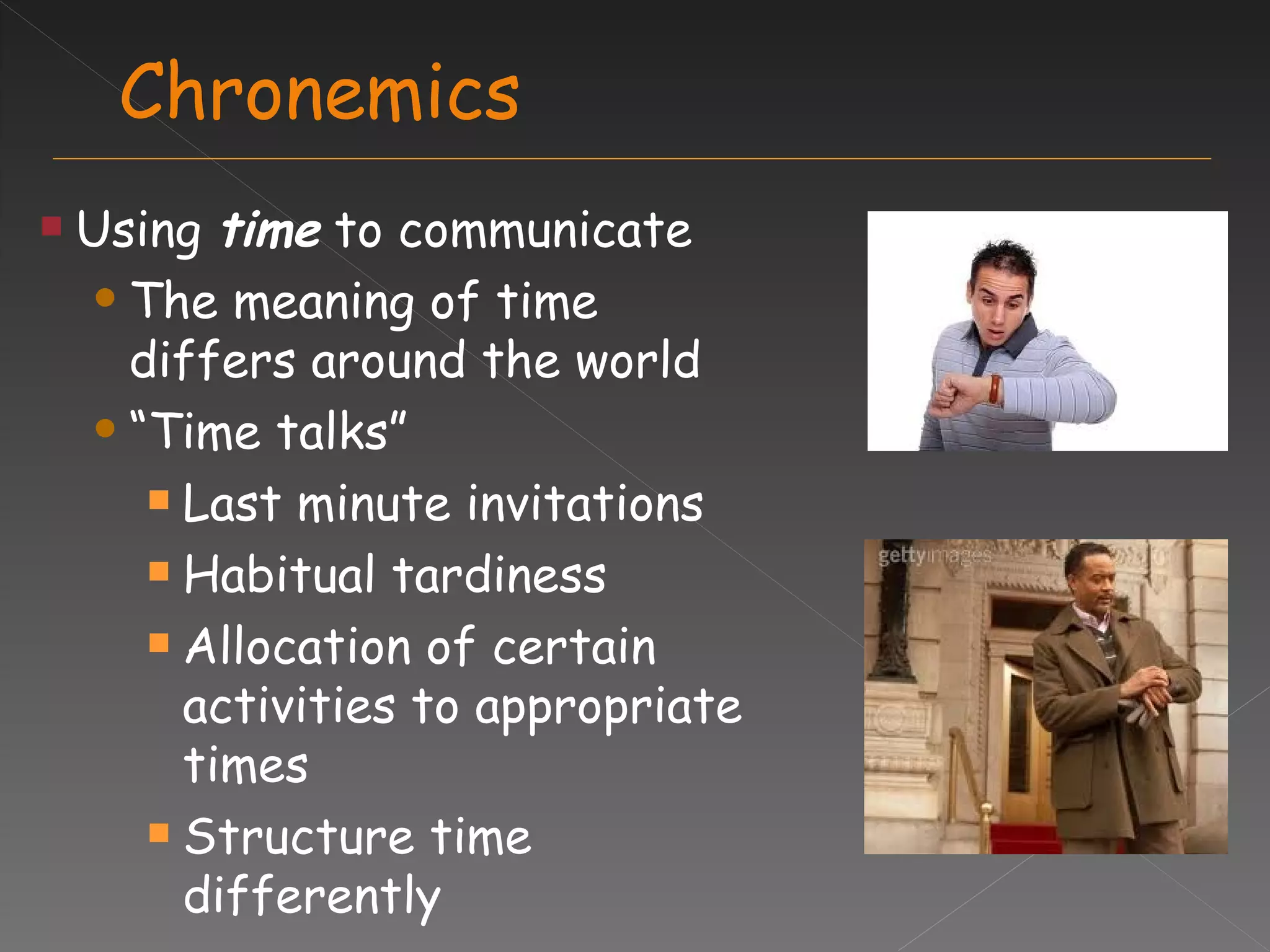
Chronemics Using  time  to communicate The meaning of time differs around the world “ Time talks” Last minute invitations Habitual tardiness Allocation of certain activities to appropriate times Structure time differently
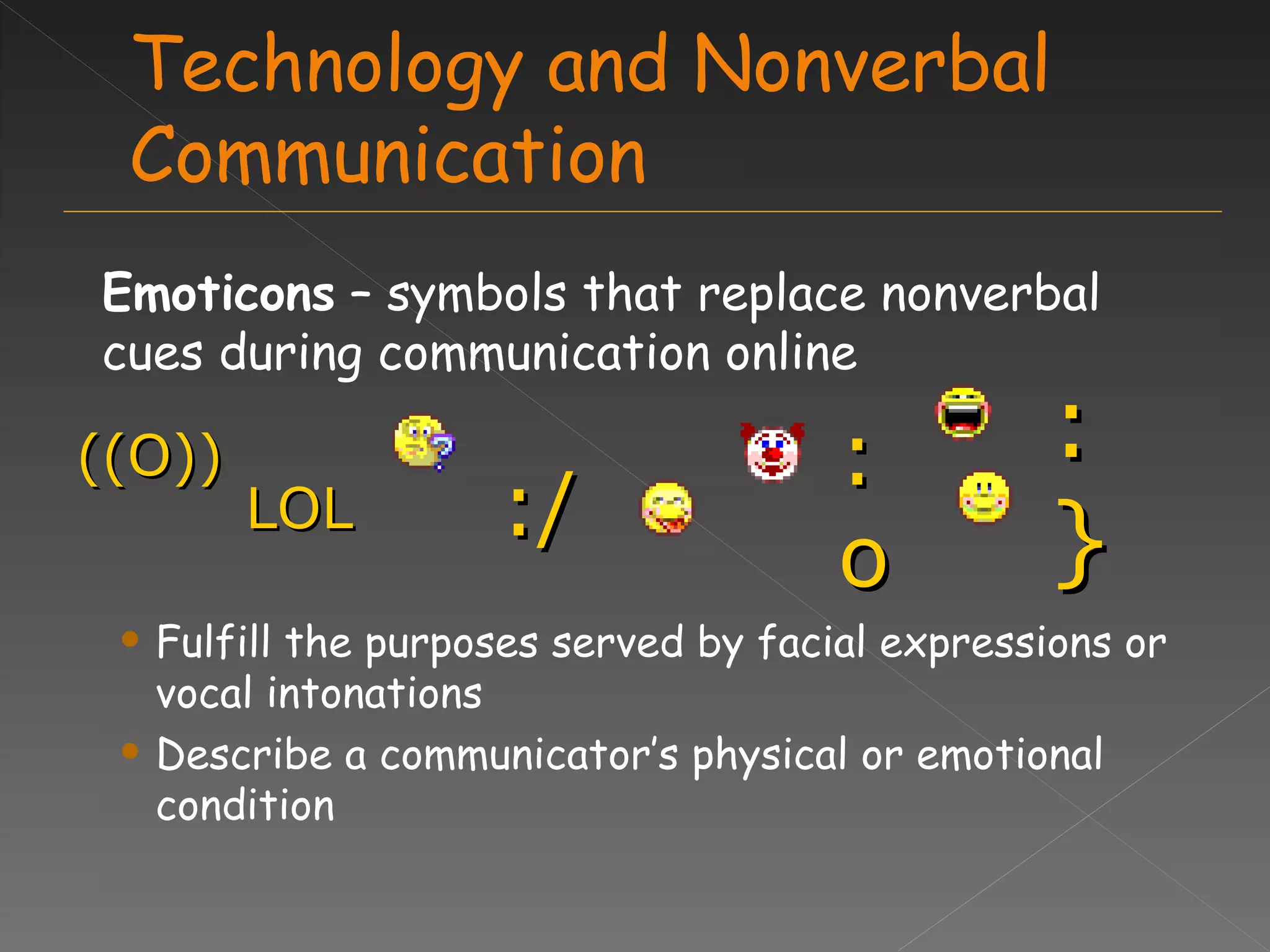
Technology and Nonverbal Communication Emoticons  – symbols that replace nonverbal cues during communication online Fulfill the purposes served by facial expressions or vocal intonations Describe a communicator’s physical or emotional condition :} ((O)) LOL :/ :o
Speech Apprehension What is your   worst nightmare   concerning public speaking? What is the worst thing that could happen to you if you make a mistake while speaking?
Speech Apprehension Being nervous is normal, even  preferred A commentator asked Tiger Woods if he was nervous during the golf  tournament.   He replied , “Of course I was nervous!”  “ When I am no longer nervous, I will know it is time to quit golfing professionally .”
Speech Behaviors to Control Nerves Prepare and fully practice Try to schedule your speech at a time that is psychologically the best for you (1 st , last, etc.) Control your intake of beverages and food A big meal can make you “loggy” Avoid stimulants: sugar; caffeine Avoid drinking milk DO: Drink water to moisten your mouth Suck on a mint just before your presentation begins
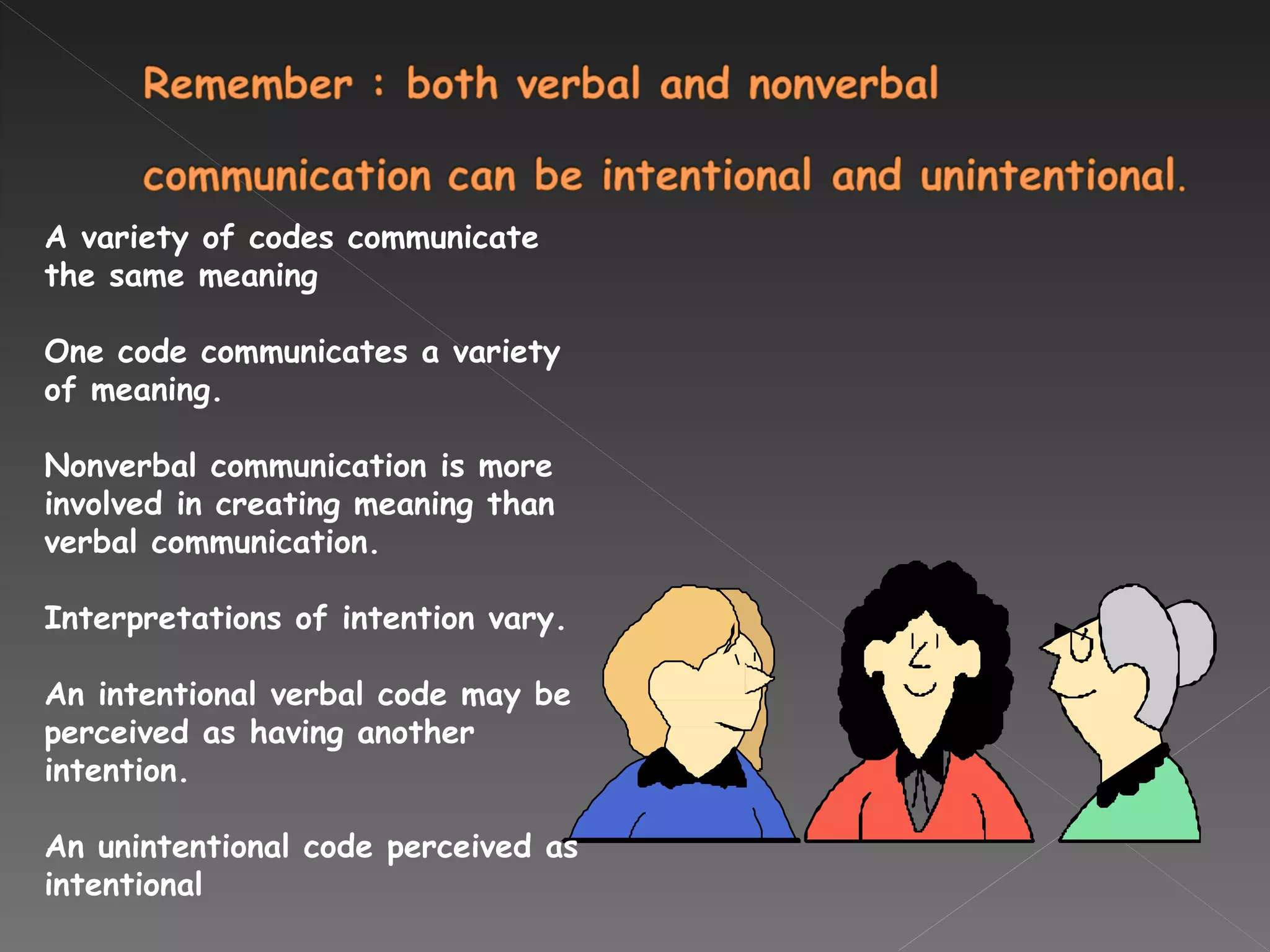
A variety of codes communicate the same meaning  One code communicates a variety of meaning.  Nonverbal communication is more involved in creating meaning than verbal communication.  Interpretations of intention vary.  An intentional verbal code may be perceived as having another intention.  An unintentional code perceived as intentional
Communication can happen in a variety of ways and a little skill can take us a long way in communicating our ideas effectively.
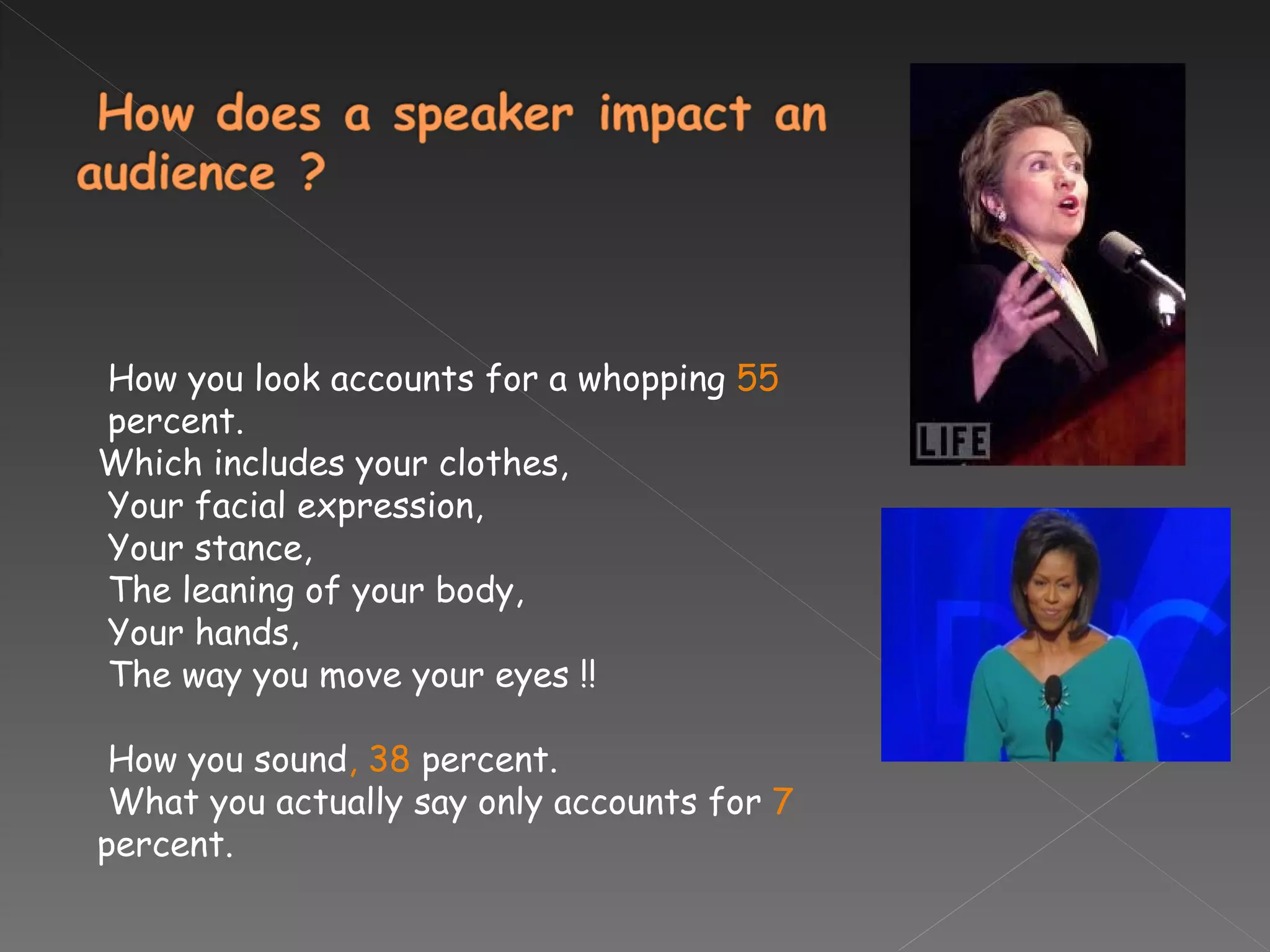
How you look accounts for a whopping  55 percent.  Which includes your clothes, Your facial expression, Your stance, The leaning of your body, Your hands, The way you move your eyes !! How you sound , 38  percent. What you actually say only accounts for  7  percent.
 
[email_address]

Kinesics in public speaking

  • 1.
  • 2.
    Identify myths aboutcommunication Describe the sender-receiver model Describe effective feedback Summarize barriers to effective communication
  • 3.
    Difference between speakingand public speaking Describe common barriers to listening Describe the importance of non verbal communication Understand Kinesics Understand public speaking
  • 4.
    Did you experiencediscomfort in silence? Has anyone ever said things without really saying them? Have you ever heard the sound of silence?
  • 5.
    ... yet wetalk all the time. Importance of speech is noted when we experience silence. Silence can be very confusing to us and sometimes even intimidating. Talking , however, seems easier. But..talking is different from speaking
  • 6.
    We are allhere because we are speakers and not just talkers. We, perhaps understand the value of speech and the fact that 5 minutes is a long time when you are making a speech. The same 5 minutes pass so quickly when you are chatting with a friend. All of us here understand this .
  • 7.
    Organize your thoughts - Giving someone directions to your house   Tailor your message to the audience Your 5 year old asks you where babies come from Your 14 year old asks you where babies come from Your 22 year old asks the same question Telling a story for maximum impact- Don’t tell the “punch line” of a story first Adapting to listener feedback - Watch for non-verbal feedback – looks of confusion, looks of pain or hurtfulness  
  • 8.
      PS ismore structured   Usually time limited Questions not allowed to interrupt the speech, usually left for at end (time permitting) PS requires more formal language No slang, jargon or bad grammar Speeches should be something special so that they qualify as life events and are remembered PS requires a different method for delivery More formal delivery- No vocalized pauses – “uh”, “ah”, “um” Don’t use stock phrases repeatedly – “you know”, “basically”, “I mean”  
  • 9.
    Speaker -speech communication starts here Message - whatever is communicated Channel – means by which a message is communicated Listener – the receiver of the communicated message Feedback – comes in many forms and must be understood Interference - anything impeding the communication of the message Situation – the time and place of occurrence
  • 10.
    Sender: initiatesa thought/feeling Encodes it into words Transmits it Receiver: Decodes the message Assigns thought/feelings to a response Encodes a response Sends a message back
  • 11.
    We only communicatewhen we want to communicate Words mean the same to both the speaker and the listener We communicate chiefly with words Nonverbal communication is silent communication Communication is a one way street The message we communicate is the message that the listener receives
  • 12.
    Misinterpretation Evaluation ofsender Projection Stereotyping Arrogance and superiority Defensiveness Inarticulateness Hidden agendas Status Environment Emotions Differences in backgrounds Poor timing Personality conflicts
  • 13.
    There are fourtypes of listening: Appreciative Listening for pleasure or enjoyment Music, movies, comedy, plays… Empathetic Listening to provide emotional support for speaker shrink listens to a patient; you listen to a friend’s rant Comprehensive Listening to understand the speakers message Direction to a friend’s house; in a class or seminar Critical Listening to evaluate a message A campaign speech; a peer’s research paper Critical Thinking Comprehensive and Critical Thinking require you to think and evaluate while listening, this helps develop Critical Thinking ski lls
  • 14.
  • 15.
    Fraudulent – pseudo listeners (nodders) Monopolistic – always want to be listened to, but never want to listen Completers – fill in missed gaps with manufactured information Selective – zero in only on parts that interest them Avoiders – close their ears to information they’d rather not deal with Defensive – assume others are criticizing Attackers – wait for you to make a mistake
  • 16.
    Not Concentrating Daydreaming,mind wandering, dozing Listening Too Hard Trying to remember every fact, no matter how minute Jumping To Conclusions Putting words into the speakers mouth; interrupting speaker, anticipating what speaker will say/do next Focusing On Delivery Instead Of Message Speakers accent, clothes, stuttering, presentation tools
  • 17.
    Take Listening SeriouslyLike any skill it takes practice and self-discipline Resist Distractions When you catch your mind wandering make a conscious effort to pull it back on track Don’t be Diverted by Appearance or Delivery Lincoln and Gandhi were strange in appearance but Were excellent speakers Suspend Judgment
  • 18.
    A passage willbe read out. You have to listen to it.
  • 19.
    It’s up tothe speaker to make the audience choose to pay attention. Every speech contains two messages: One from the speaker One received by the listener “ People hear what they want to hear and disregard the rest.” People are egocentric Egocentrism – the tendency for people to be most interested in themselves, their own problems and the way to solve them. They pay closest attention to what affects their own values, beliefs and well being.
  • 20.
    Through the speechcommunication process we understand that communication begins the moment the speech starts. However, we have also experienced that many times we communicate best without speaking. In order to illustrate this let us participate in another activity. Charades.
  • 21.
    Group members willparticipate in a game of charades. Remember that you must convey meaning without using words. 7 dyads will be made. After the group finishes, note specific examples of the various types of non-verbal communication.
  • 22.
    Message Reinforcement MessageNegation Message Substitution Message Accentuation Message Regulation
  • 23.
    Nonverbal Communication– all elements of communication that do not involve words Four basic types Proxemics – an individual’s perception and use of space Kinesics – study of body movements, including posture Facial and Eye Behavior – movements that add cues for the receiver Paralanguage – variations in speech, such as pitch, loudness, tempo, tone, duration, laughing, and crying
  • 24.
    Bands of spaceextending outward from the body; territorial space differs from culture to culture Informal: highly mobile and can be quickly changed Semi-fixed-feature: objects create distance Fixed-feature: relatively permanent objects
  • 25.
    d Distances a.Intimate: 0-18 inches b. Personal: 18 inches to 4 ft. c. Social: 4 to 12 ft. d. Public: 12 ft. to limit of sight c c b a
  • 26.
    Kinesics involves thestudy of bodily movement. Ekman and Friesen (1 969) developed a classification system identifying five types of body movements which have communication functions.
  • 27.
    Movements which havea direct verbal translatio generally a word or phrase. These are often culture specific. Recognizable emblems would include "A-OK" and "Victory."They translate into words fairly directly.
  • 28.
    Nonverbal cues directlylinked with words. They reinforce verbal communication and allow us to accent or emphasize words or ideas. We also use illustrators to help describe something, as in "It was this wide."They mostly, accompany and illustrate the verbal message
  • 29.
    Body movements whichreveal our affective, or emotional, state. Facial cues are the primary way we reveal our feelings nonverbally. Affect displays can be used to influence others. A speaker, for example, displays enthusiasm and hopes it exudes to the audience. Affect displays may also be emotional expressions and not necessarily symbolic.
  • 30.
    Nonverbal cues whichregulate interaction. Consider the regulators used in normal conversation which determine turn- taking. Individuals utilize eye behavior, inflection, and head nodding to regulate conversation. These behaviours monitor, maintain or control.
  • 31.
    Movements that satisfypersonal needs and help you adapt to your environment. Adaptors may also be behaviors or objects that are manipulated for purpose. Adaptors include behaviours like yawning and moving/adjusting your glasses .
  • 32.
    Posture and GesturesPosture sends messages: Content and confident? Angry and belligerent? Worried and discouraged? meet the world or avoid it Feelings Gestures sends messages: Movements of arms, legs, hands, and feet Gestures do not have universal meanings
  • 33.
    Clothing and ArtifactsArtifactual communication – the use of personal adornments Impacts first impression Dress and chosen images should change as our roles change Judgments regarding Success Character Dominance Competence
  • 34.
    Paralanguage Paralanguage –vocal cues that accompany language Pitch Volume Rate Pauses Nonfluencies Silence
  • 35.
    Colours Colour affectsus emotionally and physiologically Can trigger: Excitement Warmth Passion and sensuality Happiness Relaxation Persuasion
  • 36.
    Chronemics Using time to communicate The meaning of time differs around the world “ Time talks” Last minute invitations Habitual tardiness Allocation of certain activities to appropriate times Structure time differently
  • 37.
    Technology and NonverbalCommunication Emoticons – symbols that replace nonverbal cues during communication online Fulfill the purposes served by facial expressions or vocal intonations Describe a communicator’s physical or emotional condition :} ((O)) LOL :/ :o
  • 38.
    Speech Apprehension Whatis your worst nightmare concerning public speaking? What is the worst thing that could happen to you if you make a mistake while speaking?
  • 39.
    Speech Apprehension Beingnervous is normal, even preferred A commentator asked Tiger Woods if he was nervous during the golf tournament. He replied , “Of course I was nervous!” “ When I am no longer nervous, I will know it is time to quit golfing professionally .”
  • 40.
    Speech Behaviors toControl Nerves Prepare and fully practice Try to schedule your speech at a time that is psychologically the best for you (1 st , last, etc.) Control your intake of beverages and food A big meal can make you “loggy” Avoid stimulants: sugar; caffeine Avoid drinking milk DO: Drink water to moisten your mouth Suck on a mint just before your presentation begins
  • 41.
    A variety ofcodes communicate the same meaning One code communicates a variety of meaning. Nonverbal communication is more involved in creating meaning than verbal communication. Interpretations of intention vary. An intentional verbal code may be perceived as having another intention. An unintentional code perceived as intentional
  • 42.
    Communication can happenin a variety of ways and a little skill can take us a long way in communicating our ideas effectively.
  • 43.
    How you lookaccounts for a whopping 55 percent. Which includes your clothes, Your facial expression, Your stance, The leaning of your body, Your hands, The way you move your eyes !! How you sound , 38 percent. What you actually say only accounts for 7 percent.
  • 44.
  • 45.