Production Agreements,
Oil Service Contracts &
Joint Ventures
Dr. Elijah Ezendu
FIMC, FCCM, FIIAN, FBDI, FAAFM, FSSM, MIMIS, MIAP, MITD, ACIArb, ACIPM,
PhD, DocM, MBA, CWM, CBDA, CMA, MPM, PME, CSOL, CCIP, CMC, CMgr
Production Sharing Agreement
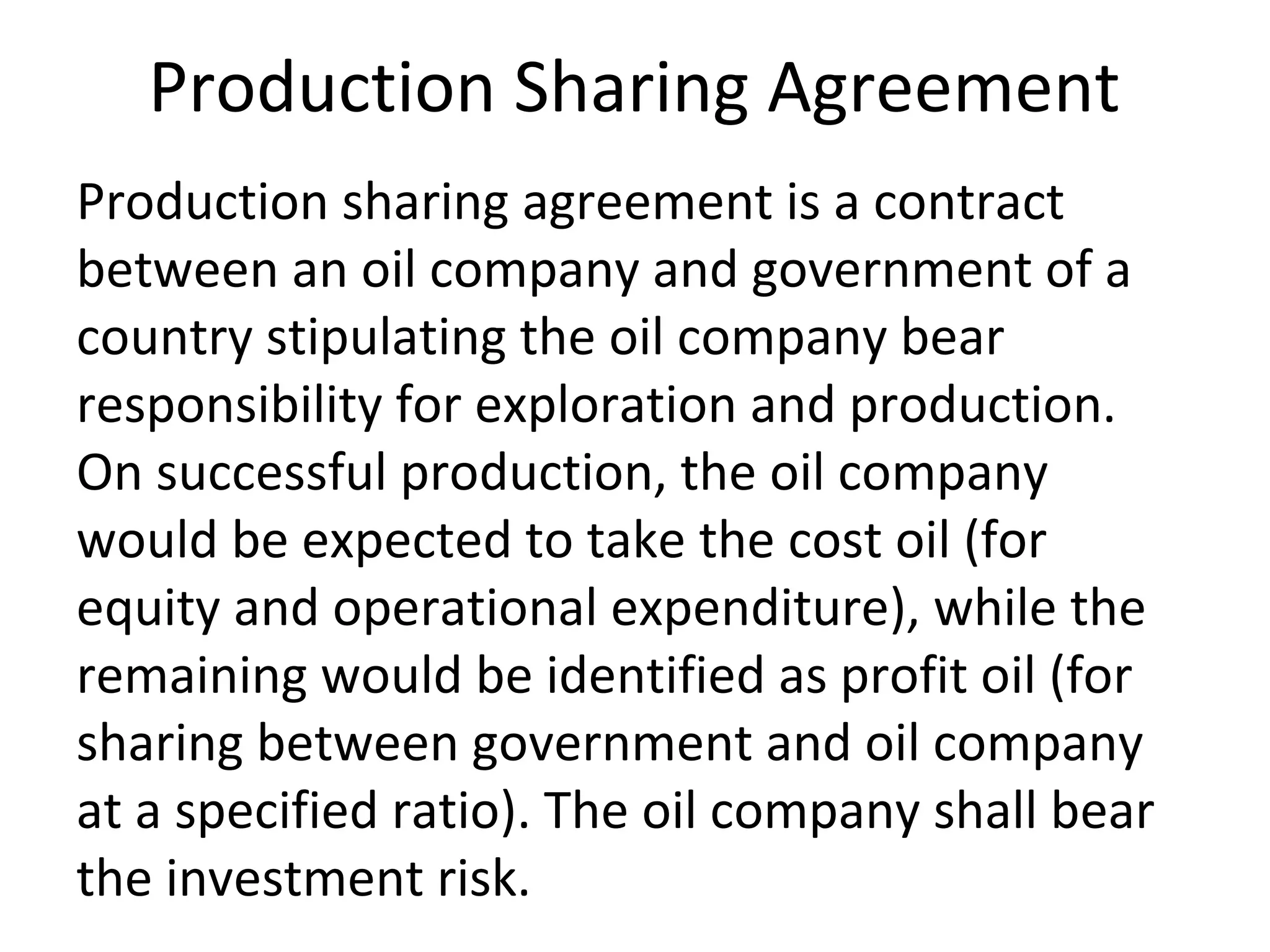
Production sharing agreement is a contract
between an oil company and government of a
country stipulating the oil company bear
responsibility for exploration and production.
On successful production, the oil company
would be expected to take the cost oil (for
equity and operational expenditure), while the
remaining would be identified as profit oil (for
sharing between government and oil company
at a specified ratio). The oil company shall bear
the investment risk.
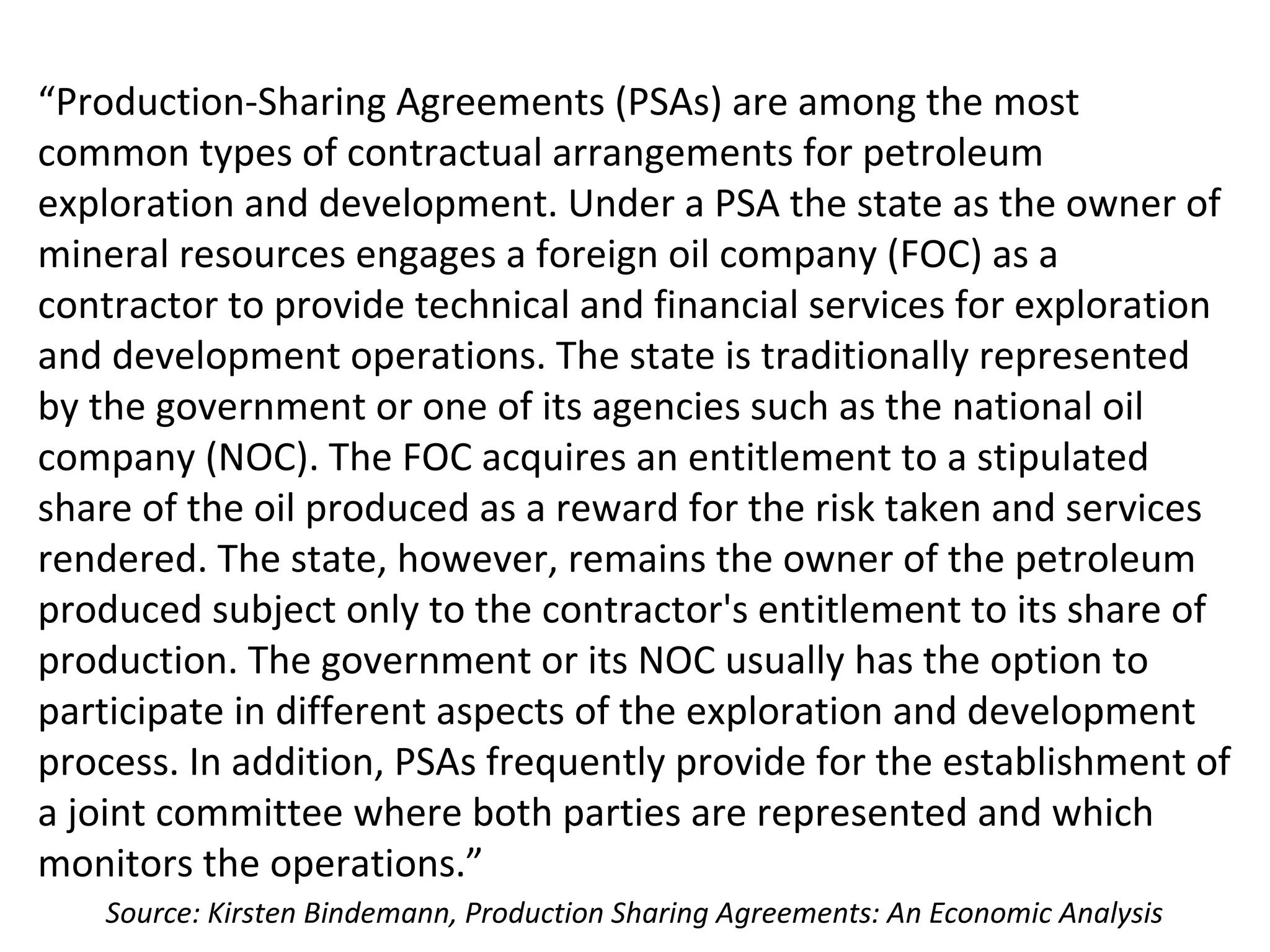
“Production-Sharing Agreements (PSAs) are among the most
common types of contractual arrangements for petroleum
exploration and development. Under a PSA the state as the owner of
mineral resources engages a foreign oil company (FOC) as a
contractor to provide technical and financial services for exploration
and development operations. The state is traditionally represented
by the government or one of its agencies such as the national oil
company (NOC). The FOC acquires an entitlement to a stipulated
share of the oil produced as a reward for the risk taken and services
rendered. The state, however, remains the owner of the petroleum
produced subject only to the contractor's entitlement to its share of
production. The government or its NOC usually has the option to
participate in different aspects of the exploration and development
process. In addition, PSAs frequently provide for the establishment of
a joint committee where both parties are represented and which
monitors the operations.”
Source: Kirsten Bindemann, Production Sharing Agreements: An Economic Analysis
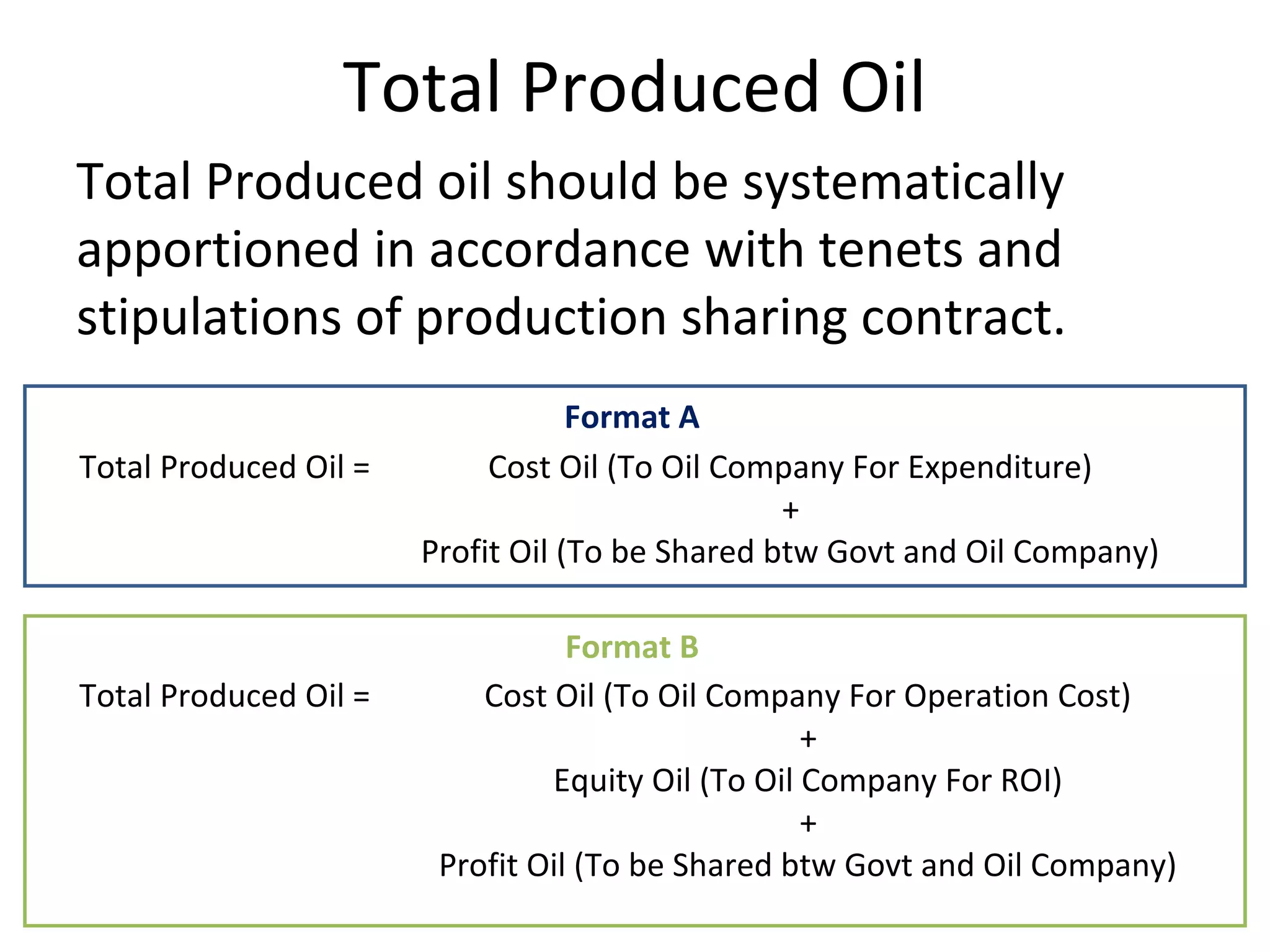
Total Produced Oil
Total Produced oil should be systematically
apportioned in accordance with tenets and
stipulations of production sharing contract.
Cost Oil (To Oil Company For Expenditure)
+
Profit Oil (To be Shared btw Govt and Oil Company)
Cost Oil (To Oil Company For Operation Cost)
+
Equity Oil (To Oil Company For ROI)
+
Profit Oil (To be Shared btw Govt and Oil Company)
Total Produced Oil =
Format A
Format B
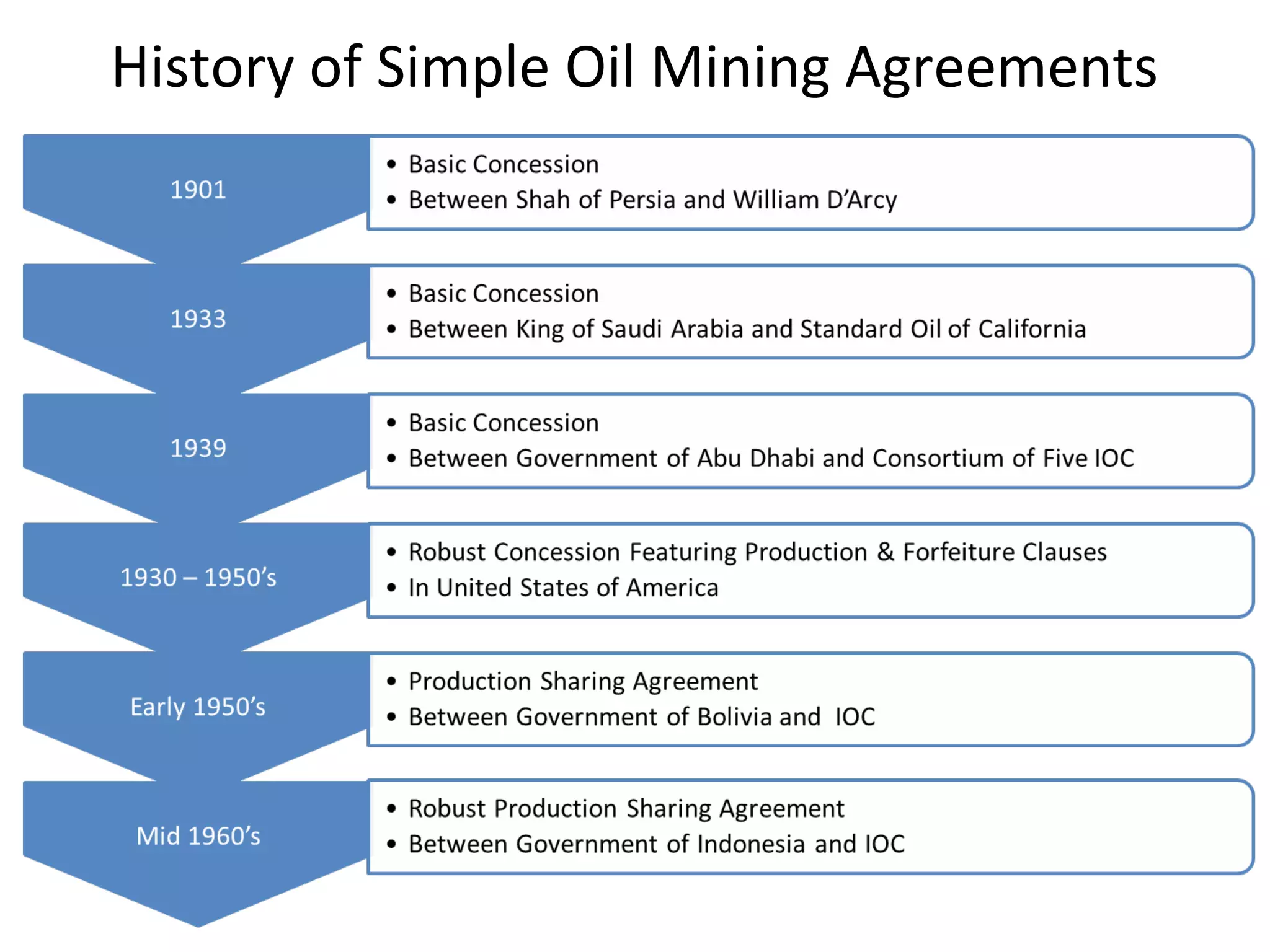
History of Simple Oil Mining Agreements
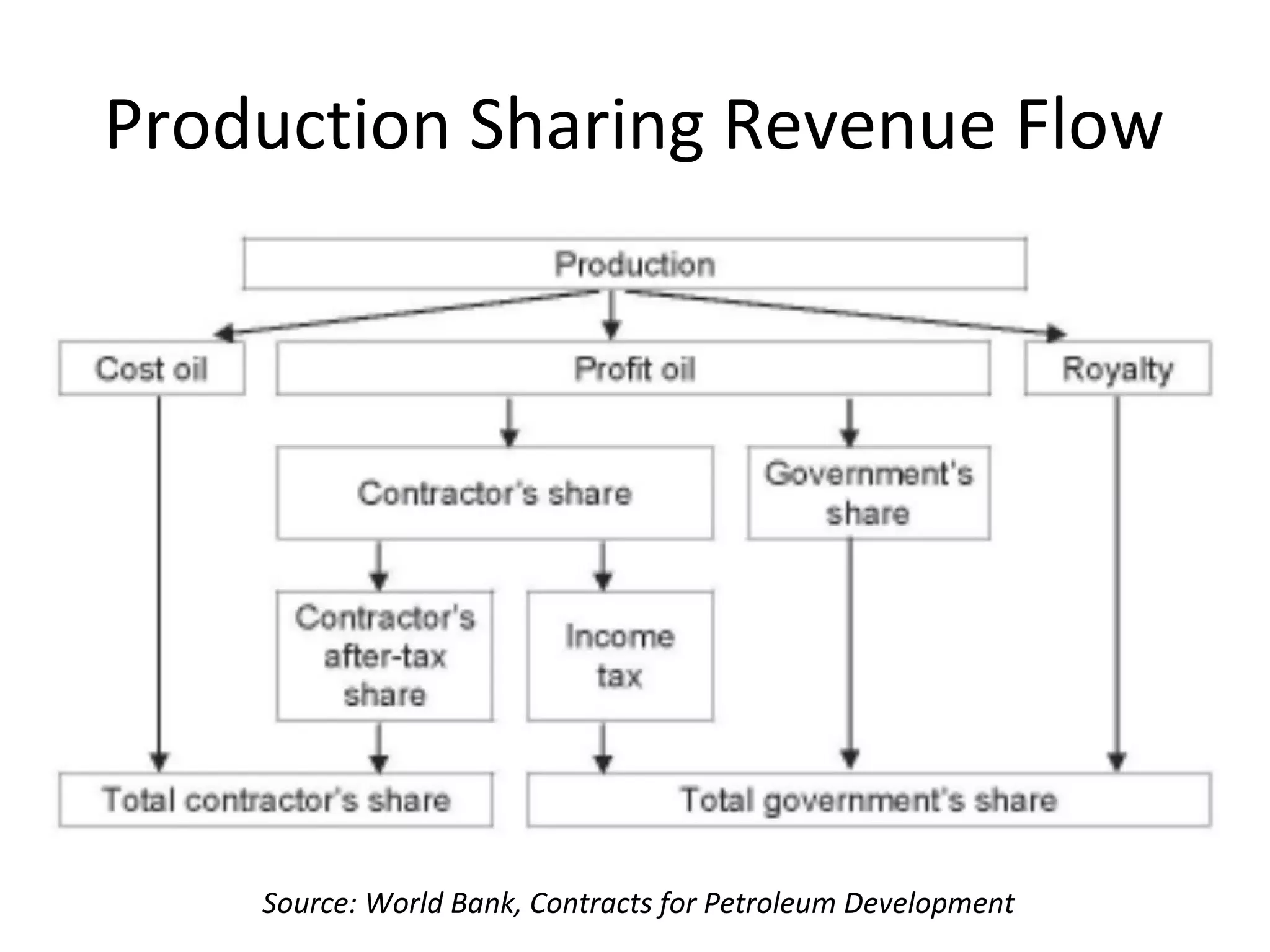
Production Sharing Revenue Flow
Source: World Bank, Contracts for Petroleum Development
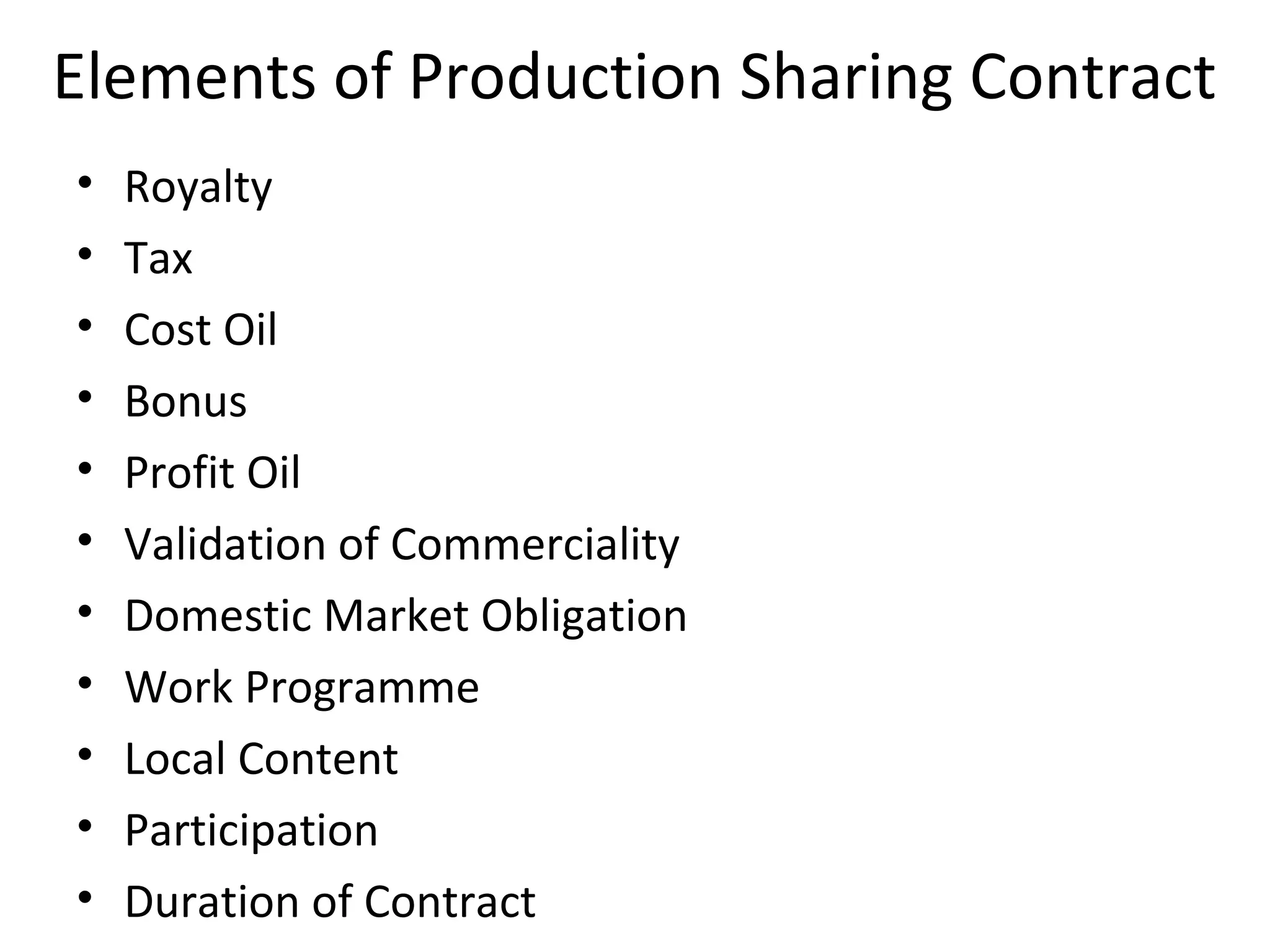
Elements of Production Sharing Contract
• Royalty
• Tax
• Cost Oil
• Bonus
• Profit Oil
• Validation of Commerciality
• Domestic Market Obligation
• Work Programme
• Local Content
• Participation
• Duration of Contract
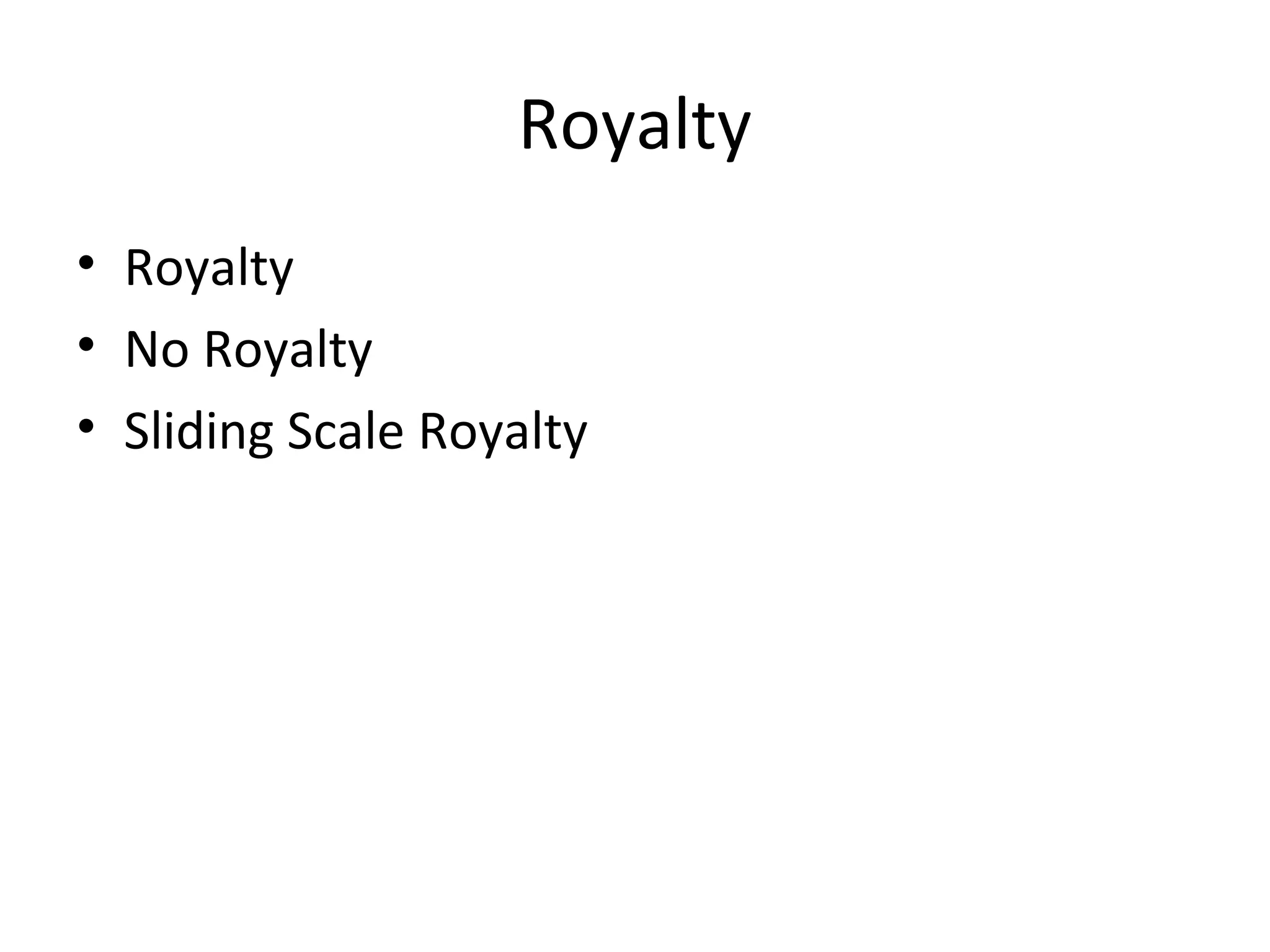
Royalty
• Royalty
• No Royalty
• Sliding Scale Royalty
Tax
• No Tax
• Progressive Tax
• Fixed Tax
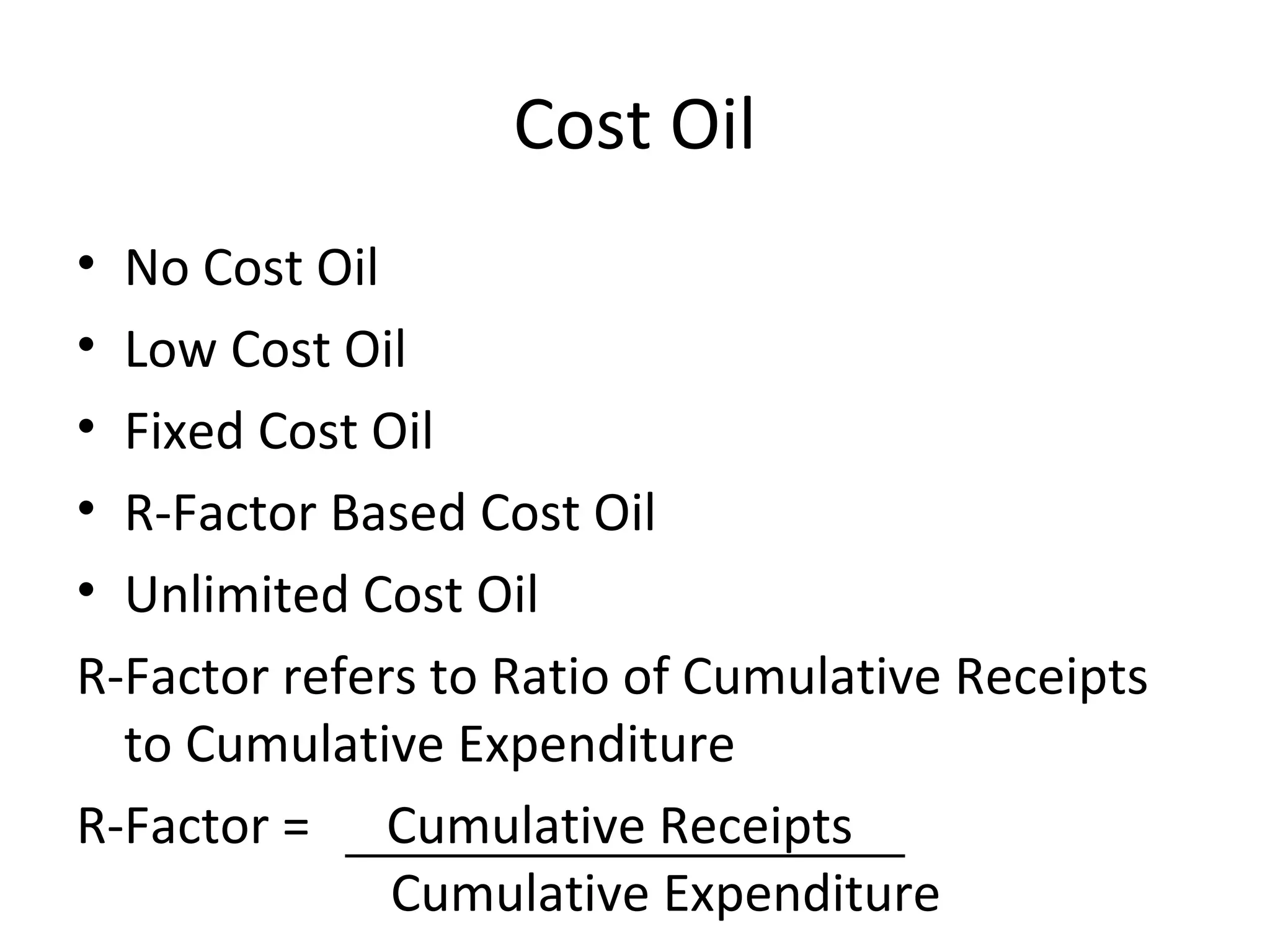
Cost Oil
• No Cost Oil
• Low Cost Oil
• Fixed Cost Oil
• R-Factor Based Cost Oil
• Unlimited Cost Oil
R-Factor refers to Ratio of Cumulative Receipts
to Cumulative Expenditure
R-Factor = Cumulative Receipts
Cumulative Expenditure
Bonus
• Fixed Production Bonus
• Sliding Scale Production Bonus
• Signature Bonus
• No Signature Bonus
• Discovery Bonus
• No Discovery Bonus
Profit Oil
• Low Profit Oil
• Fixed Profit Oil
• Volume Based Profit Oil
• R-Factor Based Profit Oil
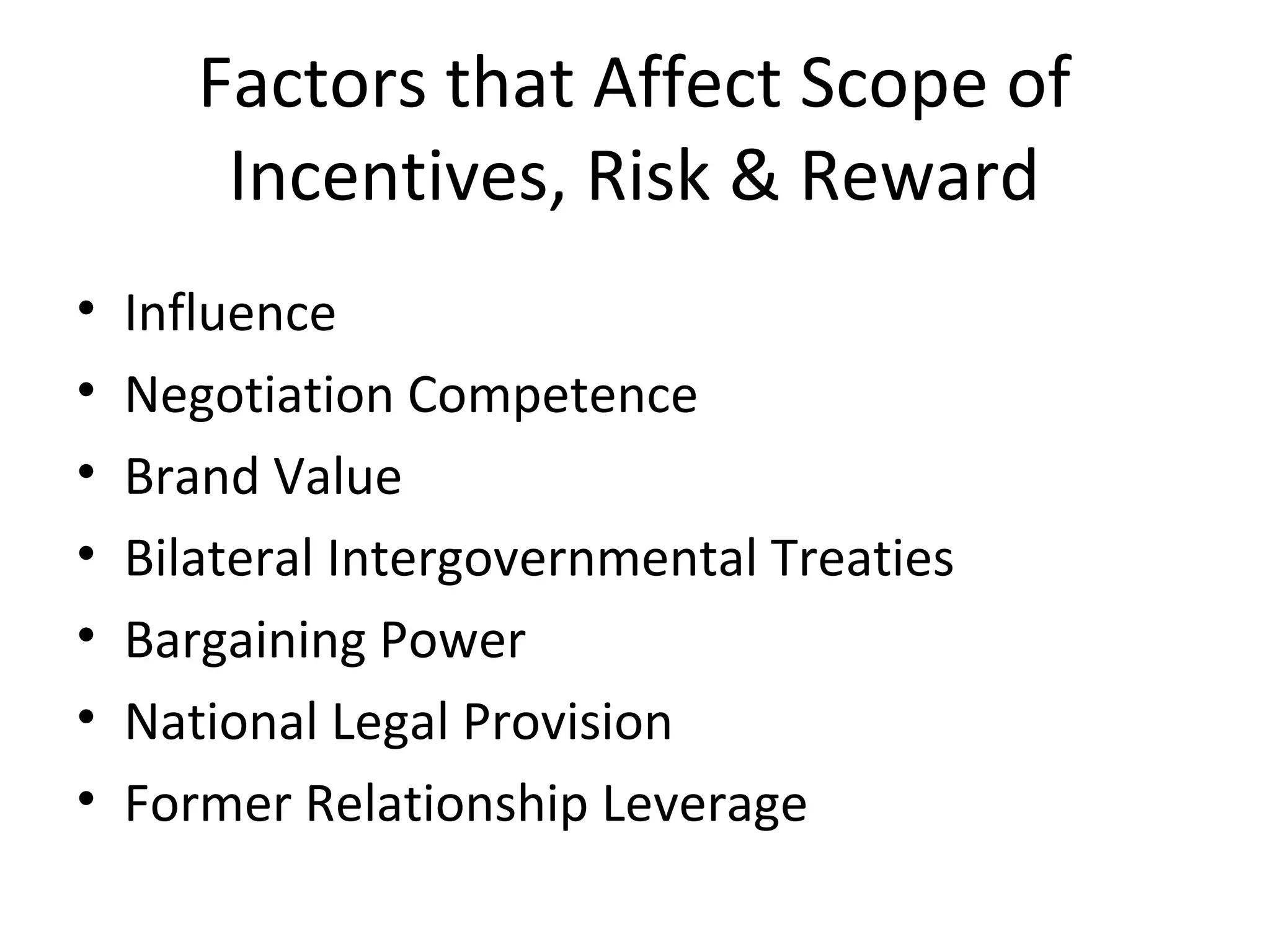
Factors that Affect Scope of
Incentives, Risk & Reward
• Influence
• Negotiation Competence
• Brand Value
• Bilateral Intergovernmental Treaties
• Bargaining Power
• National Legal Provision
• Former Relationship Leverage
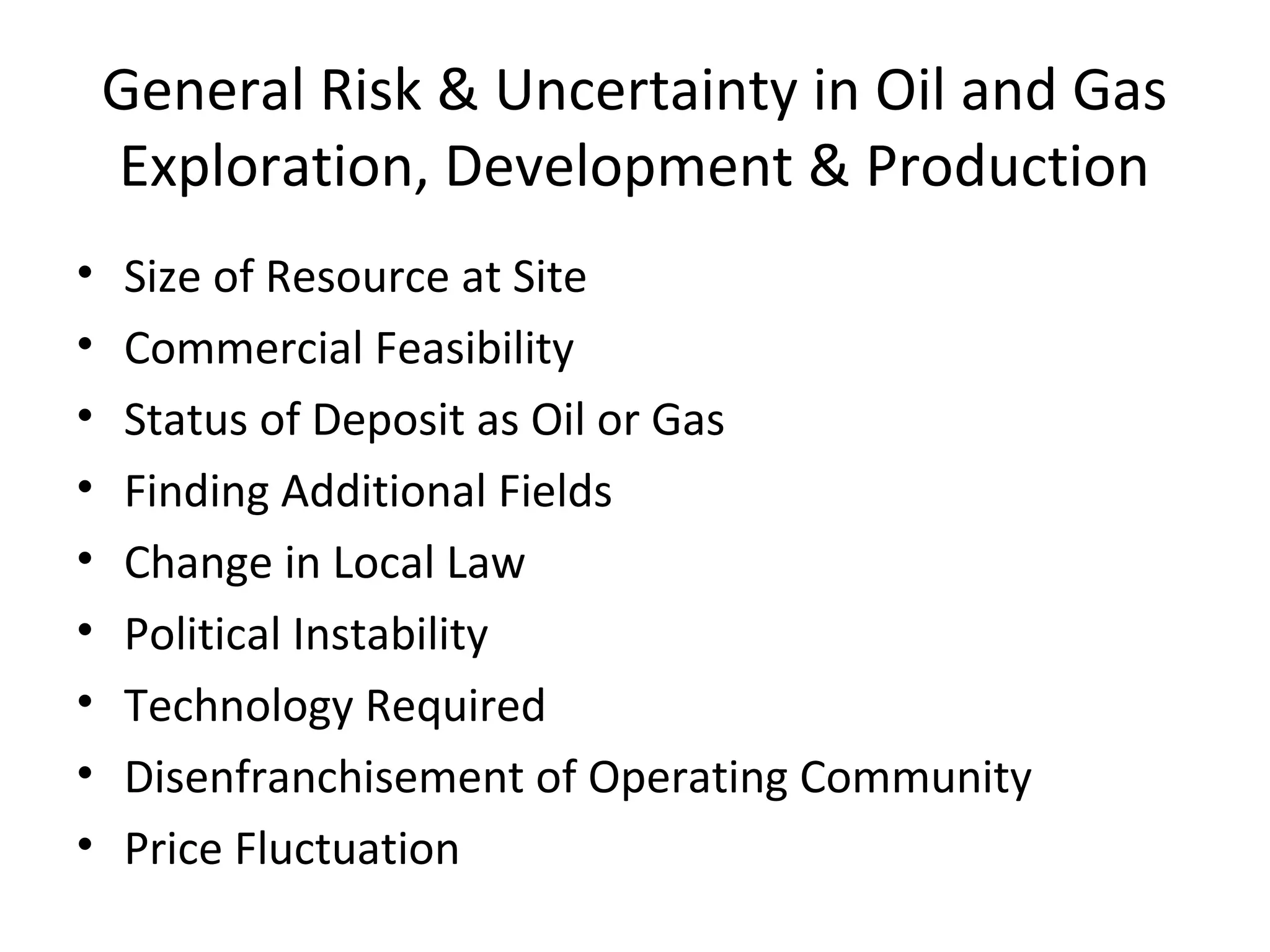
General Risk & Uncertainty in Oil and Gas
Exploration, Development & Production
• Size of Resource at Site
• Commercial Feasibility
• Status of Deposit as Oil or Gas
• Finding Additional Fields
• Change in Local Law
• Political Instability
• Technology Required
• Disenfranchisement of Operating Community
• Price Fluctuation
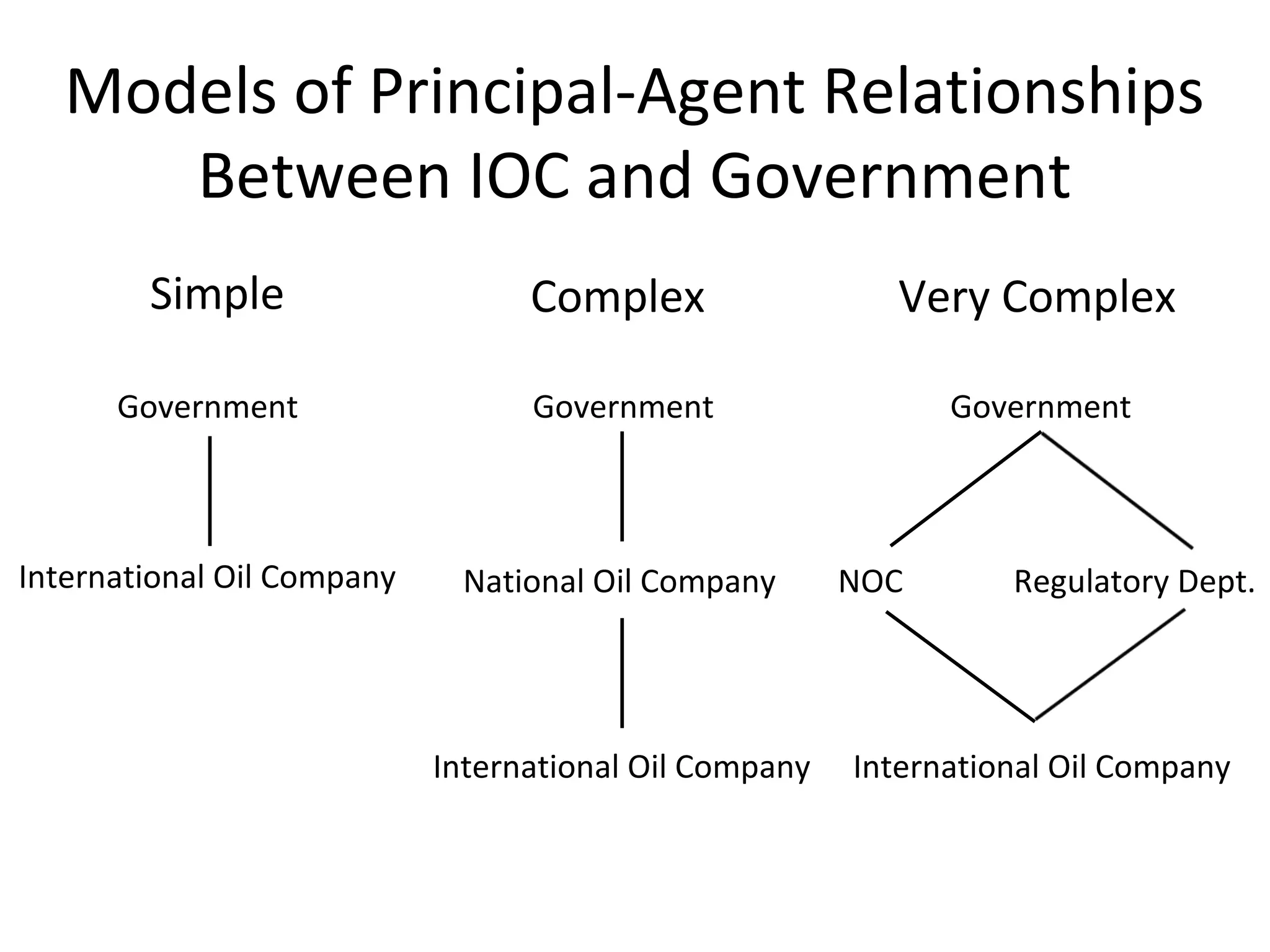
Models of Principal-Agent Relationships
Between IOC and Government
Simple Complex
Government
International Oil Company
Government
International Oil Company
National Oil Company
Very Complex
Government
NOC Regulatory Dept.
International Oil Company
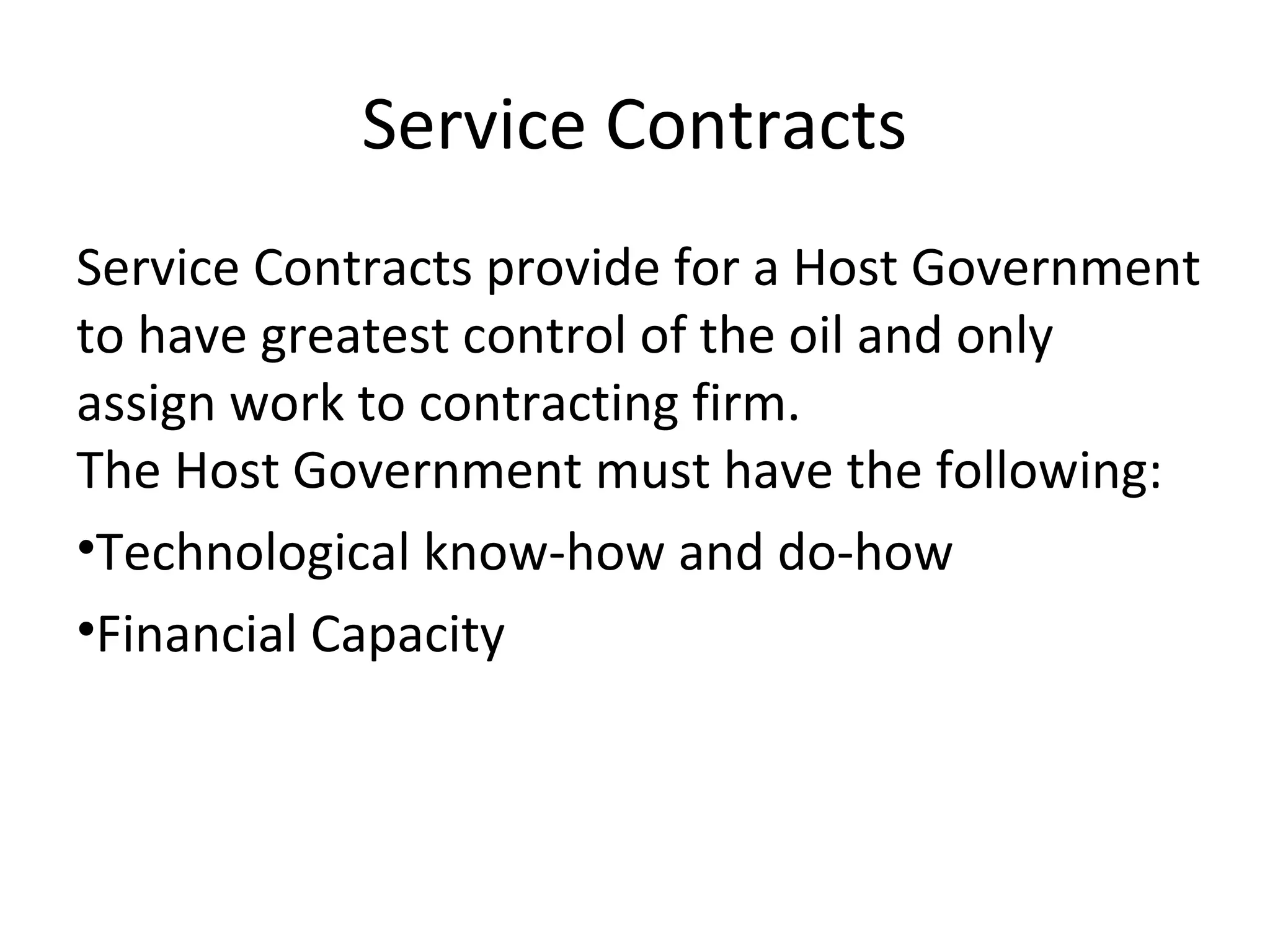
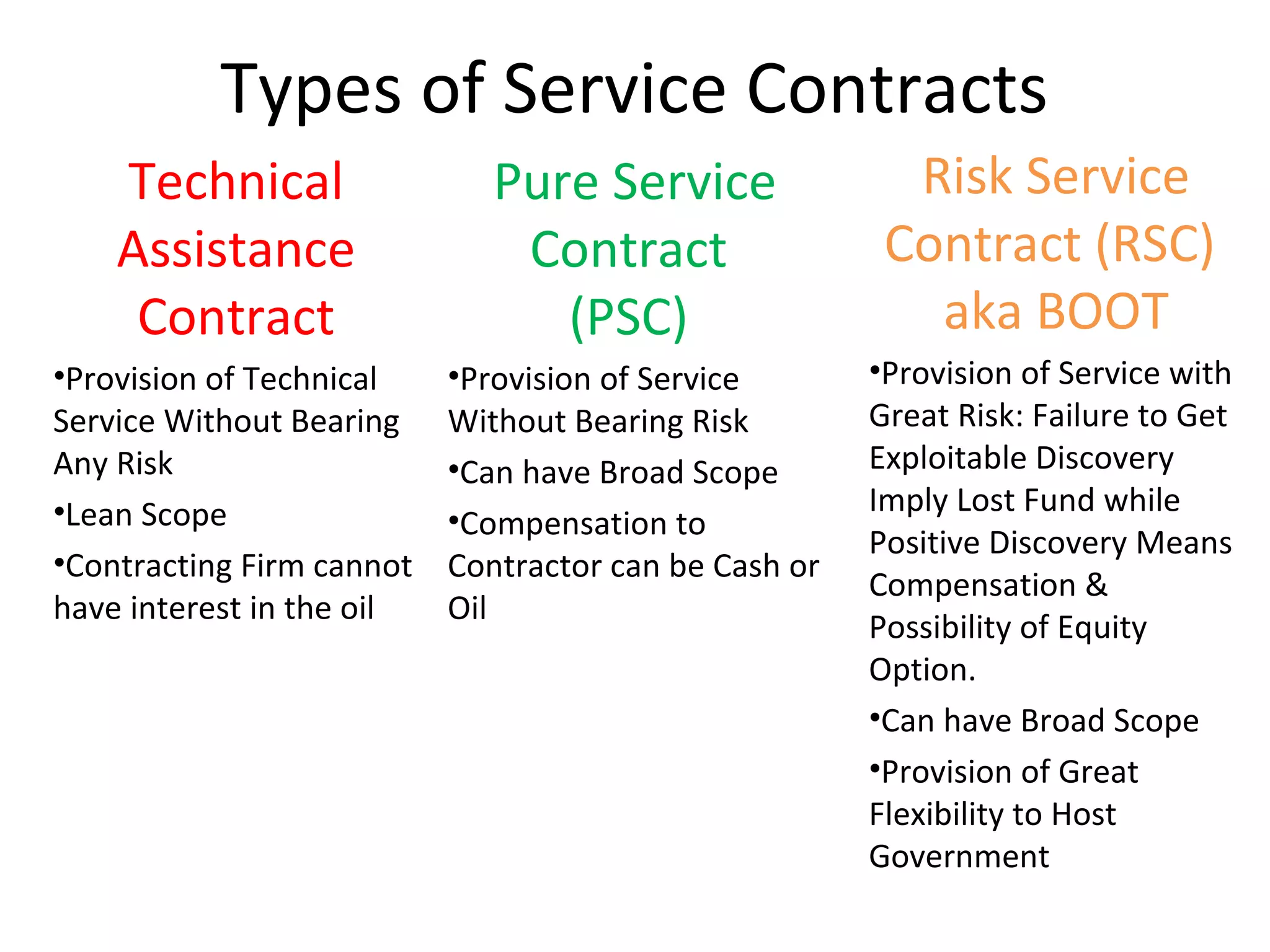
Service Contracts
Service Contracts provide for a Host Government
to have greatest control of the oil and only
assign work to contracting firm.
The Host Government must have the following:
•Technological know-how and do-how
•Financial Capacity
Types of Service Contracts
Technical
Assistance
Contract
•Provision of Technical
Service Without Bearing
Any Risk
•Lean Scope
•Contracting Firm cannot
have interest in the oil
Pure Service
Contract
(PSC)
•Provision of Service
Without Bearing Risk
•Can have Broad Scope
•Compensation to
Contractor can be Cash or
Oil
Risk Service
Contract (RSC)
aka BOOT
•Provision of Service with
Great Risk: Failure to Get
Exploitable Discovery
Imply Lost Fund while
Positive Discovery Means
Compensation &
Possibility of Equity
Option.
•Can have Broad Scope
•Provision of Great
Flexibility to Host
Government
“Alliances are institutional arrangements
that combine resources and governance
forms of several partnering organizations,
making them mutually interdependent.”
Source: Inkpen
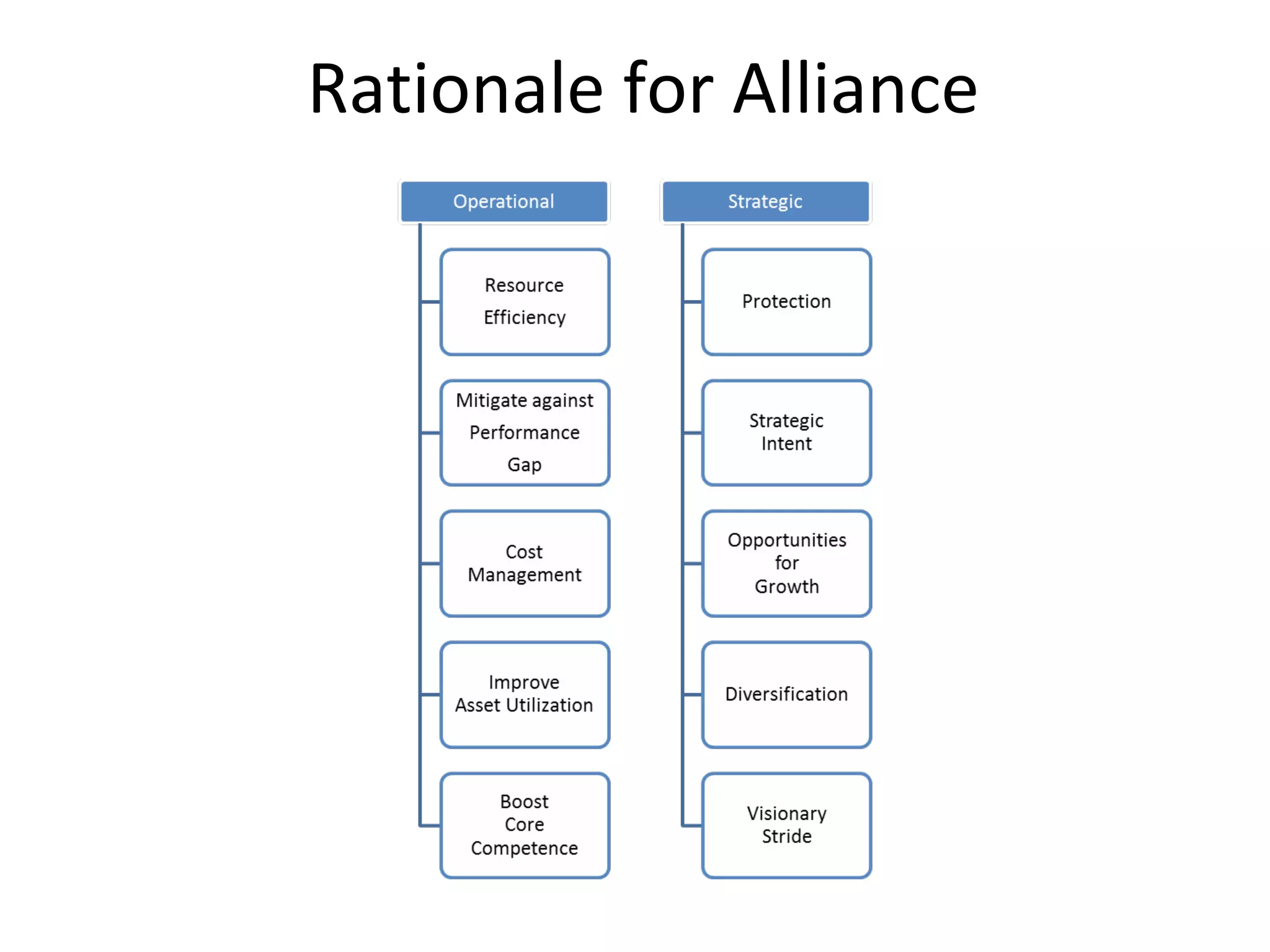
Rationale for Alliance
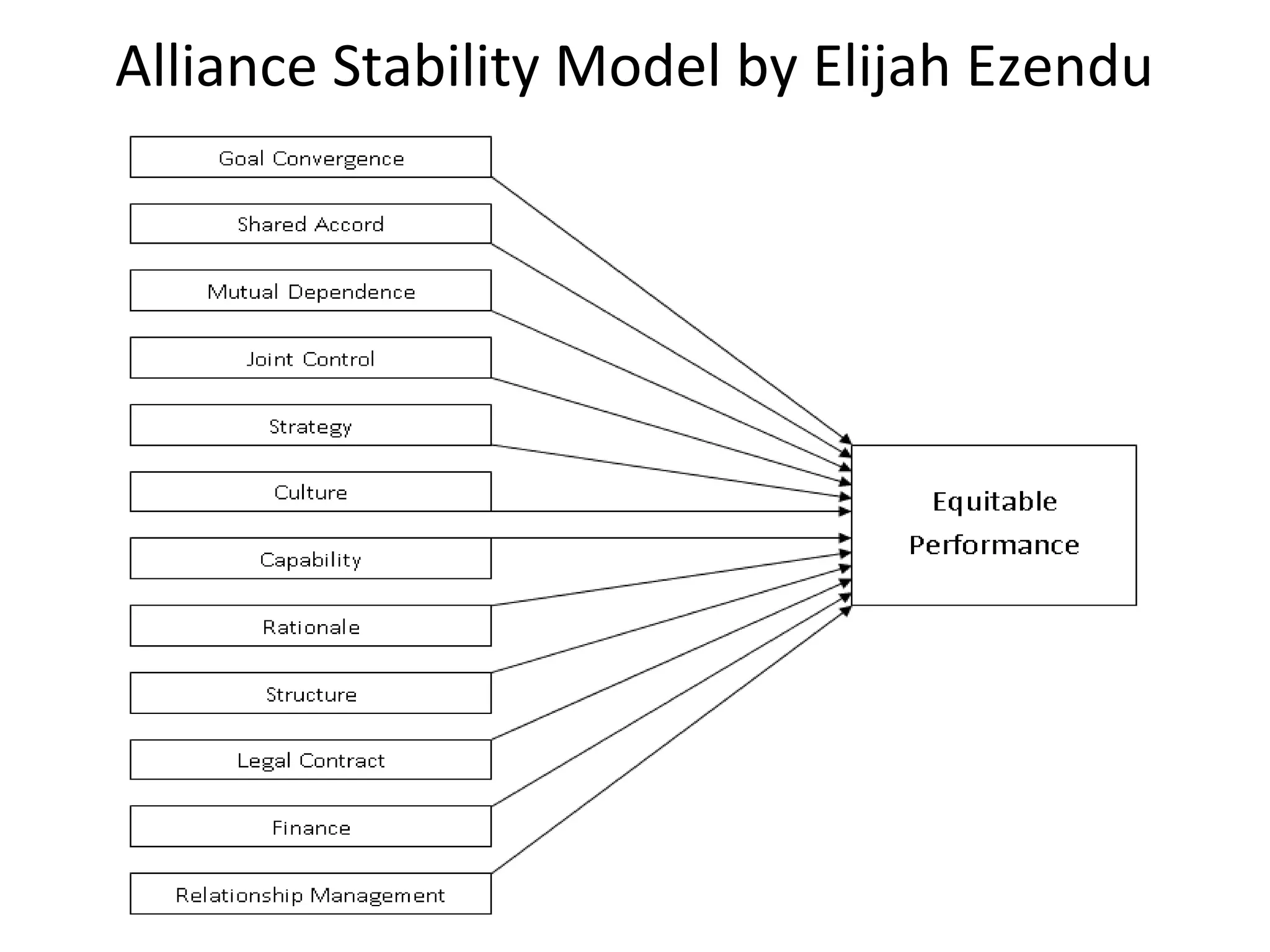
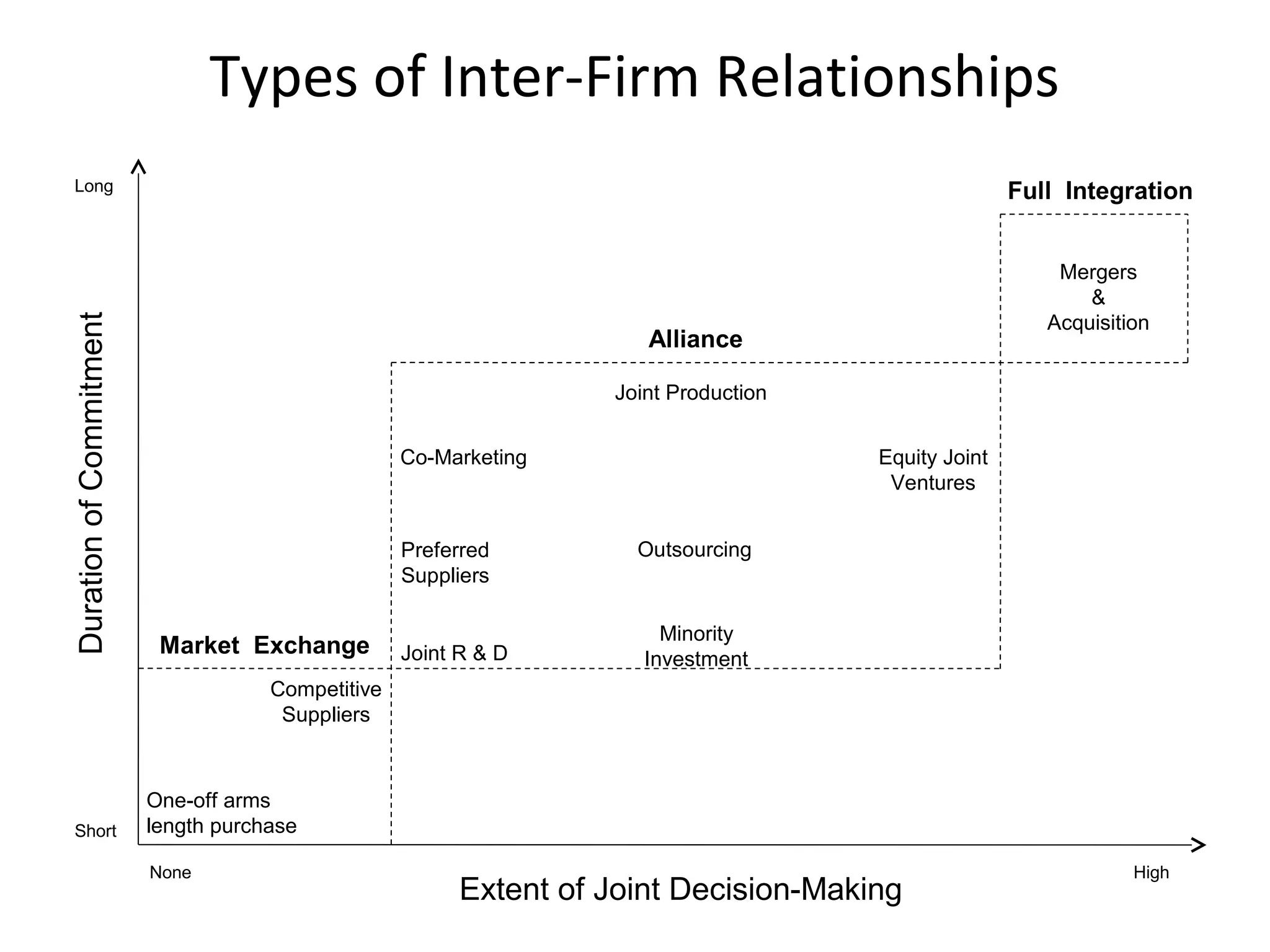
Alliance Stability Model by Elijah Ezendu
Short
Long
None High
DurationofCommitment
Extent of Joint Decision-Making
One-off arms
length purchase
Competitive
Suppliers
Joint R & D
Preferred
Suppliers
Co-Marketing
Joint Production
Equity Joint
Ventures
Mergers
&
Acquisition
Full Integration
Alliance
Market Exchange
Minority
Investment
Types of Inter-Firm Relationships
Outsourcing
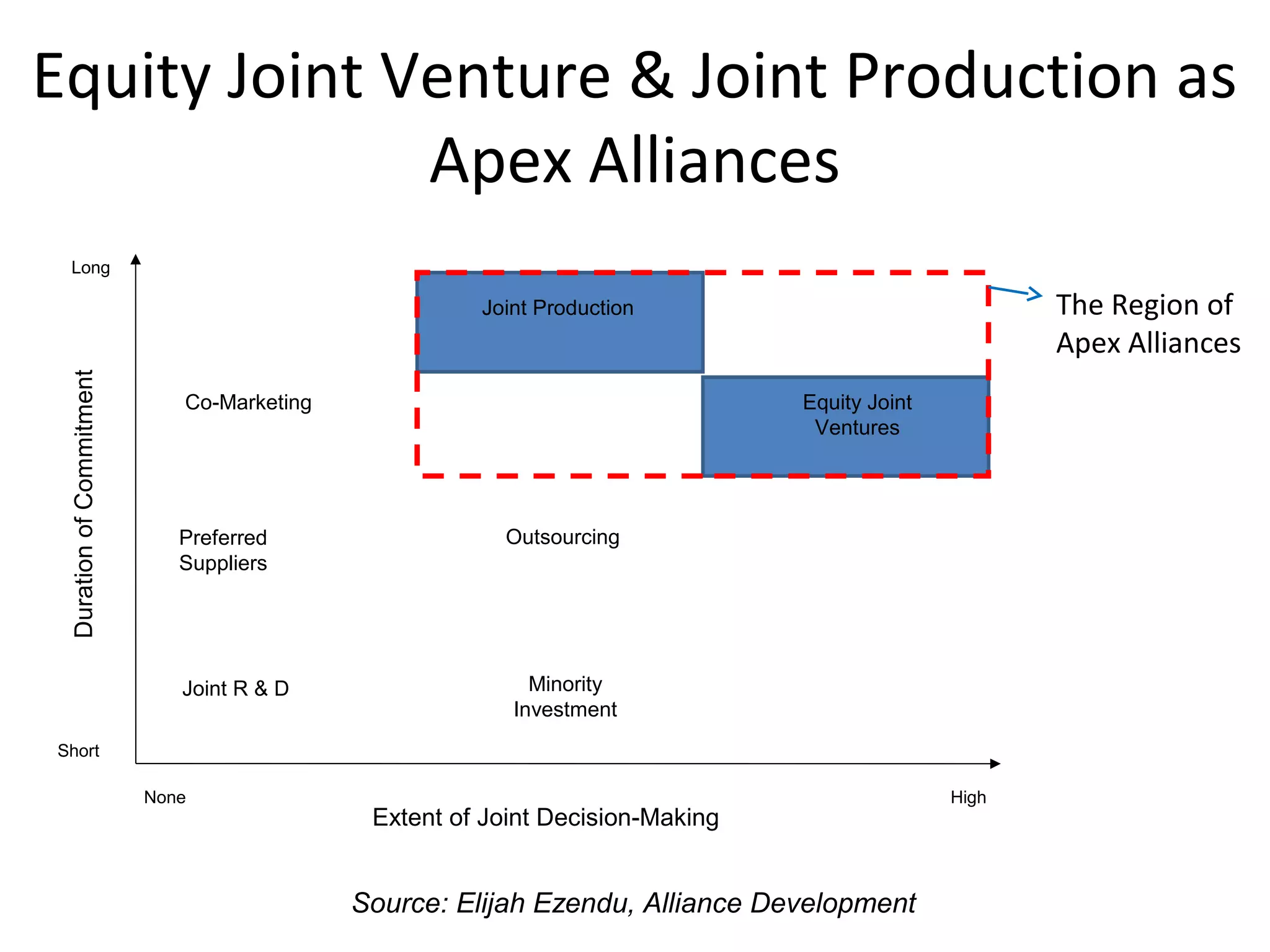
Equity Joint Venture & Joint Production as
Apex Alliances
Joint R & D
Preferred
Suppliers
Co-Marketing
Joint Production
Equity Joint
Ventures
Minority
Investment
Outsourcing
DurationofCommitment
Extent of Joint Decision-Making
Long
Short
None High
Source: Elijah Ezendu, Alliance Development
The Region of
Apex Alliances
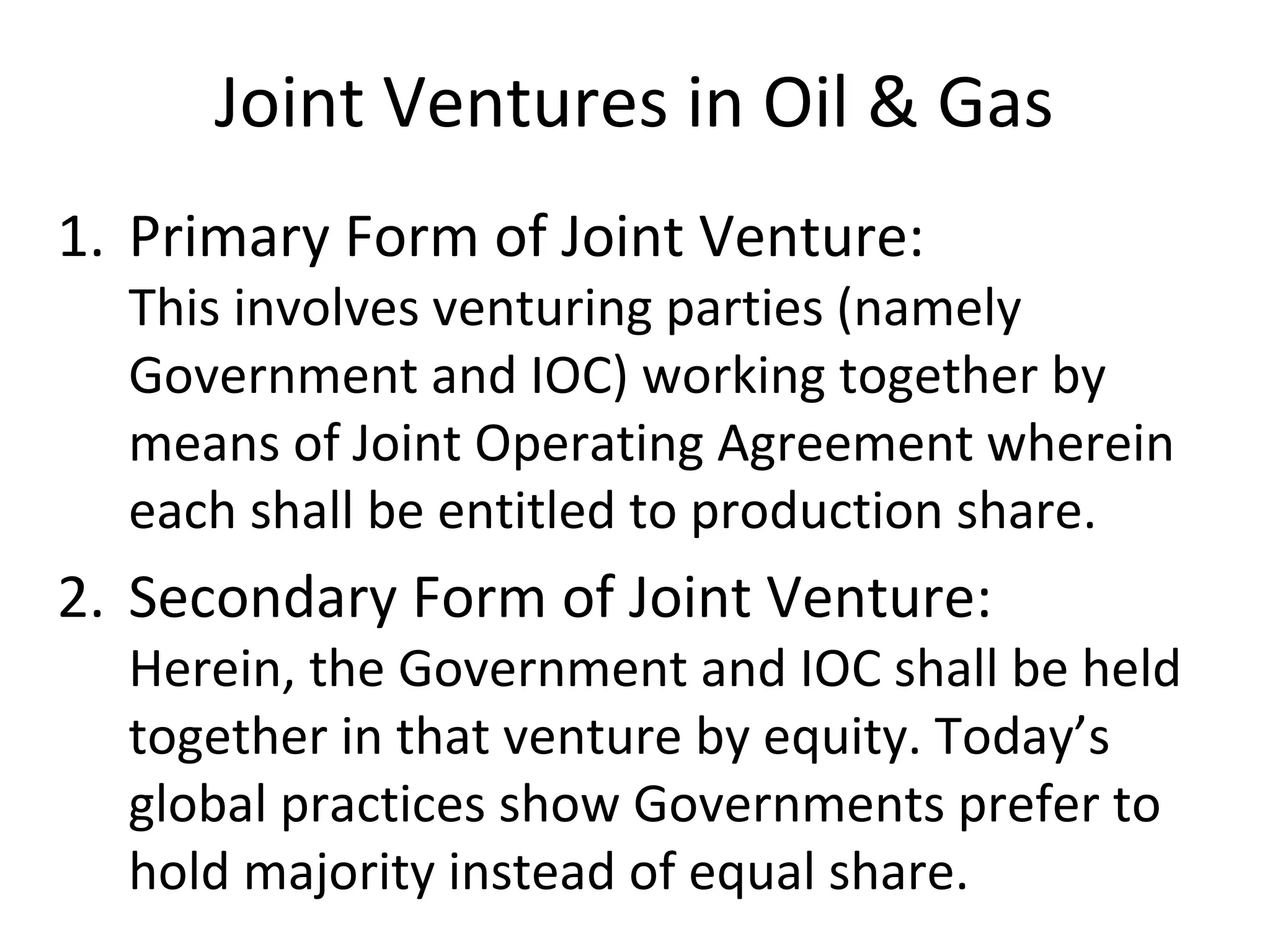
Joint Ventures in Oil & Gas
1. Primary Form of Joint Venture:
This involves venturing parties (namely
Government and IOC) working together by
means of Joint Operating Agreement wherein
each shall be entitled to production share.
2. Secondary Form of Joint Venture:
Herein, the Government and IOC shall be held
together in that venture by equity. Today’s
global practices show Governments prefer to
hold majority instead of equal share.
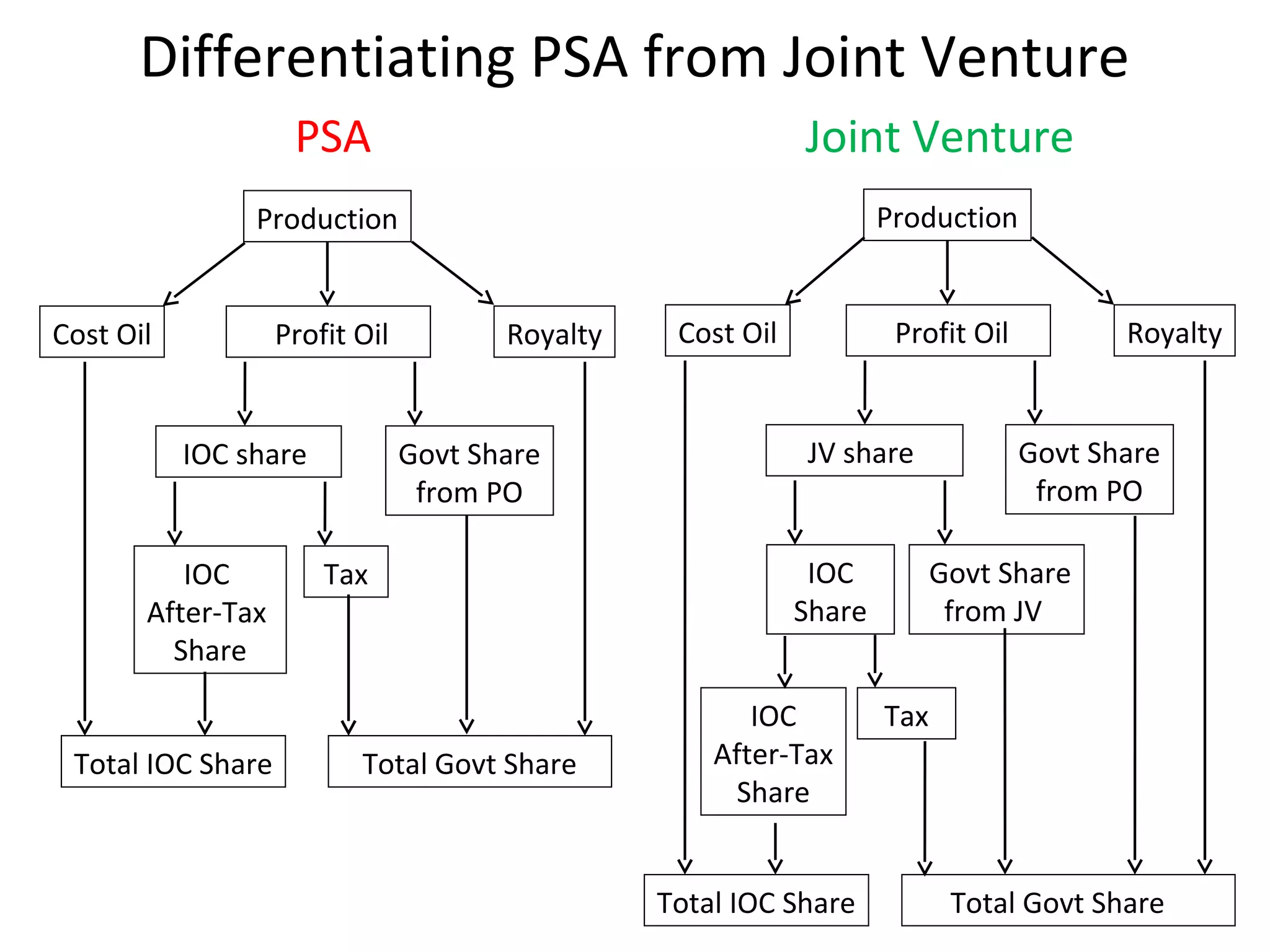
Differentiating PSA from Joint Venture
PSA Joint Venture
Production
Cost Oil Profit Oil Royalty
IOC share Govt Share
from PO
IOC
After-Tax
Share
Tax
Total IOC Share Total Govt Share
Production
Cost Oil Profit Oil Royalty
JV share Govt Share
from PO
IOC
Share
Govt Share
from JV
Total IOC Share Total Govt Share
IOC
After-Tax
Share
Tax
Regional Governments
The search for revenue centres in local
communities spurred regional governments to
take action with the intent of controlling
available mineral resources including oil and
gas.
“The entry of ExxonMobil into the Kurdish oil
market has sent shock waves throughout Iraq's
energy sector and its political classes. The
presence of one of the world's largest
international oil companies (IOCs) in the Kurdistan
Region not only challenges central government
authority but gives the Kurdistan Regional
Government (KRG) greater leverage in developing
its own oil market. More super-major IOCs are
likely to follow, which will further enhance the
recognition and financial rewards for the KRG and
its business partners.”
Source: Denise Natali, The Politics of Kurdish Crude, Middle East Policy Council
Exercise
Compare and Contrast Highlighting Pros and
Cons to Host Government and International Oil
Company.
•Production Sharing Agreements
•Joint Venture
•Pure Service Contracts
Dr Elijah Ezendu is Award-Winning Business Expert & Certified Management Consultant with expertise
in Interim Management, Strategy, Competitive Intelligence, Transformation, Restructuring, Turnaround
Management, Business Development, Marketing, Project & Cost Management, Leadership, HR, CSR, e-
Business & Software Architecture. He had functioned as Founder, Initiative for Sustainable Business
Equity; Chairman of Board, Charisma Broadcast Film Academy; Group Chief Operating Officer, Idova
Group; CEO, Rubiini (UAE); Special Advisor, RTEAN; Director, MMNA Investments; Chair, Int’l Board of
GCC Business Council (UAE); Senior Partner, Shevach Consulting; Chairman (Certification & Training),
Coordinator (Board of Fellows), Lead Assessor & Governing Council Member, Institute of Management
Consultants, Nigeria; Lead Resource, Centre for Competitive Intelligence Development; Lead
Consultant/ Partner, JK Michaels; Turnaround Project Director, Consolidated Business Holdings Limited;
Technical Director, Gestalt; Chief Operating Officer, Rohan Group; Executive Director (Various Roles),
Fortuna, Gambia & Malta; Chief Advisor/ Partner, D & E; Vice Chairman of Board, Refined Shipping;
Director of Programmes & Governing Council Member, Institute of Business Development, Nigeria;
Member of TDD Committee, International Association of Software Architects, USA; Member of Strategic
Planning and Implementation Committee, Chartered Institute of Personnel Management of Nigeria;
Country Manager (Nigeria) & Adjunct Faculty (MBA Programme), Regent Business School, South Africa;
Adjunct Faculty (MBA Programme), Ladoke Akintola University of Technology; Editor-in-Chief, Cost
Management Journal; Council Member, Institute of Internal Auditors of Nigeria; Member, Board of
Directors (Several Organizations). He holds Doctoral Degree in Management, Master of Business
Administration and Fellow of Professional Institutes in North America, UK & Nigeria. He is Innovator of
Corporate Investment Structure Based on Financials and Intangibles, for valuation highlighting
intangible contributions of host communities and ecological environment: A model celebrated globally
as remedy for unmitigated depreciation of ecological capital and developmental deprivation of host
communities. He had served as Examiner to Professional Institutes and Universities. He had been a
member of Guild of Soundtrack Producers of Nigeria. He's an author and extensively featured speaker.
Thank You

Production Agreements, Oil Service Contracts & Joint Ventures

  • 1.
    Production Agreements, Oil ServiceContracts & Joint Ventures Dr. Elijah Ezendu FIMC, FCCM, FIIAN, FBDI, FAAFM, FSSM, MIMIS, MIAP, MITD, ACIArb, ACIPM, PhD, DocM, MBA, CWM, CBDA, CMA, MPM, PME, CSOL, CCIP, CMC, CMgr
  • 2.
    Production Sharing Agreement Productionsharing agreement is a contract between an oil company and government of a country stipulating the oil company bear responsibility for exploration and production. On successful production, the oil company would be expected to take the cost oil (for equity and operational expenditure), while the remaining would be identified as profit oil (for sharing between government and oil company at a specified ratio). The oil company shall bear the investment risk.
  • 3.
    “Production-Sharing Agreements (PSAs)are among the most common types of contractual arrangements for petroleum exploration and development. Under a PSA the state as the owner of mineral resources engages a foreign oil company (FOC) as a contractor to provide technical and financial services for exploration and development operations. The state is traditionally represented by the government or one of its agencies such as the national oil company (NOC). The FOC acquires an entitlement to a stipulated share of the oil produced as a reward for the risk taken and services rendered. The state, however, remains the owner of the petroleum produced subject only to the contractor's entitlement to its share of production. The government or its NOC usually has the option to participate in different aspects of the exploration and development process. In addition, PSAs frequently provide for the establishment of a joint committee where both parties are represented and which monitors the operations.” Source: Kirsten Bindemann, Production Sharing Agreements: An Economic Analysis
  • 4.
    Total Produced Oil TotalProduced oil should be systematically apportioned in accordance with tenets and stipulations of production sharing contract. Cost Oil (To Oil Company For Expenditure) + Profit Oil (To be Shared btw Govt and Oil Company) Cost Oil (To Oil Company For Operation Cost) + Equity Oil (To Oil Company For ROI) + Profit Oil (To be Shared btw Govt and Oil Company) Total Produced Oil = Total Produced Oil = Format A Format B
  • 5.
    History of SimpleOil Mining Agreements
  • 6.
    Production Sharing RevenueFlow Source: World Bank, Contracts for Petroleum Development
  • 7.
    Elements of ProductionSharing Contract • Royalty • Tax • Cost Oil • Bonus • Profit Oil • Validation of Commerciality • Domestic Market Obligation • Work Programme • Local Content • Participation • Duration of Contract
  • 8.
    Royalty • Royalty • NoRoyalty • Sliding Scale Royalty
  • 9.
    Tax • No Tax •Progressive Tax • Fixed Tax
  • 10.
    Cost Oil • NoCost Oil • Low Cost Oil • Fixed Cost Oil • R-Factor Based Cost Oil • Unlimited Cost Oil R-Factor refers to Ratio of Cumulative Receipts to Cumulative Expenditure R-Factor = Cumulative Receipts Cumulative Expenditure
  • 11.
    Bonus • Fixed ProductionBonus • Sliding Scale Production Bonus • Signature Bonus • No Signature Bonus • Discovery Bonus • No Discovery Bonus
  • 12.
    Profit Oil • LowProfit Oil • Fixed Profit Oil • Volume Based Profit Oil • R-Factor Based Profit Oil
  • 13.
    Factors that AffectScope of Incentives, Risk & Reward • Influence • Negotiation Competence • Brand Value • Bilateral Intergovernmental Treaties • Bargaining Power • National Legal Provision • Former Relationship Leverage
  • 14.
    General Risk &Uncertainty in Oil and Gas Exploration, Development & Production • Size of Resource at Site • Commercial Feasibility • Status of Deposit as Oil or Gas • Finding Additional Fields • Change in Local Law • Political Instability • Technology Required • Disenfranchisement of Operating Community • Price Fluctuation
  • 15.
    Models of Principal-AgentRelationships Between IOC and Government Simple Complex Government International Oil Company Government International Oil Company National Oil Company Very Complex Government NOC Regulatory Dept. International Oil Company
  • 16.
    Service Contracts Service Contractsprovide for a Host Government to have greatest control of the oil and only assign work to contracting firm. The Host Government must have the following: •Technological know-how and do-how •Financial Capacity
  • 17.
    Types of ServiceContracts Technical Assistance Contract •Provision of Technical Service Without Bearing Any Risk •Lean Scope •Contracting Firm cannot have interest in the oil Pure Service Contract (PSC) •Provision of Service Without Bearing Risk •Can have Broad Scope •Compensation to Contractor can be Cash or Oil Risk Service Contract (RSC) aka BOOT •Provision of Service with Great Risk: Failure to Get Exploitable Discovery Imply Lost Fund while Positive Discovery Means Compensation & Possibility of Equity Option. •Can have Broad Scope •Provision of Great Flexibility to Host Government
  • 18.
    “Alliances are institutionalarrangements that combine resources and governance forms of several partnering organizations, making them mutually interdependent.” Source: Inkpen
  • 19.
  • 20.
    Alliance Stability Modelby Elijah Ezendu
  • 21.
    Short Long None High DurationofCommitment Extent ofJoint Decision-Making One-off arms length purchase Competitive Suppliers Joint R & D Preferred Suppliers Co-Marketing Joint Production Equity Joint Ventures Mergers & Acquisition Full Integration Alliance Market Exchange Minority Investment Types of Inter-Firm Relationships Outsourcing
  • 22.
    Equity Joint Venture& Joint Production as Apex Alliances Joint R & D Preferred Suppliers Co-Marketing Joint Production Equity Joint Ventures Minority Investment Outsourcing DurationofCommitment Extent of Joint Decision-Making Long Short None High Source: Elijah Ezendu, Alliance Development The Region of Apex Alliances
  • 23.
    Joint Ventures inOil & Gas 1. Primary Form of Joint Venture: This involves venturing parties (namely Government and IOC) working together by means of Joint Operating Agreement wherein each shall be entitled to production share. 2. Secondary Form of Joint Venture: Herein, the Government and IOC shall be held together in that venture by equity. Today’s global practices show Governments prefer to hold majority instead of equal share.
  • 24.
    Differentiating PSA fromJoint Venture PSA Joint Venture Production Cost Oil Profit Oil Royalty IOC share Govt Share from PO IOC After-Tax Share Tax Total IOC Share Total Govt Share Production Cost Oil Profit Oil Royalty JV share Govt Share from PO IOC Share Govt Share from JV Total IOC Share Total Govt Share IOC After-Tax Share Tax
  • 25.
    Regional Governments The searchfor revenue centres in local communities spurred regional governments to take action with the intent of controlling available mineral resources including oil and gas.
  • 26.
    “The entry ofExxonMobil into the Kurdish oil market has sent shock waves throughout Iraq's energy sector and its political classes. The presence of one of the world's largest international oil companies (IOCs) in the Kurdistan Region not only challenges central government authority but gives the Kurdistan Regional Government (KRG) greater leverage in developing its own oil market. More super-major IOCs are likely to follow, which will further enhance the recognition and financial rewards for the KRG and its business partners.” Source: Denise Natali, The Politics of Kurdish Crude, Middle East Policy Council
  • 27.
    Exercise Compare and ContrastHighlighting Pros and Cons to Host Government and International Oil Company. •Production Sharing Agreements •Joint Venture •Pure Service Contracts
  • 28.
    Dr Elijah Ezenduis Award-Winning Business Expert & Certified Management Consultant with expertise in Interim Management, Strategy, Competitive Intelligence, Transformation, Restructuring, Turnaround Management, Business Development, Marketing, Project & Cost Management, Leadership, HR, CSR, e- Business & Software Architecture. He had functioned as Founder, Initiative for Sustainable Business Equity; Chairman of Board, Charisma Broadcast Film Academy; Group Chief Operating Officer, Idova Group; CEO, Rubiini (UAE); Special Advisor, RTEAN; Director, MMNA Investments; Chair, Int’l Board of GCC Business Council (UAE); Senior Partner, Shevach Consulting; Chairman (Certification & Training), Coordinator (Board of Fellows), Lead Assessor & Governing Council Member, Institute of Management Consultants, Nigeria; Lead Resource, Centre for Competitive Intelligence Development; Lead Consultant/ Partner, JK Michaels; Turnaround Project Director, Consolidated Business Holdings Limited; Technical Director, Gestalt; Chief Operating Officer, Rohan Group; Executive Director (Various Roles), Fortuna, Gambia & Malta; Chief Advisor/ Partner, D & E; Vice Chairman of Board, Refined Shipping; Director of Programmes & Governing Council Member, Institute of Business Development, Nigeria; Member of TDD Committee, International Association of Software Architects, USA; Member of Strategic Planning and Implementation Committee, Chartered Institute of Personnel Management of Nigeria; Country Manager (Nigeria) & Adjunct Faculty (MBA Programme), Regent Business School, South Africa; Adjunct Faculty (MBA Programme), Ladoke Akintola University of Technology; Editor-in-Chief, Cost Management Journal; Council Member, Institute of Internal Auditors of Nigeria; Member, Board of Directors (Several Organizations). He holds Doctoral Degree in Management, Master of Business Administration and Fellow of Professional Institutes in North America, UK & Nigeria. He is Innovator of Corporate Investment Structure Based on Financials and Intangibles, for valuation highlighting intangible contributions of host communities and ecological environment: A model celebrated globally as remedy for unmitigated depreciation of ecological capital and developmental deprivation of host communities. He had served as Examiner to Professional Institutes and Universities. He had been a member of Guild of Soundtrack Producers of Nigeria. He's an author and extensively featured speaker.
  • 29.