After Dark
Generating High-Quality Recommendations using
Real-time Advanced Analytics and Machine Learning with
Chris Fregly
Data Solutions Engineer @ Databricks
Who am I?
2
Data Platform Engineer
playboy.com
Streaming Platform Engineer
NetflixOSS Committer
netflix.com, github.com/Netflix
Data Solutions Engineer
Apache Spark Contributor
databricks.com, github.com/apache/spark
Why After Dark?
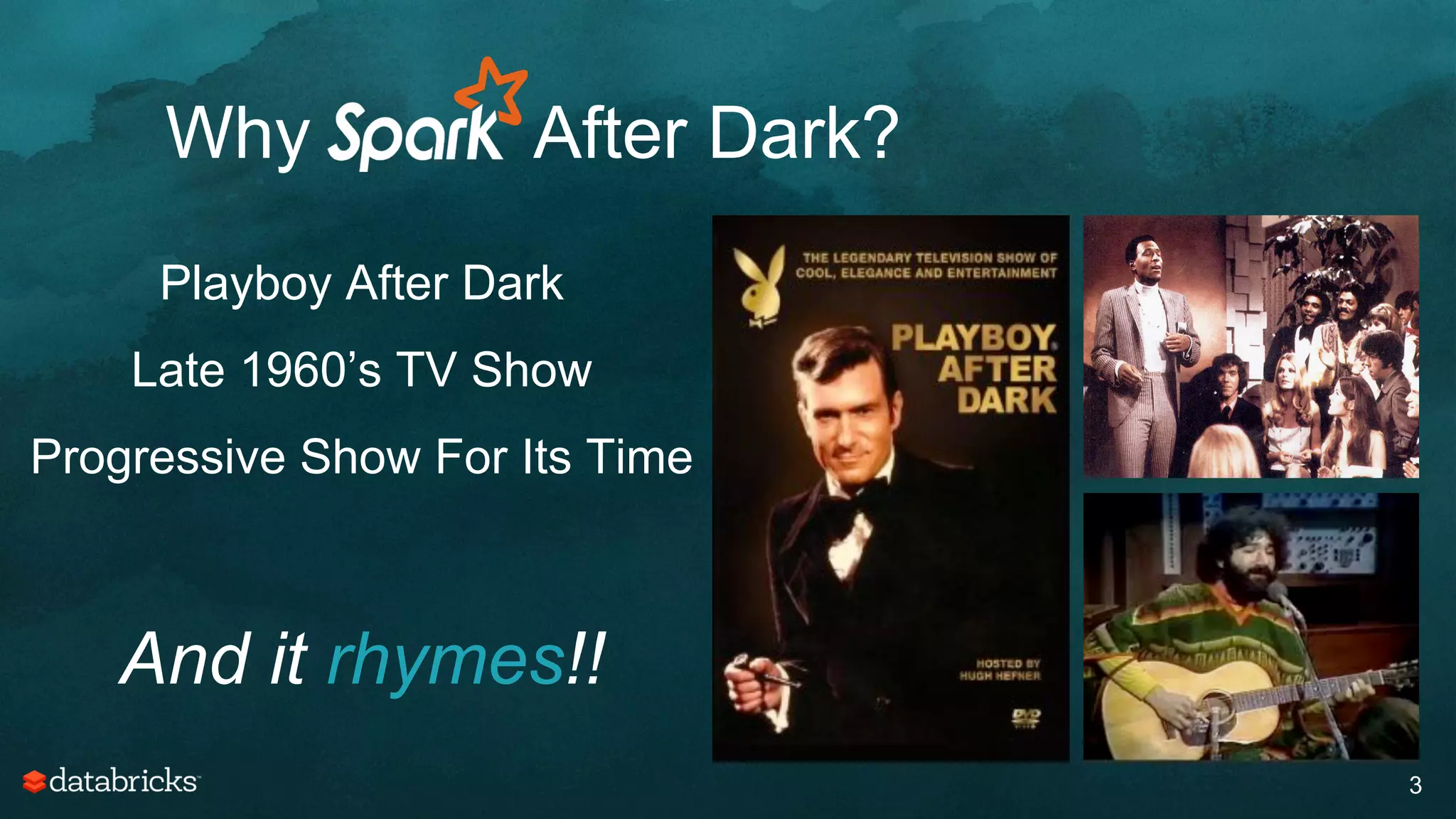
Playboy After Dark
Late 1960’s TV Show
Progressive Show For Its Time
And it rhymes!!
3
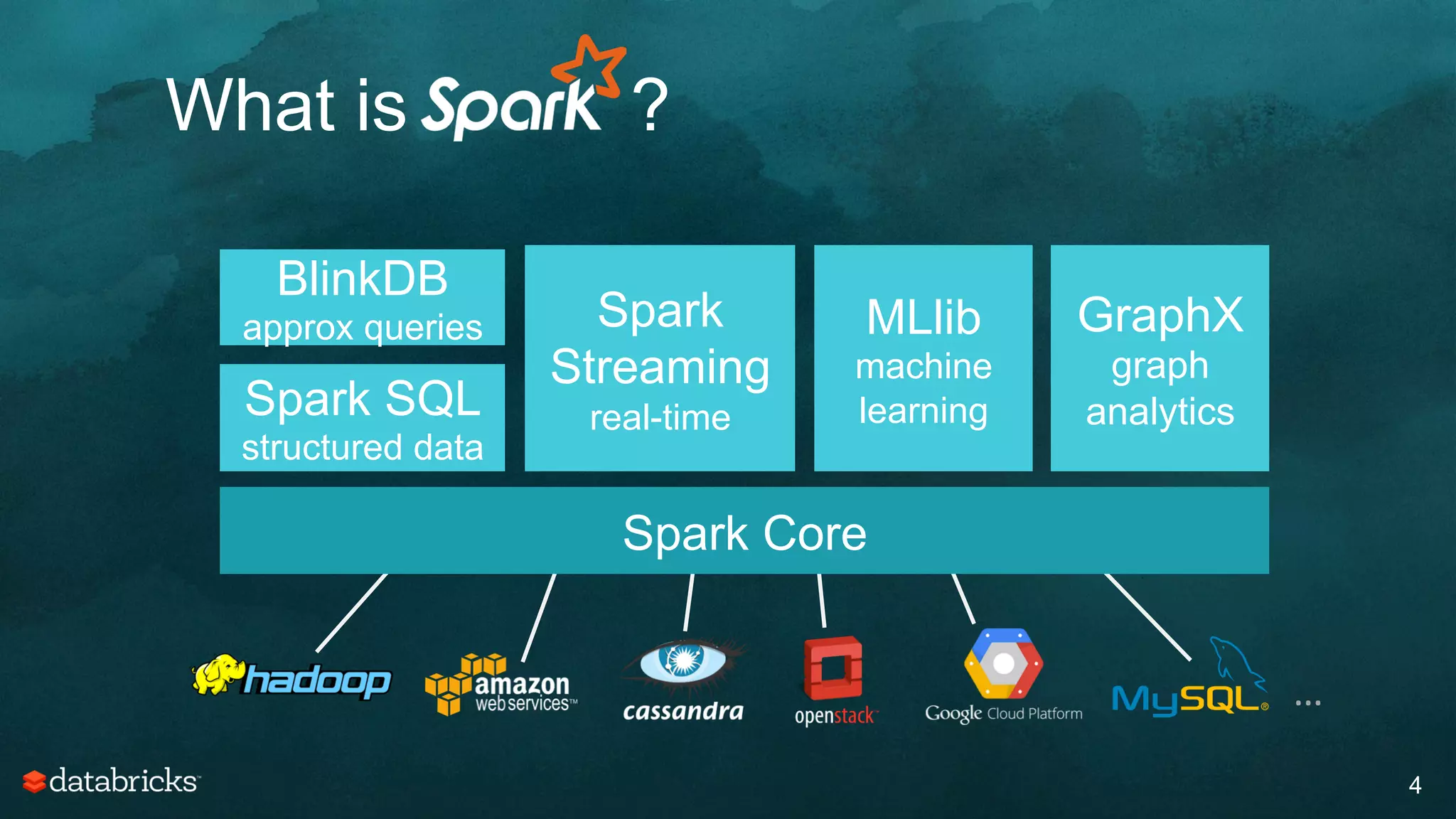
What is ?
4
Spark Core
Spark
Streaming
real-timeSpark SQL
structured data
MLlib
machine
learning
GraphX
graph
analytics
…	
  
BlinkDB
approx queries
in Production
5
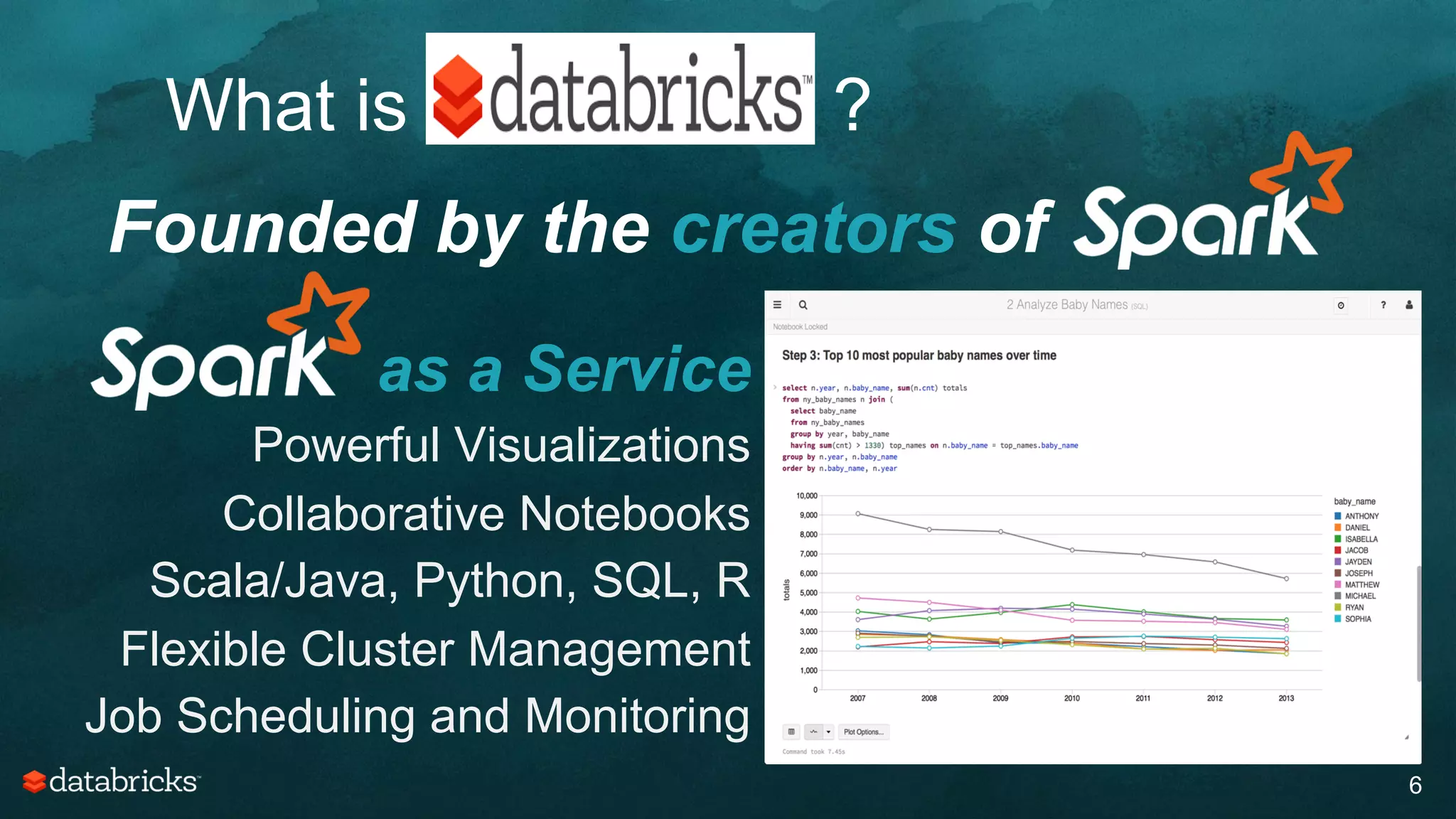
What is ?
6
Founded by the creators of
as a Service
Powerful Visualizations
Collaborative Notebooks
Scala/Java, Python, SQL, R
Flexible Cluster Management
Job Scheduling and Monitoring
in Production
7
8
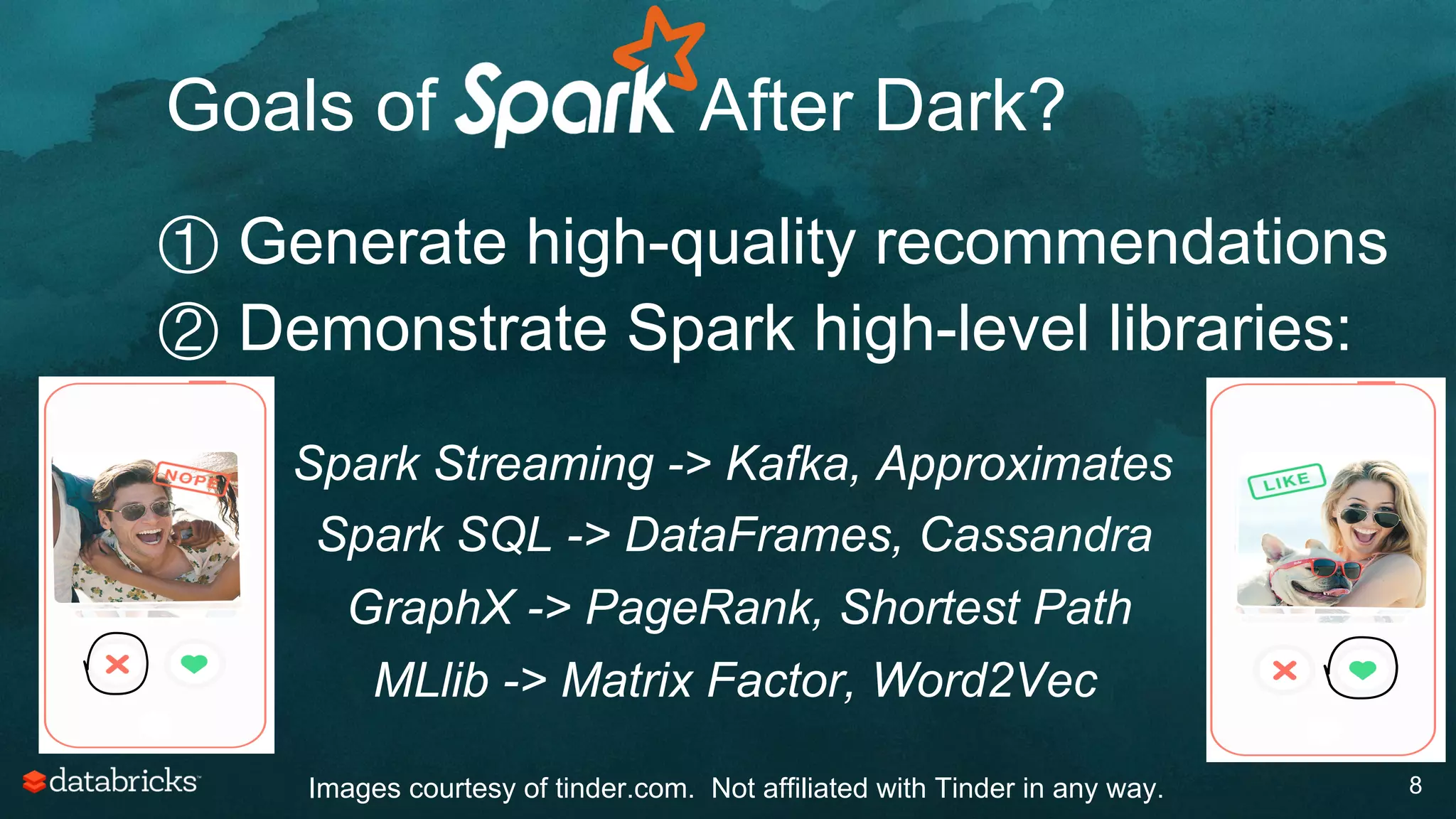
① Generate high-quality recommendations
② Demonstrate Spark high-level libraries:
③  Spark Streaming -> Kafka, Approximates
④  Spark SQL -> DataFrames, Cassandra
①  GraphX -> PageRank, Shortest Path
①  MLlib -> Matrix Factor, Word2Vec
Goals of After Dark?
Images courtesy of tinder.com. Not affiliated with Tinder in any way.
Popular Dating Sites
9
Themes of this Talk
10
① Performance
② Parallelism
③ Columnar Storage
④ Approximations
⑤ Similarity
⑥ Minimize Shuffle
Performance
11
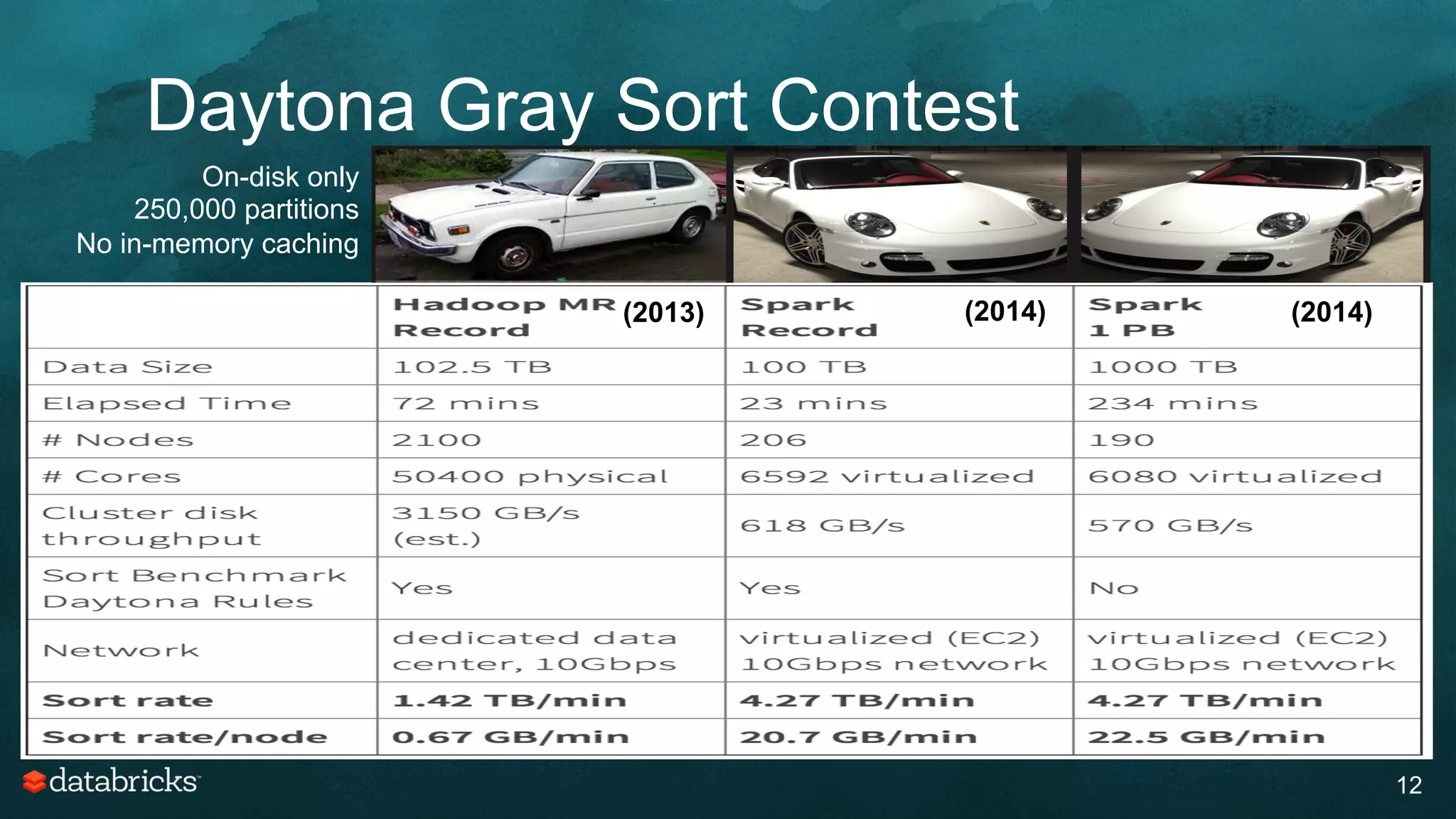
Daytona Gray Sort Contest
12
On-disk only
250,000 partitions
No in-memory caching
(2014)(2013) (2014)
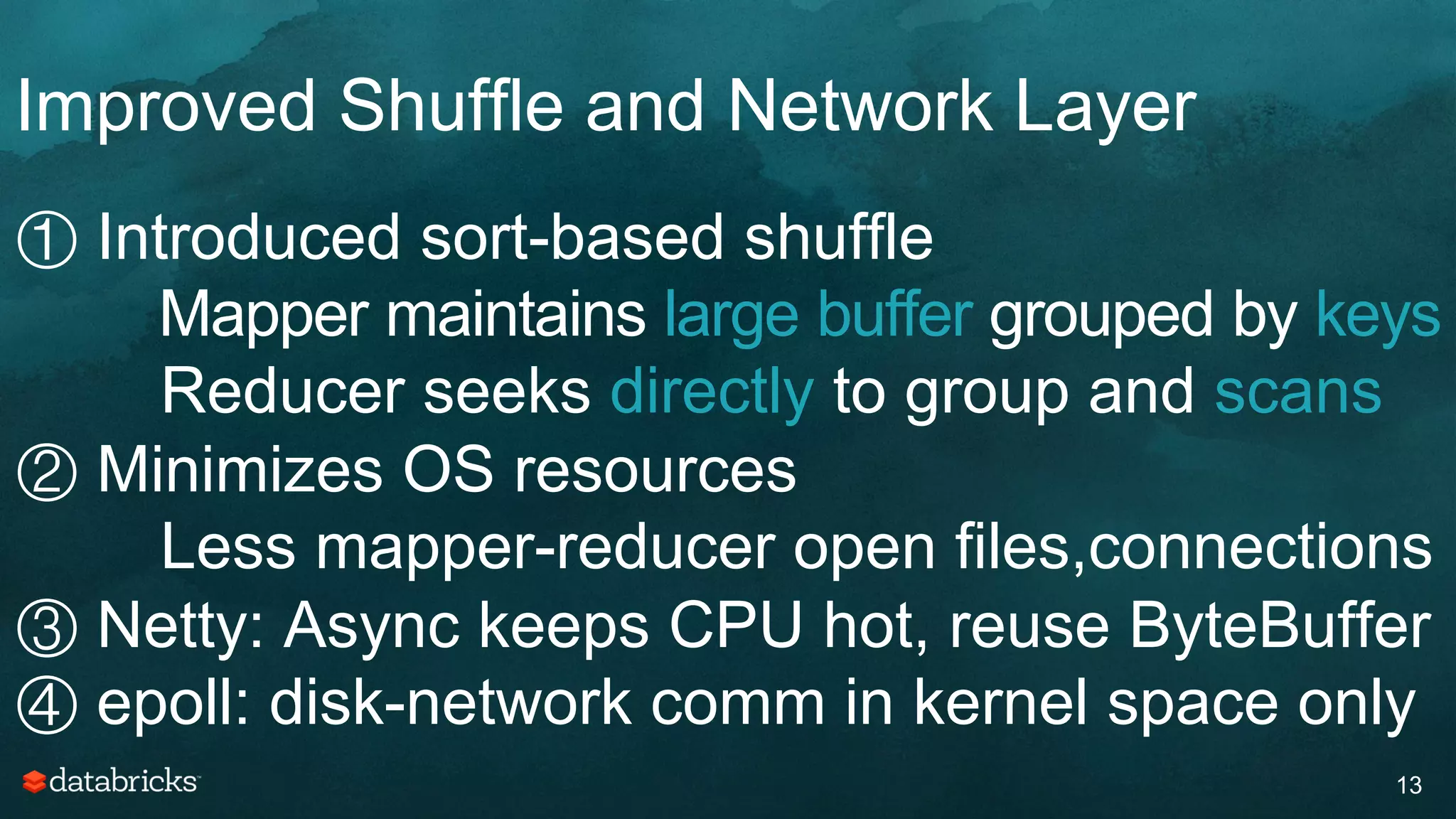
Improved Shuffle and Network Layer
13
① Introduced sort-based shuffle
Mapper maintains large buffer grouped by keys
Reducer seeks directly to group and scans
② Minimizes OS resources
Less mapper-reducer open files,connections
③ Netty: Async keeps CPU hot, reuse ByteBuffer
④ epoll: disk-network comm in kernel space only
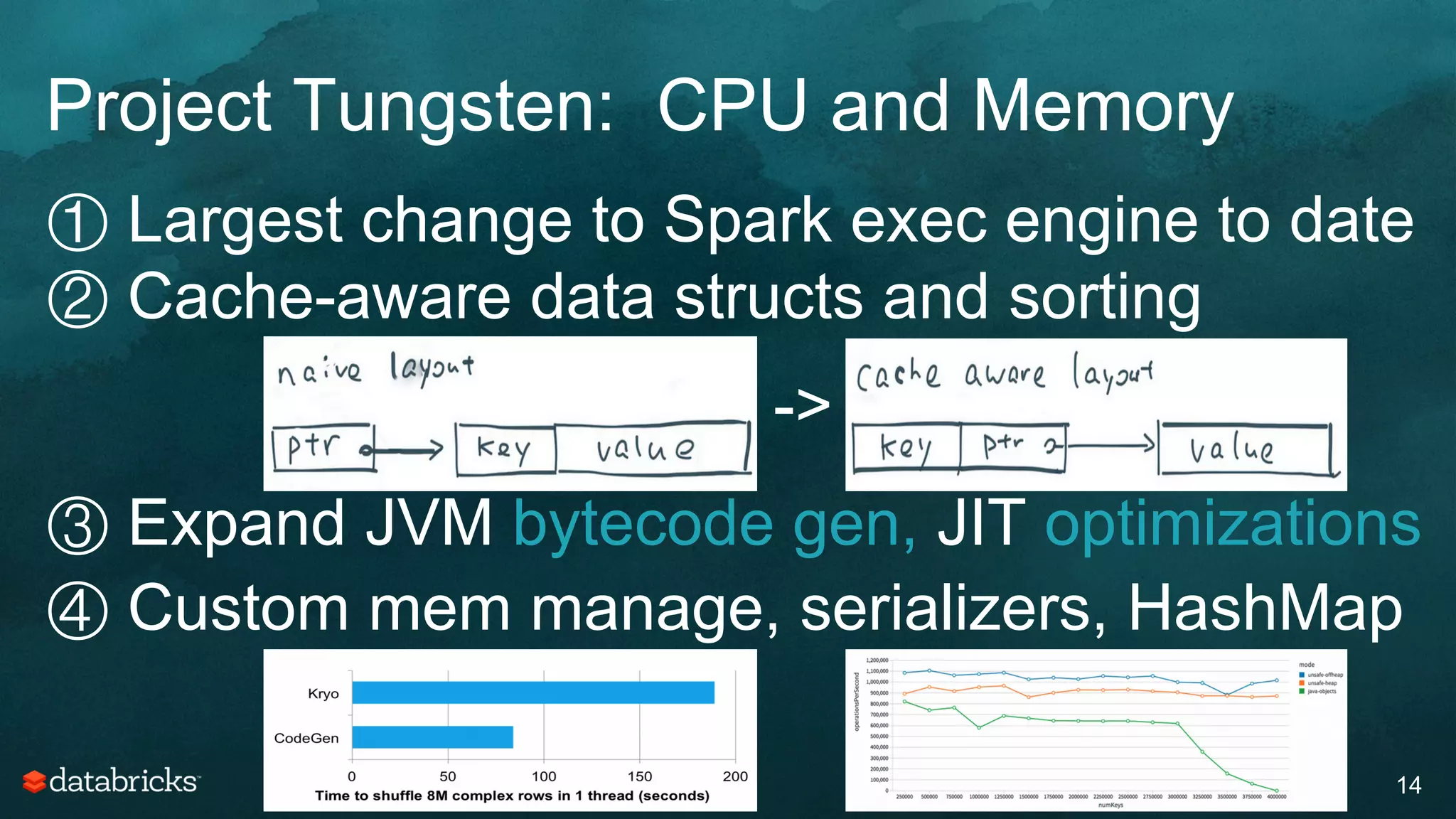
Project Tungsten: CPU and Memory
14
① Largest change to Spark exec engine to date
② Cache-aware data structs and sorting
->
③ Expand JVM bytecode gen, JIT optimizations
④ Custom mem manage, serializers, HashMap
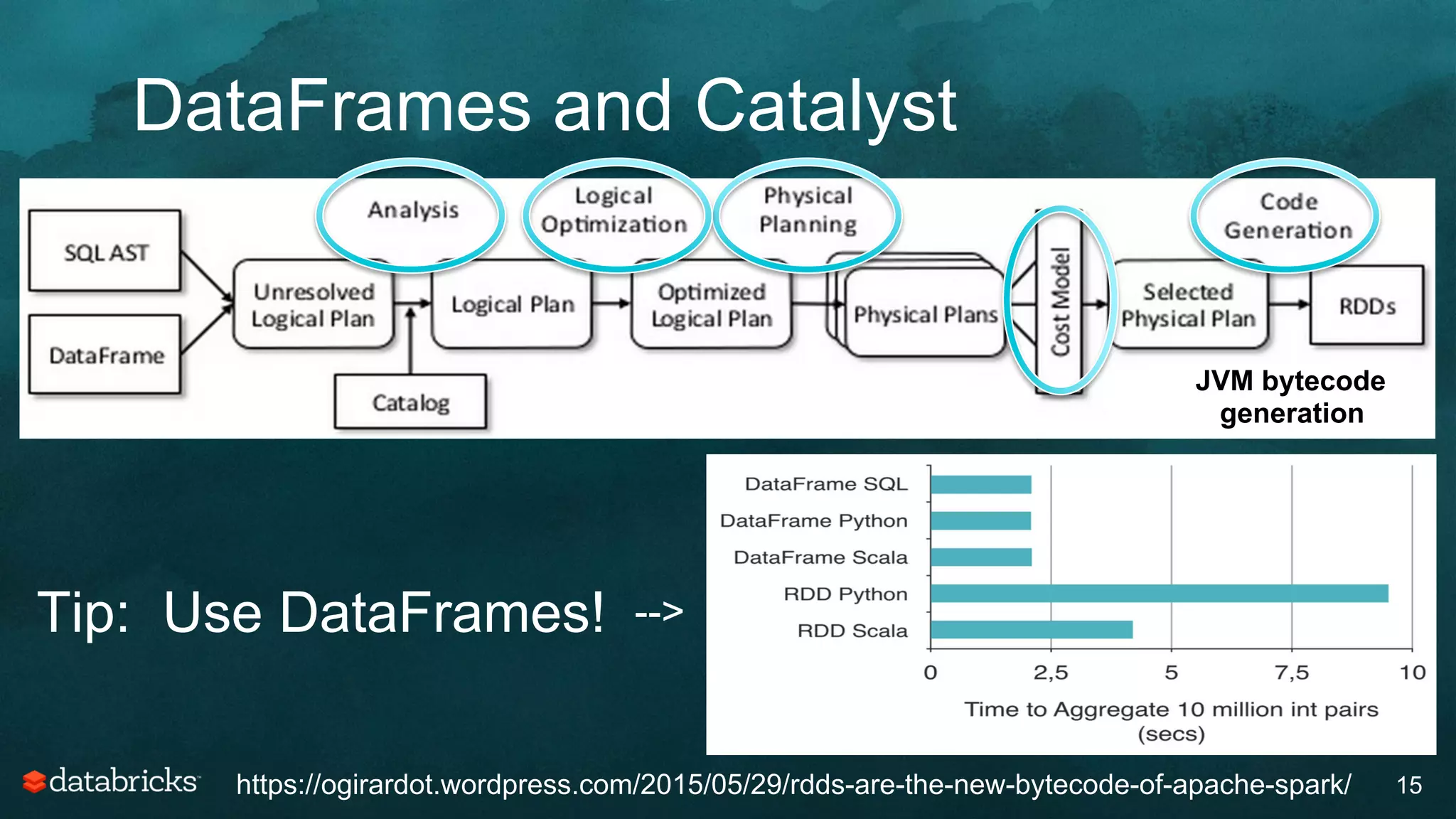
DataFrames and Catalyst
15
15
https://ogirardot.wordpress.com/2015/05/29/rdds-are-the-new-bytecode-of-apache-spark/
Tip: Use DataFrames! -->
JVM bytecode
generation
Parallelism
16
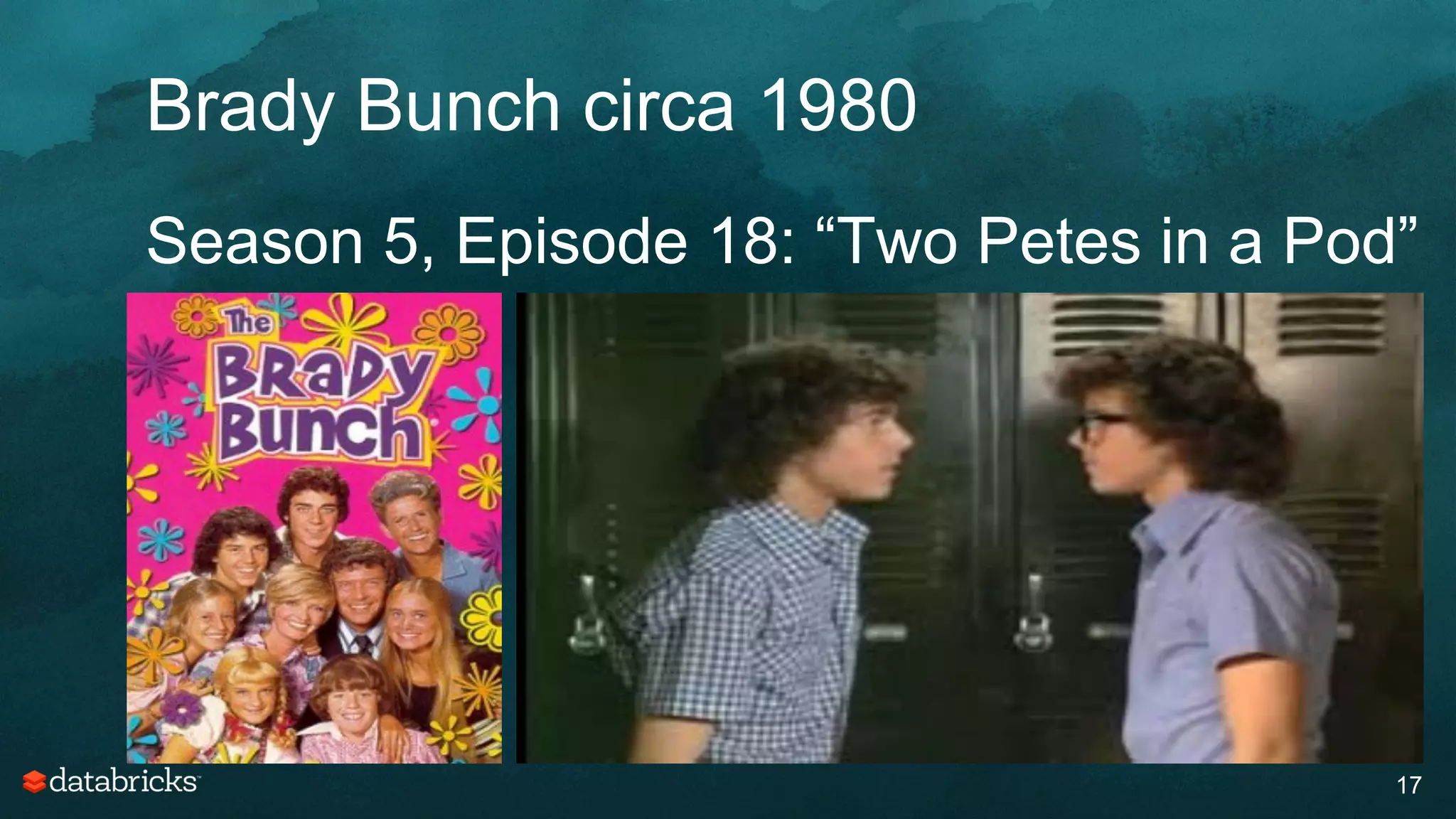
Brady Bunch circa 1980
17
Season 5, Episode 18: “Two Petes in a Pod”
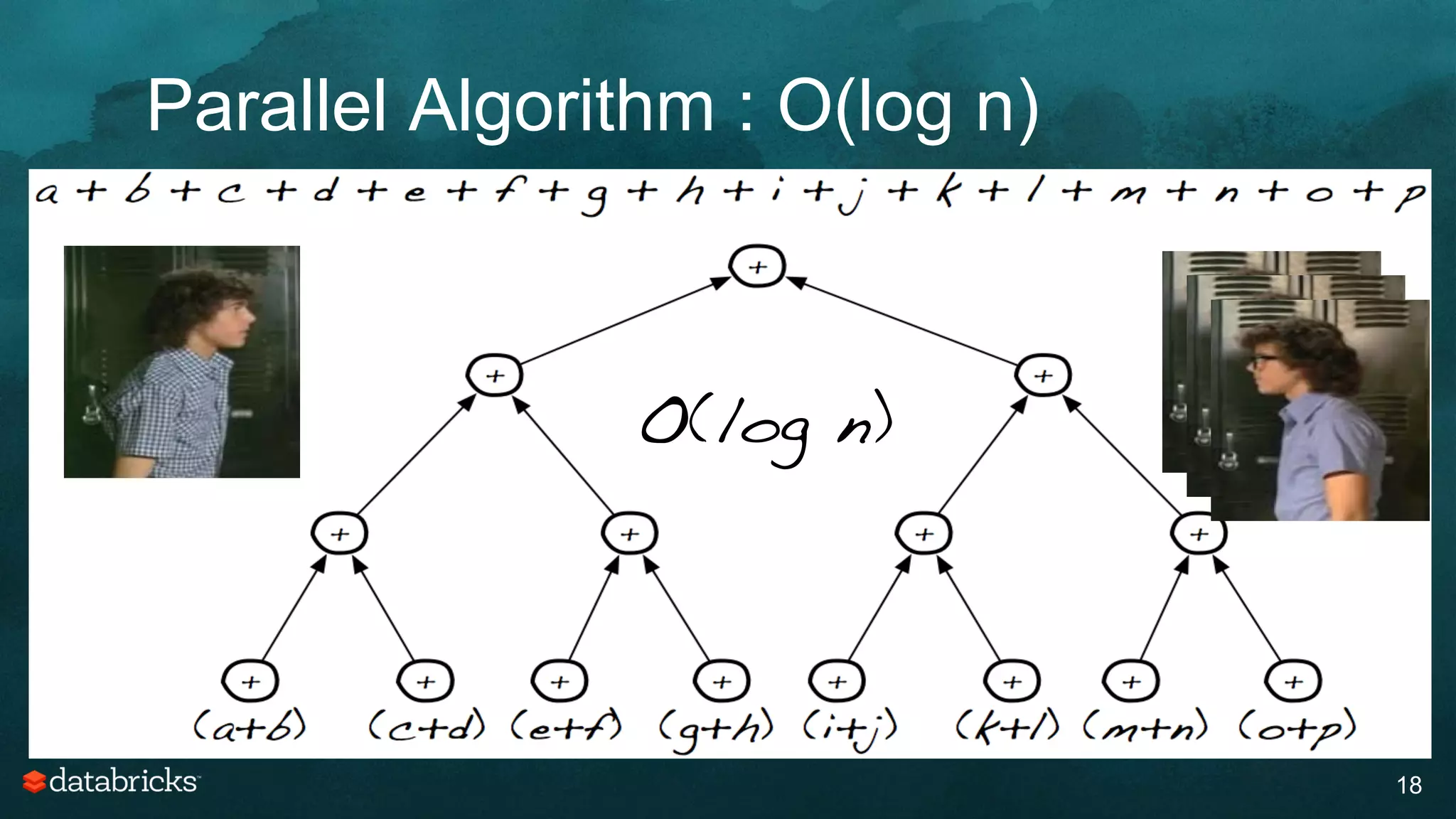
Parallel Algorithm : O(log n)
18
O(log n)
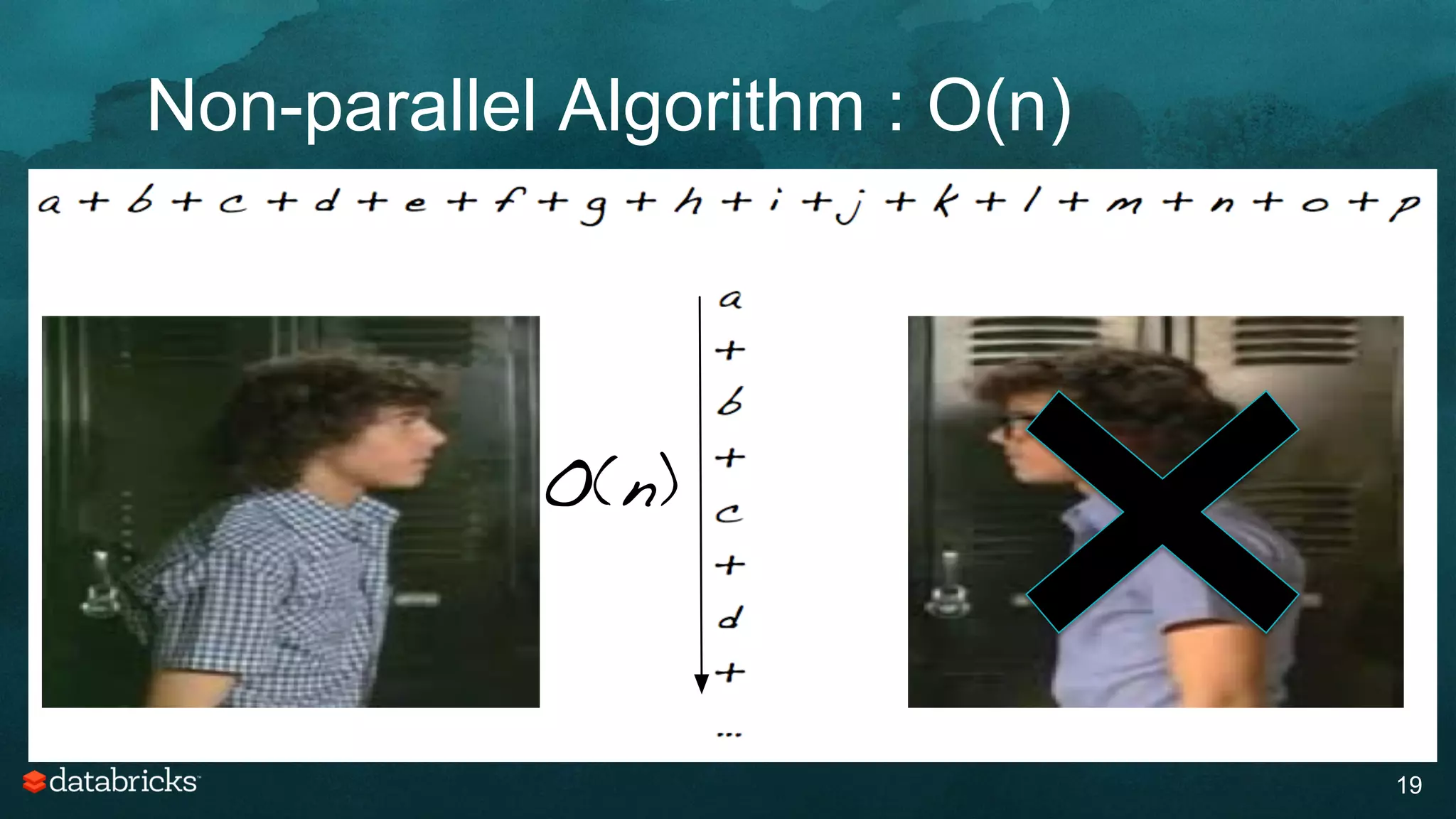
Non-parallel Algorithm : O(n)
19
O(n)
Columnar Storage
20
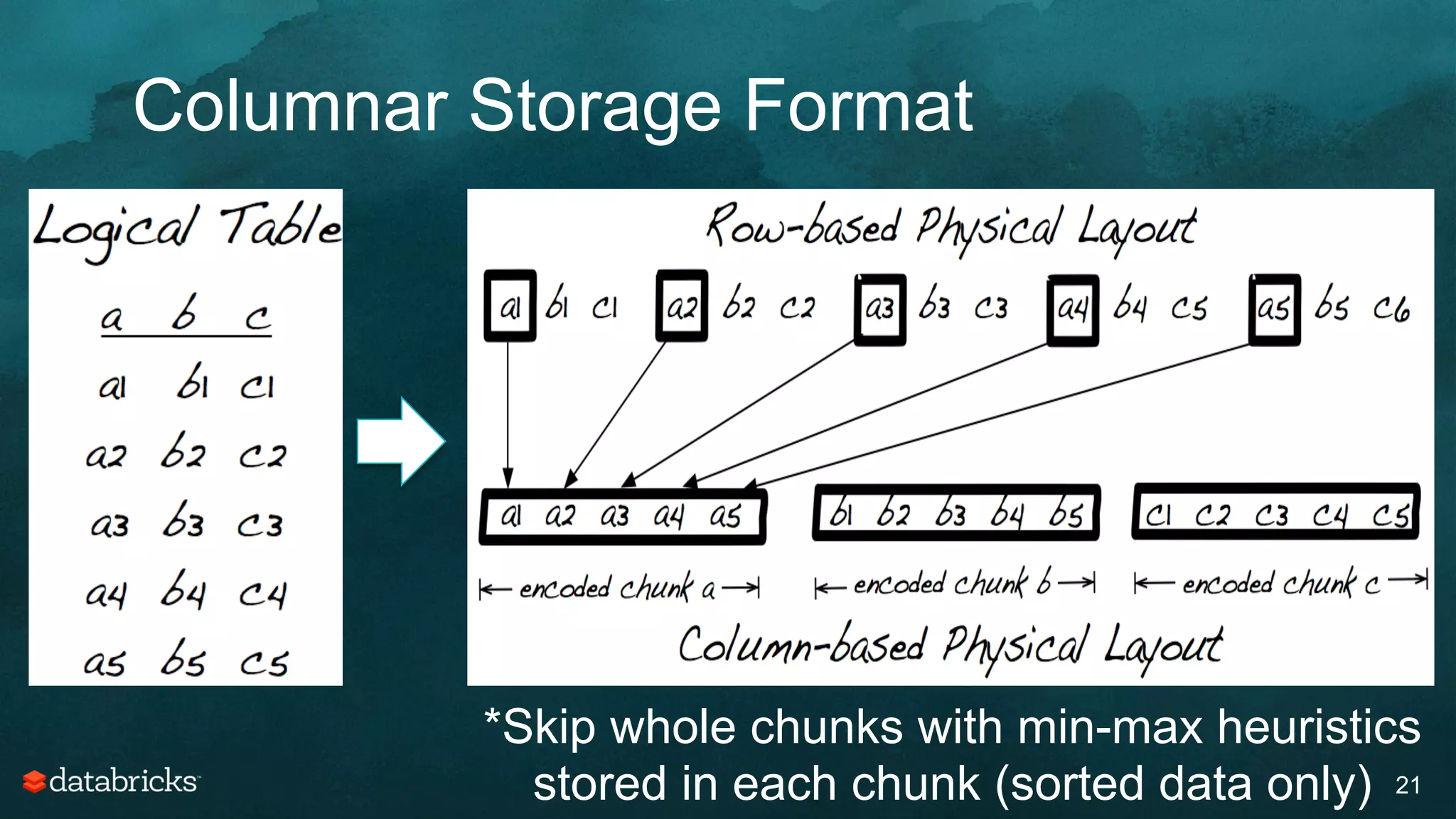
Columnar Storage Format
21
*Skip whole chunks with min-max heuristics
stored in each chunk (sorted data only)
Parquet File Format
22
① Based on Google Dremel Paper
② Implemented by Twitter and Cloudera
③ Columnar storage format
④ Optimized for fast columnar aggregations
⑤ Tight compression
⑥ Supports pushdowns
⑦ Nested, self-describing, evolving schema
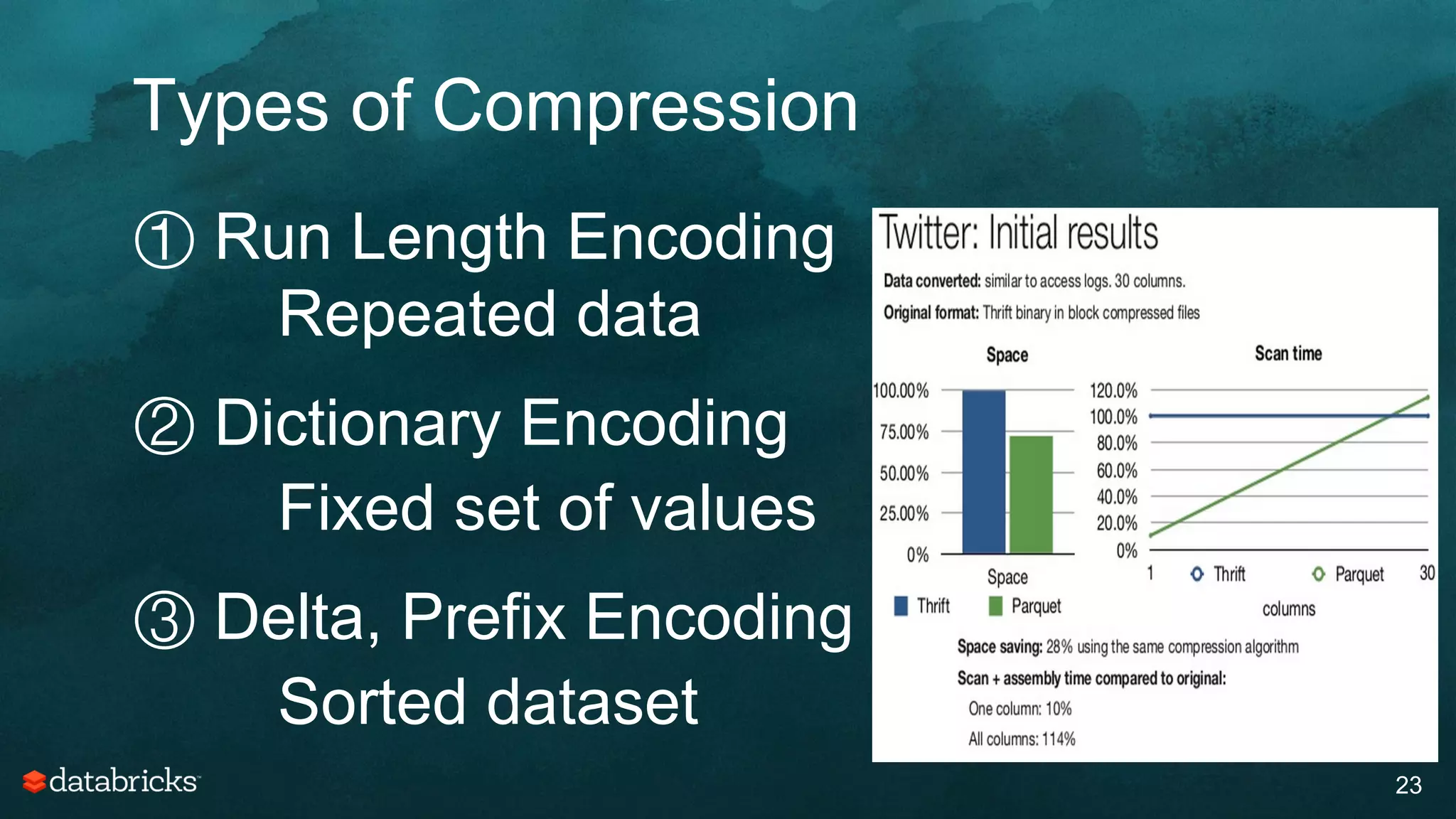
Types of Compression
23
① Run Length Encoding
Repeated data
② Dictionary Encoding
Fixed set of values
③ Delta, Prefix Encoding
Sorted dataset
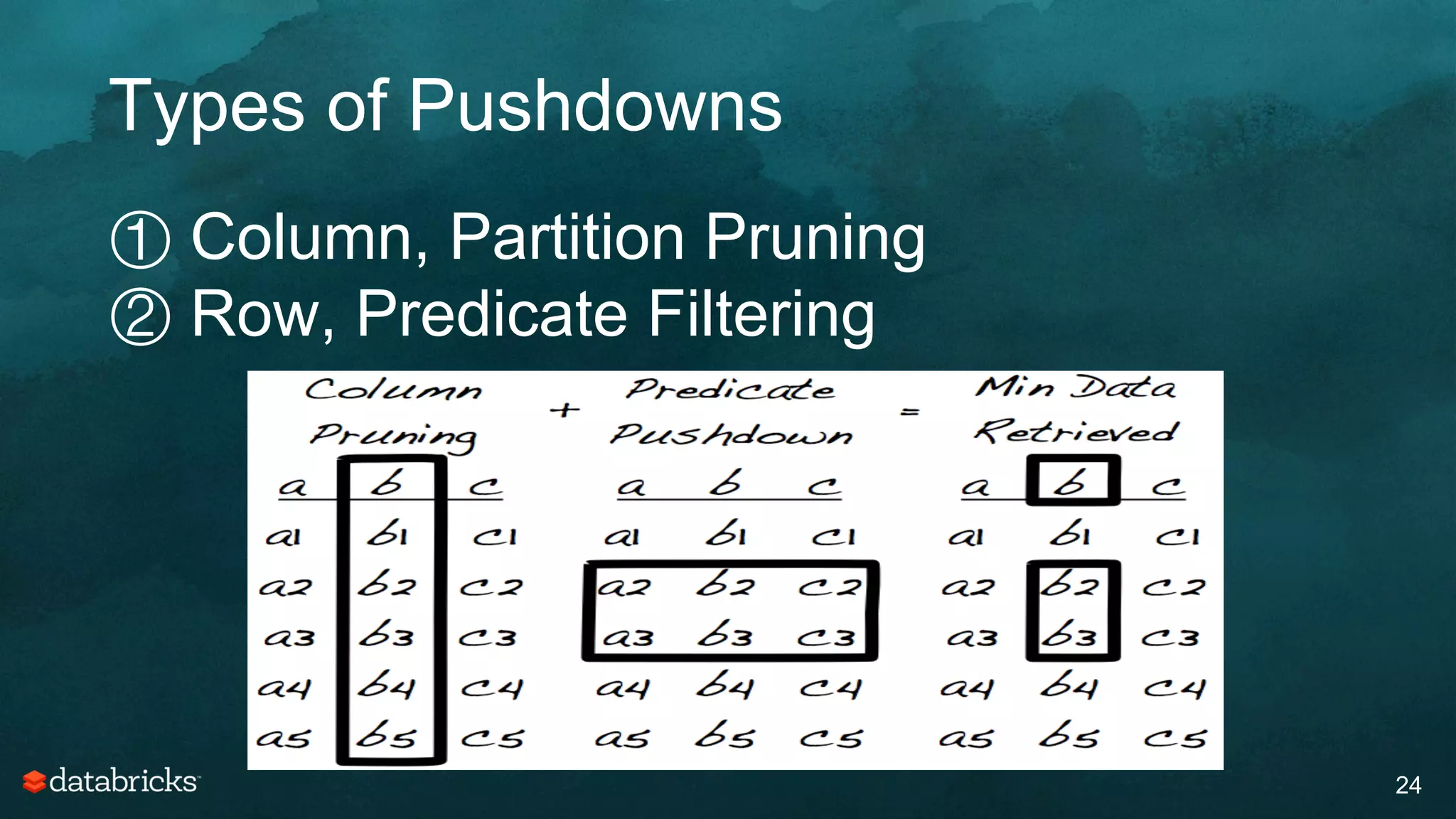
Types of Pushdowns
24
① Column, Partition Pruning
② Row, Predicate Filtering
Approximations
25
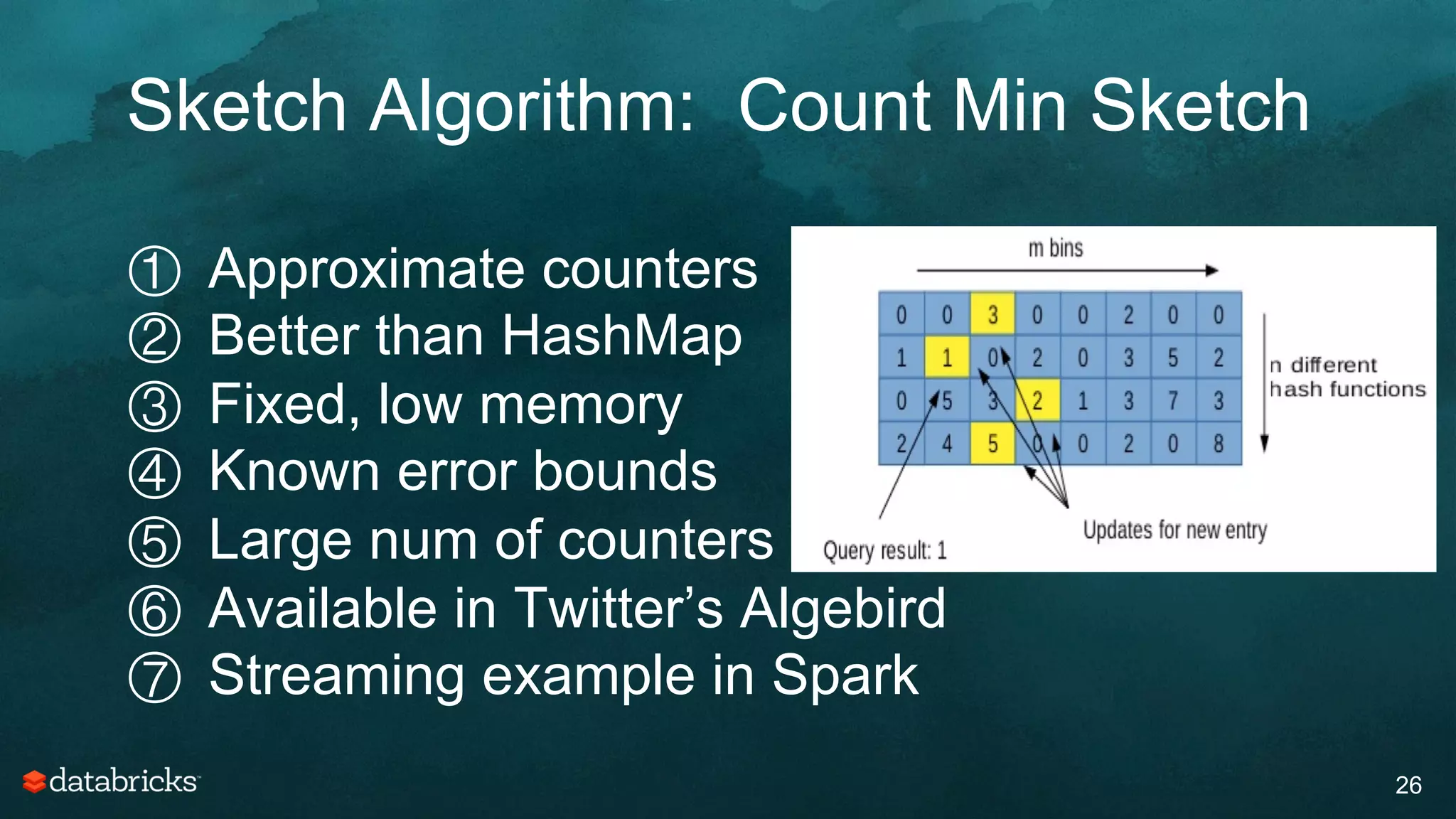
Sketch Algorithm: Count Min Sketch
26
①  Approximate counters
②  Better than HashMap
③  Fixed, low memory
④  Known error bounds
⑤  Large num of counters
⑥  Available in Twitter’s Algebird
⑦  Streaming example in Spark
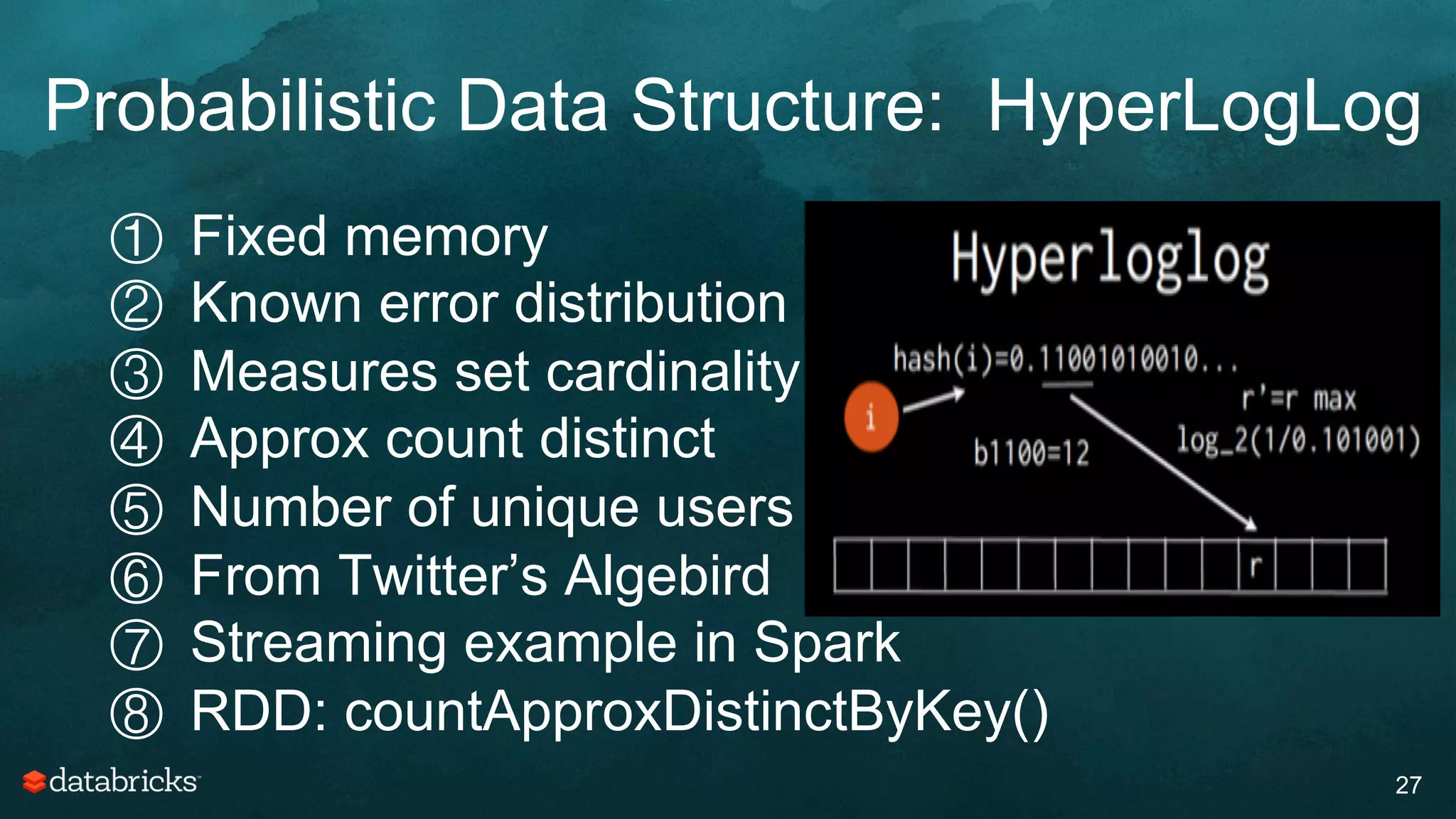
Probabilistic Data Structure: HyperLogLog
27
①  Fixed memory
②  Known error distribution
③  Measures set cardinality
④  Approx count distinct
⑤  Number of unique users
⑥  From Twitter’s Algebird
⑦  Streaming example in Spark
⑧  RDD: countApproxDistinctByKey()
Similarity
28
Types of Similarity
29
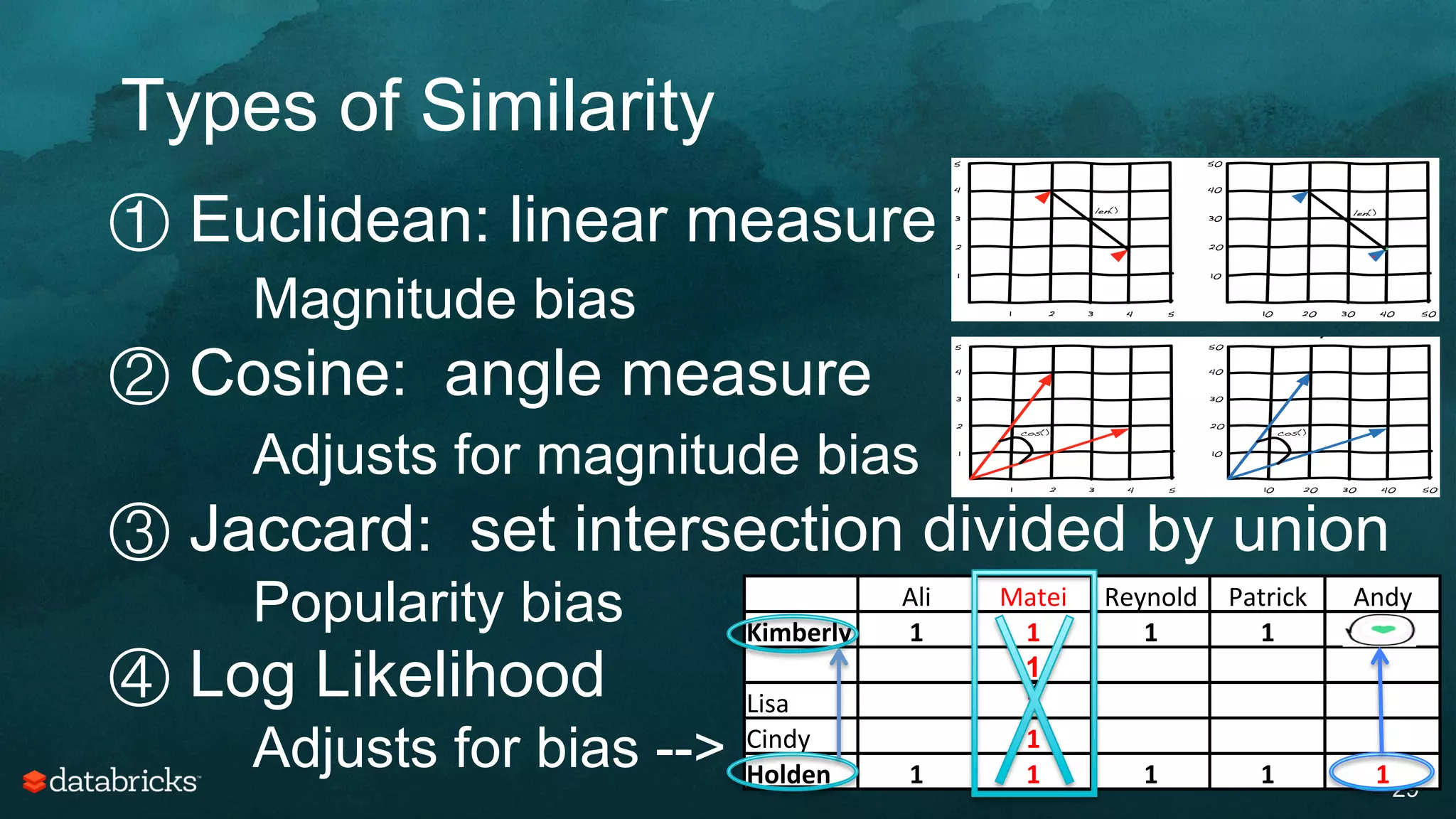
① Euclidean: linear measure
Magnitude bias
② Cosine: angle measure
Adjusts for magnitude bias
③ Jaccard: set intersection divided by union
Popularity bias
④ Log Likelihood
Adjusts for bias -->
	
  	
   Ali	
   Matei	
   Reynold	
   Patrick	
   Andy	
  
Kimberly	
   1	
   1	
   1	
   1	
  
Paula	
   1
Lisa	
   1	
  
Cindy	
   1	
   1	
  
Holden	
   1	
   1	
   1	
   1	
   1	
  
z
All-pairs Similarity
30
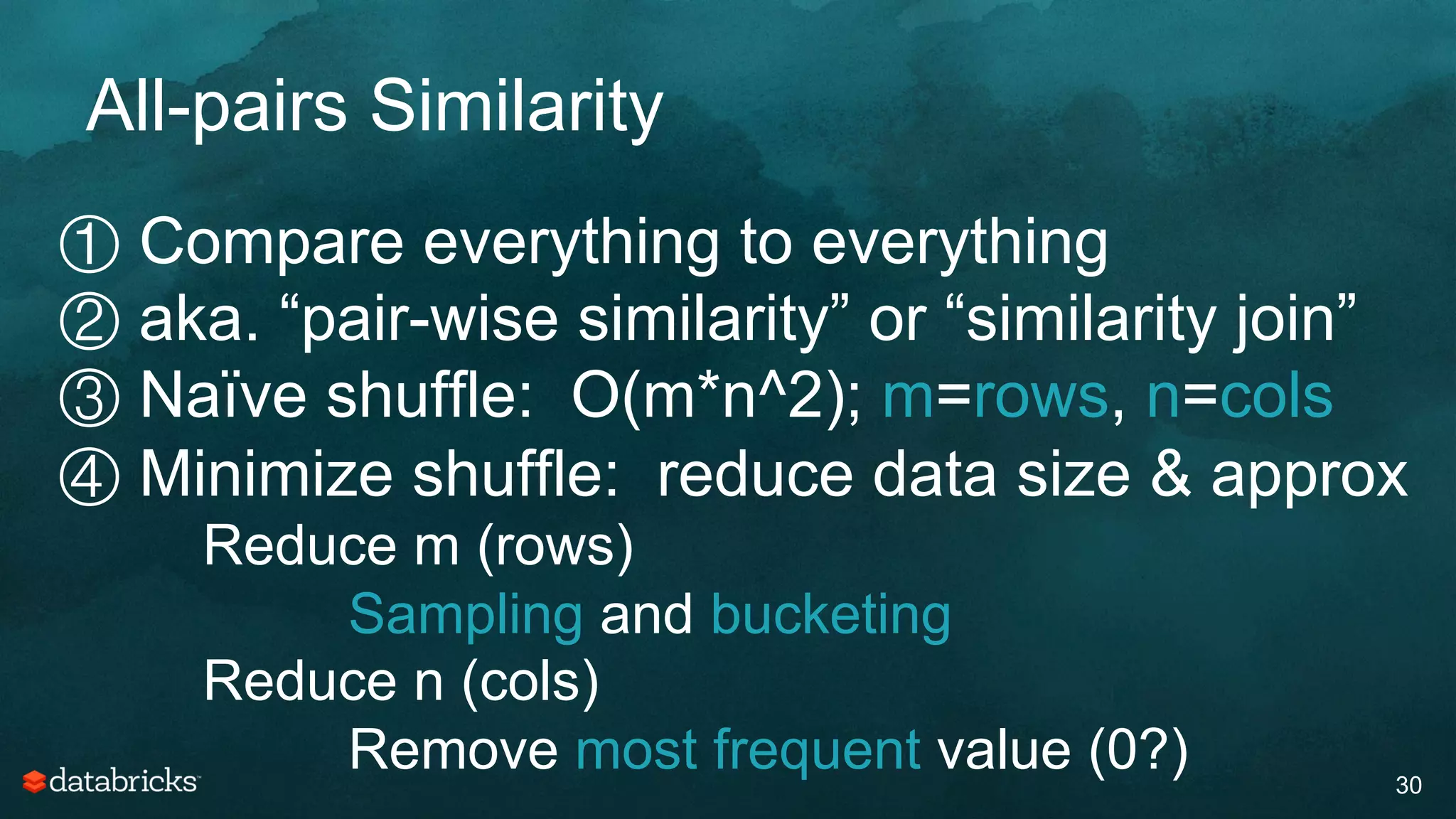
① Compare everything to everything
② aka. “pair-wise similarity” or “similarity join”
③ Naïve shuffle: O(m*n^2); m=rows, n=cols
④ Minimize shuffle: reduce data size & approx
Reduce m (rows)
Sampling and bucketing
Reduce n (cols)
Remove most frequent value (0?)
Minimize Shuffle
31
Sampling Algo: DIMSUM
32
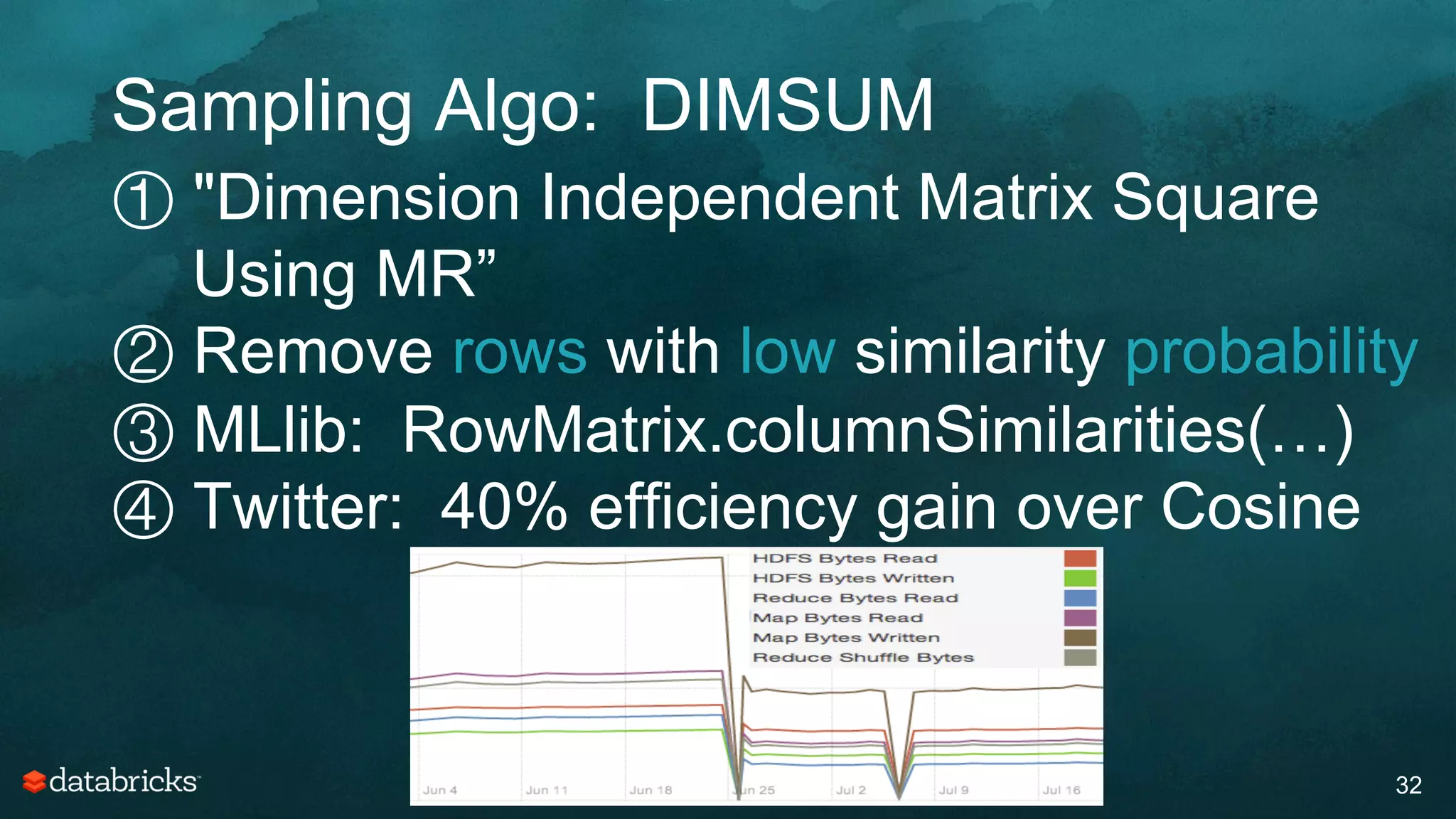
① "Dimension Independent Matrix Square
Using MR”
② Remove rows with low similarity probability
③ MLlib: RowMatrix.columnSimilarities(…)
④ Twitter: 40% efficiency gain over Cosine
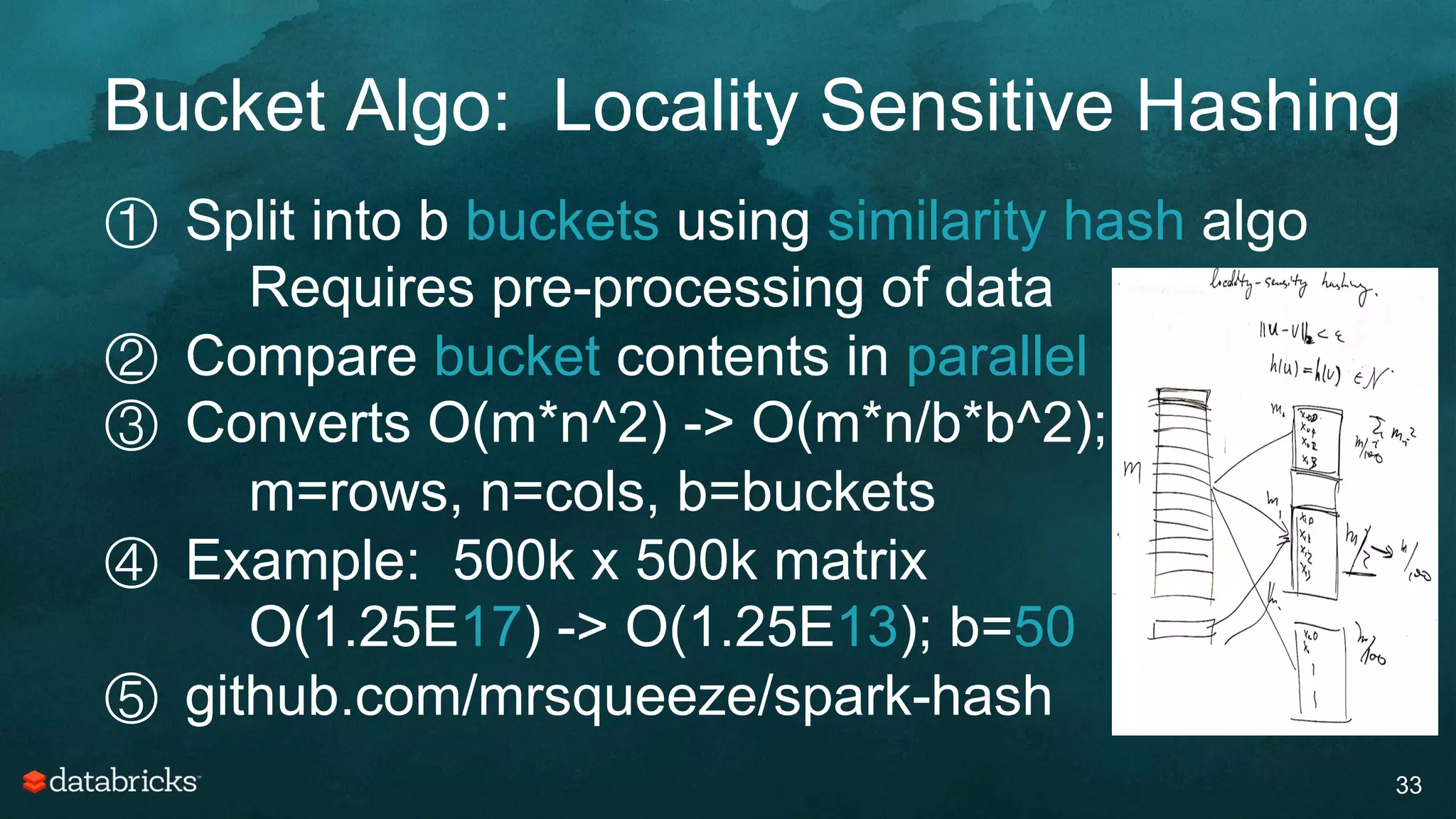
Bucket Algo: Locality Sensitive Hashing
33
①  Split into b buckets using similarity hash algo
Requires pre-processing of data
②  Compare bucket contents in parallel
③  Converts O(m*n^2) -> O(m*n/b*b^2);
m=rows, n=cols, b=buckets
④  Example: 500k x 500k matrix
O(1.25E17) -> O(1.25E13); b=50
⑤  github.com/mrsqueeze/spark-hash
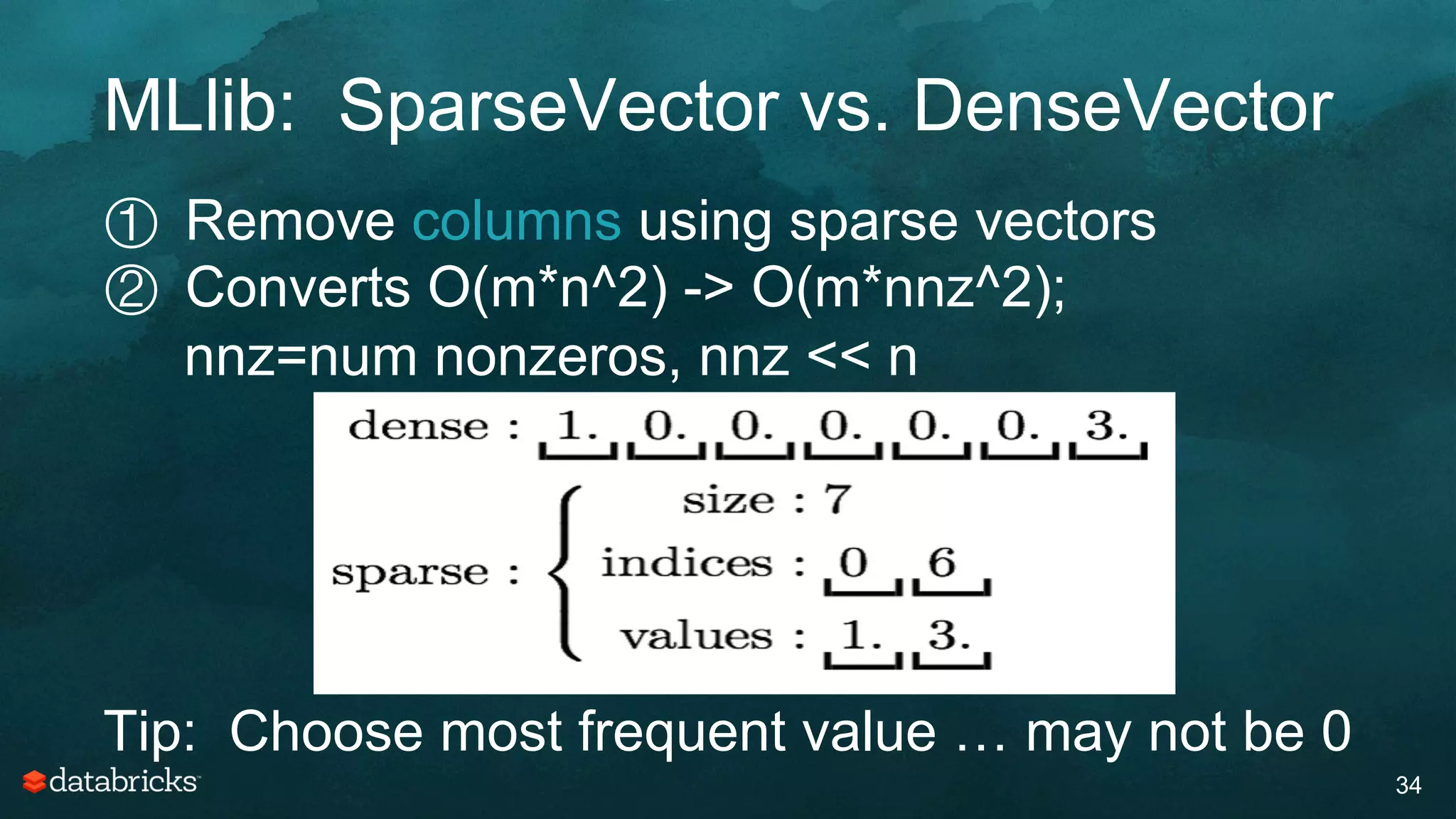
MLlib: SparseVector vs. DenseVector
34
①  Remove columns using sparse vectors
②  Converts O(m*n^2) -> O(m*nnz^2);
nnz=num nonzeros, nnz << n
Tip: Choose most frequent value … may not be 0
Interactive Demo!
35
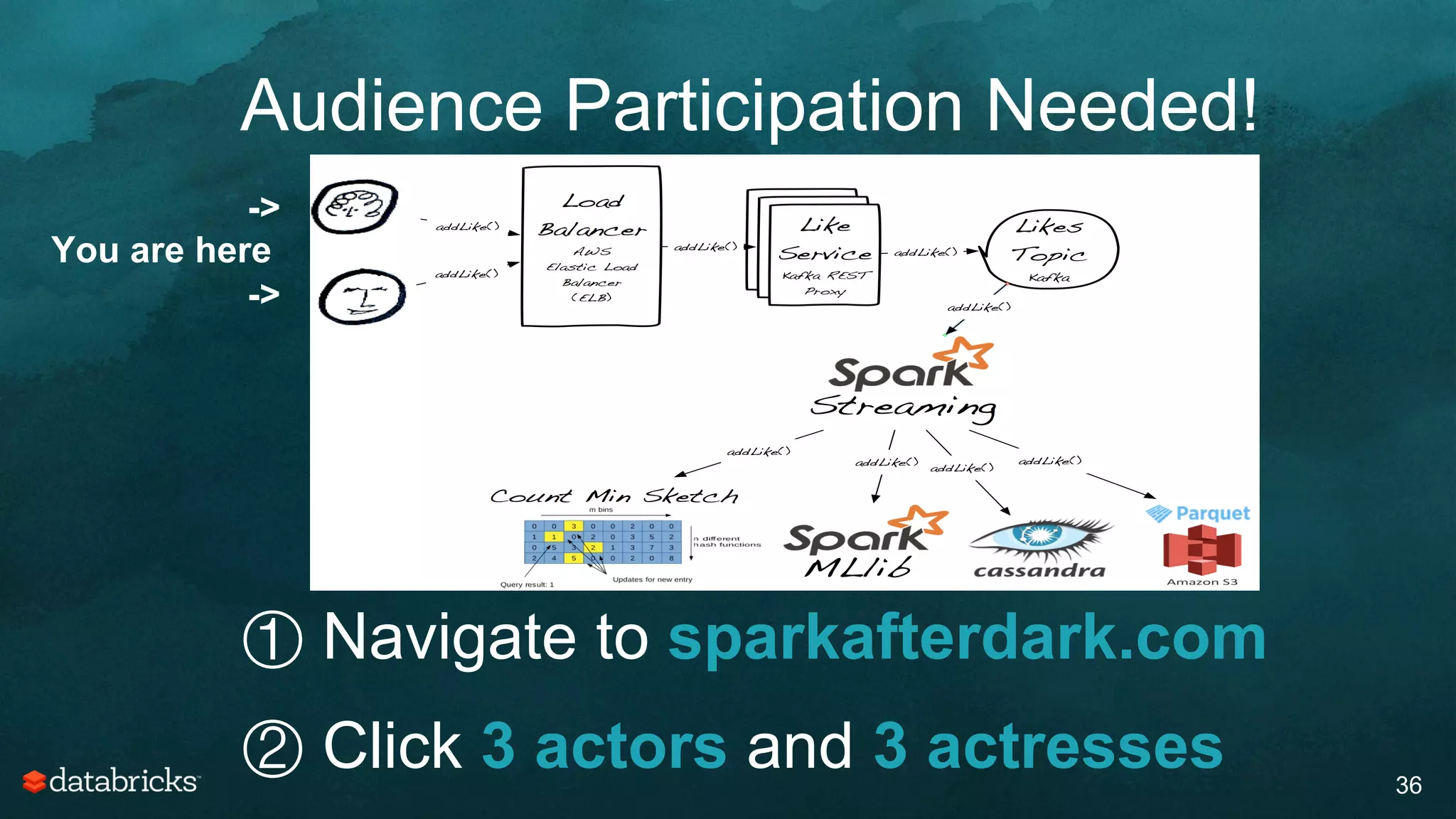
Audience Participation Needed!
36
① Navigate to sparkafterdark.com
② Click 3 actors and 3 actresses
->
You are here
->
Recommendation Terminology
37
① User
User seeking likeable recommendations
② Item
User who has been liked
*Also a user seeking likeable recommendations!
③ Types of Feedback
Explicit: Ratings, Like/Dislike
Implicit: Search, Click, Hover, View, Scroll
Types of Recommendations
38
① Non-personalized
Cold Start
No preference or behavior data for user, yet
② Personalized
Items that others with similar prefs have liked
User-Item Similarity
Items similar to your previously-liked items
Item-Item Similarity
Non-personalized
Recommendations
39
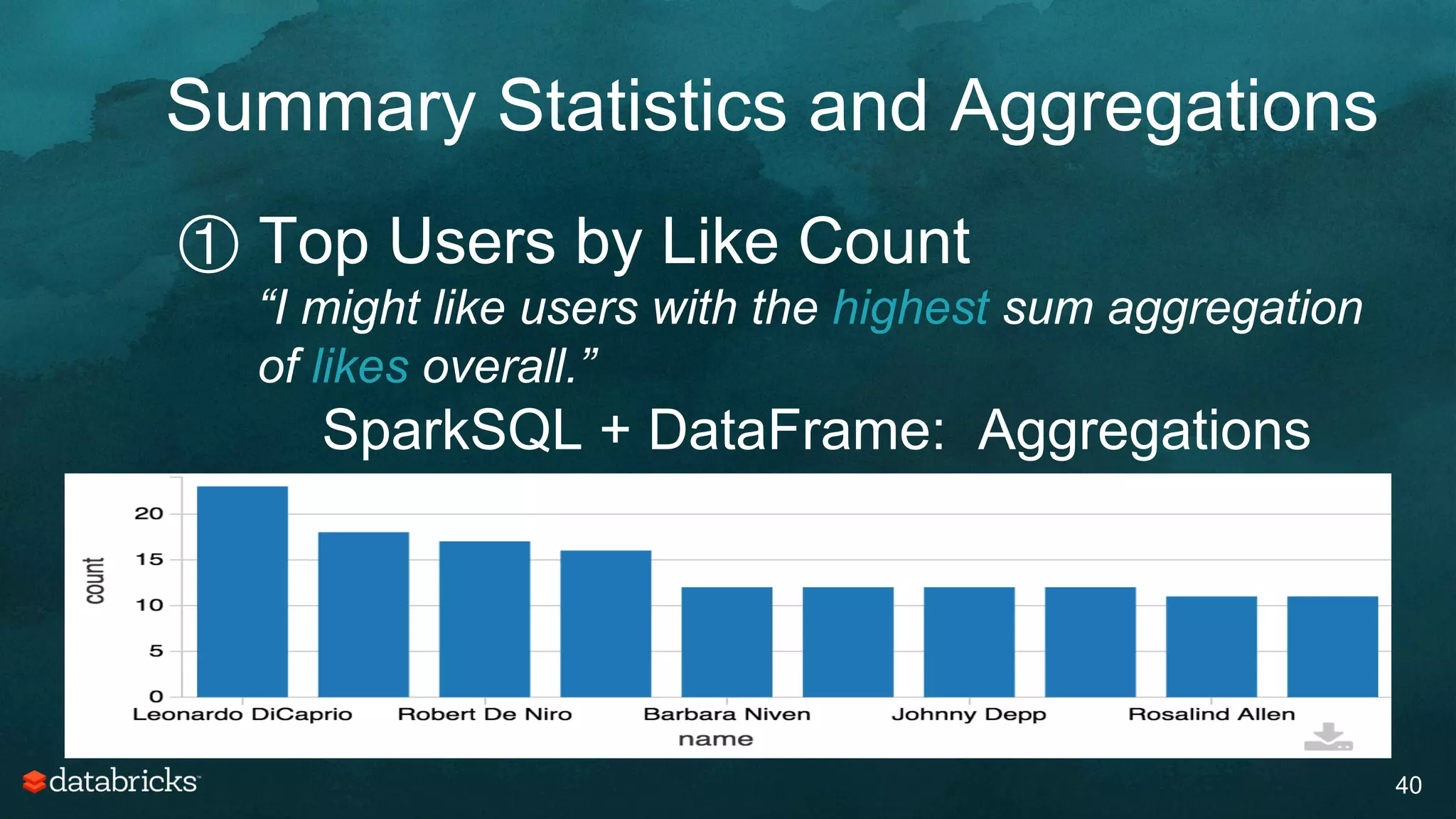
Summary Statistics and Aggregations
40
① Top Users by Like Count
“I might like users with the highest sum aggregation
of likes overall.”
SparkSQL + DataFrame: Aggregations
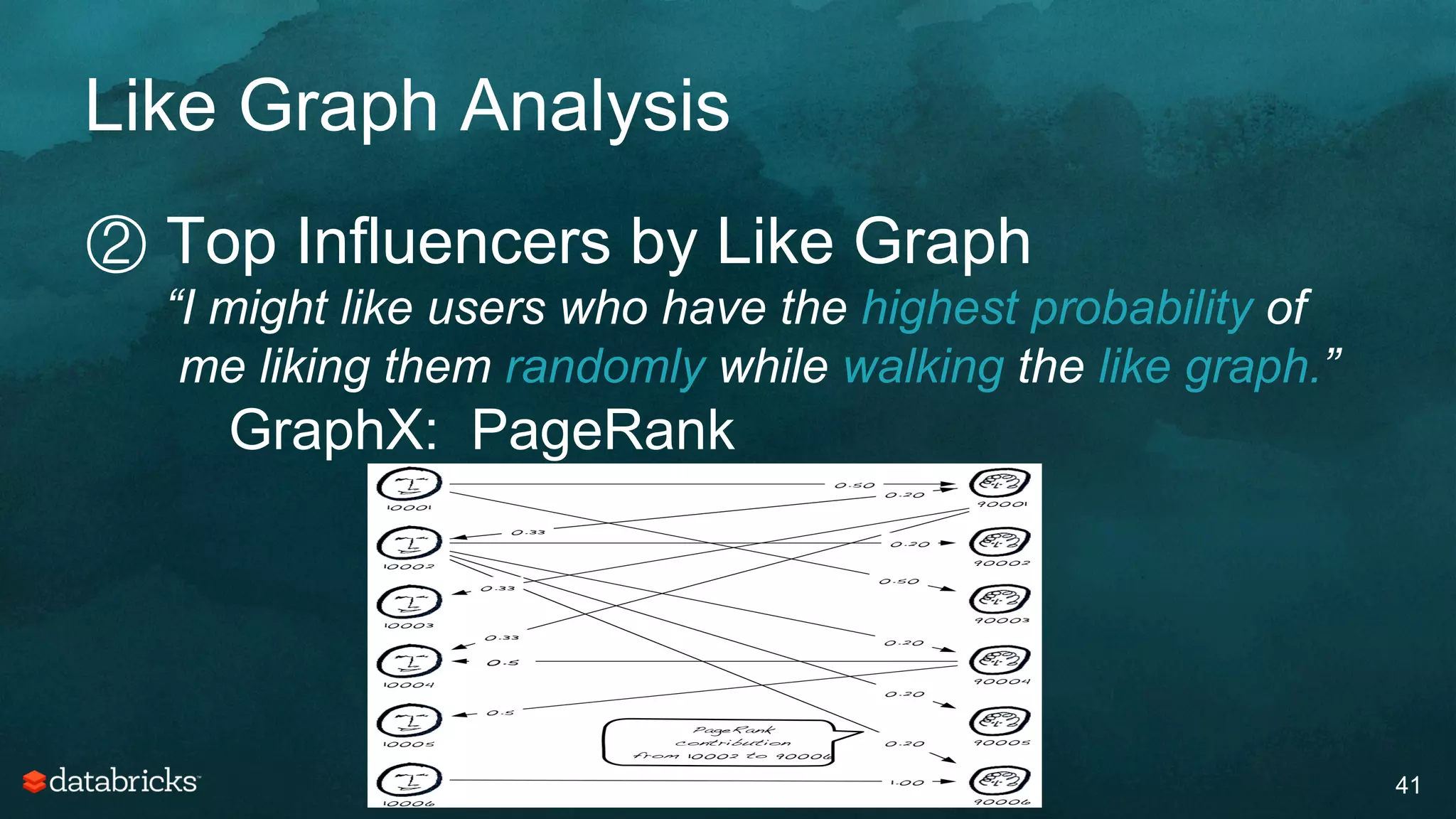
Like Graph Analysis
41
② Top Influencers by Like Graph
“I might like users who have the highest probability of
me liking them randomly while walking the like graph.”
GraphX: PageRank
Demo!
Spark SQL + DataFrames + GraphX
42
Personalized
Recommendations
43
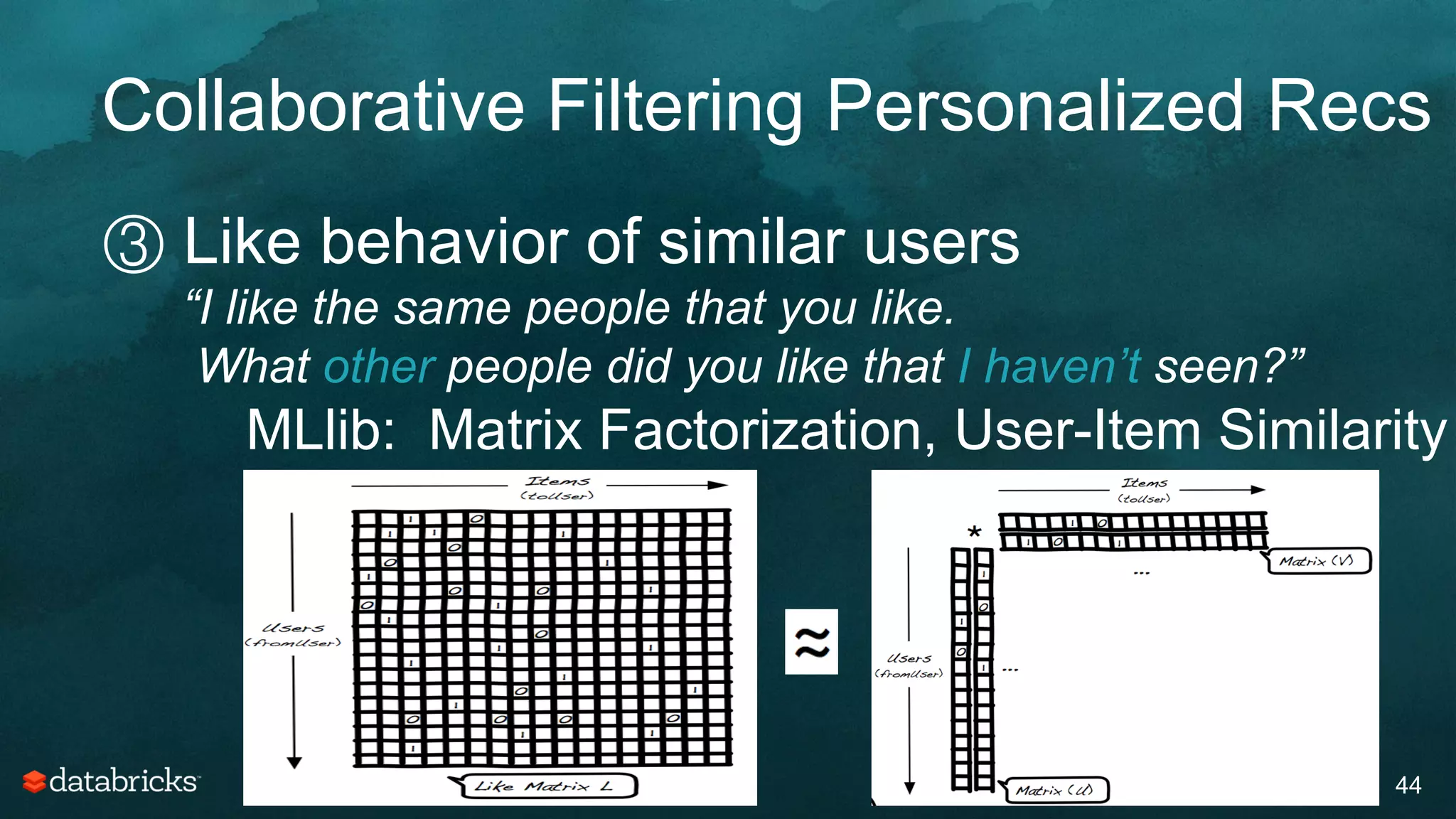
Collaborative Filtering Personalized Recs
44
③ Like behavior of similar users
“I like the same people that you like.
What other people did you like that I haven’t seen?”
MLlib: Matrix Factorization, User-Item Similarity
Text-based Personalized Recs
45
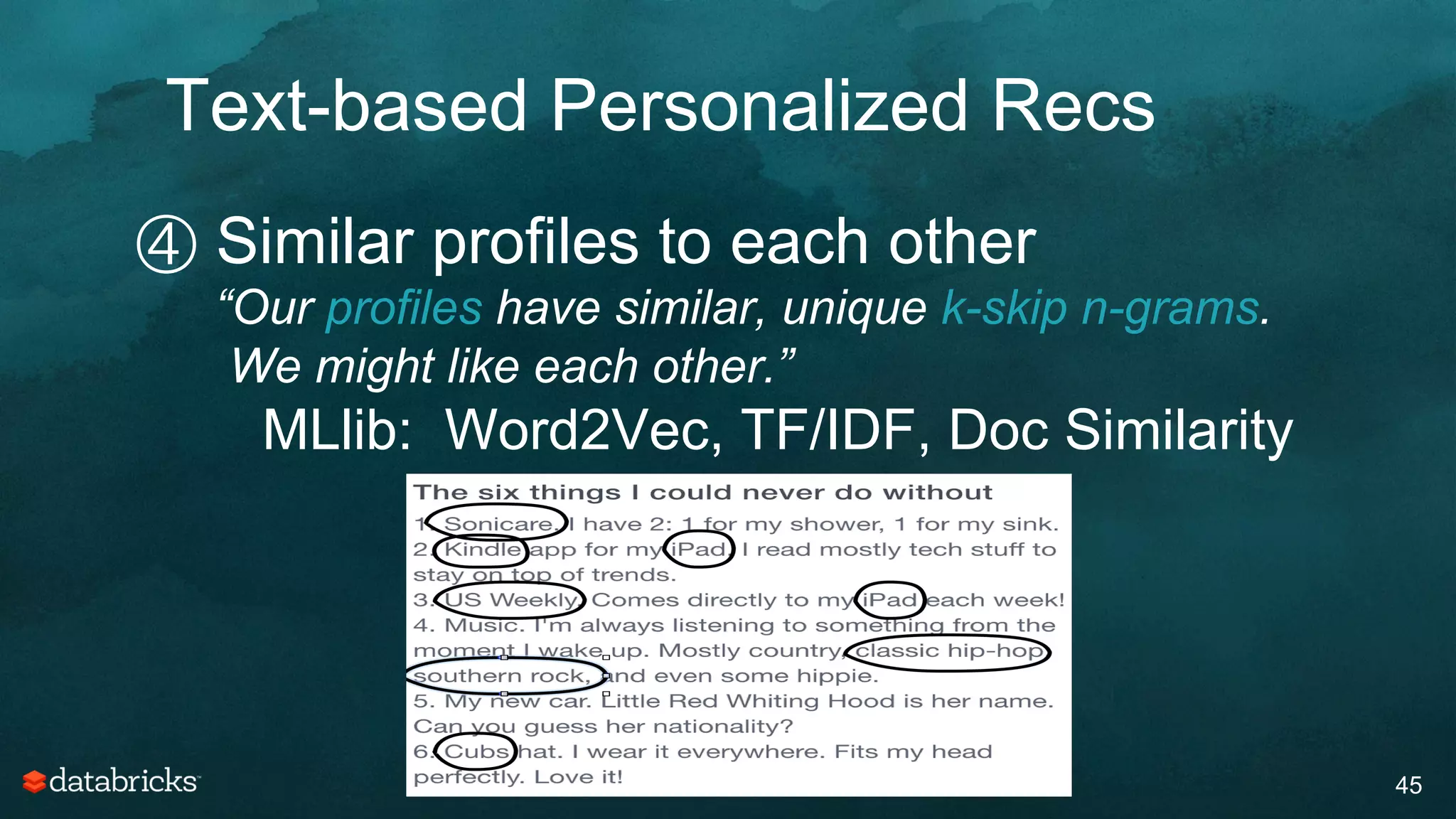
④ Similar profiles to each other
“Our profiles have similar, unique k-skip n-grams.
We might like each other.”
MLlib: Word2Vec, TF/IDF, Doc Similarity
More Text-based Personalized Recs
46
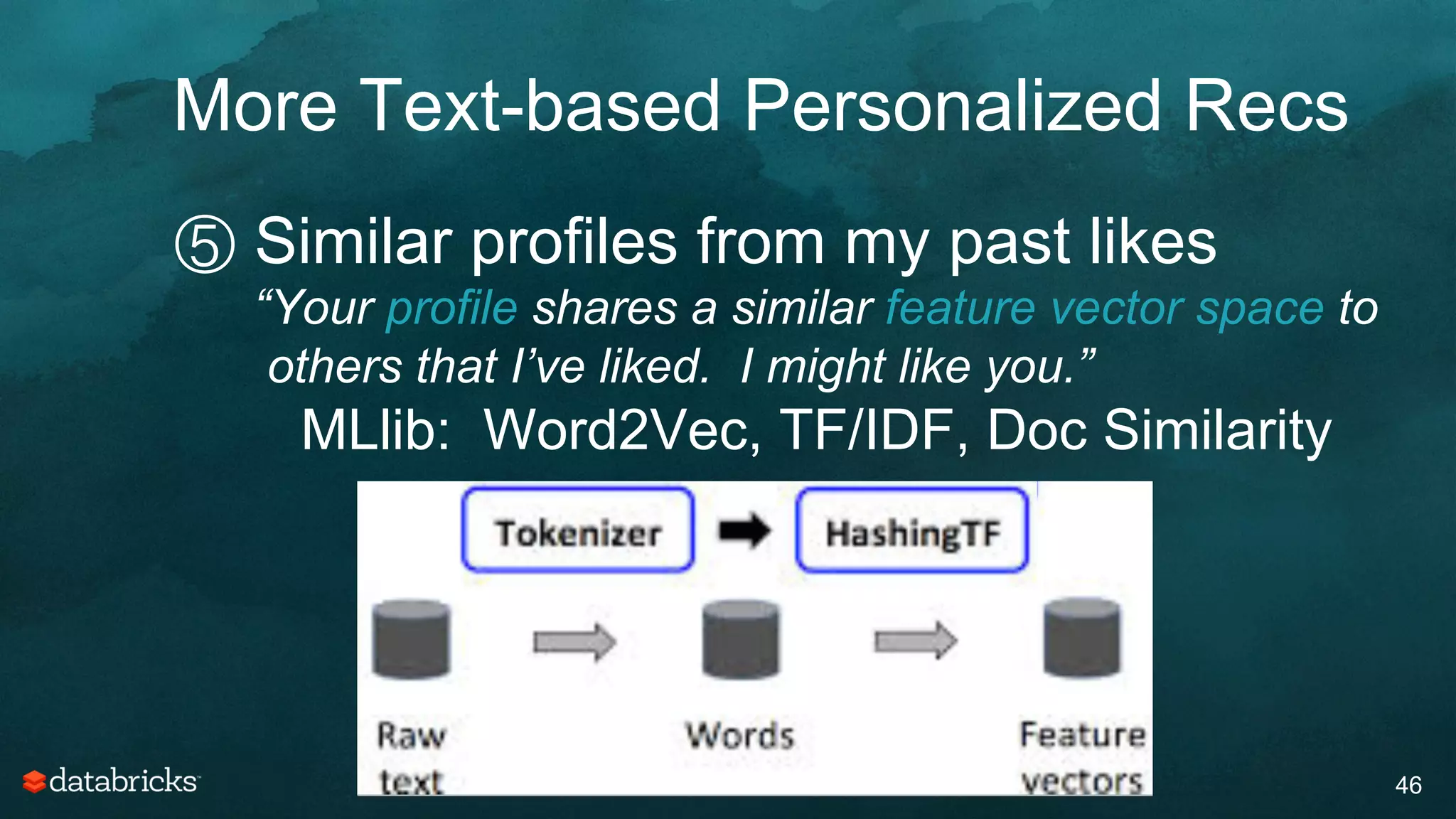
⑤ Similar profiles from my past likes
“Your profile shares a similar feature vector space to
others that I’ve liked. I might like you.”
MLlib: Word2Vec, TF/IDF, Doc Similarity
More Text-based Personalized Recs
47
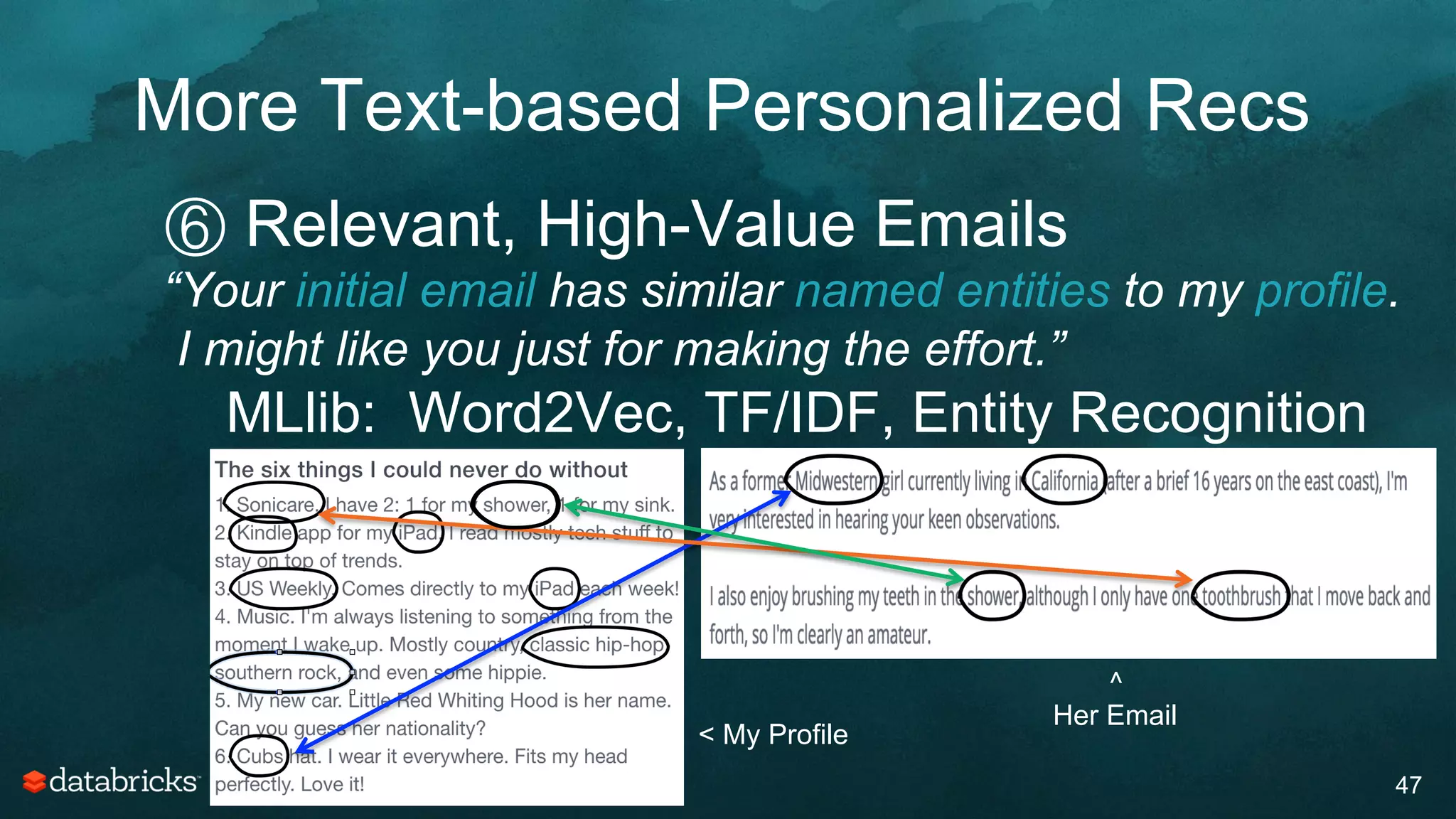
⑥ Relevant, High-Value Emails
“Your initial email has similar named entities to my profile.
I might like you just for making the effort.”
MLlib: Word2Vec, TF/IDF, Entity Recognition
^
Her Email
< My Profile
Demo!
MLlib + ALS + Word2Vec + TF/IDF
48
Bonus!
The Future of Recommendations
49
Facial Recognition
50
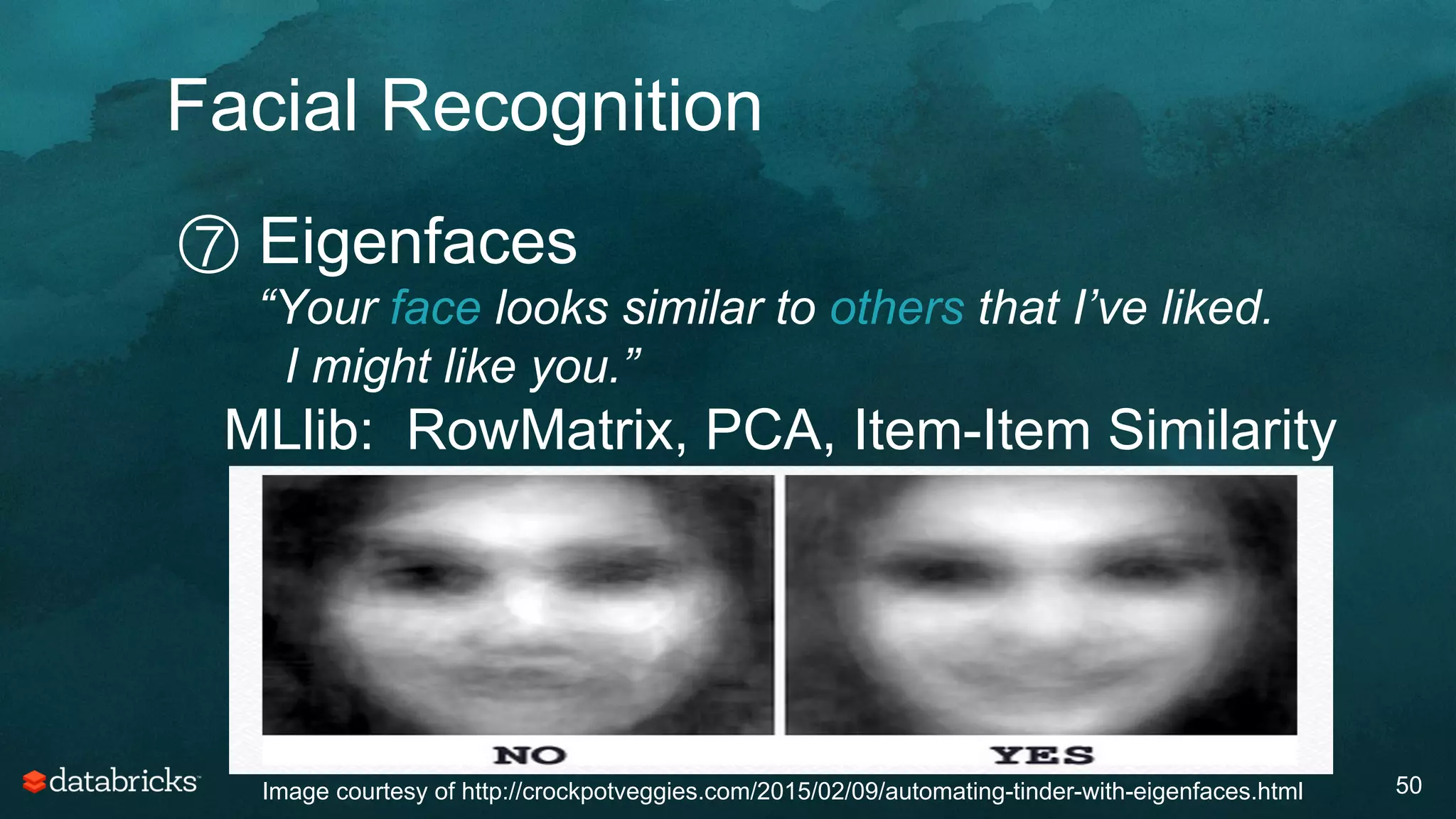
⑦ Eigenfaces
“Your face looks similar to others that I’ve liked.
I might like you.”
MLlib: RowMatrix, PCA, Item-Item Similarity
Image courtesy of http://crockpotveggies.com/2015/02/09/automating-tinder-with-eigenfaces.html
Conversation Starter Bot
51
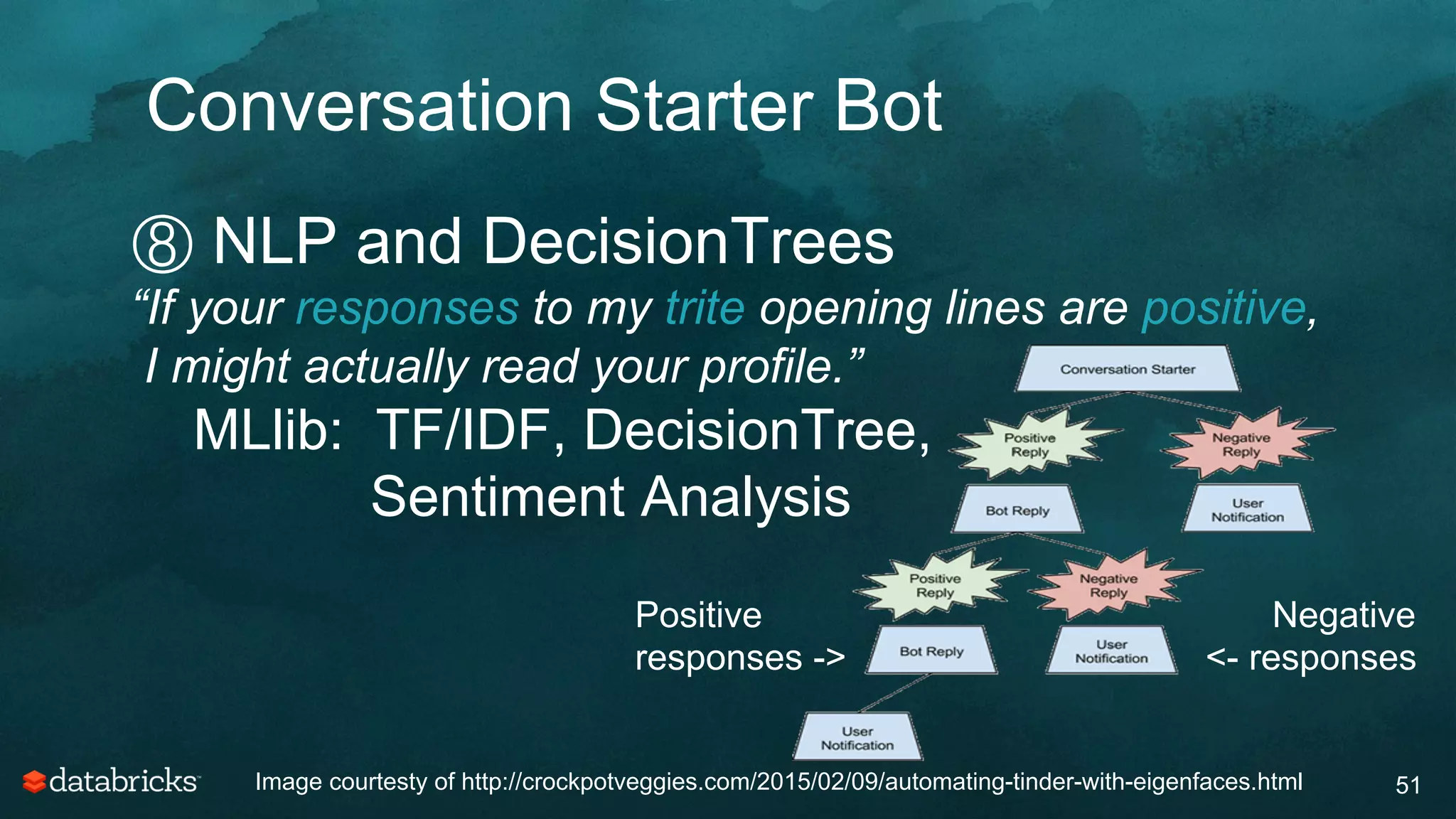
⑧ NLP and DecisionTrees
“If your responses to my trite opening lines are positive,
I might actually read your profile.”
MLlib: TF/IDF, DecisionTree,
Sentiment Analysis
Positive
responses ->
Negative
<- responses
Image courtesty of http://crockpotveggies.com/2015/02/09/automating-tinder-with-eigenfaces.html
Double Bonus!
52
Maintaining the
Compromise Recommendations (Couples)
53
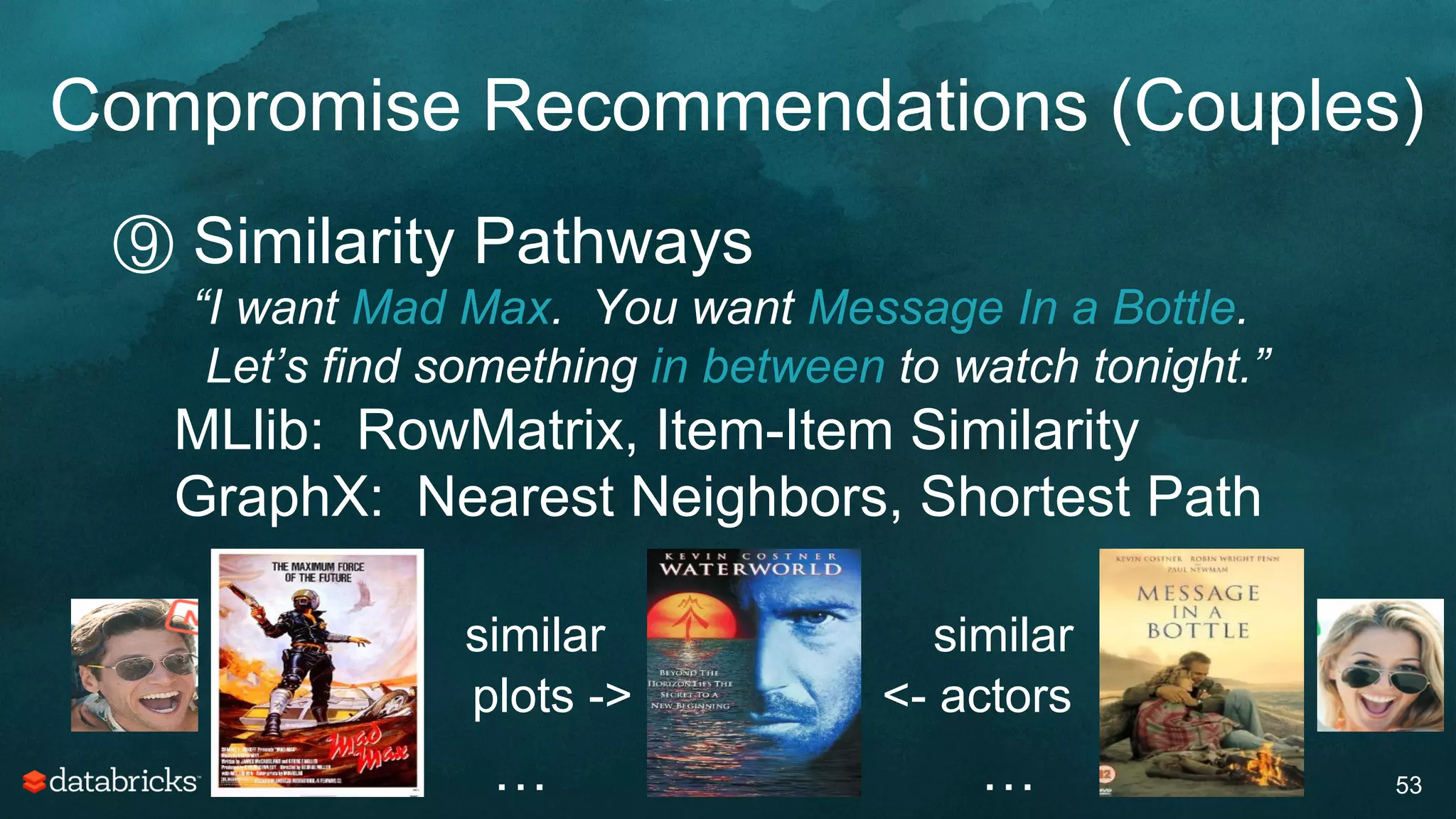
⑨ Similarity Pathways
“I want Mad Max. You want Message In a Bottle.
Let’s find something in between to watch tonight.”
MLlib: RowMatrix, Item-Item Similarity
GraphX: Nearest Neighbors, Shortest Path
similar similar
plots -> <- actors
… …
And the Final,
54
⑩ Personalized Recommendation
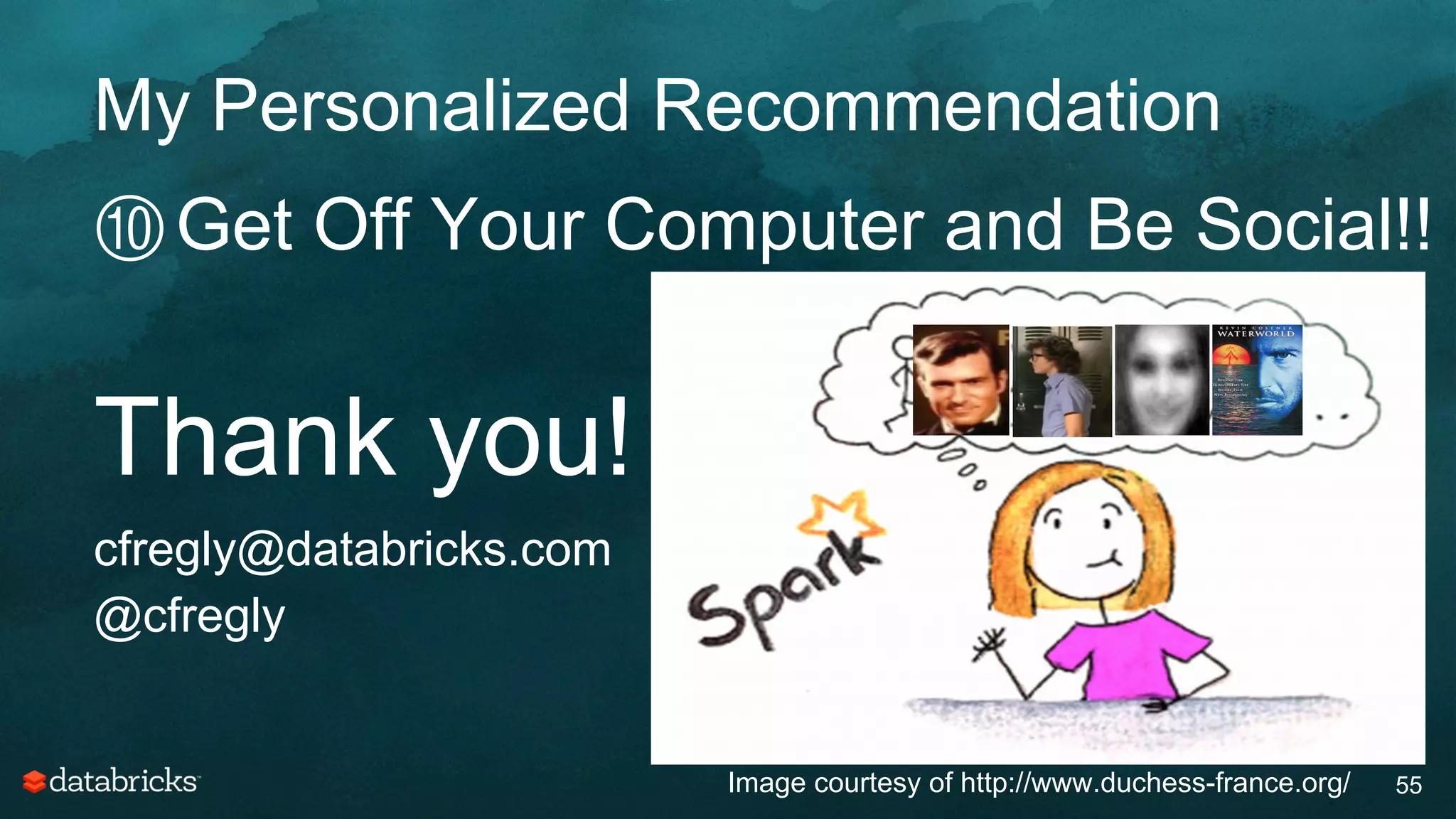
My Personalized Recommendation
55
⑩ Get Off Your Computer and Be Social!!
Thank you!
cfregly@databricks.com
@cfregly
Image courtesy of http://www.duchess-france.org/

Big Data Day LA 2015 - Spark after Dark by Chris Fregly of Databricks

  • 1.
    After Dark Generating High-QualityRecommendations using Real-time Advanced Analytics and Machine Learning with Chris Fregly Data Solutions Engineer @ Databricks
  • 2.
    Who am I? 2 DataPlatform Engineer playboy.com Streaming Platform Engineer NetflixOSS Committer netflix.com, github.com/Netflix Data Solutions Engineer Apache Spark Contributor databricks.com, github.com/apache/spark
  • 3.
    Why After Dark? PlayboyAfter Dark Late 1960’s TV Show Progressive Show For Its Time And it rhymes!! 3
  • 4.
    What is ? 4 SparkCore Spark Streaming real-timeSpark SQL structured data MLlib machine learning GraphX graph analytics …   BlinkDB approx queries
  • 5.
  • 6.
    What is ? 6 Foundedby the creators of as a Service Powerful Visualizations Collaborative Notebooks Scala/Java, Python, SQL, R Flexible Cluster Management Job Scheduling and Monitoring
  • 7.
  • 8.
    8 ① Generate high-quality recommendations ② DemonstrateSpark high-level libraries: ③  Spark Streaming -> Kafka, Approximates ④  Spark SQL -> DataFrames, Cassandra ①  GraphX -> PageRank, Shortest Path ①  MLlib -> Matrix Factor, Word2Vec Goals of After Dark? Images courtesy of tinder.com. Not affiliated with Tinder in any way.
  • 9.
  • 10.
    Themes of thisTalk 10 ① Performance ② Parallelism ③ Columnar Storage ④ Approximations ⑤ Similarity ⑥ Minimize Shuffle
  • 11.
  • 12.
    Daytona Gray SortContest 12 On-disk only 250,000 partitions No in-memory caching (2014)(2013) (2014)
  • 13.
    Improved Shuffle andNetwork Layer 13 ① Introduced sort-based shuffle Mapper maintains large buffer grouped by keys Reducer seeks directly to group and scans ② Minimizes OS resources Less mapper-reducer open files,connections ③ Netty: Async keeps CPU hot, reuse ByteBuffer ④ epoll: disk-network comm in kernel space only
  • 14.
    Project Tungsten: CPUand Memory 14 ① Largest change to Spark exec engine to date ② Cache-aware data structs and sorting -> ③ Expand JVM bytecode gen, JIT optimizations ④ Custom mem manage, serializers, HashMap
  • 15.
  • 16.
  • 17.
    Brady Bunch circa1980 17 Season 5, Episode 18: “Two Petes in a Pod”
  • 18.
    Parallel Algorithm :O(log n) 18 O(log n)
  • 19.
  • 20.
  • 21.
    Columnar Storage Format 21 *Skipwhole chunks with min-max heuristics stored in each chunk (sorted data only)
  • 22.
    Parquet File Format 22 ① Basedon Google Dremel Paper ② Implemented by Twitter and Cloudera ③ Columnar storage format ④ Optimized for fast columnar aggregations ⑤ Tight compression ⑥ Supports pushdowns ⑦ Nested, self-describing, evolving schema
  • 23.
    Types of Compression 23 ① RunLength Encoding Repeated data ② Dictionary Encoding Fixed set of values ③ Delta, Prefix Encoding Sorted dataset
  • 24.
    Types of Pushdowns 24 ① Column,Partition Pruning ② Row, Predicate Filtering
  • 25.
  • 26.
    Sketch Algorithm: CountMin Sketch 26 ①  Approximate counters ②  Better than HashMap ③  Fixed, low memory ④  Known error bounds ⑤  Large num of counters ⑥  Available in Twitter’s Algebird ⑦  Streaming example in Spark
  • 27.
    Probabilistic Data Structure:HyperLogLog 27 ①  Fixed memory ②  Known error distribution ③  Measures set cardinality ④  Approx count distinct ⑤  Number of unique users ⑥  From Twitter’s Algebird ⑦  Streaming example in Spark ⑧  RDD: countApproxDistinctByKey()
  • 28.
  • 29.
    Types of Similarity 29 ① Euclidean:linear measure Magnitude bias ② Cosine: angle measure Adjusts for magnitude bias ③ Jaccard: set intersection divided by union Popularity bias ④ Log Likelihood Adjusts for bias -->     Ali   Matei   Reynold   Patrick   Andy   Kimberly   1   1   1   1   Paula   1 Lisa   1   Cindy   1   1   Holden   1   1   1   1   1   z
  • 30.
    All-pairs Similarity 30 ① Compare everythingto everything ② aka. “pair-wise similarity” or “similarity join” ③ Naïve shuffle: O(m*n^2); m=rows, n=cols ④ Minimize shuffle: reduce data size & approx Reduce m (rows) Sampling and bucketing Reduce n (cols) Remove most frequent value (0?)
  • 31.
  • 32.
    Sampling Algo: DIMSUM 32 ① "DimensionIndependent Matrix Square Using MR” ② Remove rows with low similarity probability ③ MLlib: RowMatrix.columnSimilarities(…) ④ Twitter: 40% efficiency gain over Cosine
  • 33.
    Bucket Algo: LocalitySensitive Hashing 33 ①  Split into b buckets using similarity hash algo Requires pre-processing of data ②  Compare bucket contents in parallel ③  Converts O(m*n^2) -> O(m*n/b*b^2); m=rows, n=cols, b=buckets ④  Example: 500k x 500k matrix O(1.25E17) -> O(1.25E13); b=50 ⑤  github.com/mrsqueeze/spark-hash
  • 34.
    MLlib: SparseVector vs.DenseVector 34 ①  Remove columns using sparse vectors ②  Converts O(m*n^2) -> O(m*nnz^2); nnz=num nonzeros, nnz << n Tip: Choose most frequent value … may not be 0
  • 35.
  • 36.
    Audience Participation Needed! 36 ① Navigateto sparkafterdark.com ② Click 3 actors and 3 actresses -> You are here ->
  • 37.
    Recommendation Terminology 37 ① User User seekinglikeable recommendations ② Item User who has been liked *Also a user seeking likeable recommendations! ③ Types of Feedback Explicit: Ratings, Like/Dislike Implicit: Search, Click, Hover, View, Scroll
  • 38.
    Types of Recommendations 38 ① Non-personalized ColdStart No preference or behavior data for user, yet ② Personalized Items that others with similar prefs have liked User-Item Similarity Items similar to your previously-liked items Item-Item Similarity
  • 39.
  • 40.
    Summary Statistics andAggregations 40 ① Top Users by Like Count “I might like users with the highest sum aggregation of likes overall.” SparkSQL + DataFrame: Aggregations
  • 41.
    Like Graph Analysis 41 ② TopInfluencers by Like Graph “I might like users who have the highest probability of me liking them randomly while walking the like graph.” GraphX: PageRank
  • 42.
    Demo! Spark SQL +DataFrames + GraphX 42
  • 43.
  • 44.
    Collaborative Filtering PersonalizedRecs 44 ③ Like behavior of similar users “I like the same people that you like. What other people did you like that I haven’t seen?” MLlib: Matrix Factorization, User-Item Similarity
  • 45.
    Text-based Personalized Recs 45 ④ Similarprofiles to each other “Our profiles have similar, unique k-skip n-grams. We might like each other.” MLlib: Word2Vec, TF/IDF, Doc Similarity
  • 46.
    More Text-based PersonalizedRecs 46 ⑤ Similar profiles from my past likes “Your profile shares a similar feature vector space to others that I’ve liked. I might like you.” MLlib: Word2Vec, TF/IDF, Doc Similarity
  • 47.
    More Text-based PersonalizedRecs 47 ⑥ Relevant, High-Value Emails “Your initial email has similar named entities to my profile. I might like you just for making the effort.” MLlib: Word2Vec, TF/IDF, Entity Recognition ^ Her Email < My Profile
  • 48.
    Demo! MLlib + ALS+ Word2Vec + TF/IDF 48
  • 49.
    Bonus! The Future ofRecommendations 49
  • 50.
    Facial Recognition 50 ⑦ Eigenfaces “Your facelooks similar to others that I’ve liked. I might like you.” MLlib: RowMatrix, PCA, Item-Item Similarity Image courtesy of http://crockpotveggies.com/2015/02/09/automating-tinder-with-eigenfaces.html
  • 51.
    Conversation Starter Bot 51 ⑧ NLPand DecisionTrees “If your responses to my trite opening lines are positive, I might actually read your profile.” MLlib: TF/IDF, DecisionTree, Sentiment Analysis Positive responses -> Negative <- responses Image courtesty of http://crockpotveggies.com/2015/02/09/automating-tinder-with-eigenfaces.html
  • 52.
  • 53.
    Compromise Recommendations (Couples) 53 ⑨ SimilarityPathways “I want Mad Max. You want Message In a Bottle. Let’s find something in between to watch tonight.” MLlib: RowMatrix, Item-Item Similarity GraphX: Nearest Neighbors, Shortest Path similar similar plots -> <- actors … …
  • 54.
  • 55.
    My Personalized Recommendation 55 ⑩ GetOff Your Computer and Be Social!! Thank you! cfregly@databricks.com @cfregly Image courtesy of http://www.duchess-france.org/