Practical Data Science
on Spark & Hadoop
Collaborative Filtering
Recommendation Systems
Chris Fregly
Principal Data Solutions Engineer
IBM Spark Technology Center
Outline
①  Introduction
②  Live, Interactive, Group Demo!
③  Approximations
④  Similarity
⑤  Recommendations
⑥  Building a Model
⑦  ML Pipelines
⑧  $1 Million Netflix Prize
Who am I?
Outline
①  Introduction
②  Live, Interactive, Group Demo!
③  Approximations
④  Similarity
⑤  Recommendations
⑥  Building a Model
⑦  ML Pipelines
⑧  $1 Million Netflix Prize
Live, Interactive, Group Demo!
①  Navigate to sparkafterdark.com
②  Select 3 actresses and 3 actors
③  Wait for me to build the models
https://github.com/fluxcapacitor/pipeline -->
Outline
①  Introduction
②  Live, Interactive, Group Demo!
③  Approximations
④  Similarity
⑤  Recommendations
⑥  Building a Model
⑦  ML Pipelines
⑧  $1 Million Netflix Prize
Bloom Filter
7
Approximate set
k-hashes on put/get
False positives
Used all through Spark
From Twitter’s Algebird
Count Min Sketch
8
Approximate counters
Better than HashMap
Low, fixed memory
Known error bounds
Large number of counters
From Twitter’s Algebird
Streaming example in Spark codebase
HyperLogLog
9
Approximate cardinality
Approximate count distinct
Low memory
1.5KB @ 2% error
10^9 elements!
From Twitter’s Algebird
Streaming example in Spark codebase
countApproxDistinctByKey()
Monte Carlo Simulations
1
From Manhattan Project (A-bomb)
Simulate movement of neutrons
Law of Large Numbers (LLN)
Average of results of many trials
Converge on expected value
SparkPi example in Spark codebase
Pi # red dots / # total dots * 4
Demo!
Monte Carlo Simulation
Outline
①  Introduction
②  Live, Interactive, Group Demo!
③  Approximations
④  Similarity
⑤  Recommendations
⑥  Building a Model
⑦  ML Pipelines
⑧  $1 Million Netflix Prize
Euclidean Similarity
Linear measure
Bias toward magnitude
Cosine Similarity
Angle measure
Corrects magnitude bias
Jaccard Similarity
Set Intersection divided by Set Union
Bias towards popularity
Log Likelihood Similarity
Corrects popularity bias
Calculating Similarity
“All-pairs similarity”
“Pair-wise similarity”
“Similarity join”
Naïve impl: O(m*n^2); m=rows, n=cols
Must minimize shuffle and computation
Minimizing Shuffle and Computation
Approximate!
Reduce m (rows)
Sampling
Bucketing (aka. “Partitioning” or “Clustering”)
Removing rows with sparsity below threshold (ie. inactive)
Reduce n (cols)
Remove most frequent value (ie. 0)
Remove least popular
Reduce m (rows): Sampling
DIMSUM
“Dimension Independent Matrix Square Using MR”
Remove rows with low probability of similarity
RowMatrix.columnSimilarities()
Twitter 40% efficiency gain
over naïve cosine similarity ->
Reduce m (rows): Bucketing
LSH
“Locality Sensitive Hashing”
Split m into b buckets w/ similarity hash func()
Requires pre-processing
Compare items within buckets
Comparison is parallelizable
O(m*n^2) -> O(m*n/b*b^2)
O(1.25E17) -> O(1.25E13); b=50
Reduce n (cols)
Remove most frequent values
Replace with (index,value) pairs
O(m*n^2) -> O(m*nnz^2); nnz=number of non-zeros,
Be sure to choose most frequent value – may not be 0!
Outline
①  Introduction
②  Live, Interactive, Group Demo!
③  Approximations
④  Similarity
⑤  Recommendations
⑥  Building a Model
⑦  ML Pipelines
⑧  $1 Million Netflix Prize
Recommendation/ML Terminology
User: User seeking recommendations
Item: Item being recommended
Explicit User Feedback: like or rating
Implicit User Feedback: search, click, hover, view, scroll
Instances: Rows of user feedback/input data
Overfitting: Training a model too closely to the training data & hyperparameters
Hold Out Split: Holding out some of the instances to avoid overfitting
Features: Columns of instance rows (of feedback/input data)
Cold Start Problem: Not enough data to personalize (new)
Hyperparameter: Model-specific config knobs for tuning (tree depth, iterations, etc)
Model Evaluation: Compare predictions to actual values of hold out split
Features
Dimensions: Alias for Features
Binary Features: True or False
Numeric Discrete Features: Integers
Numeric Features: Real values
Ordinal Features: Maintains order (S -> M -> L -> XL -> XXL)
Temporal Features: Time-based (Time of Day, Binge Watching)
Categorical Features: Finite, unique set of categories(NFL teams)
Feature Engineering: Modify, reduce, combine features
Feature Engineering
Dimension Reduction: Reduce num features or “feature space”
Principle Component Analysis (PCA): Find principle features that
describe the data
One-Hot Encoding: Convert categorical feature vals to 0’s, 1’s
Bears -> 1 Bears -> 1,0,0
49’ers -> 2 --> 49’ers -> 0,1,0
Steelers-> 3 Steelers-> 0,0,1
Non-Personalized Recommendations
“Cold Start” Problem
Top K Aggregations
Summary Statistics
PageRank
Facebook Graph
Demo!
Top K Aggregations
PageRank
Personalized Recommendations
Collaborative Filtering
User-to-Item
Item-to-Item
Clustering (Similarity)
Users
Items
User-to-Item Collaborative Filtering
Find similar users based on similarity function(s)
Cosine similarity, etc
Recommend items that other similar users have chosen
Exclude items that have already been chosen
Rank items by num of similar users who have chosen
Alternating Least Squares
Matrix Factorization -->
Matrix Factorization
Item-to-Item Collaborative Filtering
Made famous by Amazon ~2003
Couldn’t scale traditional User-to-Item algos
Offline: Generates ItemID::List[CustomerID] vectors
Online: For each item in shopping cart, find similar
items based on closest List[CustomerID] vector
User and Item Clustering (Similarity)
Based on Similarity
ie. Similar Profile/Description Text or Categories
LDA Topic, K-Means, Nearest Neighbor, Eigenfaces, PCA
Streaming K Means Clustering
Initial set of k clusters with random centers
Incoming data:
Assign to closest cluster: distance to center
Update centers: minimize within-cluster-sum-of-squares
Half-life decay factor
Reduce contribution of old data to half -->
Measured in num batches or num data points
Eliminate dead clusters never assigned new data
Split existing cluster and join with dead cluster -->
Demo!
Alternating Least Squares
Matrix Factorization
Outline
①  Introduction
②  Live, Interactive, Group Demo!
③  Approximations
④  Similarity
⑤  Recommendations
⑥  Building a Model
⑦  ML Pipelines
⑧  $1 Million Netflix Prize
Split Instance Data
3 Roles
Model Training (80%)
Model Validation (10%)
Model Testing (10%)
k-folds Cross Validation
Divide instances into k sections
Alternate each k section between 3 roles above
http://www.slideshare.net/SebastianRaschka/musicmood-20140912
Hyperparameter Selection
Select sets of values for each hyperparameter
Use GridSearch to find best combo to reduce error
Avoid overfitting!
http://www.slideshare.net/ogrisel/strategies-and-tools-for-parallel-machine-learning-in-python
Evaluation Criteria
Regression (Distance has meaning)
Root Mean Square Error (RMSE)
Mean Absolute Error (MAE)
Categorical (Distance does not have meaning)
Precision/Accuracy
Outline
①  Introduction
②  Live, Interactive, Group Demo!
③  Approximations
④  Similarity
⑤  Recommendations
⑥  Building a Model
⑦  ML Pipelines
⑧  $1 Million Netflix Prize
ML Pipelines
Inspired by scikit-learn
Transformers
transform() input for estimation (training)
predict() new input
Estimators
fit() a model to the transformed dataset (training)
Pipeline
Chain everything together
Outline
①  Introduction
②  Live, Interactive, Group Demo!
③  Approximations
④  Similarity
⑤  Recommendations
⑥  Building a Model
⑦  ML Pipelines
⑧  $1 Million Netflix Prize
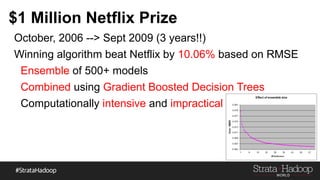
$1 Million Netflix Prize
October, 2006 --> Sept 2009 (3 years!!)
Winning algorithm beat Netflix by 10.06% based on RMSE
Ensemble of 500+ models
Combined using Gradient Boosted Decision Trees
Computationally intensive and impractical
Winning Algorithm Adjustments
“Alice effect”: Alice tends to rate lower than the average user
“Inception effect”: Inception is rate higher than average movie
“Alice-Inception effect”: Combo of Alice and Inception
Number of days since a user’s first rating
Number of days since a movie’s first rating
Number of people who have rated a movie
A movie’s overall mean rating
Factor these out and find the baseline!
Thanks!
Chris Fregly
@cfregly
References
①  https://github.com/fluxcapacitor/pipeline
②  http://www.cs.umd.edu/~samir/498/Amazon-Recommendations.pdf
③  http://blog.echen.me/2011/10/24/winning-the-netflix-prize-a-summary/
④  http://spark.apache.org/docs/latest/ml-guide.html

Practical Data Science Workshop - Recommendation Systems - Collaborative Filtering - Strata NY - 2015

  • 1.
    Practical Data Science onSpark & Hadoop Collaborative Filtering Recommendation Systems Chris Fregly Principal Data Solutions Engineer IBM Spark Technology Center
  • 2.
    Outline ①  Introduction ②  Live,Interactive, Group Demo! ③  Approximations ④  Similarity ⑤  Recommendations ⑥  Building a Model ⑦  ML Pipelines ⑧  $1 Million Netflix Prize
  • 3.
  • 4.
    Outline ①  Introduction ②  Live,Interactive, Group Demo! ③  Approximations ④  Similarity ⑤  Recommendations ⑥  Building a Model ⑦  ML Pipelines ⑧  $1 Million Netflix Prize
  • 5.
    Live, Interactive, GroupDemo! ①  Navigate to sparkafterdark.com ②  Select 3 actresses and 3 actors ③  Wait for me to build the models https://github.com/fluxcapacitor/pipeline -->
  • 6.
    Outline ①  Introduction ②  Live,Interactive, Group Demo! ③  Approximations ④  Similarity ⑤  Recommendations ⑥  Building a Model ⑦  ML Pipelines ⑧  $1 Million Netflix Prize
  • 7.
    Bloom Filter 7 Approximate set k-hasheson put/get False positives Used all through Spark From Twitter’s Algebird
  • 8.
    Count Min Sketch 8 Approximatecounters Better than HashMap Low, fixed memory Known error bounds Large number of counters From Twitter’s Algebird Streaming example in Spark codebase
  • 9.
    HyperLogLog 9 Approximate cardinality Approximate countdistinct Low memory 1.5KB @ 2% error 10^9 elements! From Twitter’s Algebird Streaming example in Spark codebase countApproxDistinctByKey()
  • 10.
    Monte Carlo Simulations 1 FromManhattan Project (A-bomb) Simulate movement of neutrons Law of Large Numbers (LLN) Average of results of many trials Converge on expected value SparkPi example in Spark codebase Pi # red dots / # total dots * 4
  • 11.
  • 12.
    Outline ①  Introduction ②  Live,Interactive, Group Demo! ③  Approximations ④  Similarity ⑤  Recommendations ⑥  Building a Model ⑦  ML Pipelines ⑧  $1 Million Netflix Prize
  • 13.
  • 14.
  • 15.
    Jaccard Similarity Set Intersectiondivided by Set Union Bias towards popularity
  • 16.
  • 17.
    Calculating Similarity “All-pairs similarity” “Pair-wisesimilarity” “Similarity join” Naïve impl: O(m*n^2); m=rows, n=cols Must minimize shuffle and computation
  • 18.
    Minimizing Shuffle andComputation Approximate! Reduce m (rows) Sampling Bucketing (aka. “Partitioning” or “Clustering”) Removing rows with sparsity below threshold (ie. inactive) Reduce n (cols) Remove most frequent value (ie. 0) Remove least popular
  • 19.
    Reduce m (rows):Sampling DIMSUM “Dimension Independent Matrix Square Using MR” Remove rows with low probability of similarity RowMatrix.columnSimilarities() Twitter 40% efficiency gain over naïve cosine similarity ->
  • 20.
    Reduce m (rows):Bucketing LSH “Locality Sensitive Hashing” Split m into b buckets w/ similarity hash func() Requires pre-processing Compare items within buckets Comparison is parallelizable O(m*n^2) -> O(m*n/b*b^2) O(1.25E17) -> O(1.25E13); b=50
  • 21.
    Reduce n (cols) Removemost frequent values Replace with (index,value) pairs O(m*n^2) -> O(m*nnz^2); nnz=number of non-zeros, Be sure to choose most frequent value – may not be 0!
  • 22.
    Outline ①  Introduction ②  Live,Interactive, Group Demo! ③  Approximations ④  Similarity ⑤  Recommendations ⑥  Building a Model ⑦  ML Pipelines ⑧  $1 Million Netflix Prize
  • 23.
    Recommendation/ML Terminology User: Userseeking recommendations Item: Item being recommended Explicit User Feedback: like or rating Implicit User Feedback: search, click, hover, view, scroll Instances: Rows of user feedback/input data Overfitting: Training a model too closely to the training data & hyperparameters Hold Out Split: Holding out some of the instances to avoid overfitting Features: Columns of instance rows (of feedback/input data) Cold Start Problem: Not enough data to personalize (new) Hyperparameter: Model-specific config knobs for tuning (tree depth, iterations, etc) Model Evaluation: Compare predictions to actual values of hold out split
  • 24.
    Features Dimensions: Alias forFeatures Binary Features: True or False Numeric Discrete Features: Integers Numeric Features: Real values Ordinal Features: Maintains order (S -> M -> L -> XL -> XXL) Temporal Features: Time-based (Time of Day, Binge Watching) Categorical Features: Finite, unique set of categories(NFL teams) Feature Engineering: Modify, reduce, combine features
  • 25.
    Feature Engineering Dimension Reduction:Reduce num features or “feature space” Principle Component Analysis (PCA): Find principle features that describe the data One-Hot Encoding: Convert categorical feature vals to 0’s, 1’s Bears -> 1 Bears -> 1,0,0 49’ers -> 2 --> 49’ers -> 0,1,0 Steelers-> 3 Steelers-> 0,0,1
  • 26.
    Non-Personalized Recommendations “Cold Start”Problem Top K Aggregations Summary Statistics PageRank Facebook Graph
  • 27.
  • 28.
  • 29.
    User-to-Item Collaborative Filtering Findsimilar users based on similarity function(s) Cosine similarity, etc Recommend items that other similar users have chosen Exclude items that have already been chosen Rank items by num of similar users who have chosen Alternating Least Squares Matrix Factorization -->
  • 30.
  • 31.
    Item-to-Item Collaborative Filtering Madefamous by Amazon ~2003 Couldn’t scale traditional User-to-Item algos Offline: Generates ItemID::List[CustomerID] vectors Online: For each item in shopping cart, find similar items based on closest List[CustomerID] vector
  • 32.
    User and ItemClustering (Similarity) Based on Similarity ie. Similar Profile/Description Text or Categories LDA Topic, K-Means, Nearest Neighbor, Eigenfaces, PCA
  • 33.
    Streaming K MeansClustering Initial set of k clusters with random centers Incoming data: Assign to closest cluster: distance to center Update centers: minimize within-cluster-sum-of-squares Half-life decay factor Reduce contribution of old data to half --> Measured in num batches or num data points Eliminate dead clusters never assigned new data Split existing cluster and join with dead cluster -->
  • 34.
  • 35.
    Outline ①  Introduction ②  Live,Interactive, Group Demo! ③  Approximations ④  Similarity ⑤  Recommendations ⑥  Building a Model ⑦  ML Pipelines ⑧  $1 Million Netflix Prize
  • 36.
    Split Instance Data 3Roles Model Training (80%) Model Validation (10%) Model Testing (10%) k-folds Cross Validation Divide instances into k sections Alternate each k section between 3 roles above http://www.slideshare.net/SebastianRaschka/musicmood-20140912
  • 37.
    Hyperparameter Selection Select setsof values for each hyperparameter Use GridSearch to find best combo to reduce error Avoid overfitting! http://www.slideshare.net/ogrisel/strategies-and-tools-for-parallel-machine-learning-in-python
  • 38.
    Evaluation Criteria Regression (Distancehas meaning) Root Mean Square Error (RMSE) Mean Absolute Error (MAE) Categorical (Distance does not have meaning) Precision/Accuracy
  • 39.
    Outline ①  Introduction ②  Live,Interactive, Group Demo! ③  Approximations ④  Similarity ⑤  Recommendations ⑥  Building a Model ⑦  ML Pipelines ⑧  $1 Million Netflix Prize
  • 40.
    ML Pipelines Inspired byscikit-learn Transformers transform() input for estimation (training) predict() new input Estimators fit() a model to the transformed dataset (training) Pipeline Chain everything together
  • 41.
    Outline ①  Introduction ②  Live,Interactive, Group Demo! ③  Approximations ④  Similarity ⑤  Recommendations ⑥  Building a Model ⑦  ML Pipelines ⑧  $1 Million Netflix Prize
  • 42.
    $1 Million NetflixPrize October, 2006 --> Sept 2009 (3 years!!) Winning algorithm beat Netflix by 10.06% based on RMSE Ensemble of 500+ models Combined using Gradient Boosted Decision Trees Computationally intensive and impractical
  • 43.
    Winning Algorithm Adjustments “Aliceeffect”: Alice tends to rate lower than the average user “Inception effect”: Inception is rate higher than average movie “Alice-Inception effect”: Combo of Alice and Inception Number of days since a user’s first rating Number of days since a movie’s first rating Number of people who have rated a movie A movie’s overall mean rating Factor these out and find the baseline!
  • 44.
    Thanks! Chris Fregly @cfregly References ①  https://github.com/fluxcapacitor/pipeline ② http://www.cs.umd.edu/~samir/498/Amazon-Recommendations.pdf ③  http://blog.echen.me/2011/10/24/winning-the-netflix-prize-a-summary/ ④  http://spark.apache.org/docs/latest/ml-guide.html