Spark SQL Deep Dive
Michael Armbrust
Melbourne Spark Meetup – June 1st 2015
What is Apache Spark?
Fast and general cluster computing system,
interoperable with Hadoop, included in all major
distros
Improves efficiency through:
>  In-memory computing primitives
>  General computation graphs
Improves usability through:
>  Rich APIs in Scala, Java, Python
>  Interactive shell
Up to 100× faster
(2-10× on disk)
2-5× less code
Spark Model
Write programs in terms of transformations on
distributed datasets
Resilient Distributed Datasets (RDDs)
>  Collections of objects that can be stored in memory
or disk across a cluster
>  Parallel functional transformations (map, filter, …)
>  Automatically rebuilt on failure
More than Map & Reduce
map
filter
groupBy
sort
union
join
leftOuterJoin
rightOuterJoin
reduce
count
fold
reduceByKey
groupByKey
cogroup
cross
zip
sample
take
first
partitionBy
mapWith
pipe
save
...
5	
  
On-Disk Sort Record:
Time to sort 100TB
2100 machines2013 Record:
Hadoop
2014 Record:
Spark
Source: Daytona GraySort benchmark, sortbenchmark.org
72 minutes
207 machines
23 minutes
Also sorted 1PB in 4 hours
6	
  
Spark “Hall of Fame”
LARGEST SINGLE-DAY INTAKE LONGEST-RUNNING JOB
LARGEST SHUFFLE MOST INTERESTING APP
Tencent
(1PB+ /day)
Alibaba
(1 week on 1PB+ data)
Databricks PB Sort
(1PB)
Jeremy Freeman
Mapping the Brain at Scale
(with lasers!)
LARGEST CLUSTER
Tencent
(8000+ nodes)
Based on Reynold Xin’s personal knowledge
Example: Log Mining
Load error messages from a log into memory,
then interactively search for various patterns
val	
  lines	
  =	
  spark.textFile(“hdfs://...”)	
  
val	
  errors	
  =	
  lines.filter(_	
  startswith	
  “ERROR”)	
  
val	
  messages	
  =	
  errors.map(_.split(“t”)(2))	
  
messages.cache()	
   lines
Block 1
lines
Block 2
lines
Block 3
Worker
Worker
Worker
Driver
messages.filter(_	
  contains	
  “foo”).count()	
  
messages.filter(_	
  contains	
  “bar”).count()	
  
. . .
tasks
results
messages
Cache 1
messages
Cache 2
messages
Cache 3
Base RDD
Transformed RDD
Action
Result: full-text search of Wikipedia in
<1 sec (vs 20 sec for on-disk data)
Result: scaled to 1 TB data in 5-7 sec#
(vs 170 sec for on-disk data)
A General Stack
Spark
Spark
Streaming#
real-time
Spark
SQL
GraphX
graph
MLlib
machine
learning
…
Spark
SQL
0
20000
40000
60000
80000
100000
120000
140000
Hadoop
MapReduce
Storm
(Streaming)
Impala (SQL)
 Giraph
(Graph)
Spark
non-test, non-example source lines
Powerful Stack – Agile Development
0
20000
40000
60000
80000
100000
120000
140000
Hadoop
MapReduce
Storm
(Streaming)
Impala (SQL)
 Giraph
(Graph)
Spark
non-test, non-example source lines
Streaming
Powerful Stack – Agile Development
0
20000
40000
60000
80000
100000
120000
140000
Hadoop
MapReduce
Storm
(Streaming)
Impala (SQL)
 Giraph
(Graph)
Spark
non-test, non-example source lines
SparkSQL
Streaming
Powerful Stack – Agile Development
0
20000
40000
60000
80000
100000
120000
140000
Hadoop
MapReduce
Storm
(Streaming)
Impala (SQL)
 Giraph
(Graph)
Spark
non-test, non-example source lines
GraphX
Streaming
SparkSQL
Powerful Stack – Agile Development
0
20000
40000
60000
80000
100000
120000
140000
Hadoop
MapReduce
Storm
(Streaming)
Impala (SQL)
 Giraph
(Graph)
Spark
non-test, non-example source lines
GraphX
Streaming
SparkSQL
Your App?
About SQL
Spark SQL
>  Part of the core distribution since Spark 1.0
(April 2014)
0
50
100
150
200
250
# Of Commits Per Month
0
50
100
150
200
2014-03
2014-04
2014-05
2014-06
2014-07
2014-08
2014-09
2014-10
2014-11
2014-12
2015-01
2015-02
2015-03
2015-04
2015-05
2015-06
# of Contributors
SELECT	
  COUNT(*)	
  
FROM	
  hiveTable	
  
WHERE	
  hive_udf(data)	
  	
  
Spark SQL
>  Part of the core distribution since Spark 1.0
(April 2014)
>  Runs SQL / HiveQL queries including UDFs
UDAFs and SerDes
About SQL
Spark SQL
>  Part of the core distribution since Spark 1.0
(April 2014)
>  Runs SQL / HiveQL queries including UDFs
UDAFs and SerDes
>  Connect existing BI tools to Spark through
JDBC
About SQL
Spark SQL
>  Part of the core distribution since Spark 1.0
(April 2014)
>  Runs SQL / HiveQL queries including UDFs
UDAFs and SerDes
>  Connect existing BI tools to Spark through
JDBC
>  Bindings in Python, Scala, and Java
About SQL
The not-so-secret truth…
is not about SQL.
SQL
SQL: The whole story
Create and Run Spark Programs Faster:
>  Write less code
>  Read less data
>  Let the optimizer do the hard work
DataFrame
noun – [dey-tuh-freym]
1.  A distributed collection of rows
organized into named columns.
2.  An abstraction for selecting, filtering,
aggregating and plotting structured
data (cf. R, Pandas).
3.  Archaic: Previously SchemaRDD
(cf. Spark < 1.3).
Write Less Code: Input & Output
Spark SQL’s Data Source API can read and write
DataFrames using a variety of formats.
21	
  
{ JSON }
Built-In External
JDBC
and more…
Write Less Code: Input & Output
Unified interface to reading/writing data in a
variety of formats:
df	
  =	
  sqlContext.read	


  .format("json")	


  .option("samplingRatio",	
  "0.1")	


  .load("/home/michael/data.json")	


df.write	


  .format("parquet")	


  .mode("append")	


  .partitionBy("year")	


  .saveAsTable("fasterData")	


Write Less Code: Input & Output
Unified interface to reading/writing data in a
variety of formats:
df	
  =	
  sqlContext.read	


  .format("json")	


  .option("samplingRatio",	
  "0.1")	


  .load("/home/michael/data.json")	


df.write	


  .format("parquet")	


  .mode("append")	


  .partitionBy("year")	


  .saveAsTable("fasterData")	


read and write	
  
functions create
new builders for
doing I/O
Write Less Code: Input & Output
Unified interface to reading/writing data in a
variety of formats:
df	
  =	
  sqlContext.read	


  .format("json")	


  .option("samplingRatio",	
  "0.1")	


  .load("/home/michael/data.json")	


df.write	


  .format("parquet")	


  .mode("append")	


  .partitionBy("year")	


  .saveAsTable("fasterData")	


Builder methods
are used to specify:
•  Format
•  Partitioning
•  Handling of
existing data
•  and more
Write Less Code: Input & Output
Unified interface to reading/writing data in a
variety of formats:
df	
  =	
  sqlContext.read	


  .format("json")	


  .option("samplingRatio",	
  "0.1")	


  .load("/home/michael/data.json")	


df.write	


  .format("parquet")	


  .mode("append")	


  .partitionBy("year")	


  .saveAsTable("fasterData")	


load(…), save(…) or
saveAsTable(…)	
  
functions create
new builders for
doing I/O
ETL Using Custom Data Sources
sqlContext.read	


  .format("com.databricks.spark.git")	


  .option("url",	
  "https://github.com/apache/spark.git")	


  .option("numPartitions",	
  "100")	


  .option("branches",	
  "master,branch-­‐1.3,branch-­‐1.2")	


  .load()	


  .repartition(1)	


  .write	


  .format("json")	


  .save("/home/michael/spark.json")	
  	
  
Write Less Code: Powerful Operations
Common operations can be expressed concisely
as calls to the DataFrame API:
•  Selecting required columns
•  Joining different data sources
•  Aggregation (count, sum, average, etc)
•  Filtering
27	
  
Write Less Code: Compute an Average
private	
  IntWritable	
  one	
  =	


  new	
  IntWritable(1)	
  
private	
  IntWritable	
  output	
  =	


  new	
  IntWritable()	
  
proctected	
  void	
  map(	


  LongWritable	
  key,	


  Text	
  value,	


  Context	
  context)	
  {	


  String[]	
  fields	
  =	
  value.split("t")	


  output.set(Integer.parseInt(fields[1]))	


  context.write(one,	
  output)	
  
}	


IntWritable	
  one	
  =	
  new	
  IntWritable(1)	
  
DoubleWritable	
  average	
  =	
  new	
  DoubleWritable()	


protected	
  void	
  reduce(	


  IntWritable	
  key,	


  Iterable<IntWritable>	
  values,	


  Context	
  context)	
  {	


  int	
  sum	
  =	
  0	


  int	
  count	
  =	
  0	


  for(IntWritable	
  value	
  :	
  values)	
  {	


  sum	
  +=	
  value.get()	


  count++	


  }	


  average.set(sum	
  /	
  (double)	
  count)	


  context.Write(key,	
  average)	
  
}	
  
data	
  =	
  sc.textFile(...).split("t")	
  
data.map(lambda	
  x:	
  (x[0],	
  [x.[1],	
  1]))	


  .reduceByKey(lambda	
  x,	
  y:	
  [x[0]	
  +	
  y[0],	
  x[1]	
  +	
  y[1]])	


  .map(lambda	
  x:	
  [x[0],	
  x[1][0]	
  /	
  x[1][1]])	


  .collect()	
  
Write Less Code: Compute an Average
Using RDDs	
  
data	
  =	
  sc.textFile(...).split("t")	
  
data.map(lambda	
  x:	
  (x[0],	
  [int(x[1]),	
  1]))	


  .reduceByKey(lambda	
  x,	
  y:	
  [x[0]	
  +	
  y[0],	
  x[1]	
  +	
  y[1]])	


  .map(lambda	
  x:	
  [x[0],	
  x[1][0]	
  /	
  x[1][1]])	


  .collect()	


Using DataFrames
	
  
sqlCtx.table("people")	


  .groupBy("name")	


  .agg("name",	
  avg("age"))	


  .collect()	
  	
  
Using SQL
	
  
SELECT	
  name,	
  avg(age)	
  
FROM	
  people	
  
GROUP	
  BY	
  name	
  
Not Just Less Code: Faster
Implementations
0 2 4 6 8 10
RDD Scala
RDD Python
DataFrame Scala
DataFrame Python
DataFrame SQL
Time to Aggregate 10 million int pairs (secs)
31	
  
Demo: Data Frames
Using Spark SQL to read, write, slice and dice
your data using a simple functions
Read Less Data
Spark SQL can help you read less data
automatically:
•  Converting to more efficient formats
•  Using columnar formats (i.e. parquet)
•  Using partitioning (i.e., /year=2014/month=02/…)1
•  Skipping data using statistics (i.e., min, max)2
•  Pushing predicates into storage systems (i.e., JDBC)
	
  
Optimization happens as late as
possible, therefore Spark SQL can
optimize across functions.
33
34
def	
  add_demographics(events):	


  u	
  =	
  sqlCtx.table("users")	


  #	
  Load	
  Hive	
  table	


  events	


  .join(u,	
  events.user_id	
  ==	
  u.user_id)	


  #	
  Join	
  on	
  user_id	


  .withColumn("city",	
  zipToCity(df.zip))	


  #	
  udf	
  adds	
  city	
  column	


events	
  =	
  add_demographics(sqlCtx.load("/data/events",	
  "json"))	
  	
  
training_data	
  =	
  events.where(events.city	
  ==	
  "Palo	
  Alto")	


  .select(events.timestamp).collect()	
  	
  
Logical Plan
filter
join
events file
users
table
expensive
only join
relevant users
Physical Plan
join
scan
(events)
filter
scan
(users)
35
def	
  add_demographics(events):	


  u	
  =	
  sqlCtx.table("users")	


  #	
  Load	
  partitioned	
  Hive	
  table	


  events	


  .join(u,	
  events.user_id	
  ==	
  u.user_id)	


  #	
  Join	
  on	
  user_id	


  .withColumn("city",	
  zipToCity(df.zip))	


  #	
  Run	
  udf	
  to	
  add	
  city	
  column	


Physical Plan
with Predicate Pushdown
and Column Pruning
join
optimized
scan
(events)
optimized
scan
(users)
events	
  =	
  add_demographics(sqlCtx.load("/data/events",	
  "parquet"))	
  	
  
training_data	
  =	
  events.where(events.city	
  ==	
  "Palo	
  Alto")	


  .select(events.timestamp).collect()	
  	
  
Logical Plan
filter
join
events file
users
table
Physical Plan
join
scan
(events)
filter
scan
(users)
Machine Learning Pipelines
tokenizer	
  =	
  Tokenizer(inputCol="text", outputCol="words”)	
  
hashingTF	
  =	
  HashingTF(inputCol="words", outputCol="features”)	
  
lr	
  =	
  LogisticRegression(maxIter=10,	
  regParam=0.01)	
  
pipeline	
  =	
  Pipeline(stages=[tokenizer,	
  hashingTF,	
  lr])	


df	
  =	
  sqlCtx.load("/path/to/data")
model	
  =	
  pipeline.fit(df)
df0 df1 df2 df3tokenizer hashingTF lr.model
lr
Pipeline Model
Set Footer from Insert Dropdown Menu 37
So how does it all work?
Plan Optimization & Execution
Set Footer from Insert Dropdown Menu 38
SQL AST
DataFrame
Unresolved
Logical
Plan
Logical
Plan
Optimized
Logical
Plan
RDDs
Selected
Physical
Plan
Analysis Logical
Optimization
Physical
Planning
CostModel
Physical
Plans
Catalog
DataFrames and SQL share the same optimization/execution pipeline
Code
Generation
An example query
SELECT	
  name	
  
FROM	
  (	


  SELECT	
  id,	
  name	


  FROM	
  People)	
  p	
  
WHERE	
  p.id	
  =	
  1	
  
Project
name
Project
id,name
Filter
id = 1
People
Logical
Plan
39
Naïve Query Planning
SELECT	
  name	
  
FROM	
  (	


  SELECT	
  id,	
  name	


  FROM	
  People)	
  p	
  
WHERE	
  p.id	
  =	
  1	
  
Project
name
Project
id,name
Filter
id = 1
People
Logical
Plan
Project
name
Project
id,name
Filter
id = 1
TableScan
People
Physical
Plan
40
Optimized Execution
Writing imperative code
to optimize all possible
patterns is hard.

Project
name
Project
id,name
Filter
id = 1
People
Logical
Plan
Project
name
Project
id,name
Filter
id = 1
People
IndexLookup
id = 1
return: name
Logical
Plan
Physical
Plan
Instead write simple rules:
•  Each rule makes one change
•  Run many rules together to
fixed point.
41
Prior Work: #
Optimizer Generators
Volcano / Cascades: 
•  Create a custom language for expressing
rules that rewrite trees of relational
operators.
•  Build a compiler that generates executable
code for these rules.
Cons:	
  Developers	
  need	
  to	
  learn	
  this	
  custom	
  
language.	
  Language	
  might	
  not	
  be	
  powerful	
  
enough.	
   42
TreeNode Library
Easily transformable trees of operators
•  Standard collection functionality - foreach,	
  
map,collect,etc.
•  transform function – recursive modification
of tree fragments that match a pattern.
•  Debugging support – pretty printing,
splicing, etc.
43
Tree Transformations
Developers express tree transformations as
PartialFunction[TreeType,TreeType]
1.  If the function does apply to an operator, that
operator is replaced with the result.
2.  When the function does not apply to an
operator, that operator is left unchanged.
3.  The transformation is applied recursively to all
children.
44
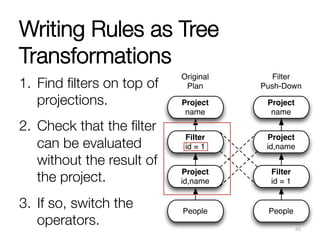
Writing Rules as Tree
Transformations
1.  Find filters on top of
projections.
2.  Check that the filter
can be evaluated
without the result of
the project.
3.  If so, switch the
operators.
Project
name
Project
id,name
Filter
id = 1
People
Original
Plan
Project
name
Project
id,name
Filter
id = 1
People
Filter
Push-Down
45
Filter Push Down Transformation
	
  
val	
  newPlan	
  =	
  queryPlan	
  transform	
  {	
  
	
  case	
  f	
  @	
  Filter(_,	
  p	
  @	
  Project(_,	
  grandChild))	


  if(f.references	
  subsetOf	
  grandChild.output)	
  =>	
  
	
  p.copy(child	
  =	
  f.copy(child	
  =	
  grandChild)	
  
}	
  
46
Filter Push Down Transformation
	
  
val	
  newPlan	
  =	
  queryPlan	
  transform	
  {	
  
	
  case	
  f	
  @	
  Filter(_,	
  p	
  @	
  Project(_,	
  grandChild))	


  if(f.references	
  subsetOf	
  grandChild.output)	
  =>	
  
	
  p.copy(child	
  =	
  f.copy(child	
  =	
  grandChild)	
  
}	
  
Partial Function
Tree
47
Filter Push Down Transformation
	
  
val	
  newPlan	
  =	
  queryPlan	
  transform	
  {	
  
	
  case	
  f	
  @	
  Filter(_,	
  p	
  @	
  Project(_,	
  grandChild))	


  if(f.references	
  subsetOf	
  grandChild.output)	
  =>	
  
	
  p.copy(child	
  =	
  f.copy(child	
  =	
  grandChild)	
  
}	
  
Find Filter on Project
48
Filter Push Down Transformation
	
  
val	
  newPlan	
  =	
  queryPlan	
  transform	
  {	
  
	
  case	
  f	
  @	
  Filter(_,	
  p	
  @	
  Project(_,	
  grandChild))	


  if(f.references	
  subsetOf	
  grandChild.output)	
  =>	
  
	
  p.copy(child	
  =	
  f.copy(child	
  =	
  grandChild)	
  
}	
  
Check that the filter can be evaluated without the result of the project.
49
Filter Push Down Transformation
	
  
val	
  newPlan	
  =	
  queryPlan	
  transform	
  {	
  
	
  case	
  f	
  @	
  Filter(_,	
  p	
  @	
  Project(_,	
  grandChild))	


  if(f.references	
  subsetOf	
  grandChild.output)	
  =>	
  
	
  p.copy(child	
  =	
  f.copy(child	
  =	
  grandChild)	
  
}	
  
If so, switch the order.
50
Filter Push Down Transformation
	
  
val	
  newPlan	
  =	
  queryPlan	
  transform	
  {	
  
	
  case	
  f	
  @	
  Filter(_,	
  p	
  @	
  Project(_,	
  grandChild))	


  if(f.references	
  subsetOf	
  grandChild.output)	
  =>	
  
	
  p.copy(child	
  =	
  f.copy(child	
  =	
  grandChild)	
  
}	
  
Scala: Pattern Matching
51
Filter Push Down Transformation
	
  
val	
  newPlan	
  =	
  queryPlan	
  transform	
  {	
  
	
  case	
  f	
  @	
  Filter(_,	
  p	
  @	
  Project(_,	
  grandChild))	


  if(f.references	
  subsetOf	
  grandChild.output)	
  =>	
  
	
  p.copy(child	
  =	
  f.copy(child	
  =	
  grandChild)	
  
}	
  
Catalyst: Attribute Reference Tracking
52
Filter Push Down Transformation
	
  
val	
  newPlan	
  =	
  queryPlan	
  transform	
  {	
  
	
  case	
  f	
  @	
  Filter(_,	
  p	
  @	
  Project(_,	
  grandChild))	


  if(f.references	
  subsetOf	
  grandChild.output)	
  =>	
  
	
  p.copy(child	
  =	
  f.copy(child	
  =	
  grandChild)	
  
}	
  
Scala: Copy Constructors
53
Optimizing with Rules
Project
name
Project
id,name
Filter
id = 1
People
Original
Plan
Project
name
Project
id,name
Filter
id = 1
People
Filter
Push-Down
Project
name
Filter
id = 1
People
Combine
Projection
IndexLookup
id = 1
return: name
Physical
Plan
54
Future Work – Project Tungsten
Consider “abcd” – 4 bytes with UTF8 encoding
java.lang.String	
  object	
  internals:	
  
OFFSET	
  	
  SIZE	
  	
  	
  TYPE	
  DESCRIPTION	


  VALUE	


  0	


  4	


  (object	
  header)	


  ...	


  4	


  4	


  (object	
  header)	


  ...	


  8	


  4	


  (object	
  header)	


  ...	


  12	


  4	
  char[]	
  String.value	


  []	


  16	


  4	


  int	
  String.hash	


  0	


  20	


  4	


  int	
  String.hash32	


  0	
  
Instance	
  size:	
  24	
  bytes	
  (reported	
  by	
  Instrumentation	
  API)	
  
Project Tungsten
Overcome JVM limitations:
•  Memory Management and Binary Processing:
leveraging application semantics to manage
memory explicitly and eliminate the overhead of
JVM object model and garbage collection
•  Cache-aware computation: algorithms and data
structures to exploit memory hierarchy
•  Code generation: using code generation to exploit
modern compilers and CPUs
Questions?
Learn more at: http://spark.apache.org/docs/latest/
Get Involved: https://github.com/apache/spark

Spark SQL Deep Dive @ Melbourne Spark Meetup

  • 1.
    Spark SQL DeepDive Michael Armbrust Melbourne Spark Meetup – June 1st 2015
  • 2.
    What is ApacheSpark? Fast and general cluster computing system, interoperable with Hadoop, included in all major distros Improves efficiency through: >  In-memory computing primitives >  General computation graphs Improves usability through: >  Rich APIs in Scala, Java, Python >  Interactive shell Up to 100× faster (2-10× on disk) 2-5× less code
  • 3.
    Spark Model Write programsin terms of transformations on distributed datasets Resilient Distributed Datasets (RDDs) >  Collections of objects that can be stored in memory or disk across a cluster >  Parallel functional transformations (map, filter, …) >  Automatically rebuilt on failure
  • 4.
    More than Map& Reduce map filter groupBy sort union join leftOuterJoin rightOuterJoin reduce count fold reduceByKey groupByKey cogroup cross zip sample take first partitionBy mapWith pipe save ...
  • 5.
    5   On-Disk SortRecord: Time to sort 100TB 2100 machines2013 Record: Hadoop 2014 Record: Spark Source: Daytona GraySort benchmark, sortbenchmark.org 72 minutes 207 machines 23 minutes Also sorted 1PB in 4 hours
  • 6.
    6   Spark “Hallof Fame” LARGEST SINGLE-DAY INTAKE LONGEST-RUNNING JOB LARGEST SHUFFLE MOST INTERESTING APP Tencent (1PB+ /day) Alibaba (1 week on 1PB+ data) Databricks PB Sort (1PB) Jeremy Freeman Mapping the Brain at Scale (with lasers!) LARGEST CLUSTER Tencent (8000+ nodes) Based on Reynold Xin’s personal knowledge
  • 7.
    Example: Log Mining Loaderror messages from a log into memory, then interactively search for various patterns val  lines  =  spark.textFile(“hdfs://...”)   val  errors  =  lines.filter(_  startswith  “ERROR”)   val  messages  =  errors.map(_.split(“t”)(2))   messages.cache()   lines Block 1 lines Block 2 lines Block 3 Worker Worker Worker Driver messages.filter(_  contains  “foo”).count()   messages.filter(_  contains  “bar”).count()   . . . tasks results messages Cache 1 messages Cache 2 messages Cache 3 Base RDD Transformed RDD Action Result: full-text search of Wikipedia in <1 sec (vs 20 sec for on-disk data) Result: scaled to 1 TB data in 5-7 sec# (vs 170 sec for on-disk data)
  • 8.
  • 9.
  • 10.
  • 11.
  • 12.
    Powerful Stack –Agile Development 0 20000 40000 60000 80000 100000 120000 140000 Hadoop MapReduce Storm (Streaming) Impala (SQL) Giraph (Graph) Spark non-test, non-example source lines GraphX Streaming SparkSQL
  • 13.
    Powerful Stack –Agile Development 0 20000 40000 60000 80000 100000 120000 140000 Hadoop MapReduce Storm (Streaming) Impala (SQL) Giraph (Graph) Spark non-test, non-example source lines GraphX Streaming SparkSQL Your App?
  • 14.
    About SQL Spark SQL > Part of the core distribution since Spark 1.0 (April 2014) 0 50 100 150 200 250 # Of Commits Per Month 0 50 100 150 200 2014-03 2014-04 2014-05 2014-06 2014-07 2014-08 2014-09 2014-10 2014-11 2014-12 2015-01 2015-02 2015-03 2015-04 2015-05 2015-06 # of Contributors
  • 15.
    SELECT  COUNT(*)   FROM  hiveTable   WHERE  hive_udf(data)     Spark SQL >  Part of the core distribution since Spark 1.0 (April 2014) >  Runs SQL / HiveQL queries including UDFs UDAFs and SerDes About SQL
  • 16.
    Spark SQL >  Partof the core distribution since Spark 1.0 (April 2014) >  Runs SQL / HiveQL queries including UDFs UDAFs and SerDes >  Connect existing BI tools to Spark through JDBC About SQL
  • 17.
    Spark SQL >  Partof the core distribution since Spark 1.0 (April 2014) >  Runs SQL / HiveQL queries including UDFs UDAFs and SerDes >  Connect existing BI tools to Spark through JDBC >  Bindings in Python, Scala, and Java About SQL
  • 18.
  • 19.
    SQL: The wholestory Create and Run Spark Programs Faster: >  Write less code >  Read less data >  Let the optimizer do the hard work
  • 20.
    DataFrame noun – [dey-tuh-freym] 1. A distributed collection of rows organized into named columns. 2.  An abstraction for selecting, filtering, aggregating and plotting structured data (cf. R, Pandas). 3.  Archaic: Previously SchemaRDD (cf. Spark < 1.3).
  • 21.
    Write Less Code:Input & Output Spark SQL’s Data Source API can read and write DataFrames using a variety of formats. 21   { JSON } Built-In External JDBC and more…
  • 22.
    Write Less Code:Input & Output Unified interface to reading/writing data in a variety of formats: df  =  sqlContext.read        .format("json")        .option("samplingRatio",  "0.1")        .load("/home/michael/data.json")     df.write        .format("parquet")        .mode("append")        .partitionBy("year")        .saveAsTable("fasterData")    
  • 23.
    Write Less Code:Input & Output Unified interface to reading/writing data in a variety of formats: df  =  sqlContext.read        .format("json")        .option("samplingRatio",  "0.1")        .load("/home/michael/data.json")     df.write        .format("parquet")        .mode("append")        .partitionBy("year")        .saveAsTable("fasterData")     read and write   functions create new builders for doing I/O
  • 24.
    Write Less Code:Input & Output Unified interface to reading/writing data in a variety of formats: df  =  sqlContext.read        .format("json")        .option("samplingRatio",  "0.1")        .load("/home/michael/data.json")     df.write        .format("parquet")        .mode("append")        .partitionBy("year")        .saveAsTable("fasterData")     Builder methods are used to specify: •  Format •  Partitioning •  Handling of existing data •  and more
  • 25.
    Write Less Code:Input & Output Unified interface to reading/writing data in a variety of formats: df  =  sqlContext.read        .format("json")        .option("samplingRatio",  "0.1")        .load("/home/michael/data.json")     df.write        .format("parquet")        .mode("append")        .partitionBy("year")        .saveAsTable("fasterData")     load(…), save(…) or saveAsTable(…)   functions create new builders for doing I/O
  • 26.
    ETL Using CustomData Sources sqlContext.read      .format("com.databricks.spark.git")      .option("url",  "https://github.com/apache/spark.git")      .option("numPartitions",  "100")      .option("branches",  "master,branch-­‐1.3,branch-­‐1.2")      .load()      .repartition(1)      .write      .format("json")      .save("/home/michael/spark.json")    
  • 27.
    Write Less Code:Powerful Operations Common operations can be expressed concisely as calls to the DataFrame API: •  Selecting required columns •  Joining different data sources •  Aggregation (count, sum, average, etc) •  Filtering 27  
  • 28.
    Write Less Code:Compute an Average private  IntWritable  one  =        new  IntWritable(1)   private  IntWritable  output  =      new  IntWritable()   proctected  void  map(          LongWritable  key,          Text  value,          Context  context)  {      String[]  fields  =  value.split("t")      output.set(Integer.parseInt(fields[1]))      context.write(one,  output)   }     IntWritable  one  =  new  IntWritable(1)   DoubleWritable  average  =  new  DoubleWritable()     protected  void  reduce(          IntWritable  key,          Iterable<IntWritable>  values,          Context  context)  {      int  sum  =  0      int  count  =  0      for(IntWritable  value  :  values)  {            sum  +=  value.get()            count++          }      average.set(sum  /  (double)  count)      context.Write(key,  average)   }   data  =  sc.textFile(...).split("t")   data.map(lambda  x:  (x[0],  [x.[1],  1]))          .reduceByKey(lambda  x,  y:  [x[0]  +  y[0],  x[1]  +  y[1]])          .map(lambda  x:  [x[0],  x[1][0]  /  x[1][1]])          .collect()  
  • 29.
    Write Less Code:Compute an Average Using RDDs   data  =  sc.textFile(...).split("t")   data.map(lambda  x:  (x[0],  [int(x[1]),  1]))          .reduceByKey(lambda  x,  y:  [x[0]  +  y[0],  x[1]  +  y[1]])          .map(lambda  x:  [x[0],  x[1][0]  /  x[1][1]])          .collect()         Using DataFrames   sqlCtx.table("people")          .groupBy("name")          .agg("name",  avg("age"))          .collect()     Using SQL   SELECT  name,  avg(age)   FROM  people   GROUP  BY  name  
  • 30.
    Not Just LessCode: Faster Implementations 0 2 4 6 8 10 RDD Scala RDD Python DataFrame Scala DataFrame Python DataFrame SQL Time to Aggregate 10 million int pairs (secs)
  • 31.
    31   Demo: DataFrames Using Spark SQL to read, write, slice and dice your data using a simple functions
  • 32.
    Read Less Data SparkSQL can help you read less data automatically: •  Converting to more efficient formats •  Using columnar formats (i.e. parquet) •  Using partitioning (i.e., /year=2014/month=02/…)1 •  Skipping data using statistics (i.e., min, max)2 •  Pushing predicates into storage systems (i.e., JDBC)  
  • 33.
    Optimization happens aslate as possible, therefore Spark SQL can optimize across functions. 33
  • 34.
    34 def  add_demographics(events):        u  =  sqlCtx.table("users")                                      #  Load  Hive  table        events              .join(u,  events.user_id  ==  u.user_id)        #  Join  on  user_id                      .withColumn("city",  zipToCity(df.zip))        #  udf  adds  city  column     events  =  add_demographics(sqlCtx.load("/data/events",  "json"))     training_data  =  events.where(events.city  ==  "Palo  Alto")                                              .select(events.timestamp).collect()     Logical Plan filter join events file users table expensive only join relevant users Physical Plan join scan (events) filter scan (users)
  • 35.
    35 def  add_demographics(events):        u  =  sqlCtx.table("users")                                      #  Load  partitioned  Hive  table        events              .join(u,  events.user_id  ==  u.user_id)        #  Join  on  user_id                      .withColumn("city",  zipToCity(df.zip))        #  Run  udf  to  add  city  column     Physical Plan with Predicate Pushdown and Column Pruning join optimized scan (events) optimized scan (users) events  =  add_demographics(sqlCtx.load("/data/events",  "parquet"))     training_data  =  events.where(events.city  ==  "Palo  Alto")                                              .select(events.timestamp).collect()     Logical Plan filter join events file users table Physical Plan join scan (events) filter scan (users)
  • 36.
    Machine Learning Pipelines tokenizer  =  Tokenizer(inputCol="text", outputCol="words”)   hashingTF  =  HashingTF(inputCol="words", outputCol="features”)   lr  =  LogisticRegression(maxIter=10,  regParam=0.01)   pipeline  =  Pipeline(stages=[tokenizer,  hashingTF,  lr])     df  =  sqlCtx.load("/path/to/data") model  =  pipeline.fit(df) df0 df1 df2 df3tokenizer hashingTF lr.model lr Pipeline Model
  • 37.
    Set Footer fromInsert Dropdown Menu 37 So how does it all work?
  • 38.
    Plan Optimization &Execution Set Footer from Insert Dropdown Menu 38 SQL AST DataFrame Unresolved Logical Plan Logical Plan Optimized Logical Plan RDDs Selected Physical Plan Analysis Logical Optimization Physical Planning CostModel Physical Plans Catalog DataFrames and SQL share the same optimization/execution pipeline Code Generation
  • 39.
    An example query SELECT  name   FROM  (        SELECT  id,  name        FROM  People)  p   WHERE  p.id  =  1   Project name Project id,name Filter id = 1 People Logical Plan 39
  • 40.
    Naïve Query Planning SELECT  name   FROM  (        SELECT  id,  name        FROM  People)  p   WHERE  p.id  =  1   Project name Project id,name Filter id = 1 People Logical Plan Project name Project id,name Filter id = 1 TableScan People Physical Plan 40
  • 41.
    Optimized Execution Writing imperativecode to optimize all possible patterns is hard. Project name Project id,name Filter id = 1 People Logical Plan Project name Project id,name Filter id = 1 People IndexLookup id = 1 return: name Logical Plan Physical Plan Instead write simple rules: •  Each rule makes one change •  Run many rules together to fixed point. 41
  • 42.
    Prior Work: # OptimizerGenerators Volcano / Cascades: •  Create a custom language for expressing rules that rewrite trees of relational operators. •  Build a compiler that generates executable code for these rules. Cons:  Developers  need  to  learn  this  custom   language.  Language  might  not  be  powerful   enough.   42
  • 43.
    TreeNode Library Easily transformabletrees of operators •  Standard collection functionality - foreach,   map,collect,etc. •  transform function – recursive modification of tree fragments that match a pattern. •  Debugging support – pretty printing, splicing, etc. 43
  • 44.
    Tree Transformations Developers expresstree transformations as PartialFunction[TreeType,TreeType] 1.  If the function does apply to an operator, that operator is replaced with the result. 2.  When the function does not apply to an operator, that operator is left unchanged. 3.  The transformation is applied recursively to all children. 44
  • 45.
    Writing Rules asTree Transformations 1.  Find filters on top of projections. 2.  Check that the filter can be evaluated without the result of the project. 3.  If so, switch the operators. Project name Project id,name Filter id = 1 People Original Plan Project name Project id,name Filter id = 1 People Filter Push-Down 45
  • 46.
    Filter Push DownTransformation   val  newPlan  =  queryPlan  transform  {    case  f  @  Filter(_,  p  @  Project(_,  grandChild))          if(f.references  subsetOf  grandChild.output)  =>    p.copy(child  =  f.copy(child  =  grandChild)   }   46
  • 47.
    Filter Push DownTransformation   val  newPlan  =  queryPlan  transform  {    case  f  @  Filter(_,  p  @  Project(_,  grandChild))          if(f.references  subsetOf  grandChild.output)  =>    p.copy(child  =  f.copy(child  =  grandChild)   }   Partial Function Tree 47
  • 48.
    Filter Push DownTransformation   val  newPlan  =  queryPlan  transform  {    case  f  @  Filter(_,  p  @  Project(_,  grandChild))          if(f.references  subsetOf  grandChild.output)  =>    p.copy(child  =  f.copy(child  =  grandChild)   }   Find Filter on Project 48
  • 49.
    Filter Push DownTransformation   val  newPlan  =  queryPlan  transform  {    case  f  @  Filter(_,  p  @  Project(_,  grandChild))          if(f.references  subsetOf  grandChild.output)  =>    p.copy(child  =  f.copy(child  =  grandChild)   }   Check that the filter can be evaluated without the result of the project. 49
  • 50.
    Filter Push DownTransformation   val  newPlan  =  queryPlan  transform  {    case  f  @  Filter(_,  p  @  Project(_,  grandChild))          if(f.references  subsetOf  grandChild.output)  =>    p.copy(child  =  f.copy(child  =  grandChild)   }   If so, switch the order. 50
  • 51.
    Filter Push DownTransformation   val  newPlan  =  queryPlan  transform  {    case  f  @  Filter(_,  p  @  Project(_,  grandChild))          if(f.references  subsetOf  grandChild.output)  =>    p.copy(child  =  f.copy(child  =  grandChild)   }   Scala: Pattern Matching 51
  • 52.
    Filter Push DownTransformation   val  newPlan  =  queryPlan  transform  {    case  f  @  Filter(_,  p  @  Project(_,  grandChild))          if(f.references  subsetOf  grandChild.output)  =>    p.copy(child  =  f.copy(child  =  grandChild)   }   Catalyst: Attribute Reference Tracking 52
  • 53.
    Filter Push DownTransformation   val  newPlan  =  queryPlan  transform  {    case  f  @  Filter(_,  p  @  Project(_,  grandChild))          if(f.references  subsetOf  grandChild.output)  =>    p.copy(child  =  f.copy(child  =  grandChild)   }   Scala: Copy Constructors 53
  • 54.
    Optimizing with Rules Project name Project id,name Filter id= 1 People Original Plan Project name Project id,name Filter id = 1 People Filter Push-Down Project name Filter id = 1 People Combine Projection IndexLookup id = 1 return: name Physical Plan 54
  • 55.
    Future Work –Project Tungsten Consider “abcd” – 4 bytes with UTF8 encoding java.lang.String  object  internals:   OFFSET    SIZE      TYPE  DESCRIPTION                                        VALUE            0          4                (object  header)                                ...            4          4                (object  header)                                ...            8          4                (object  header)                                ...          12          4  char[]  String.value                                      []          16          4        int  String.hash                                        0          20          4        int  String.hash32                                    0   Instance  size:  24  bytes  (reported  by  Instrumentation  API)  
  • 56.
    Project Tungsten Overcome JVMlimitations: •  Memory Management and Binary Processing: leveraging application semantics to manage memory explicitly and eliminate the overhead of JVM object model and garbage collection •  Cache-aware computation: algorithms and data structures to exploit memory hierarchy •  Code generation: using code generation to exploit modern compilers and CPUs
  • 57.
    Questions? Learn more at:http://spark.apache.org/docs/latest/ Get Involved: https://github.com/apache/spark