Highlights from Recommender Systems Conference
Boston, MA, USA, 15th-19th September 2016
Mindis Zickus, https://www.dunnhumby.com/
Topics
1. Everything is a recommendation at Netflix, Quora, Amazon,…
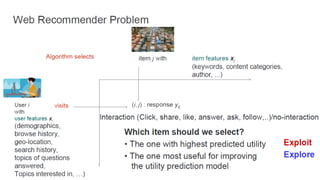
2. Adaptive and interactive recommendations
3. Text modelling algorithms for recommendations
4. Explore-exploit dilemma
5. Models to generate features: Ranking content in the news feed
at Facebook
6. Deep learning is disrupting recommenders
7. Models in production
8. Pin recommendation at Pinterest
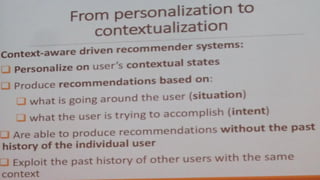
9. Contextual Turn
10. Interesting Papers, slides, algorithms
1. Everything is a recommendation
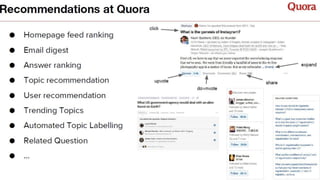
Netflix, Quora, Amazon
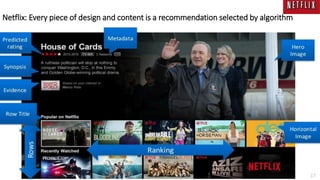
Netflix: Every piece of design and content is a recommendation selected by algorithm
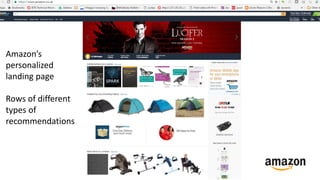
Amazon’s
personalized
landing page
Rows of different
types of
recommendations
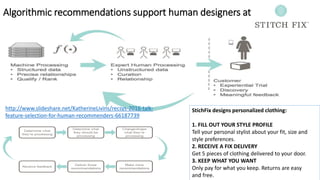
Algorithmic recommendations support human designers at
StichFix designs personalized clothing:
1. FILL OUT YOUR STYLE PROFILE
Tell your personal stylist about your fit, size and
style preferences.
2. RECEIVE A FIX DELIVERY
Get 5 pieces of clothing delivered to your door.
3. KEEP WHAT YOU WANT
Only pay for what you keep. Returns are easy
and free.
http://www.slideshare.net/KatherineLivins/recsys-2016-talk-
feature-selection-for-human-recommenders-66187739
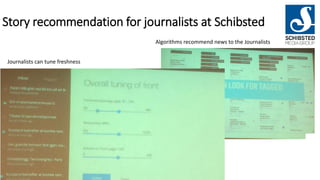
Story recommendation for journalists at Schibsted
Algorithms recommend news to the Journalists
Journalists can tune freshness
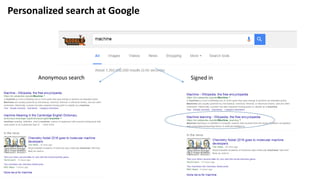
Anonymous search Signed in
Personalized search at Google
2. Adaptive and interactive recommendations
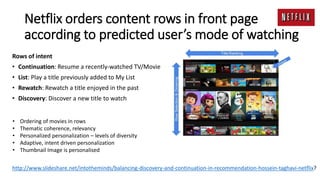
Netflix orders content rows in front page
according to predicted user’s mode of watching
Rows of intent
• Continuation: Resume a recently-watched TV/Movie
• List: Play a title previously added to My List
• Rewatch: Rewatch a title enjoyed in the past
• Discovery: Discover a new title to watch
http://www.slideshare.net/intotheminds/balancing-discovery-and-continuation-in-recommendation-hossein-taghavi-netflix?
• Ordering of movies in rows
• Thematic coherence, relevancy
• Personalized personalization – levels of diversity
• Adaptive, intent driven personalization
• Thumbnail Image is personalised
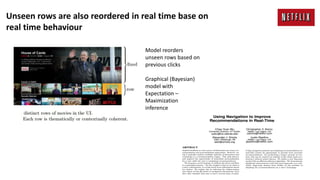
Model reorders
unseen rows based on
previous clicks
Graphical (Bayesian)
model with
Expectation –
Maximization
inference
Unseen rows are also reordered in real time base on
real time behaviour
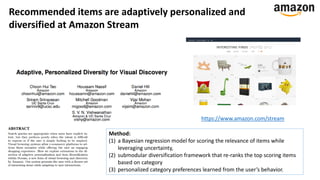
https://www.amazon.com/stream
Recommended items are adaptively personalized and
diversified at Amazon Stream
Method:
(1) a Bayesian regression model for scoring the relevance of items while
leveraging uncertainty,
(2) submodular diversification framework that re-ranks the top scoring items
based on category
(3) personalized category preferences learned from the user’s behavior.
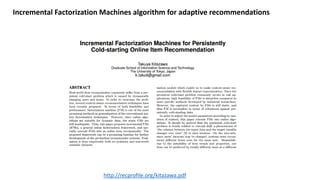
http://recprofile.org/kitazawa.pdf
Incremental Factorization Machines algorithm for adaptive recommendations
3. Text modelling algorithms for recommendations
How would your recommend a web page?
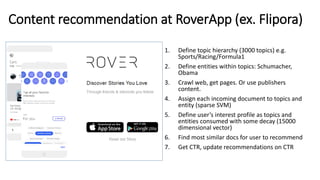
Content recommendation at RoverApp (ex. Flipora)
1. Define topic hierarchy (3000 topics) e.g.
Sports/Racing/Formula1
2. Define entities within topics: Schumacher,
Obama
3. Crawl web, get pages. Or use publishers
content.
4. Assign each incoming document to topics and
entity (sparse SVM)
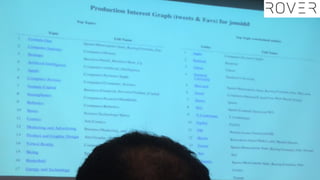
5. Define user’s interest profile as topics and
entities consumed with some decay (15000
dimensional vector)
6. Find most similar docs for user to recommend
7. Get CTR, update recommendations on CTR
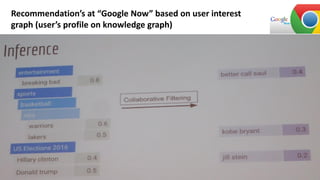
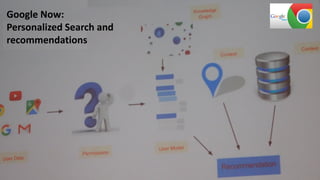
Recommendation’s at “Google Now” based on user interest
graph (user’s profile on knowledge graph)
Many industry recommenders are based or benefit from text
information
Methods:
• Tweets
• Search queries
• SMS messages
• Conversations
• Product descriptors
Many of items has some text attributes or
can be solely defined by text
• Similarity (bag of words, TF/IDF)
• Topic discovery with unsupervised learning (LDA)
• Dynamics of topics
• Taxonomies or Knowledge Graphs of Topics
• Entities (Named entity recognition)
• Sentiment
• Sequence (word2vec)
• Embedding
• User interest’s mapping
• Web pages
• Stories
• Blogs
• News
• Q&A
• Reviews
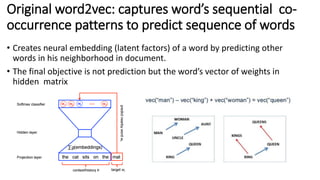
Original word2vec: captures word’s sequential co-
occurrence patterns to predict sequence of words
• Creates neural embedding (latent factors) of a word by predicting other
words in his neighborhood in document.
• The final objective is not prediction but the word’s vector of weights in
hidden matrix
Word2vec extensions for product recommendations
Yahoo: Prod2vec: predict next product in purchase sequence
https://arxiv.org/pdf/1606.07154.pdf
Criteo: Meta-Prod2Vec: extends prod2vec by leveraging item meta data, can
be used for cold start problems
https://arxiv.org/pdf/1607.07326v1.pdf
Microsoft: Item2Vec: Predict other products in basket
https://arxiv.org/ftp/arxiv/papers/1603/1603.04259.pdf
You have to do “Embedding”
• Every cool data scientist does “Embedding” these days
• Embedding means transporting/mapping the item or user to another n-dimensional
space.
• Sparse to dense representation
• Reduces dimensionality
• Space can be clusters, latent factors, dimensions.
• Embedding methods can be clustering, PCA, LD matrix factorization, neural (e.g.
word2vec), deep learning
• Embedding can be hierarchical
• Distances between items in new space gives similarity.
• There might be many types of similarities (e.g. >20 at Facebook)
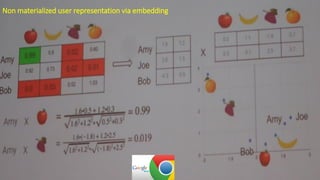
Non materialized user representation via embedding
4. Explore exploit dilemma
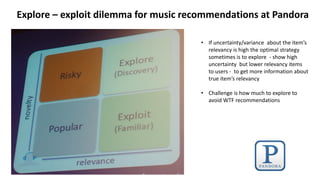
Explore – exploit dilemma for music recommendations at Pandora
• If uncertainty/variance about the item’s
relevancy is high the optimal strategy
sometimes is to explore - show high
uncertainty but lower relevancy items
to users - to get more information about
true item’s relevancy
• Challenge is how much to explore to
avoid WTF recommendations
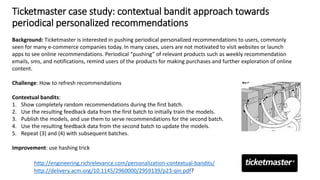
Ticketmaster case study: contextual bandit approach towards
periodical personalized recommendations
http://delivery.acm.org/10.1145/2960000/2959139/p23-qin.pdf?
Background: Ticketmaster is interested in pushing periodical personalized recommendations to users, commonly
seen for many e-commerce companies today. In many cases, users are not motivated to visit websites or launch
apps to see online recommendations. Periodical “pushing” of relevant products such as weekly recommendation
emails, sms, and notifications, remind users of the products for making purchases and further exploration of online
content.
Challenge: How to refresh recommendations
Contextual bandits:
1. Show completely random recommendations during the first batch.
2. Use the resulting feedback data from the first batch to initially train the models.
3. Publish the models, and use them to serve recommendations for the second batch.
4. Use the resulting feedback data from the second batch to update the models.
5. Repeat (3) and (4) with subsequent batches.
Improvement: use hashing trick
http://engineering.richrelevance.com/personalization-contextual-bandits/
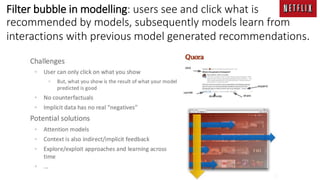
Filter bubble in modelling: users see and click what is
recommended by models, subsequently models learn from
interactions with previous model generated recommendations.
5. Models to generate features: Ranking content in
the news feed at Facebook
http://conf.turi.com/lsrs16/wp-content/uploads/Komal_Kapoor_Ranking-and-Recommendation-for-Billions-of-Users.pptx
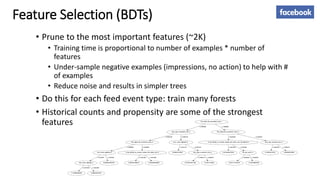
Feature Selection (BDTs)
• Prune to the most important features (~2K)
• Training time is proportional to number of examples * number of
features
• Under-sample negative examples (impressions, no action) to help with #
of examples
• Reduce noise and results in simpler trees
• Do this for each feed event type: train many forests
• Historical counts and propensity are some of the strongest
features
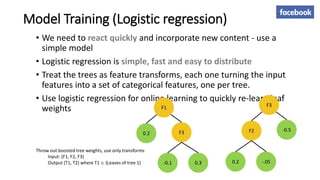
Model Training (Logistic regression)
• We need to react quickly and incorporate new content - use a
simple model
• Logistic regression is simple, fast and easy to distribute
• Treat the trees as feature transforms, each one turning the input
features into a set of categorical features, one per tree.
• Use logistic regression for online learning to quickly re-learn leaf
weights
F3
-0.1 0.3
0.2
F1
-0.5
0.2 -.05
F2
F3
Throw out boosted tree weights, use only transforms
Input: (F1, F2, F3)
Output (T1, T2) where T1  {Leaves of tree 1}
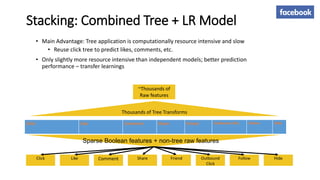
Stacking: Combined Tree + LR Model
• Main Advantage: Tree application is computationally resource intensive and slow
• Reuse click tree to predict likes, comments, etc.
• Only slightly more resource intensive than independent models; better prediction
performance – transfer learnings
~Thousands of
Raw features
Thousands of Tree Transforms
Sparse Boolean features + non-tree raw features
Like Comment Share Friend Outbound
Click
Follow HideClick
Click Like Comment Share Friend Outbound click Follow Hide
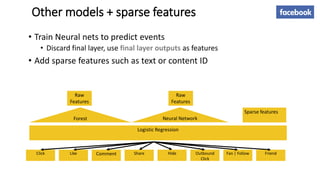
Other models + sparse features
• Train Neural nets to predict events
• Discard final layer, use final layer outputs as features
• Add sparse features such as text or content ID
Raw
Features
Forest
Raw
Features
Neural Network
Sparse features
Logistic Regression
Like Comment Share Hide Outbound
Click
Fan | Follow FriendClick
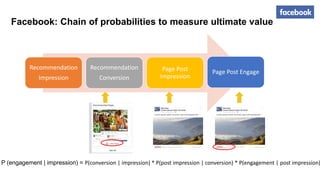
Facebook: Chain of probabilities to measure ultimate value
Recommendation
Impression
Recommendation
Conversion
Page Post
Impression
Page Post Engage
P (engagement | impression) = P(conversion | impression) * P(post impression | conversion) * P(engagement | post impression)
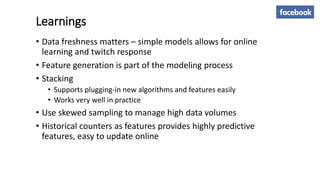
• Data freshness matters – simple models allows for online
learning and twitch response
• Feature generation is part of the modeling process
• Stacking
• Supports plugging-in new algorithms and features easily
• Works very well in practice
• Use skewed sampling to manage high data volumes
• Historical counters as features provides highly predictive
features, easy to update online
Learnings
6. Deep Learning is disrupting recommenders
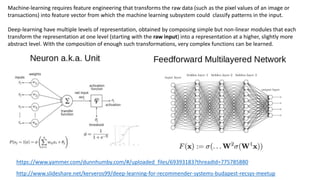
Machine-learning requires feature engineering that transforms the raw data (such as the pixel values of an image or
transactions) into feature vector from which the machine learning subsystem could classify patterns in the input.
Deep-learning have multiple levels of representation, obtained by composing simple but non-linear modules that each
transform the representation at one level (starting with the raw input) into a representation at a higher, slightly more
abstract level. With the composition of enough such transformations, very complex functions can be learned.
http://www.slideshare.net/kerveros99/deep-learning-for-recommender-systems-budapest-recsys-meetup
https://www.yammer.com/dunnhumby.com/#/uploaded_files/69393183?threadId=775785880
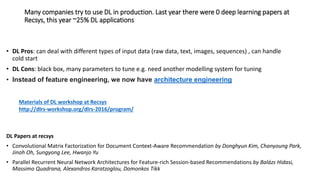
Many companies try to use DL in production. Last year there were 0 deep learning papers at
Recsys, this year ~25% DL applications
• DL Pros: can deal with different types of input data (raw data, text, images, sequences) , can handle
cold start
• DL Cons: black box, many parameters to tune e.g. need another modelling system for tuning
• Instead of feature engineering, we now have architecture engineering
DL Papers at recsys
• Convolutional Matrix Factorization for Document Context-Aware Recommendation by Donghyun Kim, Chanyoung Park,
Jinoh Oh, Sungyong Lee, Hwanjo Yu
• Parallel Recurrent Neural Network Architectures for Feature-rich Session-based Recommendations by Balázs Hidasi,
Massimo Quadrana, Alexandros Karatzoglou, Domonkos Tikk
Materials of DL workshop at Recsys
http://dlrs-workshop.org/dlrs-2016/program/
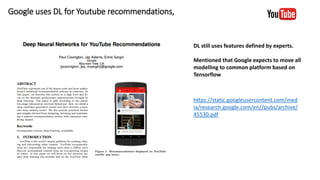
Google uses DL for Youtube recommendations,
DL still uses features defined by experts.
Mentioned that Google expects to move all
modelling to common platform based on
Tensorflow
https://static.googleusercontent.com/med
ia/research.google.com/en//pubs/archive/
45530.pdf
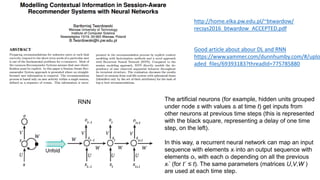
The artificial neurons (for example, hidden units grouped
under node s with values st at time t) get inputs from
other neurons at previous time steps (this is represented
with the black square, representing a delay of one time
step, on the left).
In this way, a recurrent neural network can map an input
sequence with elements xt into an output sequence with
elements ot, with each ot depending on all the previous
xtʹ (for tʹ ≤ t). The same parameters (matrices U,V,W )
are used at each time step.
Good article about abour DL and RNN
https://www.yammer.com/dunnhumby.com/#/uplo
aded_files/69393183?threadId=775785880
http://home.elka.pw.edu.pl/~btwardow/
recsys2016_btwardow_ACCEPTED.pdf
RNN
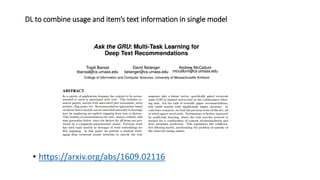
DL to combine usage and item’s text information in single model
• https://arxiv.org/abs/1609.02116
7. Models in production
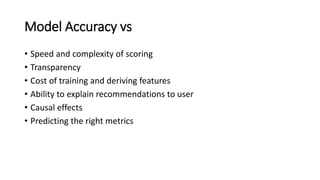
Model Accuracy vs
• Speed and complexity of scoring
• Transparency
• Cost of training and deriving features
• Ability to explain recommendations to user
• Causal effects
• Predicting the right metrics
http://www.slideshare.net/xamat/recsys-2016-tutorial-lessons-
learned-from-building-reallife-recommender-systems
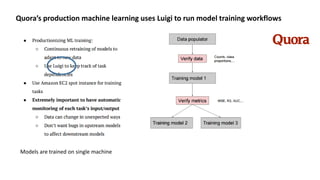
Quora’s production machine learning uses Luigi to run model training workflows
Models are trained on single machine
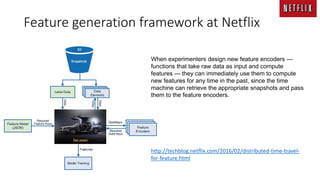
Feature generation framework at Netflix
When experimenters design new feature encoders —
functions that take raw data as input and compute
features — they can immediately use them to compute
new features for any time in the past, since the time
machine can retrieve the appropriate snapshots and pass
them to the feature encoders.
http://techblog.netflix.com/2016/02/distributed-time-travel-
for-feature.html
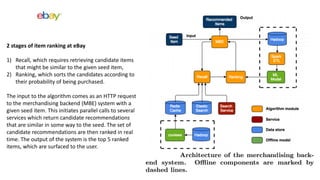
Everyone uses two stage scoring!!!!
Stage1: Candidate retrieval, aim for high recall, get thousands of item
candidates
Stage2: Reranking based on more sophisticated models, real time
context, user’s feedback
2 stages of item ranking at eBay
1) Recall, which requires retrieving candidate items
that might be similar to the given seed item,
2) Ranking, which sorts the candidates according to
their probability of being purchased.
The input to the algorithm comes as an HTTP request
to the merchandising backend (MBE) system with a
given seed item. This initiates parallel calls to several
services which return candidate recommendations
that are similar in some way to the seed. The set of
candidate recommendations are then ranked in real
time. The output of the system is the top 5 ranked
items, which are surfaced to the user.
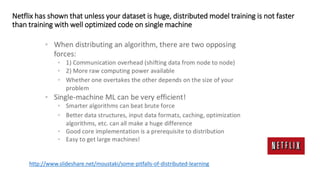
Netflix has shown that unless your dataset is huge, distributed model training is not faster
than training with well optimized code on single machine
http://www.slideshare.net/moustaki/some-pitfalls-of-distributed-learning
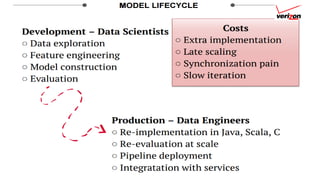
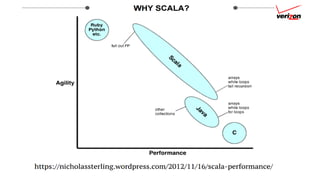
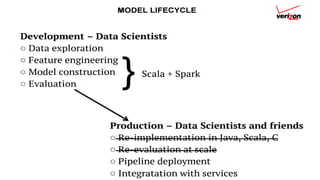
Argument for Scala to bridge data science and
production engineers
Some companies (Verizon, Asos, Credit Karma) are adopting Scala as
universal data analysis and analysis production language.
Why Scala:
• Functional language, can write data transformation pipelines
• Can use Java libraries
• Spark is in Scala
Similar to “continuous integration” movement to integrate software
development and operations.
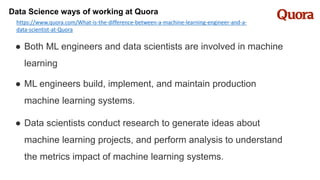
● Both ML engineers and data scientists are involved in machine
learning
● ML engineers build, implement, and maintain production
machine learning systems.
● Data scientists conduct research to generate ideas about
machine learning projects, and perform analysis to understand
the metrics impact of machine learning systems.
Data Science ways of working at Quora
https://www.quora.com/What-is-the-difference-between-a-machine-learning-engineer-and-a-
data-scientist-at-Quora
8. Example: Pin recommendation at Pinterest
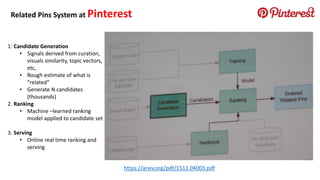
Related Pins System at Pinterest
1: Candidate Generation
• Signals derived from curation,
visuals similarity, topic vectors,
etc,
• Rough estimate of what is
“related”
• Generate N candidates
(thousands)
2. Ranking
• Machine –learned ranking
model applied to candidate set
3. Serving
• Online real time ranking and
serving
https://arxiv.org/pdf/1511.04003.pdf
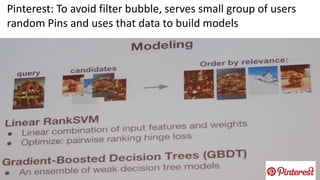
Pinterest: To avoid filter bubble, serves small group of users
random Pins and uses that data to build models
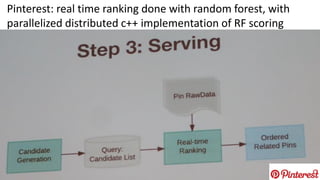
Pinterest: real time ranking done with random forest, with
parallelized distributed c++ implementation of RF scoring
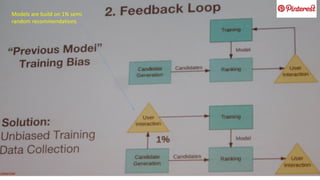
Models are build on 1% semi
random recommendations
9. Contextual turn
Contextual recommendations
• Recommendations don’t have to personal
• Majority of recommenders used in industry are item-item (non
personalized)
• Increasing number of session based recommenders
• When searching for new item it’s more important what other users did in
this situation vs. what user did previously himself
https://home.deib.polimi.it/pagano/portfolio/papers/TheContextualTurn.pdf
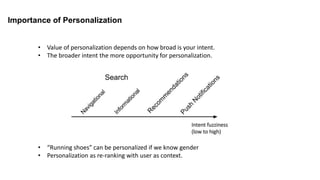
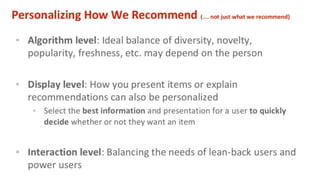
Importance of Personalization
• Value of personalization depends on how broad is your intent.
• The broader intent the more opportunity for personalization.
• “Running shoes” can be personalized if we know gender
• Personalization as re-ranking with user as context.
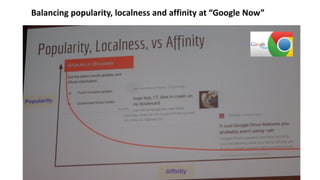
Balancing popularity, localness and affinity at “Google Now”
Google Now:
Personalized Search and
recommendations
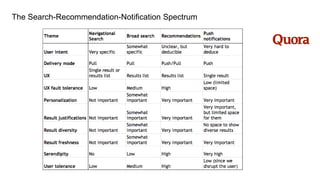
The Search-Recommendation-Notification Spectrum
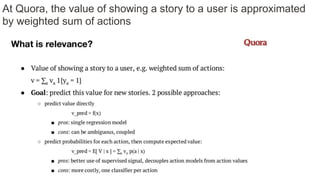
At Quora, the value of showing a story to a user is approximated
by weighted sum of actions
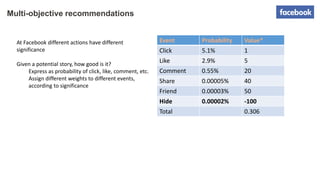
Event Probability Value*
Click 5.1% 1
Like 2.9% 5
Comment 0.55% 20
Share 0.00005% 40
Friend 0.00003% 50
Hide 0.00002% -100
Total 0.306
Multi-objective recommendations
At Facebook different actions have different
significance
Given a potential story, how good is it?
Express as probability of click, like, comment, etc.
Assign different weights to different events,
according to significance
10. Interesting Papers, slides, algorithms
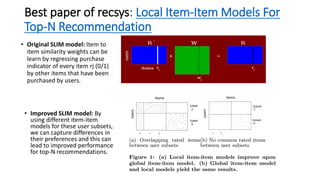
Best paper of recsys: Local Item-Item Models For
Top-N Recommendation
• Original SLIM model: Item to
item similarity weights can be
learn by regressing purchase
indicator of every item rj (0/1)
by other items that have been
purchased by users.
• Improved SLIM model: By
using different item-item
models for these user subsets,
we can capture differences in
their preferences and this can
lead to improved performance
for top-N recommendations.
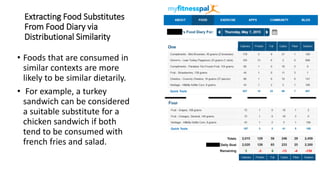
Extracting Food Substitutes
From Food Diary via
Distributional Similarity
• Foods that are consumed in
similar contexts are more
likely to be similar dietarily.
• For example, a turkey
sandwich can be considered
a suitable substitute for a
chicken sandwich if both
tend to be consumed with
french fries and salad.
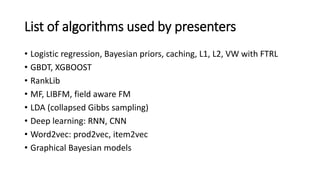
List of algorithms used by presenters
• Logistic regression, Bayesian priors, caching, L1, L2, VW with FTRL
• GBDT, XGBOOST
• RankLib
• MF, LIBFM, field aware FM
• LDA (collapsed Gibbs sampling)
• Deep learning: RNN, CNN
• Word2vec: prod2vec, item2vec
• Graphical Bayesian models
https://github.com/quora/qmf
LiRa: A New Likelihood-Based Similarity Score
For Collaborative Filtering
• https://arxiv.org/pdf/1608.08646v1.pdf
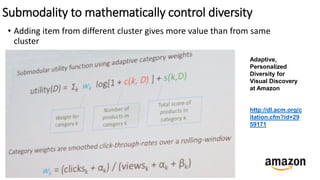
Submodality to mathematically control diversity
• Adding item from different cluster gives more value than from same
cluster
Adaptive,
Personalized
Diversity for
Visual Discovery
at Amazon
http://dl.acm.org/c
itation.cfm?id=29
59171
Negative sampling – is still an art
• Observational ata are implicit we know what user likes but don’t
• What user actually has seen or is aware of but intentionally hasn’t
clicked
• Popular not clicked items
• No single method, have to try what works
Measurement
Offline A/B testing
http://leon.bottou.org/publications/pdf/tr-2012-09-12.pdf
Targeted maximum likelihood
http://www.targetedlearningbook.com/

Recsys 2016

  • 1.
    Highlights from RecommenderSystems Conference Boston, MA, USA, 15th-19th September 2016 Mindis Zickus, https://www.dunnhumby.com/
  • 2.
    Topics 1. Everything isa recommendation at Netflix, Quora, Amazon,… 2. Adaptive and interactive recommendations 3. Text modelling algorithms for recommendations 4. Explore-exploit dilemma 5. Models to generate features: Ranking content in the news feed at Facebook 6. Deep learning is disrupting recommenders 7. Models in production 8. Pin recommendation at Pinterest 9. Contextual Turn 10. Interesting Papers, slides, algorithms
  • 3.
    1. Everything isa recommendation Netflix, Quora, Amazon
  • 4.
    Netflix: Every pieceof design and content is a recommendation selected by algorithm
  • 6.
    Amazon’s personalized landing page Rows ofdifferent types of recommendations
  • 8.
    Algorithmic recommendations supporthuman designers at StichFix designs personalized clothing: 1. FILL OUT YOUR STYLE PROFILE Tell your personal stylist about your fit, size and style preferences. 2. RECEIVE A FIX DELIVERY Get 5 pieces of clothing delivered to your door. 3. KEEP WHAT YOU WANT Only pay for what you keep. Returns are easy and free. http://www.slideshare.net/KatherineLivins/recsys-2016-talk- feature-selection-for-human-recommenders-66187739
  • 9.
    Story recommendation forjournalists at Schibsted Algorithms recommend news to the Journalists Journalists can tune freshness
  • 10.
    Anonymous search Signedin Personalized search at Google
  • 11.
    2. Adaptive andinteractive recommendations
  • 12.
    Netflix orders contentrows in front page according to predicted user’s mode of watching Rows of intent • Continuation: Resume a recently-watched TV/Movie • List: Play a title previously added to My List • Rewatch: Rewatch a title enjoyed in the past • Discovery: Discover a new title to watch http://www.slideshare.net/intotheminds/balancing-discovery-and-continuation-in-recommendation-hossein-taghavi-netflix? • Ordering of movies in rows • Thematic coherence, relevancy • Personalized personalization – levels of diversity • Adaptive, intent driven personalization • Thumbnail Image is personalised
  • 13.
    Model reorders unseen rowsbased on previous clicks Graphical (Bayesian) model with Expectation – Maximization inference Unseen rows are also reordered in real time base on real time behaviour
  • 14.
    https://www.amazon.com/stream Recommended items areadaptively personalized and diversified at Amazon Stream Method: (1) a Bayesian regression model for scoring the relevance of items while leveraging uncertainty, (2) submodular diversification framework that re-ranks the top scoring items based on category (3) personalized category preferences learned from the user’s behavior.
  • 15.
  • 16.
    3. Text modellingalgorithms for recommendations
  • 17.
    How would yourrecommend a web page?
  • 18.
    Content recommendation atRoverApp (ex. Flipora) 1. Define topic hierarchy (3000 topics) e.g. Sports/Racing/Formula1 2. Define entities within topics: Schumacher, Obama 3. Crawl web, get pages. Or use publishers content. 4. Assign each incoming document to topics and entity (sparse SVM) 5. Define user’s interest profile as topics and entities consumed with some decay (15000 dimensional vector) 6. Find most similar docs for user to recommend 7. Get CTR, update recommendations on CTR
  • 20.
    Recommendation’s at “GoogleNow” based on user interest graph (user’s profile on knowledge graph)
  • 21.
    Many industry recommendersare based or benefit from text information Methods: • Tweets • Search queries • SMS messages • Conversations • Product descriptors Many of items has some text attributes or can be solely defined by text • Similarity (bag of words, TF/IDF) • Topic discovery with unsupervised learning (LDA) • Dynamics of topics • Taxonomies or Knowledge Graphs of Topics • Entities (Named entity recognition) • Sentiment • Sequence (word2vec) • Embedding • User interest’s mapping • Web pages • Stories • Blogs • News • Q&A • Reviews
  • 22.
    Original word2vec: capturesword’s sequential co- occurrence patterns to predict sequence of words • Creates neural embedding (latent factors) of a word by predicting other words in his neighborhood in document. • The final objective is not prediction but the word’s vector of weights in hidden matrix
  • 23.
    Word2vec extensions forproduct recommendations Yahoo: Prod2vec: predict next product in purchase sequence https://arxiv.org/pdf/1606.07154.pdf Criteo: Meta-Prod2Vec: extends prod2vec by leveraging item meta data, can be used for cold start problems https://arxiv.org/pdf/1607.07326v1.pdf Microsoft: Item2Vec: Predict other products in basket https://arxiv.org/ftp/arxiv/papers/1603/1603.04259.pdf
  • 24.
    You have todo “Embedding” • Every cool data scientist does “Embedding” these days • Embedding means transporting/mapping the item or user to another n-dimensional space. • Sparse to dense representation • Reduces dimensionality • Space can be clusters, latent factors, dimensions. • Embedding methods can be clustering, PCA, LD matrix factorization, neural (e.g. word2vec), deep learning • Embedding can be hierarchical • Distances between items in new space gives similarity. • There might be many types of similarities (e.g. >20 at Facebook)
  • 25.
    Non materialized userrepresentation via embedding
  • 26.
  • 28.
    Explore – exploitdilemma for music recommendations at Pandora • If uncertainty/variance about the item’s relevancy is high the optimal strategy sometimes is to explore - show high uncertainty but lower relevancy items to users - to get more information about true item’s relevancy • Challenge is how much to explore to avoid WTF recommendations
  • 29.
    Ticketmaster case study:contextual bandit approach towards periodical personalized recommendations http://delivery.acm.org/10.1145/2960000/2959139/p23-qin.pdf? Background: Ticketmaster is interested in pushing periodical personalized recommendations to users, commonly seen for many e-commerce companies today. In many cases, users are not motivated to visit websites or launch apps to see online recommendations. Periodical “pushing” of relevant products such as weekly recommendation emails, sms, and notifications, remind users of the products for making purchases and further exploration of online content. Challenge: How to refresh recommendations Contextual bandits: 1. Show completely random recommendations during the first batch. 2. Use the resulting feedback data from the first batch to initially train the models. 3. Publish the models, and use them to serve recommendations for the second batch. 4. Use the resulting feedback data from the second batch to update the models. 5. Repeat (3) and (4) with subsequent batches. Improvement: use hashing trick http://engineering.richrelevance.com/personalization-contextual-bandits/
  • 30.
    Filter bubble inmodelling: users see and click what is recommended by models, subsequently models learn from interactions with previous model generated recommendations.
  • 31.
    5. Models togenerate features: Ranking content in the news feed at Facebook http://conf.turi.com/lsrs16/wp-content/uploads/Komal_Kapoor_Ranking-and-Recommendation-for-Billions-of-Users.pptx
  • 32.
    Feature Selection (BDTs) •Prune to the most important features (~2K) • Training time is proportional to number of examples * number of features • Under-sample negative examples (impressions, no action) to help with # of examples • Reduce noise and results in simpler trees • Do this for each feed event type: train many forests • Historical counts and propensity are some of the strongest features
  • 33.
    Model Training (Logisticregression) • We need to react quickly and incorporate new content - use a simple model • Logistic regression is simple, fast and easy to distribute • Treat the trees as feature transforms, each one turning the input features into a set of categorical features, one per tree. • Use logistic regression for online learning to quickly re-learn leaf weights F3 -0.1 0.3 0.2 F1 -0.5 0.2 -.05 F2 F3 Throw out boosted tree weights, use only transforms Input: (F1, F2, F3) Output (T1, T2) where T1  {Leaves of tree 1}
  • 34.
    Stacking: Combined Tree+ LR Model • Main Advantage: Tree application is computationally resource intensive and slow • Reuse click tree to predict likes, comments, etc. • Only slightly more resource intensive than independent models; better prediction performance – transfer learnings ~Thousands of Raw features Thousands of Tree Transforms Sparse Boolean features + non-tree raw features Like Comment Share Friend Outbound Click Follow HideClick Click Like Comment Share Friend Outbound click Follow Hide
  • 35.
    Other models +sparse features • Train Neural nets to predict events • Discard final layer, use final layer outputs as features • Add sparse features such as text or content ID Raw Features Forest Raw Features Neural Network Sparse features Logistic Regression Like Comment Share Hide Outbound Click Fan | Follow FriendClick
  • 36.
    Facebook: Chain ofprobabilities to measure ultimate value Recommendation Impression Recommendation Conversion Page Post Impression Page Post Engage P (engagement | impression) = P(conversion | impression) * P(post impression | conversion) * P(engagement | post impression)
  • 37.
    • Data freshnessmatters – simple models allows for online learning and twitch response • Feature generation is part of the modeling process • Stacking • Supports plugging-in new algorithms and features easily • Works very well in practice • Use skewed sampling to manage high data volumes • Historical counters as features provides highly predictive features, easy to update online Learnings
  • 38.
    6. Deep Learningis disrupting recommenders
  • 39.
    Machine-learning requires featureengineering that transforms the raw data (such as the pixel values of an image or transactions) into feature vector from which the machine learning subsystem could classify patterns in the input. Deep-learning have multiple levels of representation, obtained by composing simple but non-linear modules that each transform the representation at one level (starting with the raw input) into a representation at a higher, slightly more abstract level. With the composition of enough such transformations, very complex functions can be learned. http://www.slideshare.net/kerveros99/deep-learning-for-recommender-systems-budapest-recsys-meetup https://www.yammer.com/dunnhumby.com/#/uploaded_files/69393183?threadId=775785880
  • 40.
    Many companies tryto use DL in production. Last year there were 0 deep learning papers at Recsys, this year ~25% DL applications • DL Pros: can deal with different types of input data (raw data, text, images, sequences) , can handle cold start • DL Cons: black box, many parameters to tune e.g. need another modelling system for tuning • Instead of feature engineering, we now have architecture engineering DL Papers at recsys • Convolutional Matrix Factorization for Document Context-Aware Recommendation by Donghyun Kim, Chanyoung Park, Jinoh Oh, Sungyong Lee, Hwanjo Yu • Parallel Recurrent Neural Network Architectures for Feature-rich Session-based Recommendations by Balázs Hidasi, Massimo Quadrana, Alexandros Karatzoglou, Domonkos Tikk Materials of DL workshop at Recsys http://dlrs-workshop.org/dlrs-2016/program/
  • 41.
    Google uses DLfor Youtube recommendations, DL still uses features defined by experts. Mentioned that Google expects to move all modelling to common platform based on Tensorflow https://static.googleusercontent.com/med ia/research.google.com/en//pubs/archive/ 45530.pdf
  • 42.
    The artificial neurons(for example, hidden units grouped under node s with values st at time t) get inputs from other neurons at previous time steps (this is represented with the black square, representing a delay of one time step, on the left). In this way, a recurrent neural network can map an input sequence with elements xt into an output sequence with elements ot, with each ot depending on all the previous xtʹ (for tʹ ≤ t). The same parameters (matrices U,V,W ) are used at each time step. Good article about abour DL and RNN https://www.yammer.com/dunnhumby.com/#/uplo aded_files/69393183?threadId=775785880 http://home.elka.pw.edu.pl/~btwardow/ recsys2016_btwardow_ACCEPTED.pdf RNN
  • 43.
    DL to combineusage and item’s text information in single model • https://arxiv.org/abs/1609.02116
  • 45.
    7. Models inproduction
  • 46.
    Model Accuracy vs •Speed and complexity of scoring • Transparency • Cost of training and deriving features • Ability to explain recommendations to user • Causal effects • Predicting the right metrics
  • 47.
  • 48.
    Quora’s production machinelearning uses Luigi to run model training workflows Models are trained on single machine
  • 49.
    Feature generation frameworkat Netflix When experimenters design new feature encoders — functions that take raw data as input and compute features — they can immediately use them to compute new features for any time in the past, since the time machine can retrieve the appropriate snapshots and pass them to the feature encoders. http://techblog.netflix.com/2016/02/distributed-time-travel- for-feature.html
  • 50.
    Everyone uses twostage scoring!!!! Stage1: Candidate retrieval, aim for high recall, get thousands of item candidates Stage2: Reranking based on more sophisticated models, real time context, user’s feedback
  • 52.
    2 stages ofitem ranking at eBay 1) Recall, which requires retrieving candidate items that might be similar to the given seed item, 2) Ranking, which sorts the candidates according to their probability of being purchased. The input to the algorithm comes as an HTTP request to the merchandising backend (MBE) system with a given seed item. This initiates parallel calls to several services which return candidate recommendations that are similar in some way to the seed. The set of candidate recommendations are then ranked in real time. The output of the system is the top 5 ranked items, which are surfaced to the user.
  • 53.
    Netflix has shownthat unless your dataset is huge, distributed model training is not faster than training with well optimized code on single machine http://www.slideshare.net/moustaki/some-pitfalls-of-distributed-learning
  • 54.
    Argument for Scalato bridge data science and production engineers Some companies (Verizon, Asos, Credit Karma) are adopting Scala as universal data analysis and analysis production language. Why Scala: • Functional language, can write data transformation pipelines • Can use Java libraries • Spark is in Scala Similar to “continuous integration” movement to integrate software development and operations.
  • 59.
    ● Both MLengineers and data scientists are involved in machine learning ● ML engineers build, implement, and maintain production machine learning systems. ● Data scientists conduct research to generate ideas about machine learning projects, and perform analysis to understand the metrics impact of machine learning systems. Data Science ways of working at Quora https://www.quora.com/What-is-the-difference-between-a-machine-learning-engineer-and-a- data-scientist-at-Quora
  • 60.
    8. Example: Pinrecommendation at Pinterest
  • 61.
    Related Pins Systemat Pinterest 1: Candidate Generation • Signals derived from curation, visuals similarity, topic vectors, etc, • Rough estimate of what is “related” • Generate N candidates (thousands) 2. Ranking • Machine –learned ranking model applied to candidate set 3. Serving • Online real time ranking and serving https://arxiv.org/pdf/1511.04003.pdf
  • 64.
    Pinterest: To avoidfilter bubble, serves small group of users random Pins and uses that data to build models
  • 65.
    Pinterest: real timeranking done with random forest, with parallelized distributed c++ implementation of RF scoring
  • 66.
    Models are buildon 1% semi random recommendations
  • 67.
  • 70.
    Contextual recommendations • Recommendationsdon’t have to personal • Majority of recommenders used in industry are item-item (non personalized) • Increasing number of session based recommenders • When searching for new item it’s more important what other users did in this situation vs. what user did previously himself https://home.deib.polimi.it/pagano/portfolio/papers/TheContextualTurn.pdf
  • 71.
    Importance of Personalization •Value of personalization depends on how broad is your intent. • The broader intent the more opportunity for personalization. • “Running shoes” can be personalized if we know gender • Personalization as re-ranking with user as context.
  • 72.
    Balancing popularity, localnessand affinity at “Google Now”
  • 73.
  • 74.
  • 76.
    At Quora, thevalue of showing a story to a user is approximated by weighted sum of actions
  • 77.
    Event Probability Value* Click5.1% 1 Like 2.9% 5 Comment 0.55% 20 Share 0.00005% 40 Friend 0.00003% 50 Hide 0.00002% -100 Total 0.306 Multi-objective recommendations At Facebook different actions have different significance Given a potential story, how good is it? Express as probability of click, like, comment, etc. Assign different weights to different events, according to significance
  • 78.
    10. Interesting Papers,slides, algorithms
  • 79.
    Best paper ofrecsys: Local Item-Item Models For Top-N Recommendation • Original SLIM model: Item to item similarity weights can be learn by regressing purchase indicator of every item rj (0/1) by other items that have been purchased by users. • Improved SLIM model: By using different item-item models for these user subsets, we can capture differences in their preferences and this can lead to improved performance for top-N recommendations.
  • 80.
    Extracting Food Substitutes FromFood Diary via Distributional Similarity • Foods that are consumed in similar contexts are more likely to be similar dietarily. • For example, a turkey sandwich can be considered a suitable substitute for a chicken sandwich if both tend to be consumed with french fries and salad.
  • 81.
    List of algorithmsused by presenters • Logistic regression, Bayesian priors, caching, L1, L2, VW with FTRL • GBDT, XGBOOST • RankLib • MF, LIBFM, field aware FM • LDA (collapsed Gibbs sampling) • Deep learning: RNN, CNN • Word2vec: prod2vec, item2vec • Graphical Bayesian models
  • 82.
  • 83.
    LiRa: A NewLikelihood-Based Similarity Score For Collaborative Filtering • https://arxiv.org/pdf/1608.08646v1.pdf
  • 84.
    Submodality to mathematicallycontrol diversity • Adding item from different cluster gives more value than from same cluster Adaptive, Personalized Diversity for Visual Discovery at Amazon http://dl.acm.org/c itation.cfm?id=29 59171
  • 85.
    Negative sampling –is still an art • Observational ata are implicit we know what user likes but don’t • What user actually has seen or is aware of but intentionally hasn’t clicked • Popular not clicked items • No single method, have to try what works
  • 86.