SELF POTENTIAL LOG(SP)
 Introduction.
 Conditions.
 Applications.
 Tools .
 Devices.
 Unit.
 INTRODUCTION:
Self Potential (SP) geophysical surveys measure the
potential difference between any two points on the ground
produced by the small, naturally produced currents that
occur beneath the Earth surface.
OR
The SP curve is a continuous recording vs. depth of
the electrical potential difference between a movable
electrode in the borehole and a surface electrode. Adjacent
to shales , SP readings usually define a straight line known
as the shale baseline.
 CONDITIONS OF SP LOG:
Three conditions of sp log.
1. Porous and permeable strata bounded by impermeable layer.
2. Two different fluids.
3. Difference in salinity.
1. POROUS AND PERMEABLE
STRATA BOUNDED BY
IMPERMEABLE LAYER:
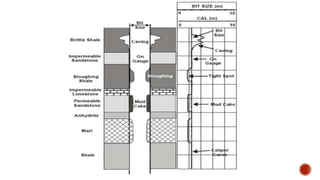
It means that the reservoir rocks are bounded by
shales above and below the reservoir rocks. During drill we
inject the detector and recorder that detect and record the
variation between shale and reservoir rocks.
2. Two different fluids:
Two different fluid means oil , gas and brine water
blow the surface.
3. DIFFERENCE IN SALINITY:
salinity means amount of salt . Difference in salinity
means how much amount of salt dissolve in water . For that
we use fresh water which tell us the difference of salt.
DIFFUSION POTENTIAL:
Diffusion:
The process by which flow of fluid from high
concentration to low concentration are called diffusion.
In bore hole water move from high concentration to
low concentration.
If fluid is more in reservoir (means Na ) then
chlorine ion, as a result fluid collect the negative ions it
means that the salinity of mud filtrate is less then
formation fluid. And the curve is different.
SHALE POTENTIAL:
Shale itself having negative charge it collect positive
charge at shale so mud filtrate has high salinity then
formation fluid.
In borehole salinity is mixture of Na and Cl ions . In
this case sodium ion is slow moving ion and chlorine ion is
fast moving ion and react with sodium pon and form
sodium chloride, It means salinity of mud filtrate is more
then formation fluid, because it collect the positive ions.
APPLICATIONS OF SP LOG:
 It is used to find the oil and gas.
 It is used to find the volume of shales.
 Finding leaks in canal embankments.
 Identifying seepage in dams and reservoirs.
 It is used to understand the aquifer level.
 Assessing the effectiveness of water-engineering remedial measures.
 It is used to find depth.
 Mineral exploration of massive sulphide ore bodies.
 TOOLS:
 DEVICE:
We use potential electrodes having two electrodes and a
voltmeter. Electrodes transmit current in the borehole and
voltmeter record the variations occur in bore hole during
drilling.
 UNIT:
Sp log

Sp log

  • 1.
    SELF POTENTIAL LOG(SP) Introduction.  Conditions.  Applications.  Tools .  Devices.  Unit.
  • 2.
     INTRODUCTION: Self Potential(SP) geophysical surveys measure the potential difference between any two points on the ground produced by the small, naturally produced currents that occur beneath the Earth surface. OR The SP curve is a continuous recording vs. depth of the electrical potential difference between a movable electrode in the borehole and a surface electrode. Adjacent to shales , SP readings usually define a straight line known as the shale baseline.
  • 3.
     CONDITIONS OFSP LOG: Three conditions of sp log. 1. Porous and permeable strata bounded by impermeable layer. 2. Two different fluids. 3. Difference in salinity.
  • 4.
    1. POROUS ANDPERMEABLE STRATA BOUNDED BY IMPERMEABLE LAYER: It means that the reservoir rocks are bounded by shales above and below the reservoir rocks. During drill we inject the detector and recorder that detect and record the variation between shale and reservoir rocks. 2. Two different fluids: Two different fluid means oil , gas and brine water blow the surface.
  • 5.
    3. DIFFERENCE INSALINITY: salinity means amount of salt . Difference in salinity means how much amount of salt dissolve in water . For that we use fresh water which tell us the difference of salt.
  • 6.
    DIFFUSION POTENTIAL: Diffusion: The processby which flow of fluid from high concentration to low concentration are called diffusion. In bore hole water move from high concentration to low concentration. If fluid is more in reservoir (means Na ) then chlorine ion, as a result fluid collect the negative ions it means that the salinity of mud filtrate is less then formation fluid. And the curve is different.
  • 7.
    SHALE POTENTIAL: Shale itselfhaving negative charge it collect positive charge at shale so mud filtrate has high salinity then formation fluid. In borehole salinity is mixture of Na and Cl ions . In this case sodium ion is slow moving ion and chlorine ion is fast moving ion and react with sodium pon and form sodium chloride, It means salinity of mud filtrate is more then formation fluid, because it collect the positive ions.
  • 8.
    APPLICATIONS OF SPLOG:  It is used to find the oil and gas.  It is used to find the volume of shales.  Finding leaks in canal embankments.  Identifying seepage in dams and reservoirs.  It is used to understand the aquifer level.  Assessing the effectiveness of water-engineering remedial measures.  It is used to find depth.  Mineral exploration of massive sulphide ore bodies.
  • 9.
  • 11.
     DEVICE: We usepotential electrodes having two electrodes and a voltmeter. Electrodes transmit current in the borehole and voltmeter record the variations occur in bore hole during drilling.
  • 12.