1
Presented by:

                  Muhammad Zubair Idrees

                Copy Rights 2012


                                           2
Contents
 Introduction

 Spontaneous Potential (SP) Log

 Principle

 How It Works

 Log Presentation

 Tools

 Applications

 Reference


                                   3
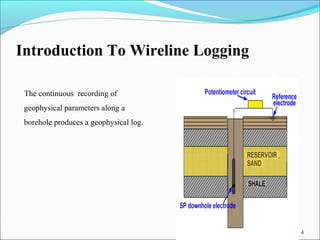
Introduction To Wireline Logging

 The continuous recording of
 geophysical parameters along a
 borehole produces a geophysical log.


                                        4
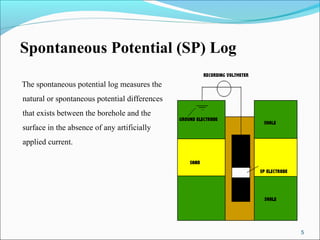
Spontaneous Potential (SP) Log

The spontaneous potential log measures the
natural or spontaneous potential differences
that exists between the borehole and the
surface in the absence of any artificially
applied current.


                                               5
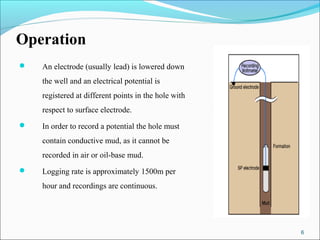
Operation
   An electrode (usually lead) is lowered down
    the well and an electrical potential is
    registered at different points in the hole with
    respect to surface electrode.
   In order to record a potential the hole must
    contain conductive mud, as it cannot be
    recorded in air or oil-base mud.
   Logging rate is approximately 1500m per
    hour and recordings are continuous.


                                                      6
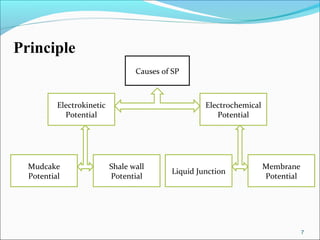
Principle
                                  Causes of SP


          Electrokinetic                            Electrochemical
            Potential                                  Potential


  Mudcake                  Shale wall                                 Membrane
                                           Liquid Junction
  Potential                Potential                                  Potential


                                                                                  7
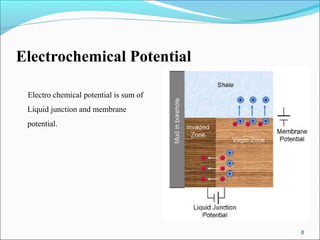
Electrochemical Potential

 Electro chemical potential is sum of
 Liquid junction and membrane
 potential.


                                        8
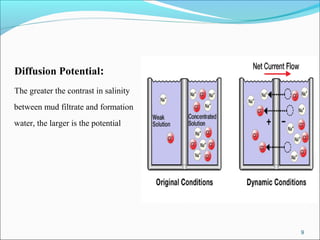
Diffusion Potential:
The greater the contrast in salinity
between mud filtrate and formation
water, the larger is the potential


                                       9
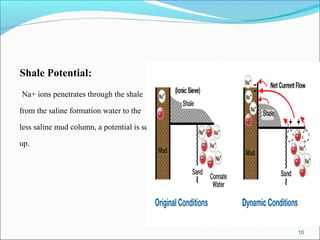
Shale Potential:
Na+ ions penetrates through the shale

from the saline formation water to the

less saline mud column, a potential is set

up.


                                             10
Electrokinetic Potential
 Mud cake Potential

     Movement of charged ion through mud cake into permeable formation

 Shale wall Potential

     Flow of fluids from borehole into shale formation.


                                                                          11
How It Works
 The spontaneous potential produce in bore hole are actual result of these two

  processes combine.
 The mud filtrate is less saline then the formation water so it becomes negetivly

  charge as a result of diffusion potential.
 But above the sand opposite the shale because the shale potential the saline solution

  (mud flitrate) becomes positivly charge.
 The excess charge is the therefore negetive opposite the sand and positive opposite

  the shale.
 This couple works in a complementry sense and creates a SP currents flowing

  between the mud filtrate the porous formation and shale.
                                                                                          12
Log Presentation
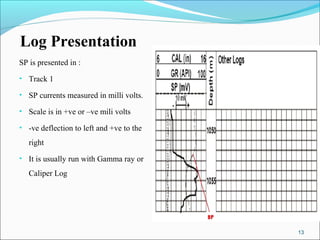
SP is presented in :
• Track 1

• SP currents measured in milli volts.

• Scale is in +ve or –ve mili volts

• -ve deflection to left and +ve to the
   right
• It is usually run with Gamma ray or
   Caliper Log


                                          13
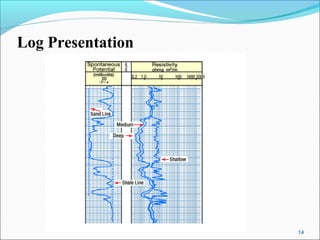
Log Presentation


                   14
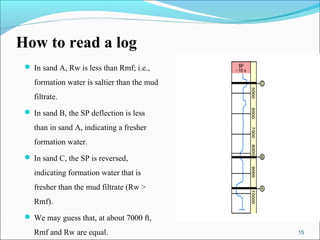
How to read a log
  In sand A, Rw is less than Rmf; i.e.,

    formation water is saltier than the mud
    filtrate.
  In sand B, the SP deflection is less

    than in sand A, indicating a fresher
    formation water.
  In sand C, the SP is reversed,

    indicating formation water that is
    fresher than the mud filtrate (Rw >
    Rmf).
  We may guess that, at about 7000 ft,

    Rmf and Rw are equal.                     15
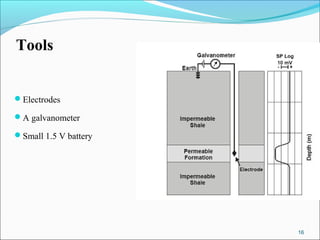
Tools


Electrodes

A galvanometer

Small 1.5 V battery


                       16
Calibration
A small battery and a potentiometer is placed in series

between the two electrodes.

The logging engineer can adjust the potentiometer so that the

SP appears in track 1.

Remove all extraneous potentials to the membrane potential,

the SP needs to be normalised in a computing centre so that

there is no potential (SP=0.0MV) opposite shale beds


                                                                 17
Application
  Two principal uses of Sp Logs

QUANTITATIVE USES
 Formation Water Resistivity (Rw)determination

 Shale Volume Indicator

QUALITATIVE USES
 Detecting permeable beds

 Correlation from well to well

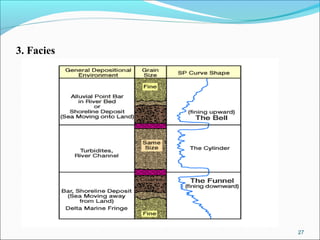
 Facies


                                                  18
QUANTITATIVE USES

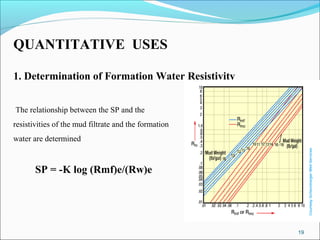
1. Determination of Formation Water Resistivity


The relationship between the SP and the
resistivities of the mud filtrate and the formation
water are determined


       SP = -K log (Rmf)e/(Rw)e


                                                      19
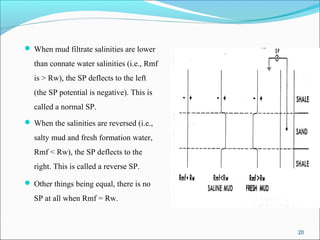
 When mud filtrate salinities are lower

   than connate water salinities (i.e., Rmf
   is > Rw), the SP deflects to the left
   (the SP potential is negative). This is
   called a normal SP.
 When the salinities are reversed (i.e.,

   salty mud and fresh formation water,
   Rmf < Rw), the SP deflects to the
   right. This is called a reverse SP.

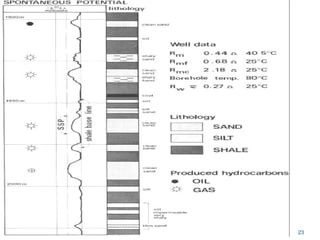
 Other things being equal, there is no

   SP at all when Rmf = Rw.


                                              20
2. Shale Volume Calculation
Shale Base Line


Th definition of s.p zero is made on thick shale intervals where s.p does not move to
  the left or right is called shale base line.


                                                                                        21
Static sp: (ssp)
The theoratical maximum deflection of s.p opposite permeable beds is called static s.por
  ssp. It is maximum possible s.p opposite a permeable water bearing formation with no
  shale.


                                                                                      22
23
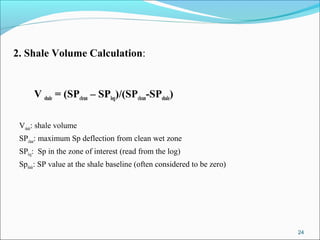
2. Shale Volume Calculation:


      V shale = (SPclean – SPlog)/(SPclean-SPshale)

 Vshale: shale volume
 SPclean: maximum Sp deflection from clean wet zone
 SPlog: Sp in the zone of interest (read from the log)
 Spshale: SP value at the shale baseline (often considered to be zero)


                                                                         24
QUALITATIVE USES
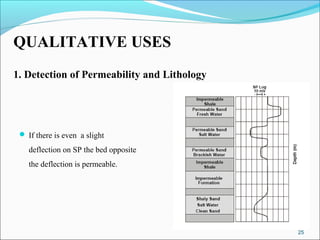
1. Detection of Permeability and Lithology


  If there is even a slight

    deflection on SP the bed opposite
    the deflection is permeable.


                                             25
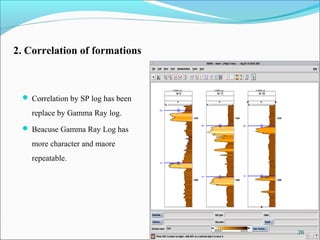
2. Correlation of formations


  Correlation by SP log has been

    replace by Gamma Ray log.
  Beacuse Gamma Ray Log has

    more character and maore
    repeatable.


                                    26
3. Facies


            27
References
 Schlumberger, 1989 Introduction “Log Interpretation Principles/Applications”
  Schlumberger Wireline and Testing, 225 Schlumberger Drive Sugar Land, Texas
  77478. pp1,2.
 Deniel A. Krygowski, 2003. “Guide to Petrophysical Interpretation” Austin Texas,
  USA. Pp 9,10
 Dr. Paul Glover.”Petrophysical Msc Course Notes”, pp 218

 http://en.wikipedia.org/wiki/Spontaneous_potential

 http://en.wikipedia.org/wiki/Spontaneous_potential_logging

 http://www.kaskus.us/showthread.php?t=899212&page=165

 http://www.petrolog.net/webhelp/Logging_Tools/sp/sp.html

                                                                                     28
THANK YOU!


             29
QUESTIONS?


             30

SP Log

  • 1.
  • 2.
    Presented by: Muhammad Zubair Idrees Copy Rights 2012 2
  • 3.
    Contents  Introduction  SpontaneousPotential (SP) Log  Principle  How It Works  Log Presentation  Tools  Applications  Reference 3
  • 4.
    Introduction To WirelineLogging The continuous recording of geophysical parameters along a borehole produces a geophysical log. 4
  • 5.
    Spontaneous Potential (SP)Log The spontaneous potential log measures the natural or spontaneous potential differences that exists between the borehole and the surface in the absence of any artificially applied current. 5
  • 6.
    Operation  An electrode (usually lead) is lowered down the well and an electrical potential is registered at different points in the hole with respect to surface electrode.  In order to record a potential the hole must contain conductive mud, as it cannot be recorded in air or oil-base mud.  Logging rate is approximately 1500m per hour and recordings are continuous. 6
  • 7.
    Principle Causes of SP Electrokinetic Electrochemical Potential Potential Mudcake Shale wall Membrane Liquid Junction Potential Potential Potential 7
  • 8.
    Electrochemical Potential Electrochemical potential is sum of Liquid junction and membrane potential. 8
  • 9.
    Diffusion Potential: The greaterthe contrast in salinity between mud filtrate and formation water, the larger is the potential 9
  • 10.
    Shale Potential: Na+ ionspenetrates through the shale from the saline formation water to the less saline mud column, a potential is set up. 10
  • 11.
    Electrokinetic Potential  Mudcake Potential  Movement of charged ion through mud cake into permeable formation  Shale wall Potential  Flow of fluids from borehole into shale formation. 11
  • 12.
    How It Works The spontaneous potential produce in bore hole are actual result of these two processes combine.  The mud filtrate is less saline then the formation water so it becomes negetivly charge as a result of diffusion potential.  But above the sand opposite the shale because the shale potential the saline solution (mud flitrate) becomes positivly charge.  The excess charge is the therefore negetive opposite the sand and positive opposite the shale.  This couple works in a complementry sense and creates a SP currents flowing between the mud filtrate the porous formation and shale. 12
  • 13.
    Log Presentation SP ispresented in : • Track 1 • SP currents measured in milli volts. • Scale is in +ve or –ve mili volts • -ve deflection to left and +ve to the right • It is usually run with Gamma ray or Caliper Log 13
  • 14.
  • 15.
    How to reada log  In sand A, Rw is less than Rmf; i.e., formation water is saltier than the mud filtrate.  In sand B, the SP deflection is less than in sand A, indicating a fresher formation water.  In sand C, the SP is reversed, indicating formation water that is fresher than the mud filtrate (Rw > Rmf).  We may guess that, at about 7000 ft, Rmf and Rw are equal. 15
  • 16.
  • 17.
    Calibration A small batteryand a potentiometer is placed in series between the two electrodes. The logging engineer can adjust the potentiometer so that the SP appears in track 1. Remove all extraneous potentials to the membrane potential, the SP needs to be normalised in a computing centre so that there is no potential (SP=0.0MV) opposite shale beds 17
  • 18.
    Application Twoprincipal uses of Sp Logs QUANTITATIVE USES  Formation Water Resistivity (Rw)determination  Shale Volume Indicator QUALITATIVE USES  Detecting permeable beds  Correlation from well to well  Facies 18
  • 19.
    QUANTITATIVE USES 1. Determinationof Formation Water Resistivity The relationship between the SP and the resistivities of the mud filtrate and the formation water are determined SP = -K log (Rmf)e/(Rw)e 19
  • 20.
     When mudfiltrate salinities are lower than connate water salinities (i.e., Rmf is > Rw), the SP deflects to the left (the SP potential is negative). This is called a normal SP.  When the salinities are reversed (i.e., salty mud and fresh formation water, Rmf < Rw), the SP deflects to the right. This is called a reverse SP.  Other things being equal, there is no SP at all when Rmf = Rw. 20
  • 21.
    2. Shale VolumeCalculation Shale Base Line Th definition of s.p zero is made on thick shale intervals where s.p does not move to the left or right is called shale base line. 21
  • 22.
    Static sp: (ssp) Thetheoratical maximum deflection of s.p opposite permeable beds is called static s.por ssp. It is maximum possible s.p opposite a permeable water bearing formation with no shale. 22
  • 23.
  • 24.
    2. Shale VolumeCalculation: V shale = (SPclean – SPlog)/(SPclean-SPshale) Vshale: shale volume SPclean: maximum Sp deflection from clean wet zone SPlog: Sp in the zone of interest (read from the log) Spshale: SP value at the shale baseline (often considered to be zero) 24
  • 25.
    QUALITATIVE USES 1. Detectionof Permeability and Lithology  If there is even a slight deflection on SP the bed opposite the deflection is permeable. 25
  • 26.
    2. Correlation offormations  Correlation by SP log has been replace by Gamma Ray log.  Beacuse Gamma Ray Log has more character and maore repeatable. 26
  • 27.
  • 28.
    References  Schlumberger, 1989Introduction “Log Interpretation Principles/Applications” Schlumberger Wireline and Testing, 225 Schlumberger Drive Sugar Land, Texas 77478. pp1,2.  Deniel A. Krygowski, 2003. “Guide to Petrophysical Interpretation” Austin Texas, USA. Pp 9,10  Dr. Paul Glover.”Petrophysical Msc Course Notes”, pp 218  http://en.wikipedia.org/wiki/Spontaneous_potential  http://en.wikipedia.org/wiki/Spontaneous_potential_logging  http://www.kaskus.us/showthread.php?t=899212&page=165  http://www.petrolog.net/webhelp/Logging_Tools/sp/sp.html 28
  • 29.
  • 30.