SONIC LOG
By
Asrar Hussain
DEFINITION AND UNIT
•Along bore hole continues measuring of
travel transit time( T) of sound waves
through one foot of formation called sonic
log.
•Unit are micro second/foot.
•The tool measures the
time it takes for a pulse of
“sound” (i.e., and elastic
wave) to travel from a
transmitter to a receiver,
which are both mounted
on the tool.
•In general, transmitted
pulse is very short and of
high amplitude vice
versa.
PRINCIPLES 0F MEASUREMENTS
TYPES OF MEASURING WAVES
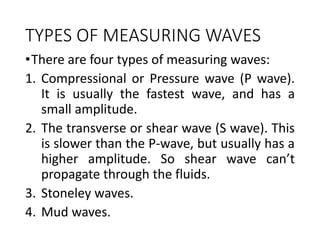
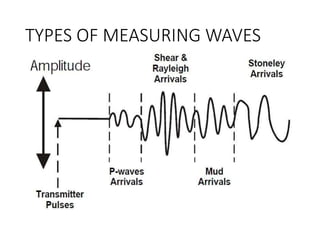
•There are four types of measuring waves:
1. Compressional or Pressure wave (P wave).
It is usually the fastest wave, and has a
small amplitude.
2. The transverse or shear wave (S wave). This
is slower than the P-wave, but usually has a
higher amplitude. So shear wave can’t
propagate through the fluids.
3. Stoneley waves.
4. Mud waves.
TYPES OF MEASURING WAVES
WORKING TOOLS
•Tools of sonic logging are generally divided
into four types:
1. Early Tool
2. Dual Receiver tool
3. Bore Hole compensated sonic tool (BHC)
EARLY TOOL
•Early tools had one transmitter (Tx) and
one receiver(Rx).
•The body of the tool was made from
rubber to stop waves travelling
preferentially down the tool from
transmitter to receiver.
•Limitation
•There were two limitation of this tool:
1. The measured travel time was always
too long.
2. The length of the formation through
which the elastic wave traveled was not
constant
DUAL RECEIVER TOOL
•They use two receivers a few
feet apart, and measure the
difference in times of arrival of
elastic waves at each Receiver
from a given pulse
from the Transmitter
•This time is called the sonic
interval transit time (Δt).
DUAL RECEIVER TOOL
•Limitation
1. If the tool is tilted in the
hole, or the hole size
changes (Fig 3)
2. Then C≠E
3. The two Rx system fails to
work.
0
BORE HOLE COMPENSATED TOOL
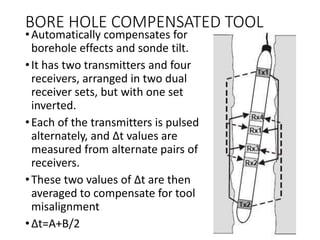
•Automatically compensates for
borehole effects and sonde tilt.
•It has two transmitters and four
receivers, arranged in two dual
receiver sets, but with one set
inverted.
•Each of the transmitters is pulsed
alternately, and Δt values are
measured from alternate pairs of
receivers.
•These two values of Δt are then
averaged to compensate for tool
misalignment
•Δt=A+B/2
APPLICATIONS
•POROSITY DETERMINATION
To use the log it is necessary to propose that a
formation has, on average, a uniform distribution of
small pores and is subjected to a heavy confining
pressure, there is a simple relationship between
velocity and porosity.
Secondary porosity, Fluid, Gas and air Effect on it.
ᶲs=∆t-∆tma/∆tf-∆tma
•SECONDARY AND FRACTURE POROSITY
Sonic log not calculate secondary porosity but it
help for calculate secondary porosity by help of
other porosity logs.
Фf = (ФN , ФD ) - ФS
•IDENTIFICATION OF LITHOLOGY
The velocity or interval travel time is rarely
diagnostic of a particular rock type.
The sonic log data is diagnostic for coals, which
have very low velocities, and evaporites, which have
a constant, well recognized velocity and transit
time.
APPLICATIONS
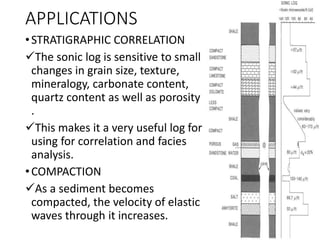
•STRATIGRAPHIC CORRELATION
The sonic log is sensitive to small
changes in grain size, texture,
mineralogy, carbonate content,
quartz content as well as porosity
.
This makes it a very useful log for
using for correlation and facies
analysis.
•COMPACTION
As a sediment becomes
compacted, the velocity of elastic
waves through it increases.
APPLICATIONS
•OVERPRESSURE
An increase in pore pressures is shown on the sonic
log by a drop in sonic velocity or an increase in sonic
travel time.
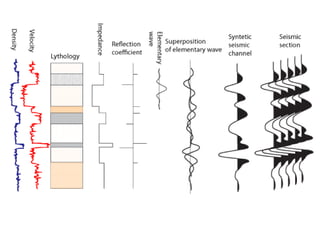
•SYNTHETIC SIESMOGRAM
Represents the seismic trace that should be velocity
observed with the seismic method at the well location.
Improve the picking of seismic horizons.
Improve the accuracy and resolution of formations of
interest
APPLICATIONS
Presentation on sonic log

Presentation on sonic log

  • 2.
  • 3.
    DEFINITION AND UNIT •Alongbore hole continues measuring of travel transit time( T) of sound waves through one foot of formation called sonic log. •Unit are micro second/foot.
  • 4.
    •The tool measuresthe time it takes for a pulse of “sound” (i.e., and elastic wave) to travel from a transmitter to a receiver, which are both mounted on the tool. •In general, transmitted pulse is very short and of high amplitude vice versa. PRINCIPLES 0F MEASUREMENTS
  • 5.
    TYPES OF MEASURINGWAVES •There are four types of measuring waves: 1. Compressional or Pressure wave (P wave). It is usually the fastest wave, and has a small amplitude. 2. The transverse or shear wave (S wave). This is slower than the P-wave, but usually has a higher amplitude. So shear wave can’t propagate through the fluids. 3. Stoneley waves. 4. Mud waves.
  • 6.
  • 7.
    WORKING TOOLS •Tools ofsonic logging are generally divided into four types: 1. Early Tool 2. Dual Receiver tool 3. Bore Hole compensated sonic tool (BHC)
  • 8.
    EARLY TOOL •Early toolshad one transmitter (Tx) and one receiver(Rx). •The body of the tool was made from rubber to stop waves travelling preferentially down the tool from transmitter to receiver. •Limitation •There were two limitation of this tool: 1. The measured travel time was always too long. 2. The length of the formation through which the elastic wave traveled was not constant
  • 9.
    DUAL RECEIVER TOOL •Theyuse two receivers a few feet apart, and measure the difference in times of arrival of elastic waves at each Receiver from a given pulse from the Transmitter •This time is called the sonic interval transit time (Δt).
  • 10.
    DUAL RECEIVER TOOL •Limitation 1.If the tool is tilted in the hole, or the hole size changes (Fig 3) 2. Then C≠E 3. The two Rx system fails to work. 0
  • 11.
    BORE HOLE COMPENSATEDTOOL •Automatically compensates for borehole effects and sonde tilt. •It has two transmitters and four receivers, arranged in two dual receiver sets, but with one set inverted. •Each of the transmitters is pulsed alternately, and Δt values are measured from alternate pairs of receivers. •These two values of Δt are then averaged to compensate for tool misalignment •Δt=A+B/2
  • 12.
    APPLICATIONS •POROSITY DETERMINATION To usethe log it is necessary to propose that a formation has, on average, a uniform distribution of small pores and is subjected to a heavy confining pressure, there is a simple relationship between velocity and porosity. Secondary porosity, Fluid, Gas and air Effect on it. ᶲs=∆t-∆tma/∆tf-∆tma
  • 13.
    •SECONDARY AND FRACTUREPOROSITY Sonic log not calculate secondary porosity but it help for calculate secondary porosity by help of other porosity logs. Фf = (ФN , ФD ) - ФS •IDENTIFICATION OF LITHOLOGY The velocity or interval travel time is rarely diagnostic of a particular rock type. The sonic log data is diagnostic for coals, which have very low velocities, and evaporites, which have a constant, well recognized velocity and transit time. APPLICATIONS
  • 14.
    •STRATIGRAPHIC CORRELATION The soniclog is sensitive to small changes in grain size, texture, mineralogy, carbonate content, quartz content as well as porosity . This makes it a very useful log for using for correlation and facies analysis. •COMPACTION As a sediment becomes compacted, the velocity of elastic waves through it increases. APPLICATIONS
  • 15.
    •OVERPRESSURE An increase inpore pressures is shown on the sonic log by a drop in sonic velocity or an increase in sonic travel time. •SYNTHETIC SIESMOGRAM Represents the seismic trace that should be velocity observed with the seismic method at the well location. Improve the picking of seismic horizons. Improve the accuracy and resolution of formations of interest APPLICATIONS