Presented by 
Badal Dutt Mathur 
10410007 
5th Year Integrated M.tech Geological Technology
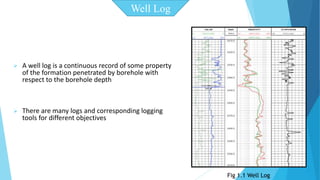
 A well log is a continuous record of some property 
of the formation penetrated by borehole with 
respect to the borehole depth 
 There are many logs and corresponding logging 
tools for different objectives 
Well Log 
Fig 1.1 Well Log
Sonic Log 
 The sonic log measures interval transit time (Δt) of a compressional 
sound wave traveling through one foot of formation. 
 The units are micro seconds/ft, which is the inverse of velocity.
Principles of measurements 
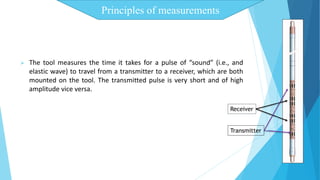
 The tool measures the time it takes for a pulse of “sound” (i.e., and 
elastic wave) to travel from a transmitter to a receiver, which are both 
mounted on the tool. The transmitted pulse is very short and of high 
amplitude vice versa. 
Receiver 
Transmitter
Working Tools 
1.Early Tool 
2.Dual Receiver Tool 
3.Borehole Compensated Sonic(BHC) Tool
Tx 
Rx 
A 
B 
C 
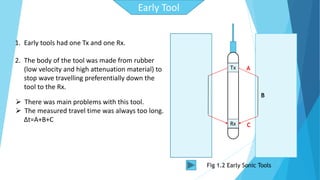
1. Early tools had one Tx and one Rx. 
2. The body of the tool was made from rubber 
(low velocity and high attenuation material) to 
stop wave travelling preferentially down the 
tool to the Rx. 
 There was main problems with this tool. 
 The measured travel time was always too long. 
Δt=A+B+C 
Early Tool 
Fig 1.2 Early Sonic Tools
Rx2 
A 
B 
C 
Rx1 D 
E 
Tx 
Dual Receiver Tool 
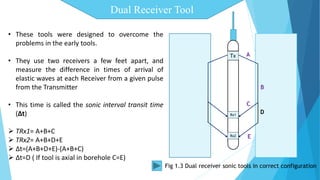
• These tools were designed to overcome the 
problems in the early tools. 
• They use two receivers a few feet apart, and 
measure the difference in times of arrival of 
elastic waves at each Receiver from a given pulse 
from the Transmitter 
• This time is called the sonic interval transit time 
(Δt) 
 TRx1= A+B+C 
 TRx2= A+B+D+E 
 Δt=(A+B+D+E)-(A+B+C) 
 Δt=D ( If tool is axial in borehole C=E) 
Fig 1.3 Dual receiver sonic tools in correct configuration
Tx 
Rx 
Rx 
Problem with Dual 
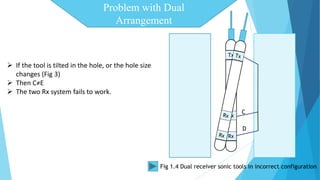
 If the tool is tilted in the hole, or the hole size 
changes (Fig 3) 
 Then C≠E 
 The two Rx system fails to work. 
Arrangement 
C 
D 
Fig 1.4 Dual receiver sonic tools in incorrect configuration
B A 
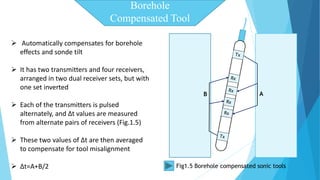
 Automatically compensates for borehole 
effects and sonde tilt 
 It has two transmitters and four receivers, 
arranged in two dual receiver sets, but with 
one set inverted 
 Each of the transmitters is pulsed 
alternately, and Δt values are measured 
from alternate pairs of receivers (Fig.1.5) 
 These two values of Δt are then averaged 
to compensate for tool misalignment 
 Δt=A+B/2 
Borehole 
Compensated Tool 
Fig1.5 Borehole compensated sonic tools
 Porosity Determination 
 Secondary and Fracture Porosity 
 Stratigraphic Correlation 
 Compaction 
 Overpressure 
 Synthetic Siesmogram 
 Identification of Lithology 
Applications
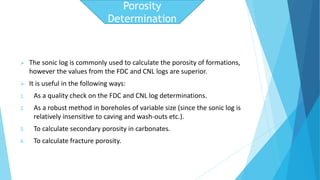
 The sonic log is commonly used to calculate the porosity of formations, 
however the values from the FDC and CNL logs are superior. 
 It is useful in the following ways: 
1. As a quality check on the FDC and CNL log determinations. 
2. As a robust method in boreholes of variable size (since the sonic log is 
relatively insensitive to caving and wash-outs etc.). 
3. To calculate secondary porosity in carbonates. 
4. To calculate fracture porosity. 
Porosity 
Determination
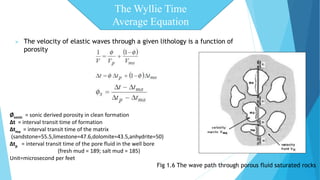
 The velocity of elastic waves through a given lithology is a function of 
porosity 
Øsonic = sonic derived porosity in clean formation 
Δt = interval transit time of formation 
Δtma = interval transit time of the matrix 
(sandstone=55.5,limestone=47.6,dolomite=43.5,anhydrite=50) 
Δtp = interval transit time of the pore fluid in the well bore 
(fresh mud = 189; salt mud = 185) 
Unit=microsecond per feet 
The Wyllie Time 
Average Equation 
Fig 1.6 The wave path through porous fluid saturated rocks
 Wyllie Time Average Equation is valid only for 
 For clean and consolidated sandstones 
 Uniformly distributed small pores 
 Correction: Observed transit times are greater in uncompacted sands; thus apply 
empirical correction factor, Cp 
 Фc= Ф/Cp 
 Cp=c* Δtsh/100 (Δtsh= Interval transit time for the adjacent shale) 
 C=shale compaction coefficient (ranges from 0.8 < c < 1.3) 
 Fluid Effect in high porosity formations with high HC saturation. 
 Correct by 
 OIL: Фcorr= Фc*0.9 
 GAS: Фcorr= Фc*0.7 
The Wyllie Time 
Average Equation
 The sonic log is sensitive only to the primary intergranular porosity 
 The sonic pulse will follow the fastest path to the receiver and this will 
avoid fractures 
 Comparing sonic porosity to a global porosity (density log, neutron 
log)should indicate zone of fracture. 
 Ф2 = (ФN , ФD ) - ФS 
Secondary and 
Fracture Porosity
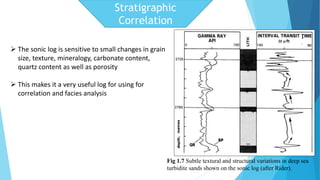
Fig 1.7 Subtle textural and structural variations in deep sea 
turbidite sands shown on the sonic log (after Rider). 
 The sonic log is sensitive to small changes in grain 
size, texture, mineralogy, carbonate content, 
quartz content as well as porosity 
 This makes it a very useful log for using for 
correlation and facies analysis 
Stratigraphic 
Correlation
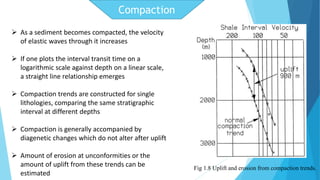
Fig 1.8 Uplift and erosion from compaction trends. 
Compaction 
 As a sediment becomes compacted, the velocity 
of elastic waves through it increases 
 If one plots the interval transit time on a 
logarithmic scale against depth on a linear scale, 
a straight line relationship emerges 
 Compaction trends are constructed for single 
lithologies, comparing the same stratigraphic 
interval at different depths 
 Compaction is generally accompanied by 
diagenetic changes which do not alter after uplift 
 Amount of erosion at unconformities or the 
amount of uplift from these trends can be 
estimated
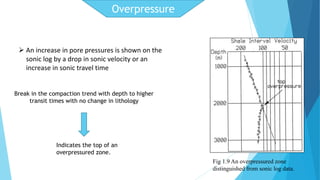
Fig 1.9 An overpressured zone 
distinguished from sonic log data. 
Overpressure 
 An increase in pore pressures is shown on the 
sonic log by a drop in sonic velocity or an 
increase in sonic travel time 
Break in the compaction trend with depth to higher 
transit times with no change in lithology 
Indicates the top of an 
overpressured zone.
synthetic 
seismogram 
acoustic 
impedenc 
e 
reflection 
coefficient 
reflection 
coeffiecient 
with 
transmission 
losses 
sonic 
 Represents the seismic trace that should be velocity 
observed with the seismic method at the 
well location 
 Improve the picking of seismic horizons 
 Improve the accuracy and resolution of 
formations of interest 
Synthetic 
Seismograms 
Fig 1.10 The construction of a synthetic seismogram.
Identification of 
Lithologies 
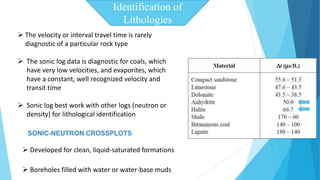
 The velocity or interval travel time is rarely 
diagnostic of a particular rock type 
 The sonic log data is diagnostic for coals, which 
have very low velocities, and evaporites, which 
have a constant, well recognized velocity and 
transit time 
 Sonic log best work with other logs (neutron or 
density) for lithological identification 
SONIC-NEUTRON CROSSPLOTS 
 Developed for clean, liquid-saturated formations 
 Boreholes filled with water or water-base muds
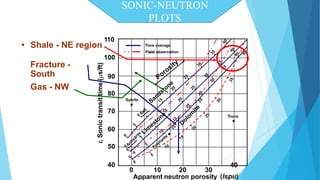
110 
• Shale - NE region 
Field 
observation 
100 
Fracture - 
South 90 
Gas - NW 
80 
70 
Trona 
60 
50 
40 
0 10 20 30 
40 
Apparent neutron porosity (lspu) 
t, Sonic transit time (μs/ft) 
Time a 
verage 
Syivite 
Tr 
SONIC-NEUTRON 
PLOTS
Example 
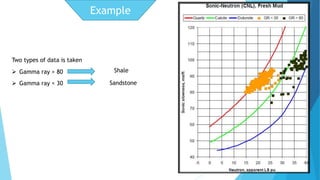
Two types of data is taken 
 Gamma ray > 80 
 Gamma ray < 30 
Shale 
Sandstone
 Serra, O. (1988) Fundamentals of well-log interpretation. 3rd ed. New 
York: Elselvier science publishers B.V.: 261-262 
 Rider, M. (2002) The geological interpretation of well logs. 2nd ed. 
Scotland: Rider French consulting Ltd.: 26-32. 
 Neuendorf, et al. (2005) Glossary of Geology. 5th ed. Virginia: American 
geological institute: 90, 379, 742. 
 Schlumberger (1989) Log interpretation principles/applications. 
Schlumberger,Houston, TX 
Refrences
Sonic log and its applications

Sonic log and its applications

  • 1.
    Presented by BadalDutt Mathur 10410007 5th Year Integrated M.tech Geological Technology
  • 2.
     A welllog is a continuous record of some property of the formation penetrated by borehole with respect to the borehole depth  There are many logs and corresponding logging tools for different objectives Well Log Fig 1.1 Well Log
  • 3.
    Sonic Log The sonic log measures interval transit time (Δt) of a compressional sound wave traveling through one foot of formation.  The units are micro seconds/ft, which is the inverse of velocity.
  • 4.
    Principles of measurements  The tool measures the time it takes for a pulse of “sound” (i.e., and elastic wave) to travel from a transmitter to a receiver, which are both mounted on the tool. The transmitted pulse is very short and of high amplitude vice versa. Receiver Transmitter
  • 5.
    Working Tools 1.EarlyTool 2.Dual Receiver Tool 3.Borehole Compensated Sonic(BHC) Tool
  • 6.
    Tx Rx A B C 1. Early tools had one Tx and one Rx. 2. The body of the tool was made from rubber (low velocity and high attenuation material) to stop wave travelling preferentially down the tool to the Rx.  There was main problems with this tool.  The measured travel time was always too long. Δt=A+B+C Early Tool Fig 1.2 Early Sonic Tools
  • 7.
    Rx2 A B C Rx1 D E Tx Dual Receiver Tool • These tools were designed to overcome the problems in the early tools. • They use two receivers a few feet apart, and measure the difference in times of arrival of elastic waves at each Receiver from a given pulse from the Transmitter • This time is called the sonic interval transit time (Δt)  TRx1= A+B+C  TRx2= A+B+D+E  Δt=(A+B+D+E)-(A+B+C)  Δt=D ( If tool is axial in borehole C=E) Fig 1.3 Dual receiver sonic tools in correct configuration
  • 8.
    Tx Rx Rx Problem with Dual  If the tool is tilted in the hole, or the hole size changes (Fig 3)  Then C≠E  The two Rx system fails to work. Arrangement C D Fig 1.4 Dual receiver sonic tools in incorrect configuration
  • 9.
    B A Automatically compensates for borehole effects and sonde tilt  It has two transmitters and four receivers, arranged in two dual receiver sets, but with one set inverted  Each of the transmitters is pulsed alternately, and Δt values are measured from alternate pairs of receivers (Fig.1.5)  These two values of Δt are then averaged to compensate for tool misalignment  Δt=A+B/2 Borehole Compensated Tool Fig1.5 Borehole compensated sonic tools
  • 10.
     Porosity Determination  Secondary and Fracture Porosity  Stratigraphic Correlation  Compaction  Overpressure  Synthetic Siesmogram  Identification of Lithology Applications
  • 11.
     The soniclog is commonly used to calculate the porosity of formations, however the values from the FDC and CNL logs are superior.  It is useful in the following ways: 1. As a quality check on the FDC and CNL log determinations. 2. As a robust method in boreholes of variable size (since the sonic log is relatively insensitive to caving and wash-outs etc.). 3. To calculate secondary porosity in carbonates. 4. To calculate fracture porosity. Porosity Determination
  • 12.
     The velocityof elastic waves through a given lithology is a function of porosity Øsonic = sonic derived porosity in clean formation Δt = interval transit time of formation Δtma = interval transit time of the matrix (sandstone=55.5,limestone=47.6,dolomite=43.5,anhydrite=50) Δtp = interval transit time of the pore fluid in the well bore (fresh mud = 189; salt mud = 185) Unit=microsecond per feet The Wyllie Time Average Equation Fig 1.6 The wave path through porous fluid saturated rocks
  • 13.
     Wyllie TimeAverage Equation is valid only for  For clean and consolidated sandstones  Uniformly distributed small pores  Correction: Observed transit times are greater in uncompacted sands; thus apply empirical correction factor, Cp  Фc= Ф/Cp  Cp=c* Δtsh/100 (Δtsh= Interval transit time for the adjacent shale)  C=shale compaction coefficient (ranges from 0.8 < c < 1.3)  Fluid Effect in high porosity formations with high HC saturation.  Correct by  OIL: Фcorr= Фc*0.9  GAS: Фcorr= Фc*0.7 The Wyllie Time Average Equation
  • 14.
     The soniclog is sensitive only to the primary intergranular porosity  The sonic pulse will follow the fastest path to the receiver and this will avoid fractures  Comparing sonic porosity to a global porosity (density log, neutron log)should indicate zone of fracture.  Ф2 = (ФN , ФD ) - ФS Secondary and Fracture Porosity
  • 15.
    Fig 1.7 Subtletextural and structural variations in deep sea turbidite sands shown on the sonic log (after Rider).  The sonic log is sensitive to small changes in grain size, texture, mineralogy, carbonate content, quartz content as well as porosity  This makes it a very useful log for using for correlation and facies analysis Stratigraphic Correlation
  • 16.
    Fig 1.8 Upliftand erosion from compaction trends. Compaction  As a sediment becomes compacted, the velocity of elastic waves through it increases  If one plots the interval transit time on a logarithmic scale against depth on a linear scale, a straight line relationship emerges  Compaction trends are constructed for single lithologies, comparing the same stratigraphic interval at different depths  Compaction is generally accompanied by diagenetic changes which do not alter after uplift  Amount of erosion at unconformities or the amount of uplift from these trends can be estimated
  • 17.
    Fig 1.9 Anoverpressured zone distinguished from sonic log data. Overpressure  An increase in pore pressures is shown on the sonic log by a drop in sonic velocity or an increase in sonic travel time Break in the compaction trend with depth to higher transit times with no change in lithology Indicates the top of an overpressured zone.
  • 18.
    synthetic seismogram acoustic impedenc e reflection coefficient reflection coeffiecient with transmission losses sonic  Represents the seismic trace that should be velocity observed with the seismic method at the well location  Improve the picking of seismic horizons  Improve the accuracy and resolution of formations of interest Synthetic Seismograms Fig 1.10 The construction of a synthetic seismogram.
  • 19.
    Identification of Lithologies  The velocity or interval travel time is rarely diagnostic of a particular rock type  The sonic log data is diagnostic for coals, which have very low velocities, and evaporites, which have a constant, well recognized velocity and transit time  Sonic log best work with other logs (neutron or density) for lithological identification SONIC-NEUTRON CROSSPLOTS  Developed for clean, liquid-saturated formations  Boreholes filled with water or water-base muds
  • 20.
    110 • Shale- NE region Field observation 100 Fracture - South 90 Gas - NW 80 70 Trona 60 50 40 0 10 20 30 40 Apparent neutron porosity (lspu) t, Sonic transit time (μs/ft) Time a verage Syivite Tr SONIC-NEUTRON PLOTS
  • 21.
    Example Two typesof data is taken  Gamma ray > 80  Gamma ray < 30 Shale Sandstone
  • 22.
     Serra, O.(1988) Fundamentals of well-log interpretation. 3rd ed. New York: Elselvier science publishers B.V.: 261-262  Rider, M. (2002) The geological interpretation of well logs. 2nd ed. Scotland: Rider French consulting Ltd.: 26-32.  Neuendorf, et al. (2005) Glossary of Geology. 5th ed. Virginia: American geological institute: 90, 379, 742.  Schlumberger (1989) Log interpretation principles/applications. Schlumberger,Houston, TX Refrences

Editor's Notes

  • #7 because the time taken for the elastic waves to pass through the mud was included in the measurement. because changes to the velocity of the wave depending upon the formation altered the critical refraction angle.
  • #17 Figure 1.7 compares the compaction trend for the same lithology in the same stratigraphic interval in one well with that in another well. The data from the well represented by the circles shows the interval to have been uplifted by 900 m relative to the other well because it has lower interval transit times (is more compact) but occurs at a shallower depth.