Borehole Geophysical Techniques
Abhijith V & Mohit Kumar
Spontaneous Potential (SP) Log
● Measures natural potential
difference between a movable
electrode in the borehole and the
fixed potential of a surface
electrode
● +ve deflection- Cations- Mud -
Membrane Potential
● -ve deflection-Anions-SSt, Porous
Lst- Liquid Junction Potential
● Applications:
-correlation
-lithology indication
-porosity and permeability
-resistivity
-salinity
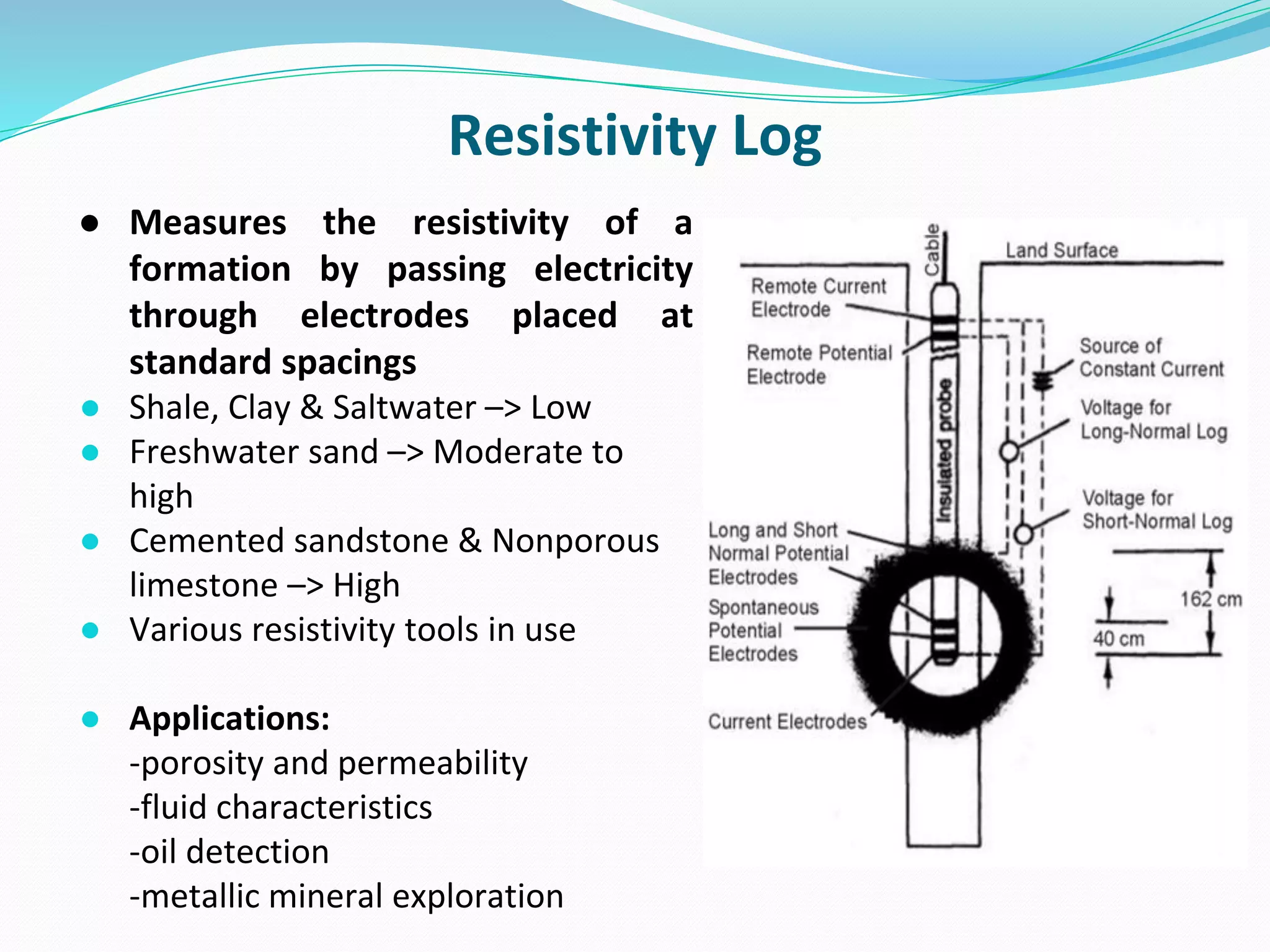
Resistivity Log
● Measures the resistivity of a
formation by passing electricity
through electrodes placed at
standard spacings
● Shale, Clay & Saltwater –> Low
● Freshwater sand –> Moderate to
high
● Cemented sandstone & Nonporous
limestone –> High
● Various resistivity tools in use
● Applications:
-porosity and permeability
-fluid characteristics
-oil detection
-metallic mineral exploration
Sonic Log
● Measures the time of first
arrival of sound pulses from a
transmitter at a receiver
● The arrival time depends on the
density of the formation, which
in turn depends on the porosity
and permeability
● Applications:
-Density of the formation
-Porosity calculation for known
lithology
-Calibration of seismic data
● It measures the natural radioactivity
of the formation.
● It provides a measurement of the
muddiness of a unit.
● Quartz arenite and clean carbonate
sediments -> low log response.
● Mudstone, volcanic ash and granite
wash -> high log response.
● It can be run in open as well as cased
holes.
● Applications:
-Identification of Lithology
-Facies correlation.
-Evaluation of radioactive minerals.
-Identify shale volumes.
Gamma Logging
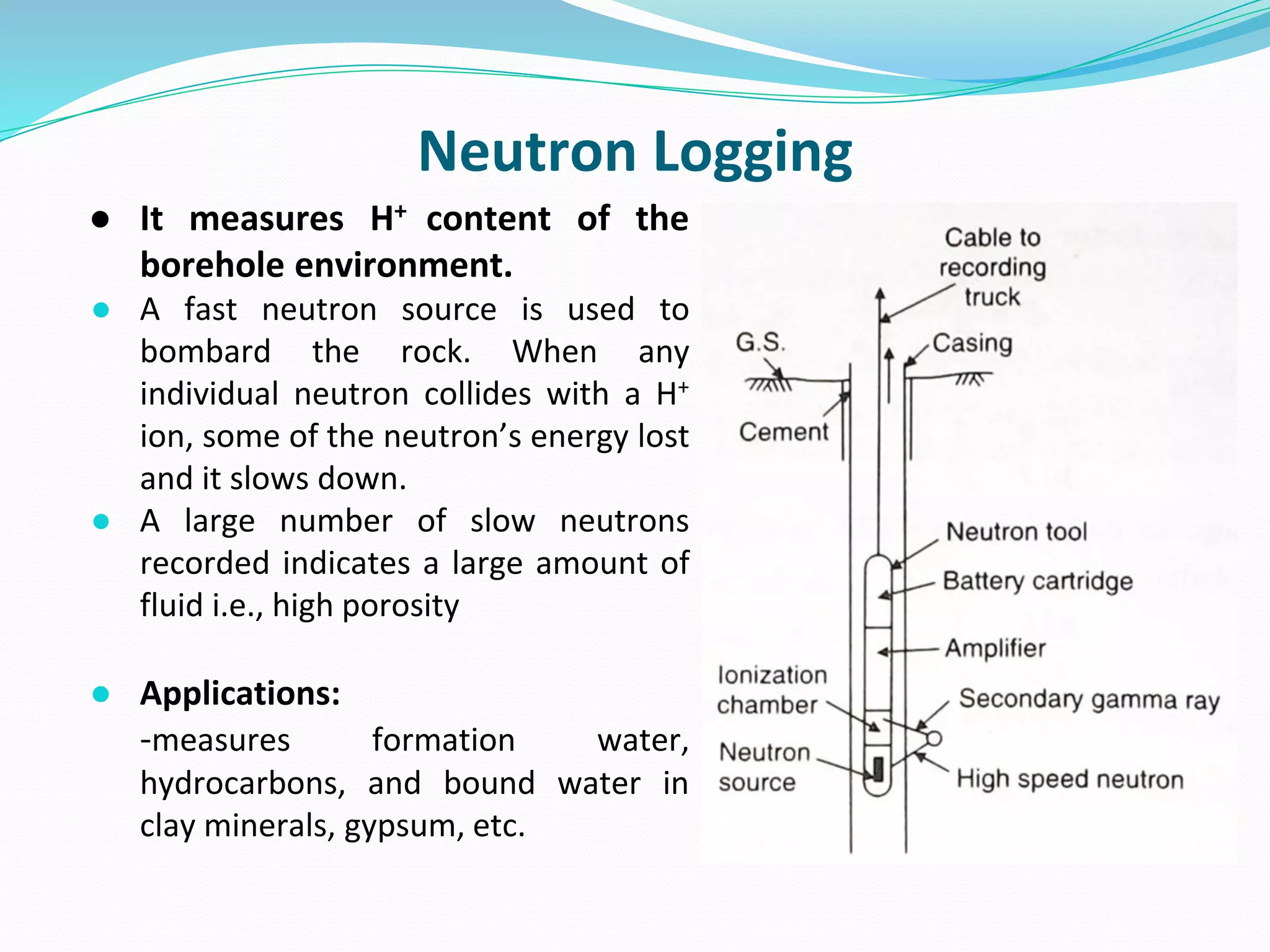
Neutron Logging
● It measures H+ content of the
borehole environment.
● A fast neutron source is used to
bombard the rock. When any
individual neutron collides with a H+
ion, some of the neutron’s energy lost
and it slows down.
● A large number of slow neutrons
recorded indicates a large amount of
fluid i.e., high porosity
● Applications:
-measures formation water,
hydrocarbons, and bound water in
clay minerals, gypsum, etc.
Density Logging
● This tool operate by emitting gamma
radiation and detecting the
proportion of the radiation that
returns to detectors on the tool.
● Denser the formation, more electrons
are present, and more energy is lost due
to collisions.
● If matrix density is known, then energy
loss is directly related to porosity.
(density decreases with increasing porosity)
● Applications:
-Identification of lithology.
-Measurement of bulk density &
porosity.
THANK YOU

Borehole Geophysical Techniques

  • 1.
  • 2.
    Spontaneous Potential (SP)Log ● Measures natural potential difference between a movable electrode in the borehole and the fixed potential of a surface electrode ● +ve deflection- Cations- Mud - Membrane Potential ● -ve deflection-Anions-SSt, Porous Lst- Liquid Junction Potential ● Applications: -correlation -lithology indication -porosity and permeability -resistivity -salinity
  • 3.
    Resistivity Log ● Measuresthe resistivity of a formation by passing electricity through electrodes placed at standard spacings ● Shale, Clay & Saltwater –> Low ● Freshwater sand –> Moderate to high ● Cemented sandstone & Nonporous limestone –> High ● Various resistivity tools in use ● Applications: -porosity and permeability -fluid characteristics -oil detection -metallic mineral exploration
  • 4.
    Sonic Log ● Measuresthe time of first arrival of sound pulses from a transmitter at a receiver ● The arrival time depends on the density of the formation, which in turn depends on the porosity and permeability ● Applications: -Density of the formation -Porosity calculation for known lithology -Calibration of seismic data
  • 5.
    ● It measuresthe natural radioactivity of the formation. ● It provides a measurement of the muddiness of a unit. ● Quartz arenite and clean carbonate sediments -> low log response. ● Mudstone, volcanic ash and granite wash -> high log response. ● It can be run in open as well as cased holes. ● Applications: -Identification of Lithology -Facies correlation. -Evaluation of radioactive minerals. -Identify shale volumes. Gamma Logging
  • 6.
    Neutron Logging ● Itmeasures H+ content of the borehole environment. ● A fast neutron source is used to bombard the rock. When any individual neutron collides with a H+ ion, some of the neutron’s energy lost and it slows down. ● A large number of slow neutrons recorded indicates a large amount of fluid i.e., high porosity ● Applications: -measures formation water, hydrocarbons, and bound water in clay minerals, gypsum, etc.
  • 7.
    Density Logging ● Thistool operate by emitting gamma radiation and detecting the proportion of the radiation that returns to detectors on the tool. ● Denser the formation, more electrons are present, and more energy is lost due to collisions. ● If matrix density is known, then energy loss is directly related to porosity. (density decreases with increasing porosity) ● Applications: -Identification of lithology. -Measurement of bulk density & porosity.
  • 8.