Regions of the
World
South
America
South America
Land Area of 6.9 million sq. miles
Has Atlantic Ocean to the east and Pacific to the west.
Countries boundaries were determined by the colonial
powers from the 16th
century onwards.
Portugal; Brazil.
Spain; Venezuela, Colombia, Ecuador, Peru,
Bolivia, Chile, Argentina, Uruguay, and Paraguay.
Britain, France, and the Netherlands; Guyana,
French Guiana, and Suriname respectively.
I. Physical Features
A. Andes Mountains- arose when the South
American and Pacific plates collided to form an
elongated zones of the western coast.
1. This area is prone to earthquakes
and volcanic eruptions.
2. Narrow in the north, broadens out
into a high plateau in the center.
i. Location of Lake Titicaca.
B. Amazon River basin, which is 4,080 miles long,
covers 3 million sq. miles in equatorial South
America.
1. It is bordered to the south by the Mato Grosso
Plateau and the highlands of Brazil, and to the
north by the Guyana Highlands.
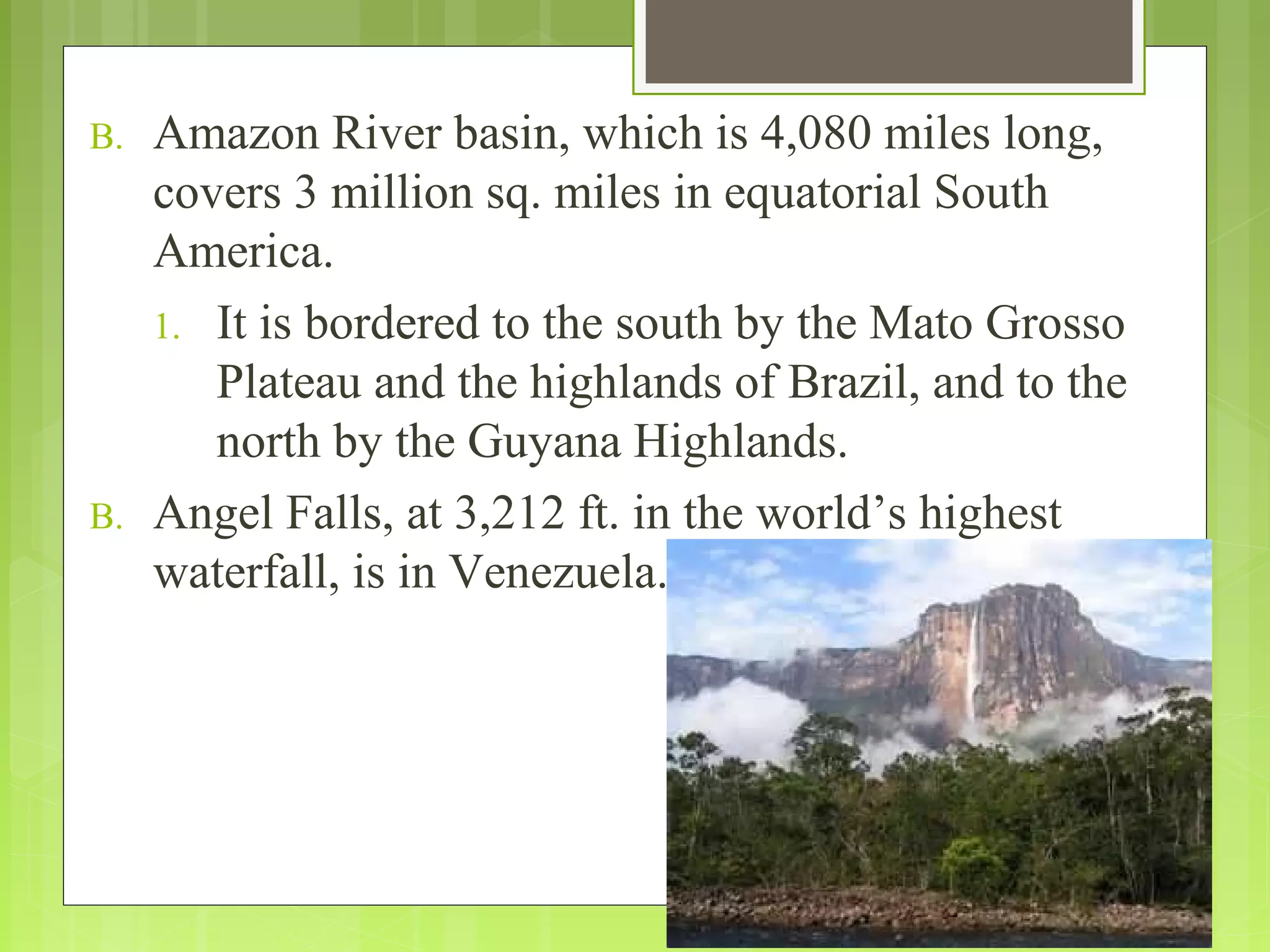
B. Angel Falls, at 3,212 ft. in the world’s highest
waterfall, is in Venezuela.
II. Climate and Vegetation
A. The continent stretches from the topics to the
sub-polar zones and is climatically diverse. The
tropics cover a large area in the north , with the
southern part being more temperate.
B. Humid Tropical zone is characterized by
extensive forests in Brazil, Guyana, and
Venezuela, and includes the world’s largest
remaining rainforest, the Amazon.
1. Areas of this zone have been cleared for
agriculture.
i. Sugarcane plantations and cattle ranches.
1. The Amazon forests are under threat from
logging and from the spread of agriculture
and settlement, and are rapidly diminishing in
size.
i. Is rich in wildlife and contains a large number of
plant species unique to the area.
C. In the north of the continent
1. Wet and dry seasons alternate, the forest trees
are deciduous.
2. The subtropical and temperate areas in the
south of the continent are marked by
extensive grasslands, with dispersed trees.
i. Example Pampas of Argentina and Patagonia.
D. In the central Andes rainfall is concentrated on the Eastern
slopes.
1. Eastern Slopes- Forested.
2. Western Slopes- Sparse vegetation is generally thorny
shrubs and animal life is limited.
D. South America has abundant wildlife
1. Llamas, anteaters, armadillos, and iguanas.
2. The seas off the west coast of temperate South America
are rich in marine life due to the nutrient-rich cold waters
of the Peru Current.
III. Population
A. South America’s
population is bout
373.7 million (2007).
1. Relatively high living
standards are reflected
by the life
expectancies.
i. 69.4 years for
males.
ii. 76.4 years for
females.
2. Current population
growth rate is 1.25%
per year.
B. The original inhabitants of the continent were
Amerindians who, migrated from Asia across the
Bering Straits.
1. From the 17th
century from Portugal and Spain
immigrated in considerable numbers.
i. They brought Africans to work as agricultural laborers.
2. During the 20th
century migration from Europe was
predominate, migrants also came from Asia.
i. People of Italian descent are significant in Argentina, and
Japanese people form locally important groups in Brazil and
Peru.
C. The continent is highly
urbanized.
1. 81.6 % of the population
lives in urban areas.
2. Over the last 50 years,
large numbers of people
have moved to cities such
as;
i. Sao Paulo 19.1
million
ii. Buenos Aires 12.4
million
iii. Rio de Janeiro 11.2
million
iv. Lima 7.5 million
3. The result is urban
congestion and the spread
of shanty towns amid
modern cities.
IV. Agriculture
A. Several agricultural products were grown in South
American before the coming of the Europeans.
1. Maize, cashews, peanuts, avocadoes, and cacao.
B. Agriculture was extensively established when the
continent was colonized.
1. Rice, wheat, sugarcane, coffee, bananas, and citrus
fruits.
C. The tropical north of the continent produces sugar,
bananas, mangoes, and rubber.
1. Wheat and temperate fruits are grown in the temperate
south.
C. Introduced animals provide the bulk of livestock.
1. Cattle, sheep
2. Indigenous animals such as Llamas and Alpacas are
reared in South America.
D. Irrigation is important in certain regions,
particularly in the west.
1. Ecuador, Peru, Chile, and Argentine.
D. Much of the forested areas of S. America are
logged for their timber.
1. This is particularly the case in the Amazon.
2. Presents concerns about the rate at which the forest
is being lost.
D. Illegal cultivation of narcotic drugs,
particularly in Colombia, is also a matter of
world concern.
V. Industrialization
A. South America is endowed with significant
mineral deposits.
1. Tin in Bolivia.
2. Iron Ore in Brazil
3. Petroleum in Venezuela.
B. Industrialization has accelerated in South
America since the 1950’s, as a result of
increased electricity generation.
1. Most of the Continent’s hydroelectric potential
has been harnessed.
C. Manufacturing ranges from food processing to metal and
chemical industries.
1. Consumer items such as textiles, clothing, and
footwear, as well as more expensive items such as
automobiles, are manufactured both for the domestic
market and for export.
VI. Languages
A. The original inhabitants of South America belonged to
various groups and have several languages.
1. Many no longer speak those languages, in some areas
large numbers still do.
i. Guarani is widespread in Paraguay.
2. Official languages in South America are now those
introduced by the colonial powers.
i. Portuguese in Brazil.
ii. English in Guyana
iii. Dutch in Suriname
iv. French in Guiana.
a. Hindi is also significant in both Guiana and Suriname.
v. Spanish in most other countries.
3. The media predominantly uses introduced European
languages.
VII. Boundary disputes and Wars
A. There was little conflict between the continent’s countries during
the 20th
century.
1. There was considerable civil strife between guerilla groups and
governments in several countries.
i. Uruguay, Colombia, and Peru
2. Armed drug cartels in Colombia also remain a major problem.
B. In Chile and Argentina, there have been period of dictatorship.
1. Military have played a large role in government.
2. During these periods there has been considerable loss of
civilian lives.
B. In 1982 Argentine invaded the Falkland Islands (GrBr).
1. After more than 1,000 people lost their lives in the ensuing
war, the islands were returned to UK rule.
Map of
South
America

South america

  • 1.
  • 2.
    South America Land Areaof 6.9 million sq. miles Has Atlantic Ocean to the east and Pacific to the west. Countries boundaries were determined by the colonial powers from the 16th century onwards. Portugal; Brazil. Spain; Venezuela, Colombia, Ecuador, Peru, Bolivia, Chile, Argentina, Uruguay, and Paraguay. Britain, France, and the Netherlands; Guyana, French Guiana, and Suriname respectively.
  • 3.
    I. Physical Features A.Andes Mountains- arose when the South American and Pacific plates collided to form an elongated zones of the western coast. 1. This area is prone to earthquakes and volcanic eruptions. 2. Narrow in the north, broadens out into a high plateau in the center. i. Location of Lake Titicaca.
  • 4.
    B. Amazon Riverbasin, which is 4,080 miles long, covers 3 million sq. miles in equatorial South America. 1. It is bordered to the south by the Mato Grosso Plateau and the highlands of Brazil, and to the north by the Guyana Highlands. B. Angel Falls, at 3,212 ft. in the world’s highest waterfall, is in Venezuela.
  • 5.
    II. Climate andVegetation A. The continent stretches from the topics to the sub-polar zones and is climatically diverse. The tropics cover a large area in the north , with the southern part being more temperate. B. Humid Tropical zone is characterized by extensive forests in Brazil, Guyana, and Venezuela, and includes the world’s largest remaining rainforest, the Amazon. 1. Areas of this zone have been cleared for agriculture. i. Sugarcane plantations and cattle ranches.
  • 6.
    1. The Amazonforests are under threat from logging and from the spread of agriculture and settlement, and are rapidly diminishing in size. i. Is rich in wildlife and contains a large number of plant species unique to the area. C. In the north of the continent 1. Wet and dry seasons alternate, the forest trees are deciduous. 2. The subtropical and temperate areas in the south of the continent are marked by extensive grasslands, with dispersed trees. i. Example Pampas of Argentina and Patagonia.
  • 7.
    D. In thecentral Andes rainfall is concentrated on the Eastern slopes. 1. Eastern Slopes- Forested. 2. Western Slopes- Sparse vegetation is generally thorny shrubs and animal life is limited. D. South America has abundant wildlife 1. Llamas, anteaters, armadillos, and iguanas. 2. The seas off the west coast of temperate South America are rich in marine life due to the nutrient-rich cold waters of the Peru Current.
  • 8.
    III. Population A. SouthAmerica’s population is bout 373.7 million (2007). 1. Relatively high living standards are reflected by the life expectancies. i. 69.4 years for males. ii. 76.4 years for females. 2. Current population growth rate is 1.25% per year.
  • 9.
    B. The originalinhabitants of the continent were Amerindians who, migrated from Asia across the Bering Straits.
  • 10.
    1. From the17th century from Portugal and Spain immigrated in considerable numbers. i. They brought Africans to work as agricultural laborers. 2. During the 20th century migration from Europe was predominate, migrants also came from Asia. i. People of Italian descent are significant in Argentina, and Japanese people form locally important groups in Brazil and Peru.
  • 11.
    C. The continentis highly urbanized. 1. 81.6 % of the population lives in urban areas. 2. Over the last 50 years, large numbers of people have moved to cities such as; i. Sao Paulo 19.1 million ii. Buenos Aires 12.4 million iii. Rio de Janeiro 11.2 million iv. Lima 7.5 million 3. The result is urban congestion and the spread of shanty towns amid modern cities.
  • 12.
    IV. Agriculture A. Severalagricultural products were grown in South American before the coming of the Europeans. 1. Maize, cashews, peanuts, avocadoes, and cacao. B. Agriculture was extensively established when the continent was colonized. 1. Rice, wheat, sugarcane, coffee, bananas, and citrus fruits.
  • 13.
    C. The tropicalnorth of the continent produces sugar, bananas, mangoes, and rubber. 1. Wheat and temperate fruits are grown in the temperate south. C. Introduced animals provide the bulk of livestock. 1. Cattle, sheep 2. Indigenous animals such as Llamas and Alpacas are reared in South America.
  • 14.
    D. Irrigation isimportant in certain regions, particularly in the west. 1. Ecuador, Peru, Chile, and Argentine. D. Much of the forested areas of S. America are logged for their timber. 1. This is particularly the case in the Amazon. 2. Presents concerns about the rate at which the forest is being lost. D. Illegal cultivation of narcotic drugs, particularly in Colombia, is also a matter of world concern.
  • 15.
    V. Industrialization A. SouthAmerica is endowed with significant mineral deposits. 1. Tin in Bolivia. 2. Iron Ore in Brazil 3. Petroleum in Venezuela. B. Industrialization has accelerated in South America since the 1950’s, as a result of increased electricity generation. 1. Most of the Continent’s hydroelectric potential has been harnessed.
  • 16.
    C. Manufacturing rangesfrom food processing to metal and chemical industries. 1. Consumer items such as textiles, clothing, and footwear, as well as more expensive items such as automobiles, are manufactured both for the domestic market and for export.
  • 17.
    VI. Languages A. Theoriginal inhabitants of South America belonged to various groups and have several languages. 1. Many no longer speak those languages, in some areas large numbers still do. i. Guarani is widespread in Paraguay. 2. Official languages in South America are now those introduced by the colonial powers. i. Portuguese in Brazil. ii. English in Guyana iii. Dutch in Suriname iv. French in Guiana. a. Hindi is also significant in both Guiana and Suriname. v. Spanish in most other countries. 3. The media predominantly uses introduced European languages.
  • 18.
    VII. Boundary disputesand Wars A. There was little conflict between the continent’s countries during the 20th century. 1. There was considerable civil strife between guerilla groups and governments in several countries. i. Uruguay, Colombia, and Peru 2. Armed drug cartels in Colombia also remain a major problem.
  • 19.
    B. In Chileand Argentina, there have been period of dictatorship. 1. Military have played a large role in government. 2. During these periods there has been considerable loss of civilian lives. B. In 1982 Argentine invaded the Falkland Islands (GrBr). 1. After more than 1,000 people lost their lives in the ensuing war, the islands were returned to UK rule.
  • 20.