Latin America Geography Mr. Jeremy Rinkel
Overview of Latin America
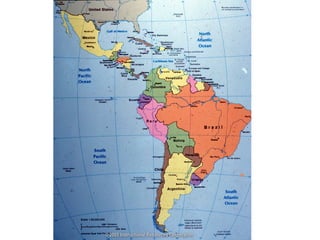
Latin America Begins at the Rio Grande River on the southern border of the United States and extends to the southern tip of South America. Covers 7,900,000 square miles or 16% of the earth’s surface
The Land Mountains Mexico has three mountain ranges West Indies islands are the tops of volcanic mountains The Andes Mountains stretches along the west coast of South America Plains Cover the coasts of Mexico and Central America Two inland plains found inside South America Pampas of Argentina and llanos of Colombia and Venezuela
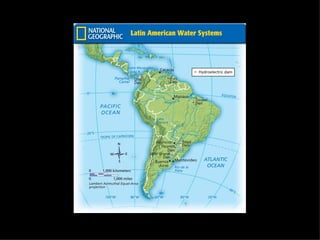
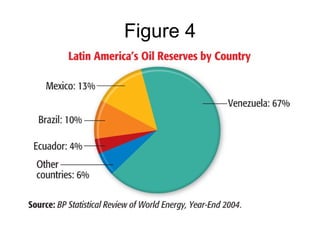
The Land Rivers Contains five rivers including the Amazon The Amazon stretches 4,000 miles and is the longest river in the Western Hemisphere. Natural Resources Oil and natural gas are prevalent in Mexico and Venezuela Other resources found are copper, iron ore, silver, and lead. Rich soil allows farmers to grow grains, fruit, and coffee.
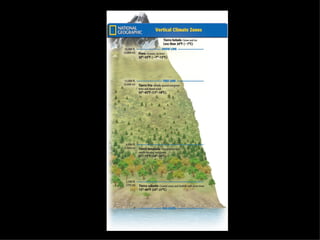
Climate and Vegetation Elevation Low elevation-hot and humid with green tropical vegetation Higher elevation- the climate becomes milder and the temperature becomes cooler Highest elevation- very little plant life (snow or frost) Rainforests Cover the lowland areas of Latin America Largest is in Brazil in the Amazon basin Found on the east coast of Central America and some of the Caribbean islands
Economy Based mainly on agriculture Farmers grow coffee, bananas, and sugarcane Latin America is a top cattle raising region in the world Service industry and manufacturing is growing
The People Population- 500 million people (9%) 70% live in cities and along the coastlines Very diversified (many different groups of people) Democratic governments have emerged and continue to emerge.
 
Latin America Physical geography varies Low-lying plains and vast water systems Beauty and magnificence of the high rugged peaks of the Andes mountains
Location and Basic Facts Located in the Western Hemisphere, south of the United States 8 million square miles of land (16% of the world’s land surface) Divided into three sub-regions: Middle America The Caribbean  South America
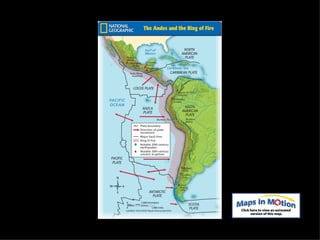
Mountains and Plateaus The Andes mountains are the most distinctive landforms in this region Located along the Pacific “Ring of Fire”  Plate movement still occurs causing earthquakes and volcanic eruptions People have settled into the mountain region and mostly plateaus
Mountains and Plateaus  The cooler climate and rich resources drew settlers in These regions were at one time very isolated Technology (cell phones, tv, and internet are breaking down physical barriers
Mountains in Middle America and the Caribbean Sierra Madre mountain ranges are surrounded by the Mexican plateau Mild climate, fertile volcanic soil, and rainfall have attracted settlers for many years The Central Highlands is a chain of volcanic peaks in which many islands in the Caribbean Sea are part of
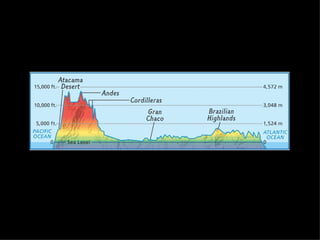
Andes of South America Stretch 4,500 miles along the western edge of South America The longest mountain chain and one of the tallest in the world
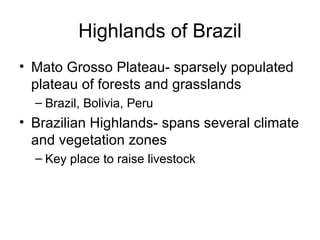
Highlands of Brazil Mato Grosso Plateau- sparsely populated plateau of forests and grasslands Brazil, Bolivia, Peru Brazilian Highlands- spans several climate and vegetation zones Key place to raise livestock
Figure 1
Figure 2
Figure 3
Figure 4
Figure 5
Figure 6
Chapter 9 Latin America Mr. Jeremy Rinkel
Mexico
 
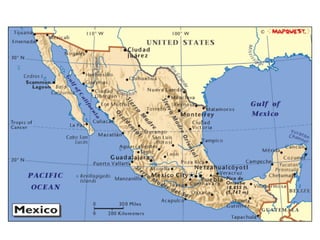
Bridging Two Continents Land bridge- a narrow strip of land that joins two larger landmasses Connects North America and South America Mexico is a peninsula or piece of land surrounded by water on three sides.
Mexico “Land of the Shaking Earth” Very rugged landscape Situated over various plates which caused the formation of mountains and volcanoes. Earthquakes occur very frequently Mount Popocatepetl “smoky mountain” Famous volcano named by Aztec Indians
Mountains and Plateau Mountain Ranges Sierra Madre Occidentl (runs north and south along western Mexico near the Pacific Ocean) Sierra Madre Oriental (runs along the eastern side of Mexico Sierra Madre del Sur (southwestern Mexico) Plateau of Mexico (covers 40% of Mexico) Northern part is desert and grassy plains Southern part rises in elevation with basins Basins are broad, flat valleys.
Coastal Lowlands Stretch along the Pacific Ocean and the Gulf of Mexico Rivers flow through the coastal plains The Rio Grande forms the border with the U.S. and drains in the Gulf of Mexico
Climate Latitude is the location north or south of the equator The Tropic of Cancer runs through the center of Mexico Mexico is usually warm year around
Climate Altitude zones Hot Land Temperate Land Cold Land
The Economy Economic Regions Service industries- is a business that provides services to people instead of making goods. Three economic regions Central Mexico The North  The South
Farming in Mexico Only 11% of the land is fertile for farming because of the mountains, deserts, and rainforests Farmers grow: coffee, corn, cotton, oranges, and sugarcane.
Central Mexico The economic heart of the country Home to half of Mexico’s population Has favorable conditions for farming Cities in Central Mexico Mexico City Guadalajara Leon Puebla
The North Includes Baja California and the northern part of the plateau of Mexico Too dry to farm, but farmers irrigate to grow Cotton, fruits, cereals, and vegetables Ranchers raise Cattle, sheep, goats, and pigs Vaqueros- cowhands developed the tools to herd, rope and brand cattle.
The North  Cities Monterrey (steel, copper, lead, and zinc) Maquiladoras- are factories that assemble parts shipped from other countries Assemble automobiles, stereo systems, computers, and other electronic devices
The South Stretches from Mexico City to the Yucatan Peninsula. Poorest people of Mexico live in this area Subsistence farm- is a farm that produces only enough to support a family’s needs Plantations (in the valleys)- large farms that raise a single crop for money. Rich farmers grow coffee and sugarcane Tourism is very popular in the South
Economic Challenges Mexico has become an industrialized country Describes a country in which industry has replaced farming as the main economic activity Challenges due to industrialization Conserving land Controlling pollution Creating new jobs Increasing trade with other countries
Pollution Mountains surround Mexico City blocking the flow of air leaving smog. Smog- is fog mixed with smoke and chemicals. The city sometimes shuts down and people must stay indoors Thousands of acres of forest are burned to make room for new fields for crops
Population Changes Mexico’s population is growing twice as fast as the United States Mexico cannot provide enough jobs 98 million people live in the southern part of the Plateau of Mexico Resources are strained with so many people living in this area Many people move to the U.S. to seek employment
Free Trade North American Free Trade Agreement Joint agreement between the U.S., Canada, and Mexico (1993) Allows money to move freely among these three countries Has created many new jobs in Mexico
Native Americans The first people came from Asia The Maya flourished in Yucatan Lived during 250 A.D to 900 A.D. Built cities around towering temples in the rainforest The Aztecs built the city Tenochtitlan Mexico City is located in this area Were fierce warriors, builders and traders Had marketplaces filled with pottery, baskets, cloth, gold, and silver
The Spanish Heritage Hernan Cortes- arrived in Mexico in 1519. Mexico remained a Spanish colony for nearly 300 years The Spaniards enslaved the Native Americans and had them work the fields and the mines Mestizo is a person with mixed Native American and European heritage 60% are mestizos 30% Native American
Modern Mexico Gained its freedom from Spain in 1821 Revolution began in 1910 because people were discontent of the way of life especially poor farmers 1920- Mexico became a federal republic 31 states share powers 1990s- people demanded reform Other parties began to rule and win elections instead of just one political party
City Life ¾ of the population in Mexico live in cities Older homes are made of adobe (sun-dried or clay bricks) Houses in poor areas are made of scrap wood, metal, or whatever material can be found Most of these homes lack electricity and running water
Country Life Most Mexican villages are very poor Homes are built of cement blocks, with a red tiled roof, sheet metal, or clay Most villages have a marketplace where clothes, food, baskets, and pottery are sold
The Arts and Recreation Painters and Writers- have created many national treasures Produced many murals or wall paintings Music and Dance Traditional music is played by a Mariachi band (a singer, 2 violinists, 2 guitarists, two horn players, and a bass player) These musicians wear colorful outfits and sombreros
The Arts and Recreation Celebrations- fiesta (feast day) Independence Day (September 15 & 16) Cinco de Mayo (May 5) Mexicans also celebrate Christmas Foods Sports Soccer is the most popular sport Bullfighting is a popular sport for tourists
Sources http://go.hrw.com/atlas/norm_htm/mexico.htm
Central America
 
The Land More than 1,000 miles north to south 300 miles wide at widest point Pacific Ocean borders the west Caribbean Sea borders the east Volcanic eruptions are common
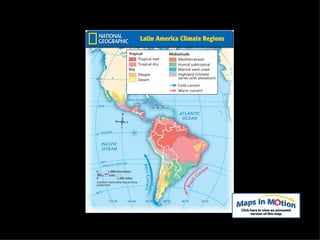
Climate mostly tropical, but varies from country to country Mountains and highlands are dry and cool year round Pacific lowlands (tropical savanna) May-Nov warm and rainy Dec-April hot and dry Eastern lowlands (tropical rainforest year round) Hurricanes (fierce storms with winds of more than 74 m.p.h.
The Economy Farming Plantations- large farms that grow produce for sale or for export (coffee, bananas, sugar cane) Substience farmer- raises small amount of crops to provide for family, extras are sold at the local market
The Economy Rainforests (provide many great treasures) Chicle- a substance used in making chewing gum. Scientists use trees and plants used for medicine or medical research Caribbean Lowlands Farmers have cleared rainforest areas to raise crops, which erodes nutrients Central American governments are trying to enforce laws from the destruction of rainforest.
Industry Few small industries Little manufacturing due to lack of fuels Bauxite (mineral used to make aluminum) is found in Costa Rica and Guatemala
The People Influence of the Past Maya Indians settled in C.A. in 250-400 B.C. 1400s- Spanish settled in Central America 1500s- Spanish claimed land and forced Native Americans to work in plantations 1600s- British settled in Belize-enslaved Africans to work as slaves in the rainforest
Independence Most countries gained in 1821 In 1903, with U.S. help, Panama won independence from Colombia Belize won independence from U.K. in 1981 This area has been challenged by revolutions since the mid 1800s.
The Population Today 35 million people Spanish is the official language except for English speaking Belize 50% live on farms or small towns People in urban areas work in manufacturing or service industry jobs Those living on the coast harvest shrimp, lobster, and other seafood for export
 
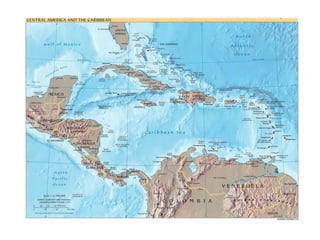
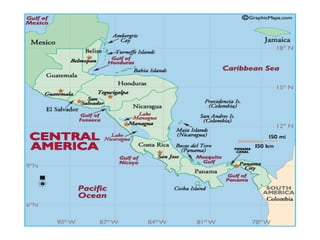
Central America includes seven countries: Belize Guatemala Honduras El Salvador Nicaragua Costa Rica Panama
Landforms Many active volcanoes. Some are dormant. Dormant —Not likely to erupt. Chain of volcanic mountains, called the  Central Highlands,  stretch along most of the region. Volcanic material has left rich, fertile soil. Farmers grow coffee, bananas, sugarcane, & other crops.
Guatemala Volcanoes 40% live like their ancestors. These people do not leave their country’s borders. Guatemalans who speak Spanish & practice European ways are called  ladinos . Live in cities. Civil War from 1960-1996.
Costa Rica Offers one of the highest standards of living in the world. High literacy rates. Most are of Spanish descent. Few wars. Lots of schools. Major export is coffee.
Panama 1903 –U.S. helped Panama gain independence. U.S. built Panama Canal. (1914) U.S. controlled the canal and the land of each side until 2000, when they gave it back to Panama. 50% of population live & work near the canal. Population is a mix of Spanish and Native American ancestry.
El Salvador Main crops are coffee, sugarcane, corn, cotton, & shrimp. Population of about six million. Only 53%  have access to safe water. 1% are indigenous to the region. Indigenous —native to the region.
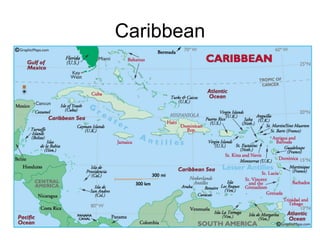
Caribbean
The Caribbean All Caribbean islands are located in the Caribbean Sea. Geographers call a group of islands an  archipelago . Many of the islands are actually the tops of a mountain range that sit on the bottom of the sea.
The Caribbean Some islands in the Caribbean are still active volcanoes. Lava can help people as well as hurt. When lava breaks down, it forms good soil for farming. Some of the islands are not volcanic. These nonvolcanic islands are called atolls. Atoll ---A chain of islands made up of coral.
Caribbean Islands Bahamas are southeast of Florida. Greater Antilles (northern Caribbean) include Jamaica, Cuba, Hispaniola (Haiti/Dominican Republic), and Puerto Rico. Lesser Antilles (southern Caribbean) include a number of smaller islands.
Climate & Economy Constant tropical savanna climate. Temperatures between 70 degrees & 85 degrees year round. Farming & tourism are the most important economic activities. Many islands rely too heavily on just one crop.
The People 1 st  permanent European settlement in the Western Hemisphere was established in 1498 in the Dominican Republic. Most people in the islands are descendents of Africans. Europeans brought millions of Africans to the islands to work as slaves on sugarcane plantations.
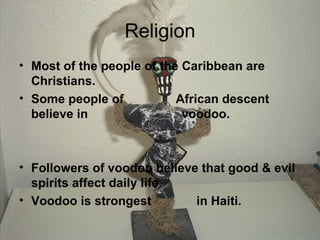
Religion Most of the people of the Caribbean are Christians. Some people of  African descent believe in  voodoo. Followers of voodoo believe that good & evil spirits affect daily life. Voodoo is strongest  in Haiti.
Independence During the 20 th  Century, most of the smaller  Caribbean islands won their freedom from colonial rule. Cuba is the only country in the Western Hemisphere with a communist government. Communism ---A government system in which there is no private property; the government owns & controls the land & goods
Cuba 90 miles south of Florida. Large producer of sugar. Also grow coffee, tobacco, rice, & fruit. Most farmers work on cooperatives. Cooperatives —Farms owned & operated by the government.
Cuba Leader is Fidel Castro. Currently Raul Castro (Fidel’s brother is in power) Most Cubans live in poverty.
Haiti Shares the island of Hispaniola with the Dominican Republic. More than 90% of population is of African descent. People are poor & live in rural areas. Coffee is a major crop. Won independence in 1804 (2 nd  in the Western Hemisphere after the U.S.)
Puerto Rico Spanish colony from 1508 until 1898. Under control of the U.S. since 1898 (Spanish-American War.) Has been a commonwealth since 1952. Commonwealth —A partly self-governing territory. More industry than any other island in the West Indies.
Puerto Rico Agriculture & tourism make up the majority of Puerto Rico’s economy. Factories make medicine, chemicals, clothing. Capital is San Juan.

Latin America

  • 1.
    Latin America GeographyMr. Jeremy Rinkel
  • 2.
  • 3.
    Latin America Beginsat the Rio Grande River on the southern border of the United States and extends to the southern tip of South America. Covers 7,900,000 square miles or 16% of the earth’s surface
  • 4.
    The Land MountainsMexico has three mountain ranges West Indies islands are the tops of volcanic mountains The Andes Mountains stretches along the west coast of South America Plains Cover the coasts of Mexico and Central America Two inland plains found inside South America Pampas of Argentina and llanos of Colombia and Venezuela
  • 5.
    The Land RiversContains five rivers including the Amazon The Amazon stretches 4,000 miles and is the longest river in the Western Hemisphere. Natural Resources Oil and natural gas are prevalent in Mexico and Venezuela Other resources found are copper, iron ore, silver, and lead. Rich soil allows farmers to grow grains, fruit, and coffee.
  • 6.
    Climate and VegetationElevation Low elevation-hot and humid with green tropical vegetation Higher elevation- the climate becomes milder and the temperature becomes cooler Highest elevation- very little plant life (snow or frost) Rainforests Cover the lowland areas of Latin America Largest is in Brazil in the Amazon basin Found on the east coast of Central America and some of the Caribbean islands
  • 7.
    Economy Based mainlyon agriculture Farmers grow coffee, bananas, and sugarcane Latin America is a top cattle raising region in the world Service industry and manufacturing is growing
  • 8.
    The People Population-500 million people (9%) 70% live in cities and along the coastlines Very diversified (many different groups of people) Democratic governments have emerged and continue to emerge.
  • 9.
  • 10.
    Latin America Physicalgeography varies Low-lying plains and vast water systems Beauty and magnificence of the high rugged peaks of the Andes mountains
  • 11.
    Location and BasicFacts Located in the Western Hemisphere, south of the United States 8 million square miles of land (16% of the world’s land surface) Divided into three sub-regions: Middle America The Caribbean South America
  • 12.
    Mountains and PlateausThe Andes mountains are the most distinctive landforms in this region Located along the Pacific “Ring of Fire” Plate movement still occurs causing earthquakes and volcanic eruptions People have settled into the mountain region and mostly plateaus
  • 13.
    Mountains and Plateaus The cooler climate and rich resources drew settlers in These regions were at one time very isolated Technology (cell phones, tv, and internet are breaking down physical barriers
  • 14.
    Mountains in MiddleAmerica and the Caribbean Sierra Madre mountain ranges are surrounded by the Mexican plateau Mild climate, fertile volcanic soil, and rainfall have attracted settlers for many years The Central Highlands is a chain of volcanic peaks in which many islands in the Caribbean Sea are part of
  • 15.
    Andes of SouthAmerica Stretch 4,500 miles along the western edge of South America The longest mountain chain and one of the tallest in the world
  • 16.
    Highlands of BrazilMato Grosso Plateau- sparsely populated plateau of forests and grasslands Brazil, Bolivia, Peru Brazilian Highlands- spans several climate and vegetation zones Key place to raise livestock
  • 17.
  • 18.
  • 19.
  • 20.
  • 21.
  • 22.
  • 23.
    Chapter 9 LatinAmerica Mr. Jeremy Rinkel
  • 24.
  • 25.
  • 26.
    Bridging Two ContinentsLand bridge- a narrow strip of land that joins two larger landmasses Connects North America and South America Mexico is a peninsula or piece of land surrounded by water on three sides.
  • 27.
    Mexico “Land ofthe Shaking Earth” Very rugged landscape Situated over various plates which caused the formation of mountains and volcanoes. Earthquakes occur very frequently Mount Popocatepetl “smoky mountain” Famous volcano named by Aztec Indians
  • 28.
    Mountains and PlateauMountain Ranges Sierra Madre Occidentl (runs north and south along western Mexico near the Pacific Ocean) Sierra Madre Oriental (runs along the eastern side of Mexico Sierra Madre del Sur (southwestern Mexico) Plateau of Mexico (covers 40% of Mexico) Northern part is desert and grassy plains Southern part rises in elevation with basins Basins are broad, flat valleys.
  • 29.
    Coastal Lowlands Stretchalong the Pacific Ocean and the Gulf of Mexico Rivers flow through the coastal plains The Rio Grande forms the border with the U.S. and drains in the Gulf of Mexico
  • 30.
    Climate Latitude isthe location north or south of the equator The Tropic of Cancer runs through the center of Mexico Mexico is usually warm year around
  • 31.
    Climate Altitude zonesHot Land Temperate Land Cold Land
  • 32.
    The Economy EconomicRegions Service industries- is a business that provides services to people instead of making goods. Three economic regions Central Mexico The North The South
  • 33.
    Farming in MexicoOnly 11% of the land is fertile for farming because of the mountains, deserts, and rainforests Farmers grow: coffee, corn, cotton, oranges, and sugarcane.
  • 34.
    Central Mexico Theeconomic heart of the country Home to half of Mexico’s population Has favorable conditions for farming Cities in Central Mexico Mexico City Guadalajara Leon Puebla
  • 35.
    The North IncludesBaja California and the northern part of the plateau of Mexico Too dry to farm, but farmers irrigate to grow Cotton, fruits, cereals, and vegetables Ranchers raise Cattle, sheep, goats, and pigs Vaqueros- cowhands developed the tools to herd, rope and brand cattle.
  • 36.
    The North Cities Monterrey (steel, copper, lead, and zinc) Maquiladoras- are factories that assemble parts shipped from other countries Assemble automobiles, stereo systems, computers, and other electronic devices
  • 37.
    The South Stretchesfrom Mexico City to the Yucatan Peninsula. Poorest people of Mexico live in this area Subsistence farm- is a farm that produces only enough to support a family’s needs Plantations (in the valleys)- large farms that raise a single crop for money. Rich farmers grow coffee and sugarcane Tourism is very popular in the South
  • 38.
    Economic Challenges Mexicohas become an industrialized country Describes a country in which industry has replaced farming as the main economic activity Challenges due to industrialization Conserving land Controlling pollution Creating new jobs Increasing trade with other countries
  • 39.
    Pollution Mountains surroundMexico City blocking the flow of air leaving smog. Smog- is fog mixed with smoke and chemicals. The city sometimes shuts down and people must stay indoors Thousands of acres of forest are burned to make room for new fields for crops
  • 40.
    Population Changes Mexico’spopulation is growing twice as fast as the United States Mexico cannot provide enough jobs 98 million people live in the southern part of the Plateau of Mexico Resources are strained with so many people living in this area Many people move to the U.S. to seek employment
  • 41.
    Free Trade NorthAmerican Free Trade Agreement Joint agreement between the U.S., Canada, and Mexico (1993) Allows money to move freely among these three countries Has created many new jobs in Mexico
  • 42.
    Native Americans Thefirst people came from Asia The Maya flourished in Yucatan Lived during 250 A.D to 900 A.D. Built cities around towering temples in the rainforest The Aztecs built the city Tenochtitlan Mexico City is located in this area Were fierce warriors, builders and traders Had marketplaces filled with pottery, baskets, cloth, gold, and silver
  • 43.
    The Spanish HeritageHernan Cortes- arrived in Mexico in 1519. Mexico remained a Spanish colony for nearly 300 years The Spaniards enslaved the Native Americans and had them work the fields and the mines Mestizo is a person with mixed Native American and European heritage 60% are mestizos 30% Native American
  • 44.
    Modern Mexico Gainedits freedom from Spain in 1821 Revolution began in 1910 because people were discontent of the way of life especially poor farmers 1920- Mexico became a federal republic 31 states share powers 1990s- people demanded reform Other parties began to rule and win elections instead of just one political party
  • 45.
    City Life ¾of the population in Mexico live in cities Older homes are made of adobe (sun-dried or clay bricks) Houses in poor areas are made of scrap wood, metal, or whatever material can be found Most of these homes lack electricity and running water
  • 46.
    Country Life MostMexican villages are very poor Homes are built of cement blocks, with a red tiled roof, sheet metal, or clay Most villages have a marketplace where clothes, food, baskets, and pottery are sold
  • 47.
    The Arts andRecreation Painters and Writers- have created many national treasures Produced many murals or wall paintings Music and Dance Traditional music is played by a Mariachi band (a singer, 2 violinists, 2 guitarists, two horn players, and a bass player) These musicians wear colorful outfits and sombreros
  • 48.
    The Arts andRecreation Celebrations- fiesta (feast day) Independence Day (September 15 & 16) Cinco de Mayo (May 5) Mexicans also celebrate Christmas Foods Sports Soccer is the most popular sport Bullfighting is a popular sport for tourists
  • 49.
  • 50.
  • 51.
  • 52.
    The Land Morethan 1,000 miles north to south 300 miles wide at widest point Pacific Ocean borders the west Caribbean Sea borders the east Volcanic eruptions are common
  • 53.
    Climate mostly tropical,but varies from country to country Mountains and highlands are dry and cool year round Pacific lowlands (tropical savanna) May-Nov warm and rainy Dec-April hot and dry Eastern lowlands (tropical rainforest year round) Hurricanes (fierce storms with winds of more than 74 m.p.h.
  • 54.
    The Economy FarmingPlantations- large farms that grow produce for sale or for export (coffee, bananas, sugar cane) Substience farmer- raises small amount of crops to provide for family, extras are sold at the local market
  • 55.
    The Economy Rainforests(provide many great treasures) Chicle- a substance used in making chewing gum. Scientists use trees and plants used for medicine or medical research Caribbean Lowlands Farmers have cleared rainforest areas to raise crops, which erodes nutrients Central American governments are trying to enforce laws from the destruction of rainforest.
  • 56.
    Industry Few smallindustries Little manufacturing due to lack of fuels Bauxite (mineral used to make aluminum) is found in Costa Rica and Guatemala
  • 57.
    The People Influenceof the Past Maya Indians settled in C.A. in 250-400 B.C. 1400s- Spanish settled in Central America 1500s- Spanish claimed land and forced Native Americans to work in plantations 1600s- British settled in Belize-enslaved Africans to work as slaves in the rainforest
  • 58.
    Independence Most countriesgained in 1821 In 1903, with U.S. help, Panama won independence from Colombia Belize won independence from U.K. in 1981 This area has been challenged by revolutions since the mid 1800s.
  • 59.
    The Population Today35 million people Spanish is the official language except for English speaking Belize 50% live on farms or small towns People in urban areas work in manufacturing or service industry jobs Those living on the coast harvest shrimp, lobster, and other seafood for export
  • 60.
  • 61.
    Central America includesseven countries: Belize Guatemala Honduras El Salvador Nicaragua Costa Rica Panama
  • 62.
    Landforms Many activevolcanoes. Some are dormant. Dormant —Not likely to erupt. Chain of volcanic mountains, called the Central Highlands, stretch along most of the region. Volcanic material has left rich, fertile soil. Farmers grow coffee, bananas, sugarcane, & other crops.
  • 63.
    Guatemala Volcanoes 40%live like their ancestors. These people do not leave their country’s borders. Guatemalans who speak Spanish & practice European ways are called ladinos . Live in cities. Civil War from 1960-1996.
  • 64.
    Costa Rica Offersone of the highest standards of living in the world. High literacy rates. Most are of Spanish descent. Few wars. Lots of schools. Major export is coffee.
  • 65.
    Panama 1903 –U.S.helped Panama gain independence. U.S. built Panama Canal. (1914) U.S. controlled the canal and the land of each side until 2000, when they gave it back to Panama. 50% of population live & work near the canal. Population is a mix of Spanish and Native American ancestry.
  • 66.
    El Salvador Maincrops are coffee, sugarcane, corn, cotton, & shrimp. Population of about six million. Only 53% have access to safe water. 1% are indigenous to the region. Indigenous —native to the region.
  • 67.
  • 68.
    The Caribbean AllCaribbean islands are located in the Caribbean Sea. Geographers call a group of islands an archipelago . Many of the islands are actually the tops of a mountain range that sit on the bottom of the sea.
  • 69.
    The Caribbean Someislands in the Caribbean are still active volcanoes. Lava can help people as well as hurt. When lava breaks down, it forms good soil for farming. Some of the islands are not volcanic. These nonvolcanic islands are called atolls. Atoll ---A chain of islands made up of coral.
  • 70.
    Caribbean Islands Bahamasare southeast of Florida. Greater Antilles (northern Caribbean) include Jamaica, Cuba, Hispaniola (Haiti/Dominican Republic), and Puerto Rico. Lesser Antilles (southern Caribbean) include a number of smaller islands.
  • 71.
    Climate & EconomyConstant tropical savanna climate. Temperatures between 70 degrees & 85 degrees year round. Farming & tourism are the most important economic activities. Many islands rely too heavily on just one crop.
  • 72.
    The People 1st permanent European settlement in the Western Hemisphere was established in 1498 in the Dominican Republic. Most people in the islands are descendents of Africans. Europeans brought millions of Africans to the islands to work as slaves on sugarcane plantations.
  • 73.
    Religion Most ofthe people of the Caribbean are Christians. Some people of African descent believe in voodoo. Followers of voodoo believe that good & evil spirits affect daily life. Voodoo is strongest in Haiti.
  • 74.
    Independence During the20 th Century, most of the smaller Caribbean islands won their freedom from colonial rule. Cuba is the only country in the Western Hemisphere with a communist government. Communism ---A government system in which there is no private property; the government owns & controls the land & goods
  • 75.
    Cuba 90 milessouth of Florida. Large producer of sugar. Also grow coffee, tobacco, rice, & fruit. Most farmers work on cooperatives. Cooperatives —Farms owned & operated by the government.
  • 76.
    Cuba Leader isFidel Castro. Currently Raul Castro (Fidel’s brother is in power) Most Cubans live in poverty.
  • 77.
    Haiti Shares theisland of Hispaniola with the Dominican Republic. More than 90% of population is of African descent. People are poor & live in rural areas. Coffee is a major crop. Won independence in 1804 (2 nd in the Western Hemisphere after the U.S.)
  • 78.
    Puerto Rico Spanishcolony from 1508 until 1898. Under control of the U.S. since 1898 (Spanish-American War.) Has been a commonwealth since 1952. Commonwealth —A partly self-governing territory. More industry than any other island in the West Indies.
  • 79.
    Puerto Rico Agriculture& tourism make up the majority of Puerto Rico’s economy. Factories make medicine, chemicals, clothing. Capital is San Juan.