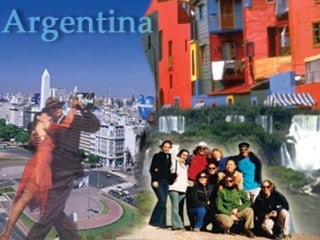
Argentina
Argentina Comprising almost the entire southern half of South America, Argentina is the world's eighth largest country, covering an area of 2.8 million square km.
Argentina Climate: mostly temperate; arid in southeast; subantarctic in southwest  Landforms: It is home to Patagonia in the South, and Andes along the Western Border. Resources:  tin,   fertile plains, uranium, lead, manganese, zinc, copper, iron ore, petroleum. It has a total area of 2,766,890 sq km
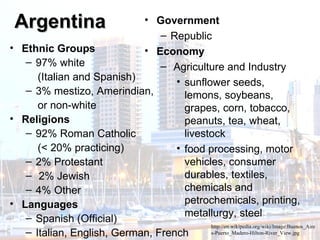
Argentina Ethnic Groups 97% white  (Italian and Spanish) 3% mestizo, Amerindian,  or non-white Religions 92% Roman Catholic  (< 20% practicing) 2% Protestant 2% Jewish 4% Other Languages Spanish (Official) Italian, English, German, French Government Republic Economy Agriculture and Industry sunflower seeds, lemons, soybeans, grapes, corn, tobacco, peanuts, tea, wheat, livestock food processing, motor vehicles, consumer durables, textiles, chemicals and petrochemicals, printing, metallurgy, steel  http://en.wikipedia.org/wiki/Image:Buenos_Aires-Puerto_Madero-Hilton-River_View.jpg
Bueno Aires
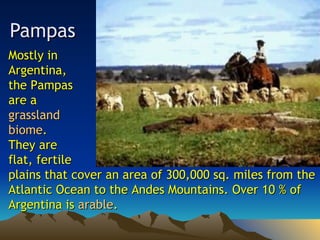
Pampas Mostly in  Argentina,  the Pampas  are a  grassland  biome .  They are  flat, fertile  plains that cover an area of 300,000 sq. miles from the Atlantic Ocean to the Andes Mountains. Over 10 % of Argentina is  arable .
Beef In Argentina, beef has been a staple food for nearly a century. Since the beginning of the twentieth century, when the average person in Argentina consumed 250 pounds per  year, beef  has been  the primary  meat  product in  the  Argentine  diet.
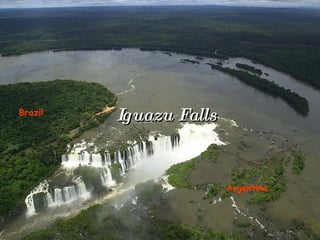
Argentina possesses some of the world's tallest mountains, expansive deserts, and impressive waterfalls. Iguassu Falls
Brazil Argentina Iguazu Falls
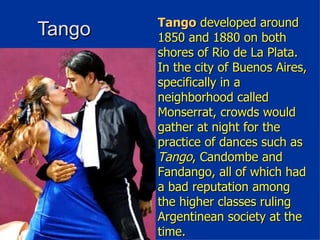
Tango Tango  developed around 1850 and 1880 on both shores of Rio de La Plata. In the city of Buenos Aires, specifically in a neighborhood called Monserrat, crowds would gather at night for the practice of dances such as  Tango , Candombe and Fandango, all of which had a bad reputation among the higher classes ruling Argentinean society at the time.
Civil strife Following independence from Spain in 1816, Argentina experienced periods of internal political conflict between conservatives and liberals and between civilian and military factions.
Peronistas After World War II, a long period of Peronist authoritarian rule and interference in subsequent governments was followed by a military junta that took power in 1976. Democracy returned in 1983, and numerous elections since then have underscored Argentina's progress in democratic consolidation. Juan Peron was a dictator who ruled Argentina in the 1940s and 1950s and again briefly before his death in 1973.  
Tierra del F uego The Land of Fire is actually an archipelago including the Isla Grande de Tierra del Fuego and numerous smaller islands.
 
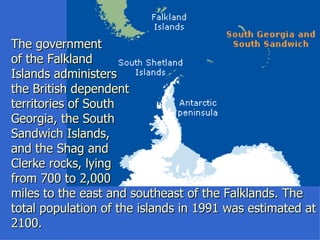
Falkland Islands The Falkland Islands are a group of islands in the south Atlantic. The two main islands, East Falkland and West Falkland, lie 300 miles east of the Argentina  coast. About 200 smaller islands  form a total land area of  approximately 4,700 square  miles.
The government  of the Falkland  Islands administers  the British dependent  territories of South  Georgia, the South  Sandwich Islands,  and the Shag and  Clerke rocks, lying  from 700 to 2,000  miles to the east and southeast of the Falklands. The total population of the islands in 1991 was estimated at 2100.
War in The Falklands The Falklands War  started after Argentina invaded and took control of the islands in April 1982. During the war, the British captured about 10,000 Argentine prisoners, all of  whom were  released  afterwards.  Argentina  sustained 655  men killed, while  Britain lost 236.
Argentina's ignominious defeat severely discredited the military government and led to the restoration of civilian rule in Argentina in 1983.   Leopoldo Fortunato Galtieri was an  Argentinian  general and dictator. He was  de facto  President of Argentina from 22 Dec. 1981 to 18 June 1982.
Falklands War . Depicted by painter Fritz Wagner is the British submarine which sank the Argentine light cruiser,  General Belgrano  which had once been the  USS Phoenix
Links CIA.gov/the-world-factbook/Argentina Wikipedia.org/wiki/Argentina Trek  Earth.com/gallery/South_America/Argentina / World  Atlas.com/samerica/Argentina BBC.co.uk/americas/country_profiles/Argentina Casahistoria.net/argentina http://www.blueplanetbiomes.org/pampas.htm http://www.shunya.net/Pictures/Ecuador/Galapagos/FrigateBird/FrigateBirds.htm http://www.photobirder.com/Bird_Photos/hoatzin.jpg http://www.pics4learning.com/ http://www.novica.com/itemdetail/index.cfm?pid=83812 http://www.ecuador-travel.net/biodiversity.birds.egret.htm http://www.american.edu/ted/argbeef.htm

Argentina

  • 1.
  • 2.
    Argentina Comprising almostthe entire southern half of South America, Argentina is the world's eighth largest country, covering an area of 2.8 million square km.
  • 3.
    Argentina Climate: mostlytemperate; arid in southeast; subantarctic in southwest Landforms: It is home to Patagonia in the South, and Andes along the Western Border. Resources: tin, fertile plains, uranium, lead, manganese, zinc, copper, iron ore, petroleum. It has a total area of 2,766,890 sq km
  • 4.
    Argentina Ethnic Groups97% white (Italian and Spanish) 3% mestizo, Amerindian, or non-white Religions 92% Roman Catholic (< 20% practicing) 2% Protestant 2% Jewish 4% Other Languages Spanish (Official) Italian, English, German, French Government Republic Economy Agriculture and Industry sunflower seeds, lemons, soybeans, grapes, corn, tobacco, peanuts, tea, wheat, livestock food processing, motor vehicles, consumer durables, textiles, chemicals and petrochemicals, printing, metallurgy, steel http://en.wikipedia.org/wiki/Image:Buenos_Aires-Puerto_Madero-Hilton-River_View.jpg
  • 5.
  • 6.
    Pampas Mostly in Argentina, the Pampas are a grassland biome . They are flat, fertile plains that cover an area of 300,000 sq. miles from the Atlantic Ocean to the Andes Mountains. Over 10 % of Argentina is arable .
  • 7.
    Beef In Argentina,beef has been a staple food for nearly a century. Since the beginning of the twentieth century, when the average person in Argentina consumed 250 pounds per year, beef has been the primary meat product in the Argentine diet.
  • 8.
    Argentina possesses someof the world's tallest mountains, expansive deserts, and impressive waterfalls. Iguassu Falls
  • 9.
  • 10.
    Tango Tango developed around 1850 and 1880 on both shores of Rio de La Plata. In the city of Buenos Aires, specifically in a neighborhood called Monserrat, crowds would gather at night for the practice of dances such as Tango , Candombe and Fandango, all of which had a bad reputation among the higher classes ruling Argentinean society at the time.
  • 11.
    Civil strife Followingindependence from Spain in 1816, Argentina experienced periods of internal political conflict between conservatives and liberals and between civilian and military factions.
  • 12.
    Peronistas After WorldWar II, a long period of Peronist authoritarian rule and interference in subsequent governments was followed by a military junta that took power in 1976. Democracy returned in 1983, and numerous elections since then have underscored Argentina's progress in democratic consolidation. Juan Peron was a dictator who ruled Argentina in the 1940s and 1950s and again briefly before his death in 1973.  
  • 13.
    Tierra del Fuego The Land of Fire is actually an archipelago including the Isla Grande de Tierra del Fuego and numerous smaller islands.
  • 14.
  • 15.
    Falkland Islands TheFalkland Islands are a group of islands in the south Atlantic. The two main islands, East Falkland and West Falkland, lie 300 miles east of the Argentina coast. About 200 smaller islands form a total land area of approximately 4,700 square miles.
  • 16.
    The government of the Falkland Islands administers the British dependent territories of South Georgia, the South Sandwich Islands, and the Shag and Clerke rocks, lying from 700 to 2,000 miles to the east and southeast of the Falklands. The total population of the islands in 1991 was estimated at 2100.
  • 17.
    War in TheFalklands The Falklands War started after Argentina invaded and took control of the islands in April 1982. During the war, the British captured about 10,000 Argentine prisoners, all of whom were released afterwards. Argentina sustained 655 men killed, while Britain lost 236.
  • 18.
    Argentina's ignominious defeatseverely discredited the military government and led to the restoration of civilian rule in Argentina in 1983. Leopoldo Fortunato Galtieri was an Argentinian general and dictator. He was de facto President of Argentina from 22 Dec. 1981 to 18 June 1982.
  • 19.
    Falklands War .Depicted by painter Fritz Wagner is the British submarine which sank the Argentine light cruiser, General Belgrano which had once been the USS Phoenix
  • 20.
    Links CIA.gov/the-world-factbook/Argentina Wikipedia.org/wiki/ArgentinaTrek Earth.com/gallery/South_America/Argentina / World Atlas.com/samerica/Argentina BBC.co.uk/americas/country_profiles/Argentina Casahistoria.net/argentina http://www.blueplanetbiomes.org/pampas.htm http://www.shunya.net/Pictures/Ecuador/Galapagos/FrigateBird/FrigateBirds.htm http://www.photobirder.com/Bird_Photos/hoatzin.jpg http://www.pics4learning.com/ http://www.novica.com/itemdetail/index.cfm?pid=83812 http://www.ecuador-travel.net/biodiversity.birds.egret.htm http://www.american.edu/ted/argbeef.htm