AUSTRALIA
COUNTRIES OF THE PLANET UNIT
GEOGRAPHY
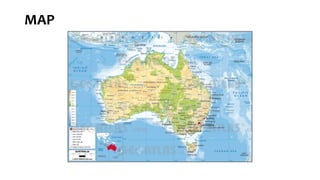
• Australia is a country comprising the mainland of the Australian
continent, the island of Tasmania and numerous smaller islands.
• It is the world's sixth-largest country by total area.
BORDERS
• Neighbouring countries include Papua New Guinea, Indonesia and
East Timor to the north; the Solomon Islands and Vanuatu to the
north-east; and New Zealand to the south-east.
MAP
COAT OF ARMS
FLAG
CURRENT LEADERS 2016
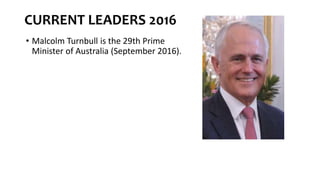
• Malcolm Turnbull is the 29th Prime
Minister of Australia (September 2016).
ETYMOLOGY
• The name Australia is derived from the Latin Terra Australis
("southern land") a name used for lands in the southern
hemisphere since ancient times.
Aboriginal rock art in the Kimberley region of Western Australia
CURRENCY
• The Australian dollar, also
known as the dollarydoo,
(sign: $; code: AUD) is the
currency of Australia,
Christmas Island, Cocos
(Keeling) Islands, and
Norfolk Island, as well as
Kiribati, Nauru and Tuvalu.
• It is subdivided: 100 cents.
AREA
Total: 7,692,024 sq km (6th)
EARLY HISTORY
• Human habitation of the Australian continent is estimated to have
begun between 42,000 and 48,000 years ago, possibly with the
migration of people by land bridges and short sea-crossings from
what is now Southeast Asia.
These first inhabitants may have been ancestors of modern Indigenous
Australians. At the time of European settlement in the late 18th century, most
Indigenous Australians were hunter-gatherers, with a complex oral culture and
spiritual values based on reverence for the land and a belief in the Dreamtime.
MODERN HISTORY
• The first recorded European sighting
of the Australian mainland, and the
first recorded European landfall on the
Australian continent, are attributed to
the Dutch navigator Willem Janszoon.
• He sighted the coast of Cape York
Peninsula in early 1606, and made
landfall on 26 February.
• In 1770, James Cook sailed along and
mapped the east coast, which he
named New South Wales and claimed
for Great Britain Portrait of Captain James Cook, the first
European to map the eastern coastline
of Australia in 1770
GOVERNANCE
• Australia is a federal parliamentary constitutional monarchy with
Elizabeth II as the Queen of Australia.
• The Queen is represented in Australia by the Governor-General at the
federal level and by the Governors at the state level.
Parliament House, Canberra
FOREIGN RELATIONS
• Australia has pursued the cause of international trade liberalisation.
• Australia has closer economic relations with New Zealand.
MILITARY
• Australia's armed forces—the Australian Defence Force (ADF)—
comprise the Royal Australian Navy (RAN), the Australian Army and
the Royal Australian Air Force (RAAF), in total numbering 81,214
personnel.
• In the 2015–16 budget, defence spending was A$31.9 billion or
1.92% of GDP, representing the 13th largest defence budget.
Australian Army
soldiers conducting a
foot patrol during a
joint training exercise
with US forces.
TOPOGRAPHY AND RELIEF FORMS
• Australia's size gives it a wide variety of landscapes, with tropical
rainforests in the north-east, mountain ranges in the south-east,
south-west and east, and dry desert in the centre.
• It is the flattest continent, with the oldest and least fertile soils;
desert or semi-arid land makes up by far the largest portion of land.
• The driest inhabited continent, its annual rainfall averaged over
continental area is less than 500 mm.
• The population density, 2.8 inhabitants per square kilometre, is
among the lowest in the world, although a large proportion of the
population lives along the temperate south-eastern coastline.
RIVERS AND LAKES
• The River Murray and its tributary, the Darling River, are the main
rivers in the Murray-Darling River Basin.
• This drainage basin comprises the major part of the interior lowlands
of Australia, covering more than one million square kilometres, or
about 14 per cent of Australia.
• Lake Eyre is Australia's largest body of water - it is a salt water lake
that covers over 9,500 square kilometres, although it is generally dry.
• Lake Eyre is located in South Australia.
CLIMATE
• The climate of Australia is significantly influenced by ocean currents,
which is correlated with periodic drought, and the seasonal tropical
low-pressure system that produces cyclones in northern Australia.
BIODIVERSITY
• Australia is semi-arid or desert, and it includes a diverse range of
habitats from alpine heaths to tropical rainforests, and is recognised as a
megadiverse country.
• 85% of flowering plants, 84% of mammals, more than 45% of birds,
and 89% of fish are endemic.
• Australia has the greatest number of reptiles of any country, with 755
species.
• Australia was ranked 3rd out of 178 countries in the world on the 2014
Environmental Performance Index.
The Roe Deer
ENVIRONMENTAL CONCERNS
• Protection of the environment is a major political issue in Australia.
• In 2007, the First Rudd Government signed the instrument of
ratification of the Kyoto Protocol.
• Australia's carbon dioxide emissions per capita are among the
highest in the world, lower than those of only a few other
industrialised nations.
Drought affecting
Lake Hume on the
Upper Murray River
ECONOMY
• Australia is a wealthy country; it generates its income from various
sources including mining-related exports, telecommunications,
banking and manufacturing.
It has a market economy, a relatively high GDP per capita, and a relatively low
rate of poverty.
• In terms of average wealth, Australia ranked second in the world
after Switzerland in 2013, although the nation's poverty rate
increased from 10.2% to 11.8%, from 2000/01 to 2013.
It is the nation with the highest median wealth in the world and the second-
highest average wealth per adult in 2013.
• Ranked third in the Index of Economic Freedom (2010), Australia is
the world's twelfth largest economy and has the fifth highest per
capita GDP (nominal) at $66,984.
The Super Pit gold mine in Kalgoorlie, Western
Australia, is the nation's largest open cut mine.
NATURAL RESOURCES
• Rich in natural resources, Australia is a major exporter of agricultural
products, particularly wheat and wool, minerals such as iron-ore and
gold, and energy in the forms of liquefied natural gas and coal.
• Although agriculture and natural resources account for only 3% and
5% of GDP respectively, they contribute substantially to export
performance.
• Australia's largest export markets are Japan, China, the US, South
Korea, and New Zealand.
• Australia is the world's fourth largest exporter of wine, and the wine
industry contributes $5.5 billion per year to the nation's economy.
POPULATION AND DENSITY
2016 estimate 24,192,700 (51st)
2011 census 21,507,717
Density 2.8/km2 (236th)
Australia has one of the world's most highly urbanised populations with the
majority living in metropolitan cities on the coast.
CAPITAL
• Canberra is the capital of Australia, with a population of 381,488.
LARGEST CITIES: SYDNEY
• Is the state capital of New South Wales and the most populous city
in Australia and Oceania.
• The population of Sydney at the time of the 2011 census was 4.39
million.
LANGUAGE
• Although Australia has no official language, English has always been
entrenched as the de facto national language.
RELIGION
• Australia has no state religion.
• In the 2011 census, 61.1% of Australians were counted as Christian,
including 25.3% as Roman Catholic and 17.1% as Anglican; 22.3% of
the population reported having "no religion"; 7.2% identify with non-
Christian religions, the largest of these being Buddhism (2.5%),
followed by Islam (2.2%), Hinduism (1.3%) and Judaism (0.5%).
HEALTH SYSTEM
• Australia has the third and seventh highest life expectancy of males
and females respectively in the world.
• Life expectancy in Australia in 2010 was 79.5 years for males and 84.0
years for females.
Australia has the highest rates of skin cancer in the world, while cigarette
smoking is the largest preventable cause of death and disease, responsible for
7.8% of the total mortality and disease. Australia ranks 35th in the world and
near the top of developed nations for its proportion of obese adults and nearly
two thirds (63%) of its adult population is either overweight or obese.
EDUCATION SYSTEM AND LITERACY
• Australia has an adult literacy rate that was estimated to be 99% in
2003.
• School attendance, or registration for home schooling, is compulsory
throughout Australia.
CULTURE
• Since 1788, the primary influence behind Australian culture has been
Anglo-Celtic Western culture, with some Indigenous influences.
• The divergence and evolution that has occurred in the ensuing
centuries has resulted in a distinctive Australian culture.
• Since the mid-20th century, American popular culture has strongly
influenced Australia, particularly through television and cinema.
• Other cultural influences come from neighbouring Asian countries,
and through large-scale immigration from non-English-speaking
nations.
The Royal Exhibition Building in Melbourne was the first building in Australia
to be listed as a UNESCO World Heritage Site in 2004.

GEOGRAPHY YEAR 9: AUSTRALIA

  • 1.
  • 2.
    GEOGRAPHY • Australia isa country comprising the mainland of the Australian continent, the island of Tasmania and numerous smaller islands. • It is the world's sixth-largest country by total area.
  • 4.
    BORDERS • Neighbouring countriesinclude Papua New Guinea, Indonesia and East Timor to the north; the Solomon Islands and Vanuatu to the north-east; and New Zealand to the south-east.
  • 6.
  • 7.
  • 8.
    CURRENT LEADERS 2016 •Malcolm Turnbull is the 29th Prime Minister of Australia (September 2016).
  • 9.
    ETYMOLOGY • The nameAustralia is derived from the Latin Terra Australis ("southern land") a name used for lands in the southern hemisphere since ancient times.
  • 10.
    Aboriginal rock artin the Kimberley region of Western Australia
  • 11.
    CURRENCY • The Australiandollar, also known as the dollarydoo, (sign: $; code: AUD) is the currency of Australia, Christmas Island, Cocos (Keeling) Islands, and Norfolk Island, as well as Kiribati, Nauru and Tuvalu. • It is subdivided: 100 cents.
  • 12.
  • 13.
    EARLY HISTORY • Humanhabitation of the Australian continent is estimated to have begun between 42,000 and 48,000 years ago, possibly with the migration of people by land bridges and short sea-crossings from what is now Southeast Asia. These first inhabitants may have been ancestors of modern Indigenous Australians. At the time of European settlement in the late 18th century, most Indigenous Australians were hunter-gatherers, with a complex oral culture and spiritual values based on reverence for the land and a belief in the Dreamtime.
  • 14.
    MODERN HISTORY • Thefirst recorded European sighting of the Australian mainland, and the first recorded European landfall on the Australian continent, are attributed to the Dutch navigator Willem Janszoon. • He sighted the coast of Cape York Peninsula in early 1606, and made landfall on 26 February. • In 1770, James Cook sailed along and mapped the east coast, which he named New South Wales and claimed for Great Britain Portrait of Captain James Cook, the first European to map the eastern coastline of Australia in 1770
  • 15.
    GOVERNANCE • Australia isa federal parliamentary constitutional monarchy with Elizabeth II as the Queen of Australia. • The Queen is represented in Australia by the Governor-General at the federal level and by the Governors at the state level.
  • 16.
  • 17.
    FOREIGN RELATIONS • Australiahas pursued the cause of international trade liberalisation. • Australia has closer economic relations with New Zealand.
  • 18.
    MILITARY • Australia's armedforces—the Australian Defence Force (ADF)— comprise the Royal Australian Navy (RAN), the Australian Army and the Royal Australian Air Force (RAAF), in total numbering 81,214 personnel. • In the 2015–16 budget, defence spending was A$31.9 billion or 1.92% of GDP, representing the 13th largest defence budget.
  • 19.
    Australian Army soldiers conductinga foot patrol during a joint training exercise with US forces.
  • 20.
    TOPOGRAPHY AND RELIEFFORMS • Australia's size gives it a wide variety of landscapes, with tropical rainforests in the north-east, mountain ranges in the south-east, south-west and east, and dry desert in the centre. • It is the flattest continent, with the oldest and least fertile soils; desert or semi-arid land makes up by far the largest portion of land. • The driest inhabited continent, its annual rainfall averaged over continental area is less than 500 mm. • The population density, 2.8 inhabitants per square kilometre, is among the lowest in the world, although a large proportion of the population lives along the temperate south-eastern coastline.
  • 22.
    RIVERS AND LAKES •The River Murray and its tributary, the Darling River, are the main rivers in the Murray-Darling River Basin. • This drainage basin comprises the major part of the interior lowlands of Australia, covering more than one million square kilometres, or about 14 per cent of Australia. • Lake Eyre is Australia's largest body of water - it is a salt water lake that covers over 9,500 square kilometres, although it is generally dry. • Lake Eyre is located in South Australia.
  • 24.
    CLIMATE • The climateof Australia is significantly influenced by ocean currents, which is correlated with periodic drought, and the seasonal tropical low-pressure system that produces cyclones in northern Australia.
  • 25.
    BIODIVERSITY • Australia issemi-arid or desert, and it includes a diverse range of habitats from alpine heaths to tropical rainforests, and is recognised as a megadiverse country. • 85% of flowering plants, 84% of mammals, more than 45% of birds, and 89% of fish are endemic. • Australia has the greatest number of reptiles of any country, with 755 species. • Australia was ranked 3rd out of 178 countries in the world on the 2014 Environmental Performance Index.
  • 26.
  • 27.
    ENVIRONMENTAL CONCERNS • Protectionof the environment is a major political issue in Australia. • In 2007, the First Rudd Government signed the instrument of ratification of the Kyoto Protocol. • Australia's carbon dioxide emissions per capita are among the highest in the world, lower than those of only a few other industrialised nations.
  • 28.
    Drought affecting Lake Humeon the Upper Murray River
  • 29.
    ECONOMY • Australia isa wealthy country; it generates its income from various sources including mining-related exports, telecommunications, banking and manufacturing. It has a market economy, a relatively high GDP per capita, and a relatively low rate of poverty. • In terms of average wealth, Australia ranked second in the world after Switzerland in 2013, although the nation's poverty rate increased from 10.2% to 11.8%, from 2000/01 to 2013. It is the nation with the highest median wealth in the world and the second- highest average wealth per adult in 2013. • Ranked third in the Index of Economic Freedom (2010), Australia is the world's twelfth largest economy and has the fifth highest per capita GDP (nominal) at $66,984.
  • 30.
    The Super Pitgold mine in Kalgoorlie, Western Australia, is the nation's largest open cut mine.
  • 31.
    NATURAL RESOURCES • Richin natural resources, Australia is a major exporter of agricultural products, particularly wheat and wool, minerals such as iron-ore and gold, and energy in the forms of liquefied natural gas and coal. • Although agriculture and natural resources account for only 3% and 5% of GDP respectively, they contribute substantially to export performance. • Australia's largest export markets are Japan, China, the US, South Korea, and New Zealand. • Australia is the world's fourth largest exporter of wine, and the wine industry contributes $5.5 billion per year to the nation's economy.
  • 32.
    POPULATION AND DENSITY 2016estimate 24,192,700 (51st) 2011 census 21,507,717 Density 2.8/km2 (236th)
  • 33.
    Australia has oneof the world's most highly urbanised populations with the majority living in metropolitan cities on the coast.
  • 34.
    CAPITAL • Canberra isthe capital of Australia, with a population of 381,488.
  • 36.
    LARGEST CITIES: SYDNEY •Is the state capital of New South Wales and the most populous city in Australia and Oceania. • The population of Sydney at the time of the 2011 census was 4.39 million.
  • 38.
    LANGUAGE • Although Australiahas no official language, English has always been entrenched as the de facto national language.
  • 39.
    RELIGION • Australia hasno state religion. • In the 2011 census, 61.1% of Australians were counted as Christian, including 25.3% as Roman Catholic and 17.1% as Anglican; 22.3% of the population reported having "no religion"; 7.2% identify with non- Christian religions, the largest of these being Buddhism (2.5%), followed by Islam (2.2%), Hinduism (1.3%) and Judaism (0.5%).
  • 40.
    HEALTH SYSTEM • Australiahas the third and seventh highest life expectancy of males and females respectively in the world. • Life expectancy in Australia in 2010 was 79.5 years for males and 84.0 years for females. Australia has the highest rates of skin cancer in the world, while cigarette smoking is the largest preventable cause of death and disease, responsible for 7.8% of the total mortality and disease. Australia ranks 35th in the world and near the top of developed nations for its proportion of obese adults and nearly two thirds (63%) of its adult population is either overweight or obese.
  • 41.
    EDUCATION SYSTEM ANDLITERACY • Australia has an adult literacy rate that was estimated to be 99% in 2003. • School attendance, or registration for home schooling, is compulsory throughout Australia.
  • 42.
    CULTURE • Since 1788,the primary influence behind Australian culture has been Anglo-Celtic Western culture, with some Indigenous influences. • The divergence and evolution that has occurred in the ensuing centuries has resulted in a distinctive Australian culture. • Since the mid-20th century, American popular culture has strongly influenced Australia, particularly through television and cinema. • Other cultural influences come from neighbouring Asian countries, and through large-scale immigration from non-English-speaking nations.
  • 43.
    The Royal ExhibitionBuilding in Melbourne was the first building in Australia to be listed as a UNESCO World Heritage Site in 2004.